How much space does a rabbit need? Why a hutch isn't enough, and the minimum sizes
Many of the hutches sold for rabbits in pet stores are not really enough of a home. The Rabbit Welfare Association & Fund (RWAF), the RSPCA and PDSA all say the same thing: a rabbit needs not just a hutch but a large space to run, jump and hide. This article looks at the sizes the three organizations give and their reasons. Making the inside of your home rabbit-safe is a separate topic; see Making your home rabbit-safe.
- Minimum space: RWAF, the RSPCA and PDSA recommend at least 3 m x 2 m x 1 m (about 10 ft x 6 ft x 3 ft) for a pair of rabbits; "the bigger the better."
- A hutch alone isn't enough: Sleeping quarters can count toward the space but shouldn't be the main home.
- Constant access: The exercise area should be attached to the sleeping area and open at all times.
- Standing upright: On their hind legs, a rabbit's ears shouldn't touch the roof.
- Hiding places: As many as there are rabbits, plus one extra if possible.
What do the sources say?
The three organizations' minimums are very close:
| Organization | Recommended minimum |
|---|---|
| RWAF | One continuous space of at least 3 m x 2 m x 1 m (about 9'10" x 6'7" x 3'3"); the sleeping area, at least 1.8 m x 0.6 m x 0.6 m, counts toward it |
| RSPCA | For two medium-sized rabbits, no smaller than 3 m x 2 m x 1 m including shelter and exercise area; "the bigger the better" |
| PDSA | At least 10 ft x 6 ft x 3 ft (3 m x 2 m x 1 m) for a pair; "the absolute minimum," with much more recommended |
RWAF's details matter: the space should be one block, not split up, and all of it should be available at all times, not just for limited periods. The same standard applies indoors and outdoors. A single rabbit needs the same minimum as a pair, though RWAF also stresses that rabbits should live in at least friendly pairs. Supervised free-roaming counts in addition to this minimum.
According to RWAF, upper floors of two-story hutches, raised platforms, tunnels and connecting pipes don't count toward the minimum; they're great for enrichment but don't replace space. Total square footage isn't enough either: the page gives the example of an 8 ft x 8 ft area that fails because it has no 3-meter length. RWAF says the 3-meter length lets rabbits run rather than just hop, and the 1-meter height allows jumping and "binkying," the happy mid-air leap. These sizes are based on research by the RSPCA and Bristol University.
Standing, stretching, turning
The RSPCA's definition is very concrete. A full-grown rabbit, as an absolute minimum in both the shelter and the exercise area, must be able to:
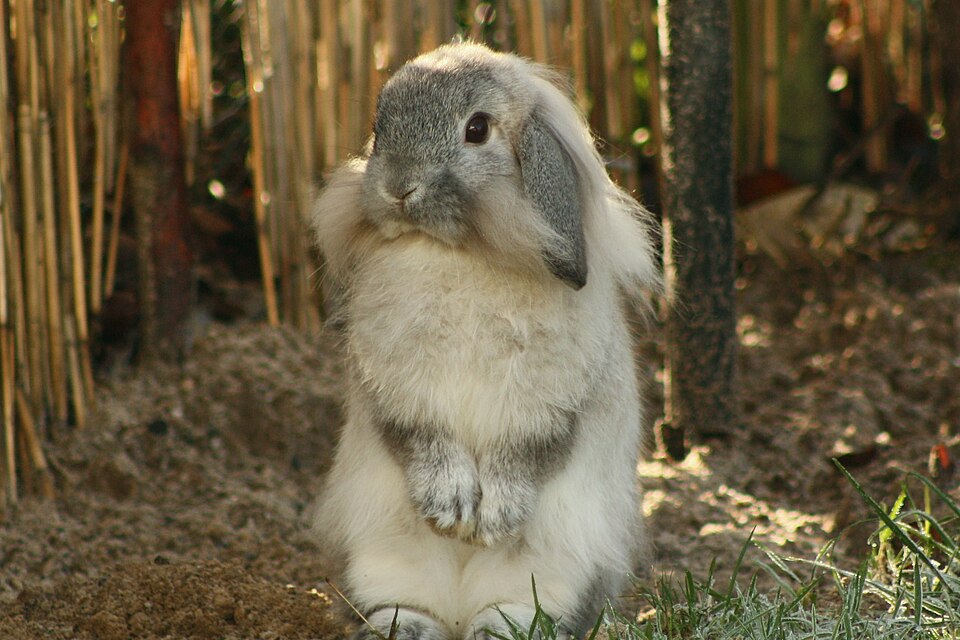
- Stand on its hind legs: Without its ears touching the roof.
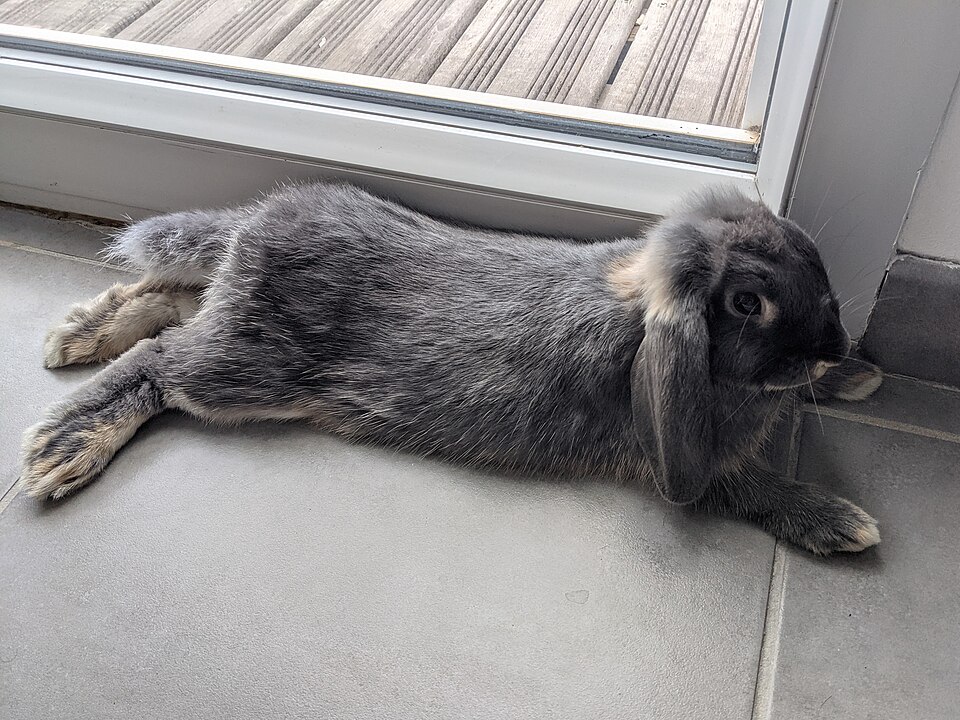
- Lie fully outstretched: In any direction.
- Turn around without obstruction.
RWAF explains why it matters: a rabbit that can't stand up on its hind legs can develop a painful, permanent spinal deformity. Cramped conditions are also linked to obesity and a shorter life, and the same page connects confinement with frustration and depression.
The exercise area: attached, not separate
The RSPCA wants the exercise area to be spacious, permanently attached to the shelter and accessible at all times. Ideally rabbits have 24-hour access, because according to the RSPCA they are most active in the early morning, late afternoon and overnight. PDSA likewise says the exercise area should be accessible at all times so rabbits can choose when to use it, and notes they're most active at dawn and dusk. Closing the run door on your way to work and opening it in the evening doesn't match these recommendations.
Hiding places
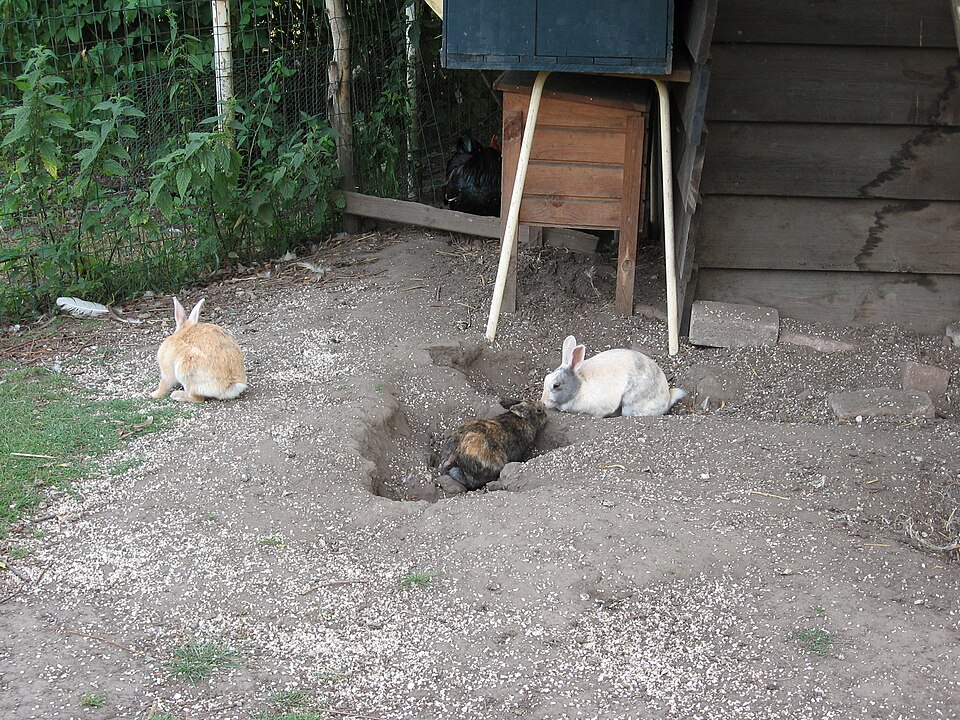
The RSPCA recommends as many hiding places as there are rabbits, plus one extra if possible, in addition to the main shelter. Vary their sizes, give them more than one opening, and don't fill so much space that rabbits can't move freely. For outdoor enclosures PDSA lists soil, tubes and boxes for digging, hiding and exploring. For tunnel and box ideas, see our enrichment article.
What should the hutch be?
The RSPCA says a small traditional hutch shouldn't be a rabbit's only home; hutches alone aren't large enough to meet a rabbit's needs. The main shelter should be large enough for all the rabbits to rest together; the RSPCA's examples include a large hutch, a kids' playhouse, a wooden shed or a robust box. RWAF's "A Hutch is Not Enough" page adds that a small hutch makes it hard to find a dry, warm spot, and suggests thinking of a hutch as a "safe space" within a larger enclosure or attaching a run.
If your rabbit's movement, posture or weight has changed, or it doesn't jump up easily, talk to your veterinarian. Tüylüm is a record-keeping tool; it doesn't diagnose.
Practical steps
- Measure: Measure the length, width and height of the current space, and check RWAF's 3-meter length.
- Connect: Attach the sleeping area permanently to the exercise area and don't close the door.
- Check: When your rabbit stands on its hind legs, do its ears touch the roof?
- Add hiding places: Provide the number of rabbits plus one in tunnels, boxes or hides.
- Expand: If the space is small, enlarge it permanently with a kids' playhouse, panel fencing or part of a room.
You can add cleaning the space and refreshing hiding places as care tasks in the Today tab. You can follow your rabbit's weight on a chart with Weight tracking.
Frequently asked questions
Does one rabbit need less space?
RWAF writes that a single rabbit needs the same minimum as a pair, and recommends rabbits live in at least friendly pairs. We covered companions in Why shouldn't rabbits live alone?
Is indoors different from outdoors?
RWAF says the same standards apply both indoors and outdoors.
Does free-roaming replace the space?
RWAF counts supervised free-roaming in addition to the minimum, so on top of the space, not instead of it.

Keep track of your pet's care in TüylümLog vet visits, vaccine and medication dates, and we'll remind you when it's time. Share it all with your family in Home.
Sources
- Rabbit Welfare Association & Fund · Minimum space requirements for pet rabbits
- Rabbit Welfare Association & Fund · A Hutch is Not Enough
- RSPCA · Creating a good home for rabbits
- PDSA · Creating the ideal home for your rabbits
This article is for general information only; it is not a diagnosis or treatment advice and does not replace a visit to a veterinarian. Talk to your vet about decisions on your pet's health. By Tüylüm · Published and last checked: November 9, 2026. Spotted a mistake? Write to [email protected] and we'll fix it right away. Photos are from Wikimedia Commons, used under the license shown below each photo.