Raising silkworms: mulberry leaves, five instars and a cocoon, a small guide
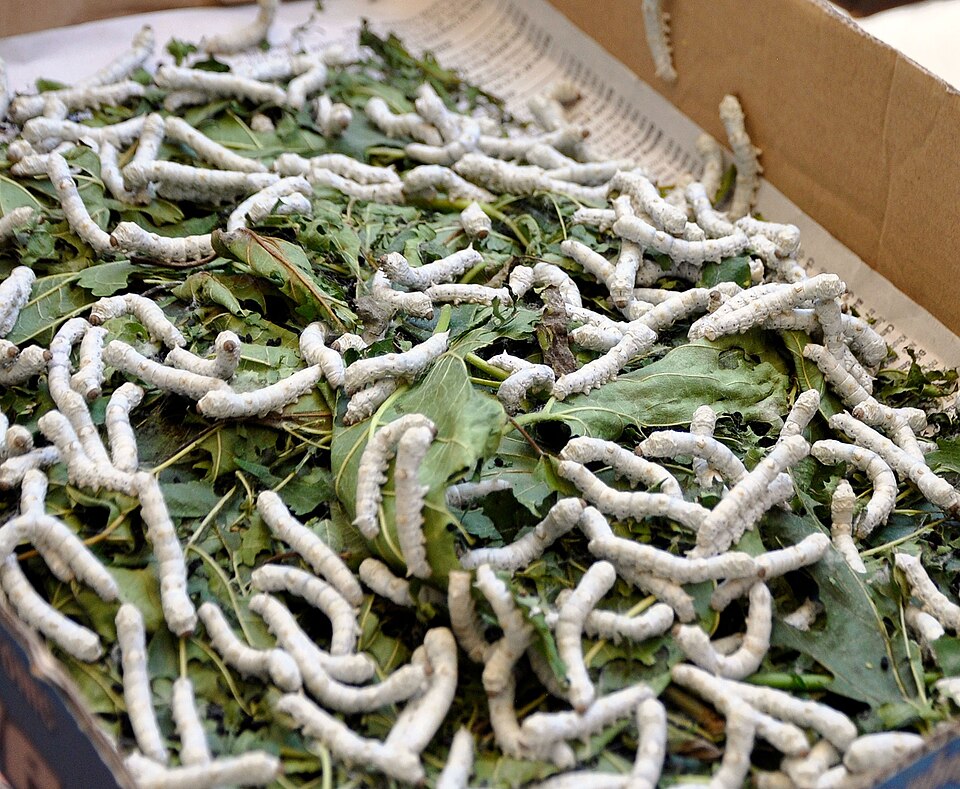
The silkworm (Bombyx mori) has been raised for silk for thousands of years, and curious people also raise it on a small scale. According to a 2023 review by Fehmi Gürel of Akdeniz University in Türkiye, it goes through complete metamorphosis: egg, larva, pupa (chrysalis) and moth. This article draws on that review and on a guide published by Kenya's National Sericulture Station. The second one is written for farmers, so read it as a framework for understanding what a silkworm needs, not as a recipe for your home.
- One food: According to Gürel, fresh mulberry leaves are the silkworm larva's only natural food. If you don't have mulberry leaves, don't start.
- Five ages, four sleeps: The larva molts four times. While molting, it stays still for at least 24 hours and doesn't eat.
- Most eating at the end: About 90% of all the leaves eaten during the larval period are eaten in the 5th age.
- Cocoon: The larva spins its cocoon in 2-3 days; in commercial production, the thread in a cocoon is 1,000-1,400 meters long.
- The moth can't fly: The domesticated silkworm moth is flightless.
The life cycle in brief
Gürel writes that under the best conditions the larval period lasts about 25 days, and during that time the larva's weight grows roughly ten-thousand-fold. Timing varies with conditions: the Kenyan station's guide gives the whole cycle as 6-8 weeks depending on climate. The stages, according to the guide:
| Stage | Duration (Kenyan station) |
|---|---|
| Egg | 11-14 days (10-12 days in the guide's incubation section) |
| Larva | 24-30 days |
| Pupa (inside the cocoon) | 12-15 days |
| Adult moth | 6-10 days |
The two incubation figures in the guide don't match, so we've kept the range wide. The guide was written for Kenyan conditions; treat the numbers as an order of magnitude.
One more interesting detail: according to a research paper in the journal Insects, the domestic silk moth was domesticated from its wild relative Bombyx mandarina, which can fly, and lost the ability to fly. The authors say humans domesticated the silkworm about 5,000 years ago; the Kenyan guide mentions more than 4,000 years. Either way, the moth can't escape and blend into the wild.
Food: mulberry leaves and how much
Gürel describes the silkworm as monophagous, meaning it feeds on a single plant. Because mulberry leaves aren't available all year, researchers have worked on artificial diets. But according to the paper, artificial diet isn't economical for the whole larval period because of its cost; in Japan it's generally used only for the first three ages. So there's no source for trying a "substitute for mulberry" at home.
One number from Gürel helps with planning: a larva eats 25-30 grams of mulberry leaves over its whole larval period, and about 90% of that is eaten in the last age. Gürel also writes that in temperate climates fresh, tender leaves are usually plentiful in spring, and rearing is mostly done once a year in that season. In other words, you need to time the hatching of the eggs to when the mulberry tree has leaves.
The Kenyan guide also explains how to offer leaves by age:
| Age | Leaves | Approximate length |
|---|---|---|
| 1st | Young leaves chopped into small pieces, at least twice a day | 4 days |
| 2nd | Young leaves | 4 days |
| 3rd | Good, healthy shoot leaves | 3 days |
| 4th | Whole shoots | 6 days |
| 5th | Whole shoots, single layer | 7-8 days |
In the last age, the guide also advises against giving old, yellowed or diseased leaves.
Molting: don't touch, don't feed
According to Gürel, commercial silkworms have four sleeps and five ages. The time between two sleeps is called an "age." During a molt the larva stops eating and stays still for at least 24 hours. The Kenyan guide says this "sleep" lasts 18-24 hours, the larvae aren't fed during it, and the bed is kept dry and uncovered. A motionless larva isn't dead; don't poke it or try to move it to give it a leaf.
Temperature, humidity and cleaning
The Kenyan guide gives a general range of 23-28 °C and 70-85% humidity; both decrease as the larvae age:
| Age | Temperature | Humidity |
|---|---|---|
| 1st-2nd | 26-28 °C | 85% |
| 3rd | 24-26 °C | 80% |
| 4th | 24-25 °C | 75% |
| 5th | 23-24 °C | 70% |
For cleaning, the guide recommends cleaning the bed after every molt for young larvae and every other day for mature ones. It also lists disease signs: sluggish, swollen larvae, vomiting, mummified larvae. Against these diseases, the guide lists disinfection and avoiding extreme heat or cold and low humidity. The disinfection method it describes is for farm scale and uses strong chemicals; don't try it at home, and ask an agriculture faculty instead.
The Kenyan guide and Gürel's paper are written for silk production. In commercial production, the pupae inside the cocoons are killed and the cocoons are dried. According to the Kenyan guide, the pupal stage lasts 12-15 days, after which the moth emerges. The sources don't give a recipe for home rearing; for a detailed care routine, we suggest asking an agriculture faculty or your local agriculture office.
Cocoon: how do you know it's ready to spin?
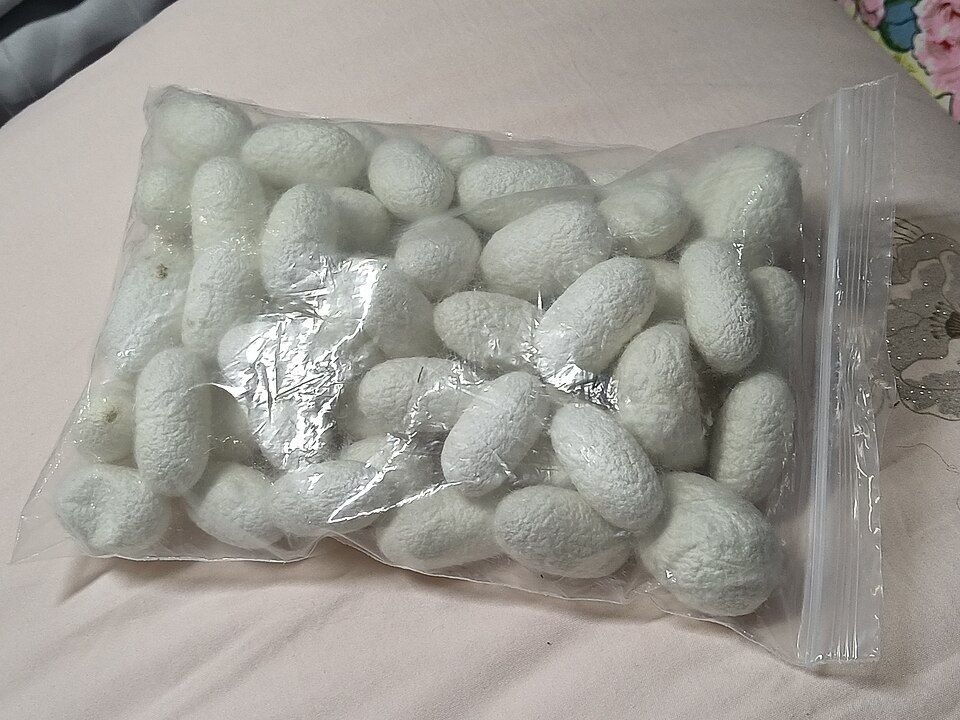
According to Gürel, the larva stops eating at the end of the 5th age and spins its cocoon within 2-3 days. The Kenyan guide says spinning starts about 8 days after the 5th age begins, and that a ready larva stops feeding and turns cream-white. Cocoons are harvested 7-8 days after spinning starts, once the pupae are brown and hard.
Questions to ask before you start
- Do you have mulberry leaves? According to Gürel, the rearing season depends on how plentiful mulberry leaves are. You don't want to leave the larvae hungry in the week the leaves run out.
- How many larvae? Leaf needs rise quickly in the last week; start with a small number.
- Measure the temperature: The ranges in the Kenyan guide aren't wide; a simple thermometer will do.
- Bed cleaning: According to the guide, every molt for young larvae and every other day for mature ones.
- Think about the moth: The moth that emerges can't fly; plan in advance what you'll do.
Frequently asked questions
Can I give my silkworms lettuce or another leaf?
According to Gürel, fresh mulberry leaves are the silkworm larva's only natural food; that's why the paper is about artificial diets. Our sources don't recommend any leaf other than mulberry.
Does the moth that comes out of the cocoon lay eggs?
Gürel gives the life cycle as egg, larva, pupa and moth, so the cycle returns to the egg. Our sources don't describe a method for mating moths at home.
Where can I get eggs?
Our sources don't recommend where to buy. You can ask a university agriculture faculty or your local agriculture office.
You can follow daily care tasks in the Today tab. Photograph each age change and the cocoon in the Memory book, and next year you'll have your own calendar ready.

Keep track of your pet's care in TüylümLog vet visits, vaccine and medication dates, and we'll remind you when it's time. Share it all with your family in Home.
Sources
- Akdeniz University (F. Gürel, European Journal of Science and Technology) · The Use of Artificial Diets in Silkworm (Bombyx mori L.) Rearing
- Infonet Biovision (content from Kenya's National Sericulture Station) · Mulberry silkworm
- Insects (MDPI, PubMed Central) · Flight Muscle and Wing Mechanical Properties are Involved in Flightlessness of the Domestic Silkmoth, Bombyx mori
This article is for general information only; it is not a diagnosis or treatment advice and does not replace a visit to a veterinarian. Talk to your vet about decisions on your pet's health. By Tüylüm · Published and last checked: November 9, 2026. Spotted a mistake? Write to [email protected] and we'll fix it right away. Photos are from Wikimedia Commons, used under the license shown below each photo.