Ferrets and other pets at home: who can they live with, and who should they stay away from?
People have kept ferrets for more than two thousand years. According to RSPCA Australia, their first job was to help hunters by flushing rabbits out of their burrows. Today most ferrets are playful house pets that nap on the couch; but the hunter inside is still there. That's why the answer to "Will a ferret get along with my other pets?" depends on who those other pets are. A ferret can become friends with a dog; but in its eyes, a rabbit or a hamster may always stay prey.
- Never with prey animals: Rabbits, hamsters, guinea pigs, gerbils, mice, rats, birds and reptiles should never share space with a ferret (AFA, RSPCA Australia).
- Training won't change it: According to RSPCA Australia, a ferret is a natural hunter, and this instinct can't be trained out of it.
- Cats and dogs: A ferret can become friends with many larger pets; but introductions must be careful and always supervised. The AFA recommends against introducing ferrets to dogs with a strong prey drive.
- A new ferret: Introduce it over a few weeks, swap bedding, and meet on neutral ground.
- Recognize a fight: Repeatedly grabbing the same ferret hard by the neck and shaking it, one ferret constantly running away and hiding, and wounds around the neck are serious warning signs.
A ferret is a hunter
According to the RSPCA, ferrets are predators with a very long hunting history behind them: their wild ancestors, polecats, hunt rodents, rabbits, hares, hedgehogs and reptiles. Ferrets don't see very well; according to the RSPCA, they rely more on their senses of smell, taste and hearing.
According to RSPCA Australia, ferrets are natural hunters that are known to hunt smaller animals living in the same home, and you can't train this behavior out of them. So "my ferret is very gentle" isn't a good enough reason to leave it in the same room as a rabbit.

Rabbits, rodents and birds: never together
The AFA doesn't recommend introducing ferrets to birds, rabbits, rodents (including hamsters, gerbils and guinea pigs) or reptiles. RSPCA Australia also says ferrets need to be kept away from small animals in the same home, such as rabbits and guinea pigs.
- Never let a ferret and prey animals loose in the same area, not even "for a little while."
- According to RSPCA Australia, they need to be kept apart; so the cages of prey animals shouldn't be in rooms where the ferret roams, and there should be a closed door between them.
- Think hard before getting a new rodent or rabbit while you have a ferret at home; according to RSPCA Australia, this instinct doesn't change with training.
- Kittens are at risk too: RSPCA Australia lists kittens among the small animals that should be kept away from ferrets.
If your rabbit needs a companion, it should be another rabbit, not a ferret: why rabbits shouldn't live alone. And for your bird's safety: household dangers for birds.
Living with cats and dogs
According to the AFA, a ferret's playful, curious nature can make it a natural companion for most larger pets. The RSPCA also says ferrets can form friendships with other animals that aren't prey, especially when they're introduced at a young age and with care.
But all the sources agree on the same warning: introductions shouldn't be rushed, and supervision is essential. Our sources don't give a detailed step-by-step list for introducing a ferret to a cat or a dog; their shared advice is to go slowly and carefully and to always be right there with them.
- Know your dog: According to the AFA, dogs with a strong prey drive shouldn't be introduced to a ferret.
- Start early: According to the RSPCA, friendships form best when the ferret is young and is introduced with care.
- Always be there: According to the AFA, proper supervision is essential during introductions. Be with them every moment they're together; keep them apart when you're not home.
- Keep kittens separate: According to RSPCA Australia, kittens should also be kept away from ferrets.
- Watch for signs: According to the RSPCA, constant screaming shows that a ferret is on high alert in the face of danger. If your ferret is screaming or hiding, stop the introduction and keep them apart for a while.
Ferrets among themselves
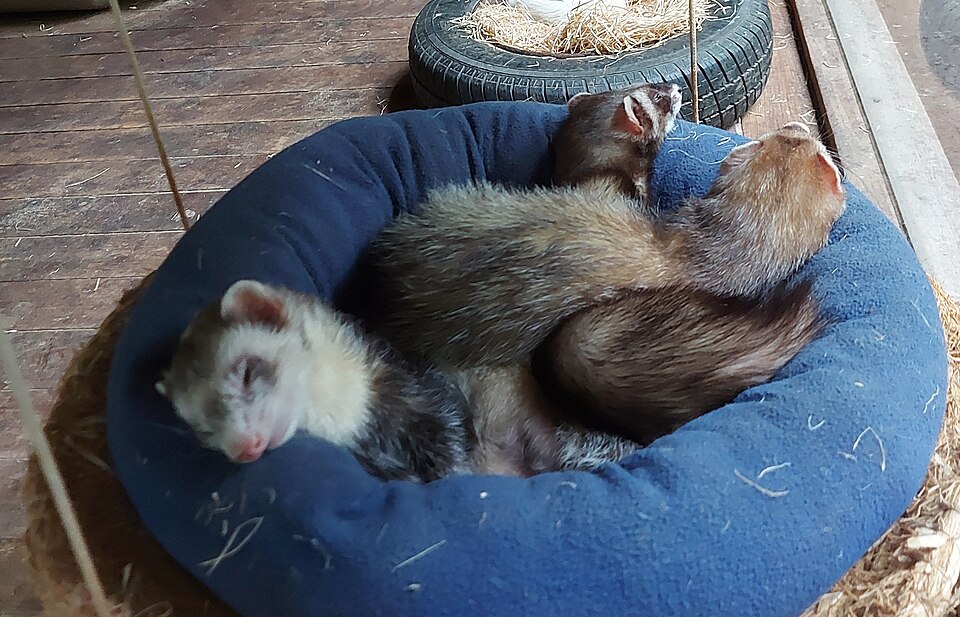
A ferret's best friend is still another ferret. According to Woodgreen, ferrets don't cope well with living alone and should be kept in pairs or groups; when they sleep, they almost always pile on top of each other in one big heap.
According to the RSPCA, there should ideally be no more than four ferrets together, and if possible they should be siblings from the same litter. RSPCA Australia also recommends small groups of 2–4 ferrets, and siblings. According to Woodgreen, pairs can be the same sex or one male and one female; but in every case, they should all be neutered.
- Enough for everyone: The RSPCA wants enough shelter, food, water and hiding places for all the ferrets at all times. RSPCA Australia also recommends several food and water bowls and plenty of sleeping spots; that way, there's less competition.
- Vet first: According to RSPCA Australia, before you keep ferrets together or add a new adult ferret to a group, you need to talk to your vet about breeding control.
Introducing a new ferret
According to Woodgreen, ferrets can be picky about their friends; so new pairs, and new ferrets joining a group, should be introduced carefully and watched for up to two weeks.
- Start with scent: According to RSPCA Australia, spread the introduction over a few weeks; swap bedding so they get used to each other's scent.
- Take turns roaming: Let the new ferret roam the room freely while the resident ferret stays in its own area (RSPCA Australia).
- Choose neutral ground: A place neither ferret thinks of as "mine." According to Woodgreen, ideally an area where they can stay undisturbed for a week or two.
- If you'll use the existing area: Woodgreen recommends cleaning it thoroughly with a pet-safe disinfectant and making it as different as possible with new toys.
- Start in the morning, with two people: Woodgreen recommends starting the introduction in the morning, having two people there, and staying with them for a day or two. Have a towel and a carrier ready in case you need to separate them.
- Protect yourself: According to Woodgreen, ferrets that feel threatened can behave unpredictably; wear suitable shoes and clothing so you don't get bitten.
- Check for wounds: Woodgreen recommends checking the ferrets for wounds in the first few days.
According to Woodgreen, ferret introductions often look very rough, even like fighting; but this is usually natural and rarely leads to serious injury. What matters is telling what's normal from what's dangerous.
| What do you see? | What could it mean? |
|---|---|
| Walking past each other without reacting, sniffing each other | A positive start (Woodgreen) |
| Wrestling with arched backs, hopping around | Play (Woodgreen) |
| One gently grabbing the other by the neck and dragging it to bed | May be a sign of acceptance (Woodgreen) |
| Roles switching during a chase | Normal play (RSPCA Australia) |
| The same ferret always running away and hiding | Aggression or incompatibility (RSPCA Australia) |
| Repeatedly grabbing the same ferret hard by the neck and shaking it, making it scream | Incompatibility; separate them and get help (Woodgreen) |
| After a few days, one is still frightened, keeps its distance and hisses | This pair probably won't get along (Woodgreen) |
According to the RSPCA and RSPCA Australia, check your ferrets carefully for bites and traces of blood, especially around the neck. Woodgreen says puncture wounds may be seen on the neck. If you find a wound, separate the ferrets and take them to your vet; according to RSPCA Australia, bites can cause pain and infection and may need veterinary care.
Reintroducing after time apart
RSPCA Australia points out an interesting detail: if a ferret is separated from its group for a few days or longer, for example while staying at the vet clinic, the others may treat it like a stranger when it comes back, and fights can break out. So keep an eye on their relationship after it returns; if needed, reintroduce them carefully from the beginning. The ferrets left behind may also show stress-related changes in behavior while their companion is away.
The RSPCA recommends checking your ferrets every day for signs of stress, fear or aggression. In a healthy, happy group, ferrets should be alert, active, curious, playful and easy to handle. If you see repeated hiding, biting or fighting, according to the RSPCA it's time to make changes to the group or the housing: you can add hiding places or move one or two ferrets to a separate area.
Frequently asked questions
Can a ferret and a cat live in the same home?
In many homes, they do. According to the AFA, a ferret can become friends with most larger pets; but introductions must be done carefully, and supervision is essential. RSPCA Australia, however, recommends keeping kittens away from ferrets.
My rabbit and my ferret have gotten used to each other. Can they play together?
No. According to RSPCA Australia, a ferret is a natural hunter, and this instinct can't be trained out. The AFA also doesn't recommend introducing ferrets to rabbits. Always keep them apart.
I have one ferret. Should I get a second one?
The RSPCA recommends planning for more than one ferret if you're going to keep ferrets; according to Woodgreen, ferrets don't cope well with living alone. A ferret that lives alone needs to spend plenty of time with you every day. Before you get a second ferret, talk to your vet about breeding control, and introduce them using the steps above. For more: before getting a ferret.

Keep track of your pet's care in TüylümLog vet visits, vaccine and medication dates, and we'll remind you when it's time. Share it all with your family in Home.
Sources
- RSPCA · Ferrets (ferret fact sheet)
- RSPCA · Keeping ferrets together
- American Ferret Association · Frequently Asked Questions
- RSPCA Australia · How should I care for my ferrets?
- RSPCA Australia · How do I socialise my ferrets with people and other ferrets?
- Woodgreen Pets Charity · Ferret companions: how many should you keep?
By Tüylüm · Published and last checked: October 24, 2026. Spotted a mistake? Write to [email protected] and we'll fix it right away. Photos are from Wikimedia Commons, used under the license shown below each photo.