Ferret cages and sleeping areas: how big, how many levels, and where?
The small, single-level cages in pet stores look like they were made for ferrets. According to the American Ferret Association (AFA), they weren't: these cages are truly too small for a ferret to live in. According to the AFA, a ferret shouldn't be kept in a cage full time; it should be out of its cage for at least 4 hours every day, and at least 2 of those hours should be spent with a person. The cage is a large, well-ventilated base that protects your ferret while you're not watching or while traveling. In this article, we explain how to set up that base.
- Make it big: The sources give different measurements, but they all say "as big as possible." Small pet store cages aren't enough (AFA).
- Build up: Levels, ramps and shelves add space; keep the falls short (RSPCA Australia, PDSA).
- No wire floors: Floors and shelves should be solid; if there's wire, cover it (PDSA, Merck).
- Escape-proof it: If its head fits through a gap, its whole body will follow. The door should latch securely; a double latch is ideal (RSPCA Australia).
- Soft, dust-free bedding: Hammocks, sleeping sacks, towels. No wood shavings, newspaper or cedar (RSPCA Australia, Merck).
- Cool, dry, draft-free: About 15–21 °C (59–70 °F) (RSPCA); no direct sunlight (Blue Cross).
How big?
The sources give different measurements. One reason is that some are talking only about a cage, while others mean the ferrets' entire living space:
| Source | Recommended space |
|---|---|
| Merck Veterinary Manual | A cage at least 3 ft wide by 3 ft deep and 2 ft high (about 90 × 90 × 60 cm), plus 2–4 hours outside the cage every day |
| Blue Cross | For a pair of ferrets, at least 3 m (10 ft) long, 2 m (6 ft) wide and 2 m (6 ft) high |
| PDSA | For a pair of ferrets, at least 10 m² (about 108 sq ft); more for each additional ferret |
| RSPCA Australia | There are no evidence-based recommendations for the optimal size yet; building up rather than out adds space |
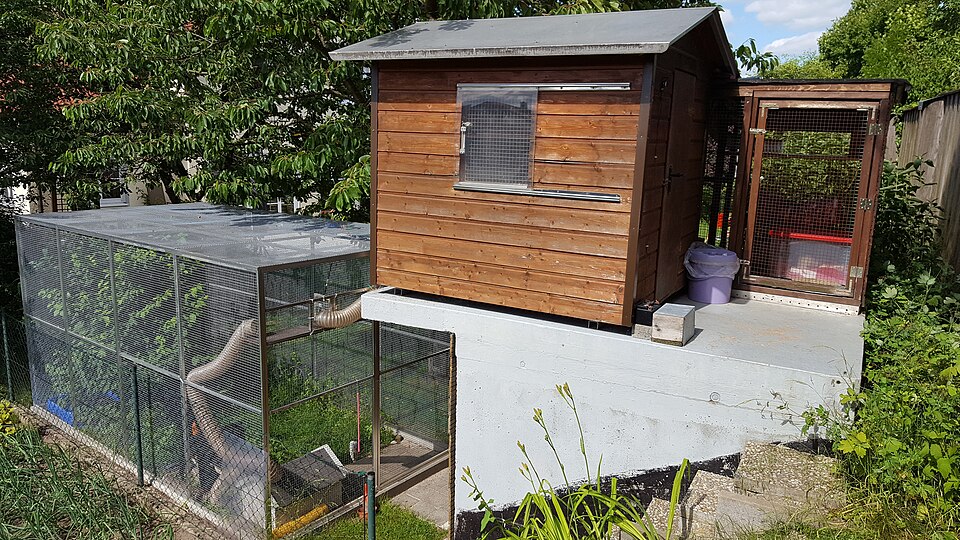
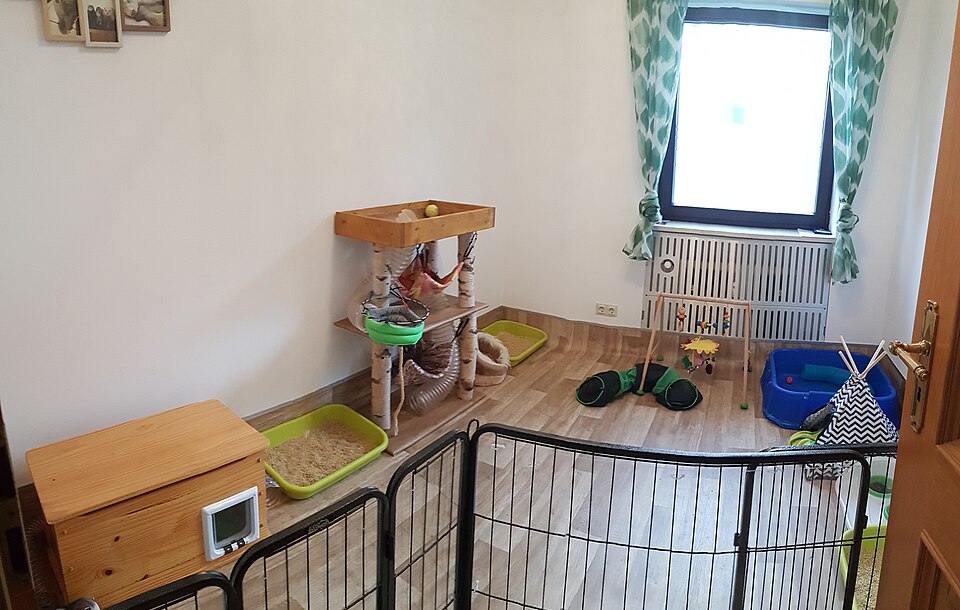
PDSA's rule is simple: the bigger the better. According to RSPCA Australia, some owners give their ferrets a whole room. PDSA also considers a converted shed, a custom-built ferret enclosure or a dedicated room suitable. To get a room ready for a ferret: ferret-proofing your home.
Levels, ramps and flooring
According to RSPCA Australia, ferrets enjoy ramps, shelves and mezzanine floors, so don't be afraid to build up to add space. Blue Cross also recommends tall cages with solid platforms and multiple levels for indoors.
- Short falls: According to PDSA, ferrets have poor eyesight, so keep the falls between levels short. Blue Cross also says shelves shouldn't be too high; ferrets can fall and hurt themselves.
- No wire floors: According to PDSA, the floor should be solid; if there's wire, cover it with something like vinyl so your ferret's feet don't get sore. According to Merck, bare wire can harm the pads of a ferret's paws.
- Cover wire levels: The AFA recommends covering wire-bottomed levels with a clear plastic runner cut to fit, then cloth on top. According to the AFA, solid ramps are safer for paws and easier to clean.
- Sharp wire and openings: Merck recommends checking the cage for sharp or rough wire and for any opening big enough for your ferret to escape through.
Escape-proofing
RSPCA Australia's rule is easy to remember: if a ferret can fit its head through a gap, the rest of its body will quickly follow. Blue Cross also says the gaps between the bars should be too small for a ferret to fit its head through.
- The door: According to RSPCA Australia, the cage door should latch securely; a double latch is ideal. Blue Cross recommends putting bolts on the doors of outdoor hutches.
- Check every day: RSPCA Australia wants you to check the enclosure every day for possible escape routes. If it's outdoors on dirt, check for tunnels being dug, too.
- Against digging: According to Blue Cross, ferrets love to dig. Wire mesh can be fitted to the underside of an outdoor run, but cover it with something like turf or carpet so they don't get hurt.
The sleeping area: hammocks and dust-free bedding
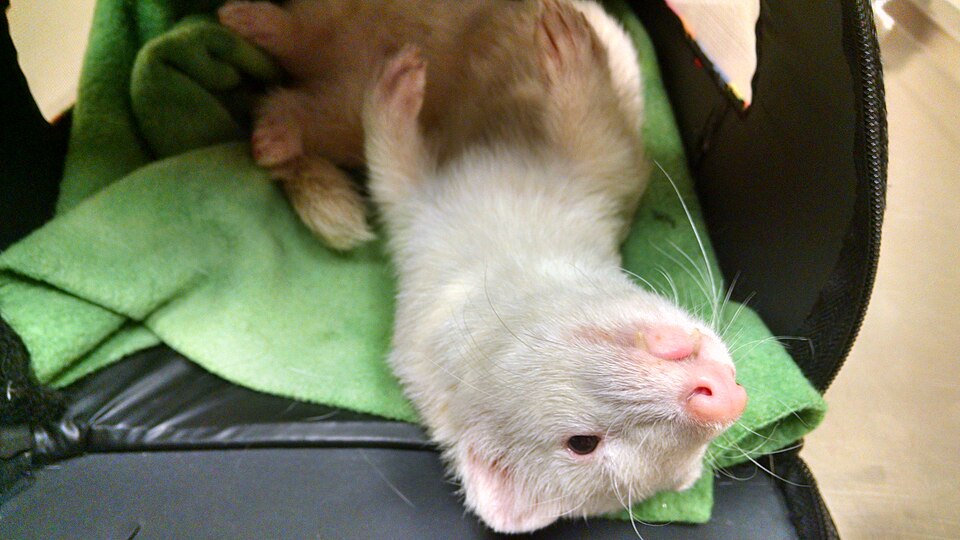
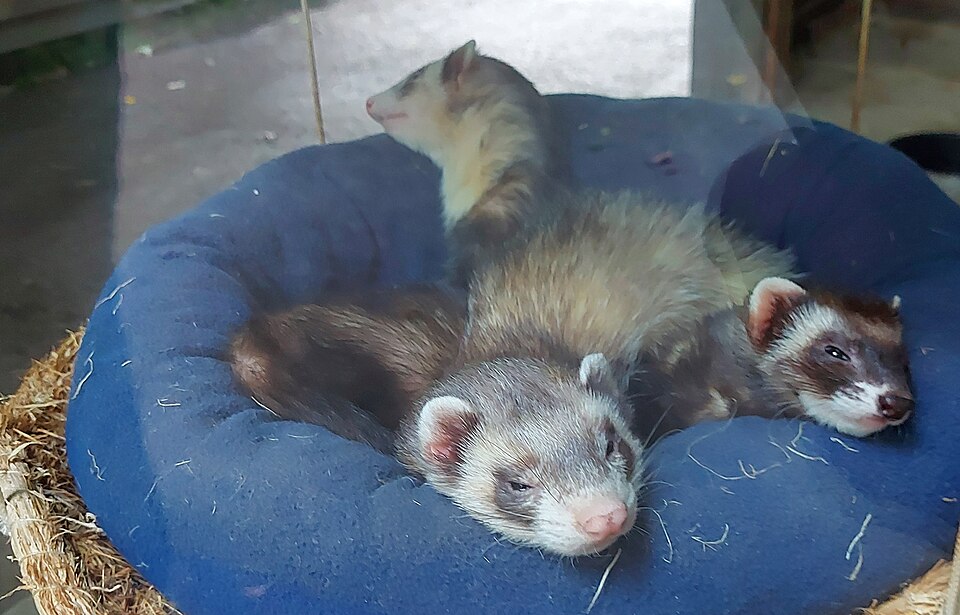
According to the RSPCA, ferrets sleep or rest for up to 20 hours a day. That makes the sleeping area the most important corner of the cage. For a safe resting spot, the RSPCA suggests an old T-shirt, a hammock or a sleeping box, with dust-free bedding. PDSA wants several warm, dry sleeping spots, especially hammocks.
| Use | Don't use |
|---|---|
| Hammocks, sleeping sacks or fabric huts (RSPCA Australia, Merck) | Wood shavings: can harm the respiratory system (RSPCA Australia) |
| A clean towel or small blanket that doesn't unravel and has no dangling strings (RSPCA Australia, Merck) | Newspaper and wood chips (Merck) |
| Undyed recycled paper bedding, 2–4 cm (about 1–1.5 in) thick (RSPCA Australia) | Cedar: its oil may be toxic to ferrets (Merck) |
- Together or apart: According to Blue Cross, the sleeping area should be big enough for ferrets to huddle together or sleep separately if they want; in outdoor hutches it should also be insulated.
- Fabric for the season: According to the AFA, fleece beds are a ferret favorite and are especially good in winter; in summer, switch to cotton, which is cooler.
- Bolster beds: According to the AFA, many ferrets like bolster-style beds with a small blanket inside to hide under.
- No floor bedding needed: According to PDSA, because ferrets use a litter box, bedding on the floor usually isn't necessary.
Bedding and hammocks are also the main source of odor; for a cleaning routine: ferret smell and cleaning.
Litter box, food and water
RSPCA Australia recommends putting something in every corner of the enclosure: food, water, bedding and a litter box. The RSPCA also wants the toilet area to be separate from where your ferrets eat, sleep and play.
- Litter box: According to RSPCA Australia, one or more litter boxes, half-filled with paper pellets and cleaned daily. The more ferrets you have, the more boxes you need.
- Secure the box: According to the AFA, ferrets love to push litter boxes around and tip them over; you can fasten the box to the cage with a clamp. Keep any plastic- or rubber-coated parts of the clamp out of reach of your ferret's mouth.
- Bowls that don't tip: According to Merck, ferrets tip their bowls over; use sturdy bowls or attach them to the cage. RSPCA Australia recommends keeping food available at all times in several small, sturdy dishes, keeping water in several bowls that can't be tipped, and hanging a water bottle as a backup.
- Water every day: According to Blue Cross, fresh water should always be available and changed daily.
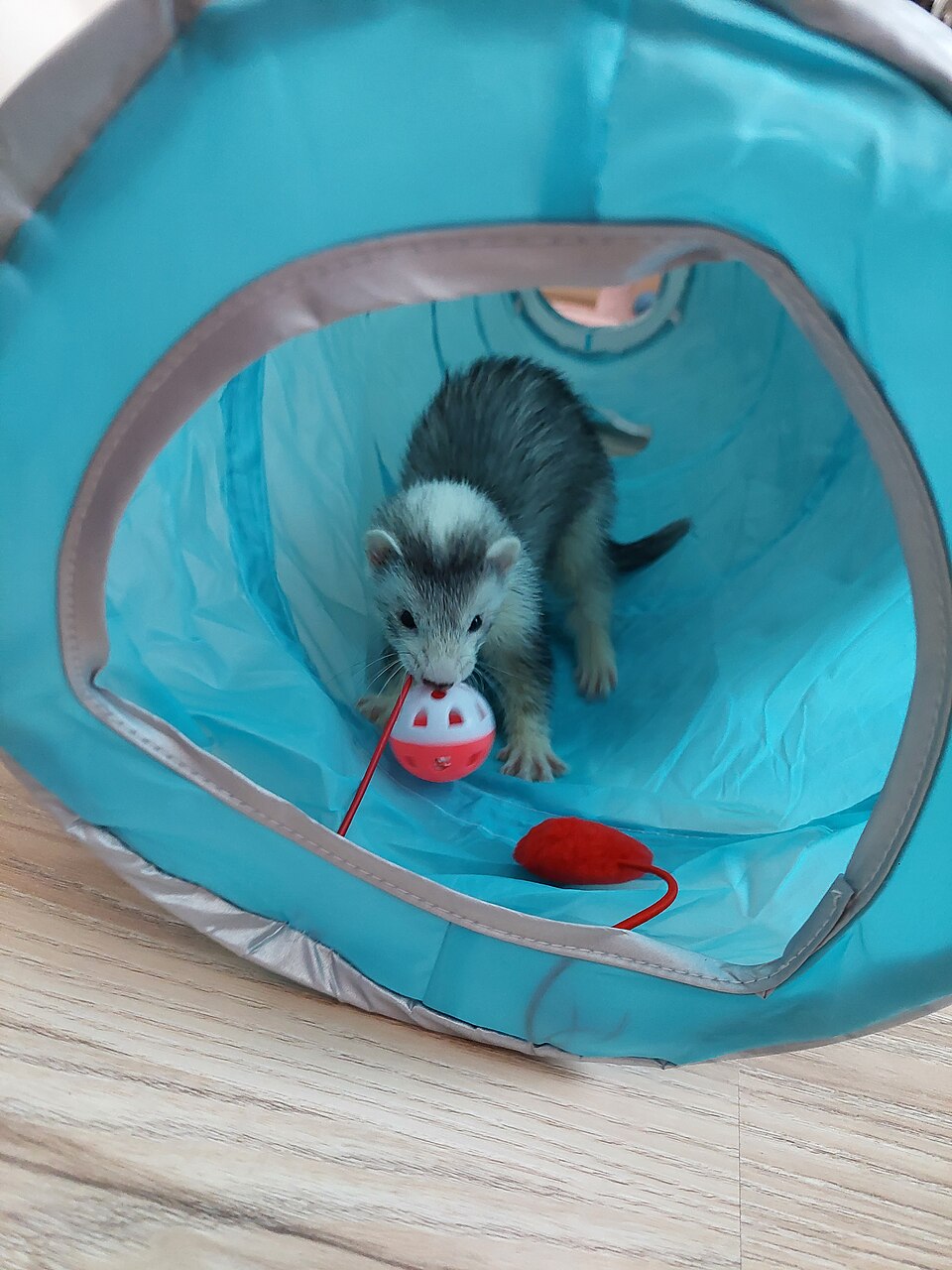
- No toys hanging on string: According to the AFA, don't hang toys from the top of the cage on string; ferrets have been known to chew and swallow the string. Toys that could break into pieces shouldn't go in the cage either. For safe toy ideas: ferret sleep and play.
To teach your ferret to use a litter box: ferret smell and cleaning.
Where should the cage go?
- Cool, dry, draft-free: According to the RSPCA, the place where your ferret lives should be well ventilated, dry and free of drafts, at about 15–21 °C (59–70 °F).
- Not in front of a window: Merck recommends keeping the cage away from drafts and dampness, and not placing it directly in front of a window.
- No sun: According to Blue Cross, a cage or hutch shouldn't be in direct sunlight. Ferrets are very sensitive to heat: ferrets in hot weather.
- Never a garage: According to Blue Cross, ferrets or any other animals should never be kept in a garage used for vehicles; the fumes can kill them.
- Outdoors: According to Blue Cross, most ferrets can live either indoors or outdoors. An outdoor hutch should be protected from rain, wind and drafts.
Tüylüm's Today tab has a ready-made Toilet cleaning task for ferrets. You can also add weekly bedding washes and cage checks as your own tasks; everyone in your Home sees the same list. Food & litter supplies calculates when your litter will run out and reminds you before it does.
Frequently asked questions
Can my ferret stay in its cage all day?
No. According to the AFA, a ferret shouldn't be kept in a cage full time; it should be out of its cage for at least 4 hours every day, and at least 2 of those hours should be spent with a person. Merck also recommends at least 2–4 hours outside the cage every day.
Can I put wood shavings on the cage floor?
According to RSPCA Australia, wood shavings can harm the respiratory system; Merck also advises against newspaper and wood chips. According to PDSA, because ferrets use a litter box, bedding on the floor usually isn't necessary. For bedding, use hammocks, towels or undyed paper bedding.
Can I keep my ferret's cage in the backyard?
According to Blue Cross, most ferrets can live outdoors, too. But the hutch needs an insulated sleeping area, protection from rain, wind and drafts, and no direct sunlight. Ferrets don't cope well with heat; for summer: ferrets in hot weather.

Keep track of your pet's care in TüylümLog vet visits, vaccine and medication dates, and we'll remind you when it's time. Share it all with your family in Home.
Sources
- American Ferret Association · Your Ferret's Cage (PDF)
- RSPCA Australia · Where should I keep my ferrets?
- Blue Cross · Caring for your ferret
- PDSA · Ferrets as pets
- Merck Veterinary Manual · Providing a Home for a Ferret
- RSPCA · Creating a good home for your ferrets
By Tüylüm · Published and last checked: October 26, 2026. Spotted a mistake? Write to [email protected] and we'll fix it right away. Photos are from Wikimedia Commons, used under the license shown below each photo.