Giant African land snail care: a calm pet, but watch out for the eggs
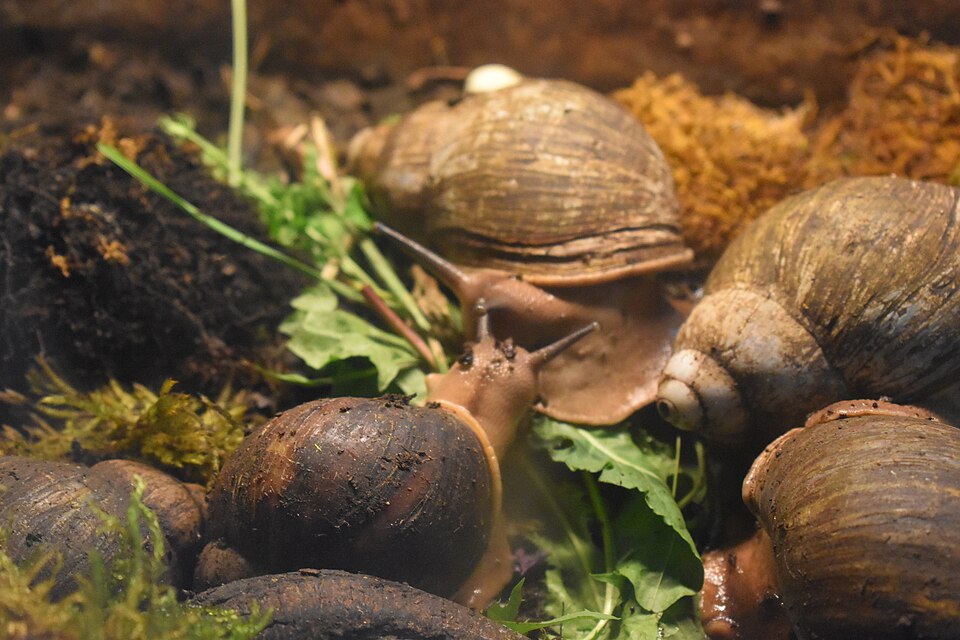
When the lights go out, slow movement begins in the terrarium. The snail that spent the day buried in the soil glides out carrying its shell, stretches out the long tentacles that hold its eyes and makes its way toward a slice of cucumber. According to the RSPCA, giant African land snails are active at night and come from humid regions south of the Sahara. The Royal Veterinary College (RVC) describes this snail as the largest known land snail: it can reach 20 cm in length and lives 5–7 years on average, and up to 10 years in good conditions. It's a quiet pet, but its care needs more attention than it might seem.
- A sturdy tank with a lid: According to the RSPCA and the RVC, a glass or sturdy plastic tank of at least 60 × 45 × 40 cm for two snails.
- A steady temperature: The ideal range is 21–23 °C (70–73 °F); the tank shouldn't drop below 18 °C (64 °F) or go above 29 °C (84 °F).
- Calcium at all times: Cuttlebone, natural chalk or crushed eggshell for the shell.
- Eggs: According to the AES, even a snail living alone can lay eggs. Never put the eggs out into the wild or throw them in the trash alive.
- Hygiene: Wash your hands thoroughly after handling the snail and cleaning the tank.
Think first: an invasive species
The RSPCA stresses how important it is to learn about a giant African land snail's needs, how big it grows and how long it lives before you get one. You'll also need to find someone who knows its needs and can look after it every day when you go on vacation. Finding a vet who knows this species ahead of time will make things easier too.
There's also a wildlife side to all this. The RVC describes this snail as a highly invasive species. According to the Global Invasive Species Database (run by an IUCN specialist group), it is one of the worst snail pests in tropical and subtropical regions, and one of the ways it reaches new places is the pet trade. According to the US Department of Agriculture (USDA APHIS), this snail feeds on more than 500 types of crops and ornamental plants. APHIS also points out that a single snail can be enough to start a new population.
- According to the AES, in some countries it's illegal even to keep giant African land snails. According to the USDA, selling and owning them is federally illegal in the US.
- Never release the snail or its eggs into your garden, a park, a plant pot or the wild.
- If you can no longer look after it, give it to someone who knows the species.
The terrarium: lid, substrate and shade
According to the RSPCA and the RVC, snails climb the sides of their tank and will soon escape if there's no lid. Wooden boxes aren't suitable: the snail can chew the wood, splinters can injure it, and according to the RVC, wood can't be cleaned properly, which makes it easier for disease to spread.
- Tank: Choose a well-ventilated glass or plastic tank with a secure lid. The more snails you have, the bigger the tank should be.
- Location: According to the RSPCA, keep the tank away from direct sunlight, radiators and drafts. It should also be away from places where chemicals such as fly or flea sprays are used.
- Substrate: The RSPCA recommends 3–6 cm, and the RVC at least 4–6 cm, of peat or soil substrate. The substrate should be damp but not wet.
- Hiding place: The AES recommends a large piece of tree bark; if you collected it yourself, soak it in water overnight to get rid of any chemicals.
- Water dish: Add a very shallow dish. According to the RVC, the water should be no deeper than 5 mm, because snails can drown in deeper water. Change the water every day.
- Monitoring: Put in a minimum/maximum thermometer and a humidity gauge (hygrometer).
The RSPCA and the RVC don't recommend soil from a garden or park: it can be stony and may contain fertilizer and pesticides. Make sure the substrate you use is free of fertilizer and chemicals. No extra lighting is needed; according to the RVC, indirect daylight in the room is enough. Snails prefer not to come out in bright light, so a lightly shaded corner of the room is best.
Temperature and humidity
| Measure | What the sources recommend |
|---|---|
| Temperature | 21–23 °C / 70–73 °F (RSPCA, RVC) |
| Lower and upper limits | Not below 18 °C (64 °F), not above 29 °C (84 °F) (RSPCA, RVC) |
| Humidity | 70–80% (AES), 75–90% (RVC) |
| Water dish depth | 5 mm at most (RVC) |
If the room isn't warm enough, the RSPCA says a heat mat can be placed under half of the tank; the AES also wants the heater connected to a thermostat and sudden temperature changes avoided. To keep the humidity up, lightly mist the tank with lukewarm water. The RSPCA recommends misting every other day and the RVC every day; adjust how often you do it based on the reading on your hygrometer.
What happens if it's too hot, too cold or too dry? According to the RSPCA, the snail hides, becomes inactive and may seal the opening of its shell with a thin membrane. It can then stay dormant for months, and if the temperature is very low, it can die. According to the AES, the snail becomes active again once conditions improve. More about this membrane over the shell opening: snail shells and calcium.
Food and calcium
Some of the foods the RSPCA and the RVC list:
- Greens: Lettuce, cabbage, spinach, watercress, dandelion and grass.
- Vegetables and fruit: Zucchini, cucumber, apple, melon, grapes and banana. The AES also lists kale, broccoli, peppers, green beans, strawberries and parsley.
- Wash: According to the RSPCA and the RVC, all food should be washed thoroughly to remove pesticide and chemical residues.
- Remove: Take out any food that hasn't been eaten within 24 hours; the AES wants moldy food removed immediately.
- Protein: According to the AES, snails also need protein. Ask a vet who works with exotic animals which product to give and how much.
Calcium is essential for the shell to form and grow normally. The RSPCA and the RVC recommend cuttlebone, natural chalk, crushed eggshell or a powdered calcium supplement. If you're thinking of using a supplement, talk to your vet. A detailed guide to how the shell is built and where calcium can come from: snail shells and calcium.
Cleaning and hygiene
The RSPCA asks that the glass of the tank be cleaned regularly of the slime and droppings snails leave behind. According to the RSPCA and the RVC, detergents and disinfectants shouldn't be used for cleaning; the AES also recommends only hot water and a cloth. The sources give different advice on how often to change the substrate and how much of it to change; what they agree on is not using chemicals. According to the RSPCA, any chemical that touches a snail's skin is absorbed quickly and can be toxic.
According to the AES, snails can carry Salmonella bacteria, so wash your hands thoroughly after handling your snail or cleaning its tank. APHIS also notes that these snails can carry organisms that can cause disease in people, and recommends wearing gloves when handling them. If you have any concerns about your own health, talk to a doctor.
If you need to move your snail, the RSPCA recommends holding it very gently by its shell and picking it up while it's resting on the soil, not while it's stuck to the glass. Better still, wait for the snail to climb onto a leaf and move it along with the leaf.
Eggs: the biggest responsibility
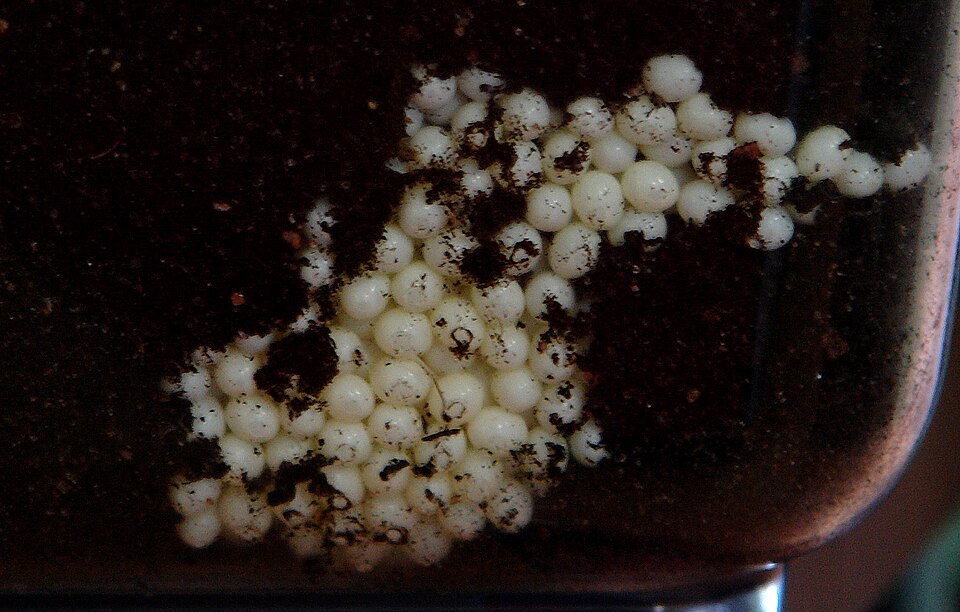
According to the RSPCA and the RVC, snails have both female and male reproductive organs, so keeping two snails together most likely means babies. The AES goes a step further: a giant African land snail can lay eggs without ever mating, and a snail that has mated once can lay eggs more than once. So even a snail that hasn't been with other snails for a long time can produce eggs.
The numbers aren't small. According to the Global Invasive Species Database, a snail can lay up to 100 eggs in its first year and up to 500 in its second. According to APHIS, adults lay eggs about every two to three months, and each egg is about 6 mm across.
The AES recommends that inexperienced keepers freeze eggs for 48 hours before throwing them away; surplus eggs must always be frozen before you dispose of them. Don't put eggs in the garden or a plant pot, and don't throw them in the trash alive. According to the AES, breeding is a job for experienced keepers only.
What does a healthy snail look like?
According to the RSPCA, a healthy snail has a clean, unbroken shell, and its body has no unusual swelling, lumps or spots. Small white spots on the skin can be a sign of a problem a vet should look at. A snail that never comes out of its shell may be dehydrated. The main health problems the RSPCA wants you to learn about are dehydration, calcium deficiency, exposure to chemicals, skin problems and a broken shell. If you notice any of these, ask a vet who works with exotic animals.
You can use the ready-made invertebrate tasks in Tüylüm's Today tab (Water dish / humidity, Terrarium cleaning) and add a daily fresh food and egg check as tasks of your own; everyone in your Home sees the same list. When you go on vacation, you can use the Pet sitter note to share the daily tasks and your vet's details in a single message.
Our other invertebrate guides: Invertebrates.
Frequently asked questions
Is a giant African land snail happy on its own?
According to the RVC, giant African land snails can be kept alone or in groups. In the wild they usually live alone and mostly come together to mate; in a tank, they are sometimes seen sleeping together. If you keep more than one snail, be ready for eggs.
My snail has pulled back into its shell and sealed the opening with a membrane. What should I do?
According to the RSPCA, this can be a sign that it's too hot, too cold or too dry. Check the temperature and humidity and fix the problem. According to the AES, the snail becomes active again once conditions improve. If it doesn't, ask a vet who works with exotic animals.
Can I give it soil or greens from the garden?
The RSPCA and the RVC don't recommend garden soil: it can be stony and may contain fertilizer and pesticides. Always wash greens thoroughly, and if you suspect they may have been sprayed, don't give them at all.

Keep track of your pet's care in TüylümLog vet visits, vaccine and medication dates, and we'll remind you when it's time. Share it all with your family in Home.
Sources
- RSPCA · Handle with care: Giant African land snails (PDF)
- Royal Veterinary College (RVC) · Giant African land snail care sheet (PDF, December 2024)
- Amateur Entomologists' Society · Giant African Land Snails
- USDA APHIS · Giant African Snail
- IUCN SSC Invasive Species Specialist Group · Global Invasive Species Database: Achatina fulica
- USDA National Invasive Species Information Center · Giant African Snail
By Tüylüm · Published and last checked: October 24, 2026. Spotted a mistake? Write to [email protected] and we'll fix it right away. Photos are from Wikimedia Commons, used under the license shown below each photo.