What should a hamster cage be like? Floor space, deep bedding and a wheel that keeps the back straight
In the wild, a hamster walks nonstop at night, digs deep tunnels underground and carries food back to its nest. According to the RSPCA, wild hamsters can run up to five miles, or about 8 kilometers, a day. For a pet hamster, all of these needs have to fit into one place: its cage. Unfortunately, according to the PDSA, most hamster cages sold in stores aren't big enough to meet a hamster's most basic needs. In this article, we set up the right home step by step.
- Floor space: According to the figure cited by the PDSA, at least 100 × 50 cm. This is a minimum; bigger is always better.
- Deep bedding: So your hamster can dig and make tunnels, Blue Cross recommends at least 20 cm of bedding and the PDSA at least 25 cm.
- Wheel: A large wheel with a flat, solid surface. According to the PDSA, at least 20 cm in diameter for dwarf hamsters and at least 30 cm for Syrian hamsters. Your hamster's back shouldn't arch while it runs.
- Hiding places: A nest box that's dark inside and several hiding places.
- Living alone: According to the RSPCA, a Syrian hamster should always live on its own.
Space first: floor, not height
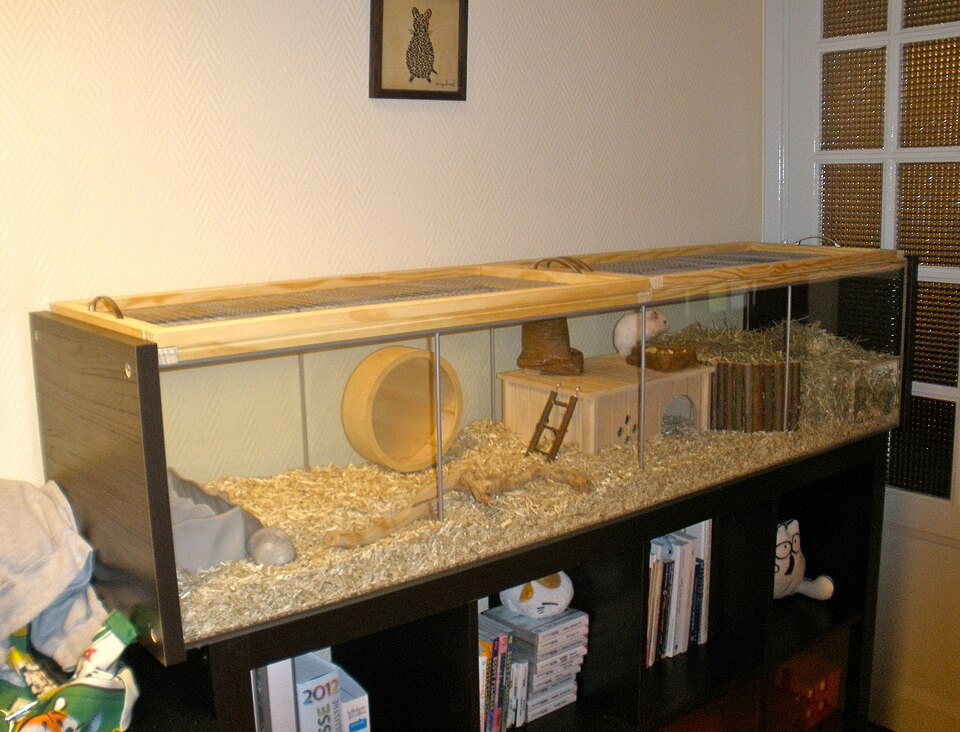
The PDSA says there isn't much evidence on exactly how big a hamster cage should be. Even so, it cites the minimum of 100 × 50 cm of floor space recommended by the Veterinary Association for Animal Welfare, a Germany-based association of vets, and stresses that this is a minimum. Blue Cross also recommends at least 100 × 50 cm of floor space and 50 cm of height.
According to the PDSA, large single-level cages are generally better than tall multi-level ones: hamsters have poor eyesight and can easily fall from a height. Blue Cross also recommends avoiding complicated tube systems; these aren't well ventilated, are usually too narrow for Syrian hamsters, and dwarf hamsters struggle in vertical tunnels.
| Feature | What the sources recommend |
|---|---|
| Floor space | At least 100 × 50 cm (PDSA, Blue Cross) |
| Height | 50 cm (Blue Cross) |
| Bedding depth | At least 20 cm (Blue Cross), at least 25 cm (PDSA) |
| Bar spacing | Narrower than 1 cm (Blue Cross) |
| Floor | Solid and flat; not wire mesh (RSPCA) |
| Levels | A single-level, roomy space (PDSA) |
The PDSA recommends a very large cage, a glass tank or a homemade enclosure. According to Blue Cross, tanks allow for deep bedding and reduce the risk of escaping through the bars, but they need a wire mesh lid on top for good ventilation. According to the RSPCA, the floor should be solid; wire mesh floors can cause foot problems. Make sure lids and doors are secure: as the PDSA puts it, hamsters are master escape artists.
Deep bedding: hamsters want to dig
According to the RSPCA, wild hamsters live in deep burrows and build their own nests. According to the PDSA, these tunnels are used for sleeping, hiding and storing food, so it's important that the bedding can hold its shape.
- Paper-based bedding: According to the PDSA, it can be used on its own or mixed with other bedding.
- Hemp or aspen bedding: It's dust-free but doesn't hold tunnels well on its own; the PDSA recommends mixing in paper bedding.
- Soft hay: According to the PDSA, it makes tunnels sturdier. The RSPCA also lists good-quality hay among suitable nesting materials.
- Unscented toilet paper: The PDSA recommends the cheap, thin kind; thick toilet paper can block the gut if swallowed.
- Leave nesting material outside: According to the PDSA, if you put the material outside the nest box, your hamster will fill its nest itself.
- Cotton wool and "fluffy" nesting materials: According to the RSPCA and the PDSA, these materials separate into fine strands that can wrap around legs and cut off circulation, and can block the gut if swallowed.
- Dusty wood shavings and sawdust: According to the PDSA, they can cause breathing problems.
- Scented bedding: It can irritate the airways (PDSA).
- Newspaper: According to the PDSA, the ink may be toxic to hamsters.
The wheel: the back should stay straight
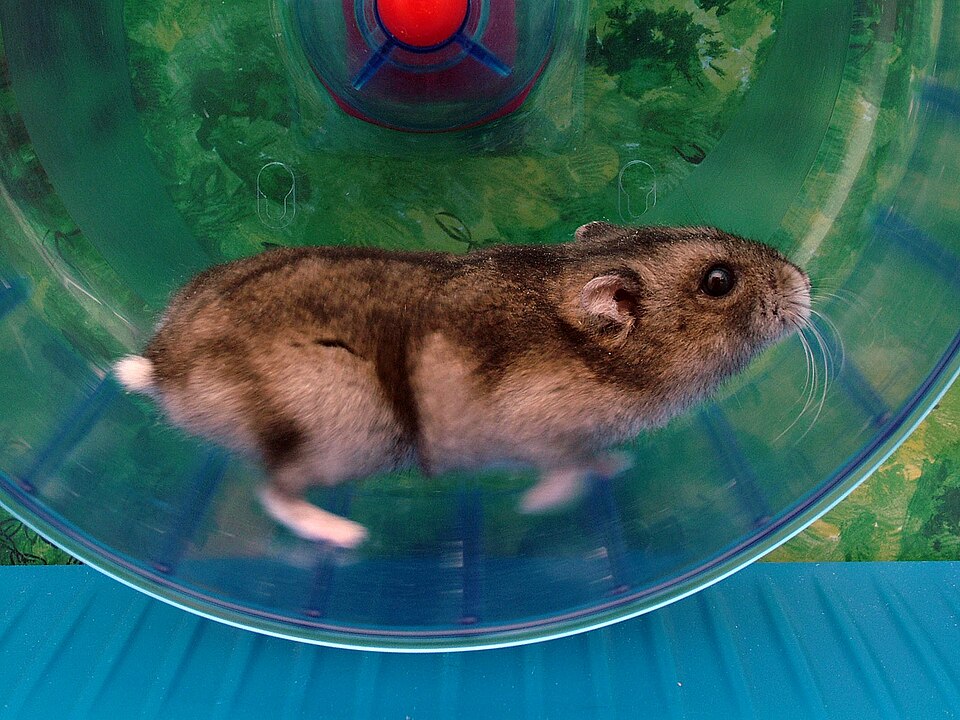
According to the PDSA, the wheel should be as large and wide as possible. Most wheels on sale are too small and force the hamster to run with its back arched, which can lead to long-term pain. The running surface should also be flat and solid, not rungs or gaps where legs could get caught.
According to Blue Cross, wheels sold with cages are often too small. A hamster will use such a wheel anyway, and over time its spine can be damaged. On the right wheel, a hamster should be able to run with its back completely straight and without lifting its head. The RSPCA also recommends a large-diameter, solidly built wheel with no central axle and, ideally, a non-slip surface.
| Hamster | Minimum wheel diameter, according to the PDSA |
|---|---|
| Dwarf hamsters | 20 cm |
| Syrian hamster | 30 cm |
According to the RSPCA, the wheel shouldn't be the only entertainment. If your hamster develops sores on its feet because of the wheel, remove the wheel temporarily and talk to your vet.
According to Blue Cross, hamster balls shouldn't be used: the hamster tires quickly and can't get out of the ball. The ball isn't well ventilated, and while inside it, the hamster can't reach water, food or a hiding place. For time outside the cage, use a safe play area with high sides and always keep your hamster in sight.
Hiding places and the nest box
According to the RSPCA, the nest box should be dark inside and big enough for your hamster to set up a food store, sleep and turn around comfortably. Some boxes have an entrance that's an angled tube that blocks out light. Hamsters like their nest box to be close to their food and nesting material, but keep it away from the water so it doesn't get wet if the bottle leaks. The RSPCA recommends a box without a base: when you lift it, you can check on your hamster without disturbing it.
According to Blue Cross, hamsters like to sleep far from the entrance, so a multi-chamber hideout is ideal. You can join cardboard boxes together or connect them with cardboard tubes. If you cut a hole in the bottom of the box, your hamster can dig from its nest down into the bedding. The PDSA also lists cardboard boxes, ceramic pots and multi-chamber wooden houses among suitable hiding places.
Add tubes, cardboard boxes and chew blocks next to the hiding places. We've explained why chewing matters so much in our article on why rodents chew. The PDSA and Blue Cross also recommend scattering food around the enclosure, or burying some of it in the bedding, rather than putting it in a bowl; searching for its food keeps your hamster busy and lets it use its natural foraging instinct.
Why should a Syrian hamster live alone?
According to the RSPCA, Syrian and Chinese hamsters aren't social by nature and should always live on their own. Although dwarf species such as Roborovski, Campbell's and winter white hamsters can sometimes live in pairs or trios under the right conditions, the RSPCA reminds owners that they don't need a companion to be happy either; dwarf hamsters that get along at first may fight as they get older.
The PDSA agrees: hamsters don't get lonely, and keeping them together can lead to fighting, stress and injuries. If you want to keep more than one hamster, set up a separate home for each. According to Blue Cross, hamsters don't play-fight; every fight should be taken seriously.
According to the RSPCA, hamsters communicate through scent. Putting hamsters that don't know each other side by side, even in separate cages, can stress them.
Where to put the cage at home
- Steady temperature: According to the PDSA, 18–21 °C (64–70 °F), away from drafts and direct sunlight. If the cage gets too hot, the hamster can't escape and may get heatstroke; if it gets too cold, it can go into a dangerous hibernation-like state called "torpor."
- Indoors: According to the RSPCA and Blue Cross, hamsters should live inside the house.
- A quiet corner: The PDSA recommends a spot away from noisy, vibrating appliances such as televisions and washing machines.
- Sources of ultrasound: According to the RSPCA, hamsters are very sensitive to high-frequency sounds that we can't hear. Televisions, computer screens, vacuum cleaners and running water can make these sounds.
- Regular light: The RSPCA recommends a room where the lights go off at roughly the same time every night. Hamsters are also sensitive to bright sunlight.
- Away from cats and dogs: According to the RSPCA, the presence and smell of predators can stress a hamster.
Is it okay to keep the cage in a bedroom, and at what times should you spend time with your hamster? We've covered this in our article why is my hamster awake at night?
Cleaning: without upsetting its routine
- While your hamster is awake: According to the RSPCA and the PDSA, clean while your hamster is awake, not in the middle of the day while it's asleep.
- A quick clean every day: The PDSA recommends removing wet or soiled bedding and uneaten food, and cleaning the bowls and the bottle.
- Full clean: According to the PDSA, small cages need a full clean once a week, and large enclosures every few weeks. The RSPCA considers one or two deep cleans a month enough in most cases.
- A familiar smell: Put some of the old bedding that isn't soiled back into the new bedding (RSPCA, PDSA). Blue Cross recommends about a third.
- Everything back in its place: According to the PDSA, hamsters are creatures of habit; put their nests, toys and bowls back where they were.
- Don't empty the food store completely: According to Blue Cross, taking away all of the food it has hoarded stresses a hamster. If you have to, replace it with a similar amount of food and mix in a little of the old food.
For rodents, Tüylüm's Today tab comes with ready-made Food, Water and Cage cleaning (weekly) tasks; everyone in your Home sees the same list. To see when the bedding will run out, you can use Food & litter supplies; it reminds you before it runs out.
For more of our rodent articles: rodents.
Frequently asked questions
The cage I bought from a store is too small. What should I do?
The PDSA considers most store-bought cages inadequate and recommends a very large cage, a glass tank or a homemade enclosure. The floor space should be at least 100 × 50 cm, and it should be deep enough to hold at least 20–25 cm of bedding.
Is the wheel that came with the cage good enough?
Usually not. According to Blue Cross, wheels sold with cages are generally small. If your hamster's back arches or it lifts its head while running, the wheel is too small. The minimum diameters the PDSA recommends are 20 cm for dwarf hamsters and 30 cm for Syrian hamsters.
Can I keep two Syrian hamsters together in a big cage?
No. According to the RSPCA, Syrian hamsters should always live on their own. According to the PDSA, if they're put together they'll fight, and this can lead to injury or even death. However big the cage is, each hamster needs its own home.

Keep track of your pet's care in TüylümLog vet visits, vaccine and medication dates, and we'll remind you when it's time. Share it all with your family in Home.
Sources
- PDSA · Hamsters as pets
- Blue Cross · Hamster care
- RSPCA · Creating the right home for your hamster
- RSPCA · Understanding hamster behaviour
- RSPCA · Keeping hamsters together
By Tüylüm · Published and last checked: October 24, 2026. Spotted a mistake? Write to [email protected] and we'll fix it right away. Photos are from Wikimedia Commons, used under the license shown below each photo.