Why is my hamster awake at night? Sleep patterns, playtime and wheel noise

A hamster that sleeps curled up in its nest all day, then comes out once the house goes quiet in the evening and starts running on its wheel... This isn't bad temper; it's its nature. According to the RSPCA, wild hamsters are usually active only at dusk and at night, and they can run up to five miles, or about 8 kilometers, a day. Understanding your hamster's body clock means less stress for it and calmer nights for you. In this article, we talk about sleep patterns, playtime and that familiar sound of the wheel at night.
- Hamsters sleep during the day and become active in the evening and at night. According to Blue Cross, they're most active in the evening.
- Don't wake it while it's sleeping: According to the RSPCA, picking up a resting or sleeping hamster stresses it; according to Blue Cross, a startled hamster may bite.
- Spend time with your hamster every day, during its waking hours; the RSPCA recommends regular daily attention rather than long sessions on weekends.
- If the cage is in your bedroom, your hamster's nighttime activity may disturb your sleep; Wood Green doesn't recommend a bedroom that's in use.
- The wheel should be large, solid and flat-surfaced; your hamster should be able to run without arching its back (RSPCA, Blue Cross, Wood Green).
A body built for the night
According to the RSPCA, because hamsters are nocturnal animals, they have large eyes, and their retinas are dominated by rod cells that work in low light. They have other tools for finding their way in the dark, too: according to the RSPCA, hamsters gather information about the objects around them by flicking their whiskers back and forth 30 times a second. Their senses of smell and hearing are also sharp enough to detect predators.
What do they do all night? They walk, dig, explore and collect food. According to the RSPCA, the word "hamster" comes from the German word hamstern, meaning "to hoard": a Syrian hamster can carry up to half its body weight in food in its cheek pouches and store it in its nest.
According to the RSPCA, because hamsters are prey animals, they're usually wary of new sights, sounds and smells; when they're frightened, they retreat to their nest.
Why shouldn't you wake it?
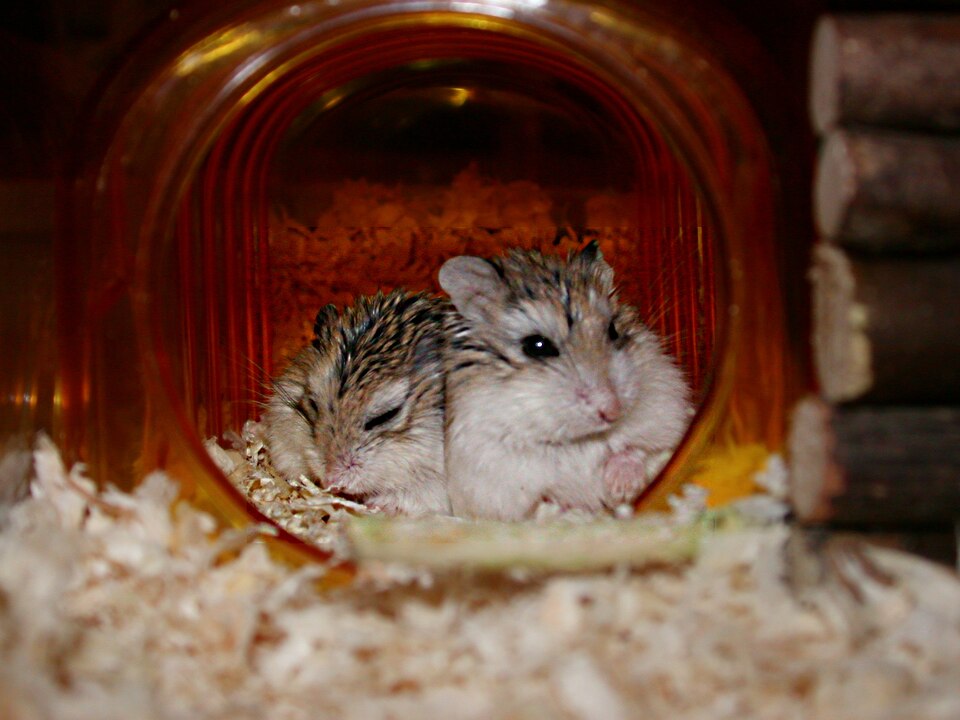
According to the RSPCA, hamsters need to be able to sleep undisturbed during the day. A resting or sleeping hamster shouldn't be picked up unless it's unavoidable; it stresses them. Blue Cross gives a similar warning: a hamster that's disturbed during the day and gets startled may bite. So before you try to hold your hamster, make sure it's fully awake.
According to Blue Cross, never put your hand into your hamster's bed: it may be asleep and will get a fright. Don't wake it up to put it in its play area either; only take it out when it has woken up on its own.
The same rule applies to cleaning. According to the RSPCA, clean the cage while your hamster is awake, not in the middle of the day while it's asleep; having its sleep interrupted can stress it.
Can the cage go in a bedroom?
According to Blue Cross, hamsters are most active in the evening, and this can be a problem if the cage is in a bedroom. Wood Green also recommends not putting the cage in a bedroom that's in use: hamsters are most active at night and may disturb your sleep. But it isn't only about your sleep; your hamster's routine matters too. According to the RSPCA, hamsters should be kept in a room where the lights go off at roughly the same time every night, and irregular lighting should be avoided. A room where the light stays on until late at night can throw off your hamster's body clock.
- Regular light: The RSPCA recommends a room where the lights don't stay on until late and regular hours are kept.
- Away from screens: According to the RSPCA, televisions and computer screens can give off high-frequency sounds (ultrasound) that hamsters can hear but we can't; hamsters are very sensitive to these sounds and can become stressed.
- Other sources of ultrasound: Vacuum cleaners and running water can also make these sounds (RSPCA).
- Away from bright sun: According to the RSPCA, hamsters are sensitive to bright sunlight.
- A quiet corner: According to the RSPCA, a hamster should live somewhere quiet where it can rest undisturbed.
For where to put the cage, temperature and size: what should a hamster cage be like?
Wheel noise
That rattling at night is familiar in many homes. The sound comes from your hamster's most natural need: according to Wood Green, wild hamsters walk for miles every night, collecting food and carrying it back to their burrows in their cheek pouches. The wheel is part of meeting that need; the solution isn't to take it away but to choose the right wheel and put the cage in the right room.
- Large and solid: The RSPCA recommends a good-quality, large-diameter, solidly built wheel with no central axle, ideally with a non-slip surface.
- Upright and flat-surfaced: Wood Green recommends an upright, flat-surfaced wheel with a diameter of 12 inches (about 30 cm) for Syrian and Chinese hamsters, and 8 inches (about 20 cm) for other hamsters.
- A straight back: According to Blue Cross, a hamster should be able to run on the wheel without arching its back or lifting its head. Wheels that come with cages are often too small for this.
- Don't let it be the only fun: According to the RSPCA, the wheel shouldn't be the only enrichment. Deep bedding, hiding places and space to explore also fill its night.
According to the RSPCA, hamsters need plenty of space to play and exercise at night; deep bedding where they can dig and build a nest is part of that too.
When should you play with it?
The RSPCA recommends interacting with your hamster every day and handling it as often as possible, but while respecting its sleep pattern. According to the RSPCA, it's best to build a routine: short, regular time every day, rather than ignoring it all week and spending long hours with it on weekends.
- Wait for it to wake up: Go over in the evening once your hamster has come out on its own and started moving around. According to Wood Green, hamsters, like us, don't much like being woken up.
- Let it hear your voice: Wood Green says that talking softly to your hamster helps it notice you're there.
- Let it sniff your hand: According to Blue Cross, put your hand into the cage and let it sniff and get used to you; then stroke it gently. The RSPCA also recommends letting your hamster investigate your hands at its own pace.
- Offer treats: Blue Cross says that giving treats by hand helps your hamster link you with good things.
- Cup your hands: According to the RSPCA, pick up your hamster by cupping both hands and let it sit on your palms.
- Keep it low: The RSPCA recommends holding your hamster just above a stable surface such as a table, no more than a few inches up. According to Blue Cross, hamsters are short-sighted and can't judge depth well; they can easily fall off a table or a ledge and get hurt.
If your hamster is very timid, Blue Cross suggests this: keep your hand inside the cage without touching it at all, so it gets used to your scent and presence. If it's wary of coming near your hands, you can let it walk into a tunnel or hiding house and lift it that way. According to the RSPCA, hamsters are timid by nature and don't like loud, threatening noises, so stay calm around your hamster and never frighten it.
According to the RSPCA, a hamster should never be left outside its cage unsupervised or overnight. If you let it roam outside the cage once it's tame, always stay with it and make sure other animals such as cats and dogs can't get to it.
If its nighttime routine changes
According to the RSPCA, hamsters have a fast metabolism and can go downhill quickly when they get sick. They don't show pain, so they may be suffering before you notice. The RSPCA says unusual behaviors, such as repetitive movements, can be a sign of a problem, and recommends talking to a vet right away if you see signs of illness.
Don't wait if your hamster isn't waking up in the evening, doesn't seem to be eating or is behaving differently than usual. In winter, watch for one more possibility: according to Blue Cross, if pet hamsters get very cold or their food runs low, they can go into a state called "torpor," which is similar to hibernation and can be dangerous. The RSPCA also recommends keeping your hamster warm in winter. If you're worried that your hamster has gone into this state, call your vet.
If you're leaving your hamster with someone while you go on vacation, you can use Tüylüm's Pet sitter note to share daily tasks, vet details and notes like "don't wake it during the day, spend time with it in the evening" in a single WhatsApp message. The RSPCA also recommends that during this time your hamster stays in its familiar cage and is left the food it's used to.
More of our rodent articles: rodents.
Frequently asked questions
I can't sleep because of the wheel noise at night. What can I do?
Your hamster needs to run at exactly these hours; according to the RSPCA, it needs plenty of space to play and exercise at night. Blue Cross and Wood Green don't recommend keeping the cage in a bedroom that's in use; consider moving it to another quiet room with a steady lighting routine.
Can I wake my hamster during the day to cuddle it?
Not unless you have to. According to the RSPCA, picking up a sleeping or resting hamster stresses it; according to Blue Cross, a startled hamster may bite. Wait for it to wake up on its own in the evening.
Can I handle my hamster when I have a cold?
According to the RSPCA, hamsters can catch colds from people, and the reverse is also possible. Blue Cross recommends being careful when handling your hamster while you have a cold, paying attention to hygiene and wearing gloves if necessary.

Keep track of your pet's care in TüylümLog vet visits, vaccine and medication dates, and we'll remind you when it's time. Share it all with your family in Home.
Sources
- RSPCA · Understanding hamster behaviour
- RSPCA · Creating the right home for your hamster
- RSPCA · Hamsters
- RSPCA · Hamster health and welfare
- Blue Cross · Hamster care
- Wood Green · Caring for hamsters as pets
By Tüylüm · Published and last checked: October 24, 2026. Spotted a mistake? Write to [email protected] and we'll fix it right away. Photos are from Wikimedia Commons, used under the license shown below each photo.