 Tüylüm
Sphynx
Known for its nearly hairless, peach-soft skin and huge ears, the Sphynx is a chatty cat that bonds closely with its people. It needs regular baths and protection from sun and cold. Heart disease is common in the breed, and it is not hypoallergenic.

 Lifespan≈ 6.7 yearsUK 2019 data, only 18 cats; low certainty
 Weight6–14 lb (2.7–6.4 kg)males are larger
 OriginCanada (Toronto)a natural genetic change in 1966
 CoatNearly hairlessfine down; needs regular baths
 EnergyHighcurious, playful, smart
 VoiceChattytells you what it wants
 With kidsGooddelicate skin; no rough play
 Time aloneDislikes ita second cat is often advised
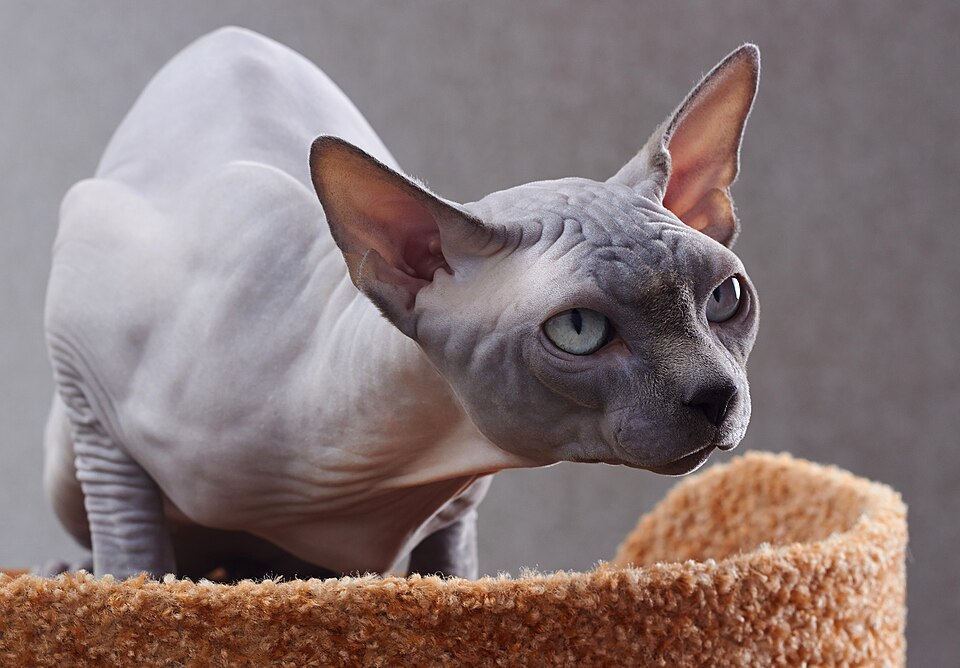
At first glance the Sphynx looks hairless; touch it and it feels warm and soft, like the skin of a peach. Its huge ears, lemon-shaped eyes and wrinkled skin make it instantly recognizable, but for the people who love it, its real hallmark is how attached it gets to its humans. Without a coat, it is not as easy to care for as many expect, and some serious health problems are common in the breed. On this page we've pulled together its temperament, care needs and health issues from breed registries, animal welfare resources and scientific studies.
- Temperament: Deeply attached to its people, curious and chatty; it follows you from room to room and stays close for your warmth.
- Care takes effort: Its skin gets oily, so it needs regular baths, ear cleaning and protection from sun and cold.
- Not hypoallergenic: The substances that trigger cat allergies are in the skin and saliva, not the fur; being hairless doesn't prevent allergies.
- Health: Heart disease (especially HCM) is common in this breed; an inherited condition that causes muscle weakness has a DNA test.
- Lifespan: In UK data from 2019, life expectancy was about 6.7 years, the shortest of the breeds studied, though the data come from a small number of cats.
What to know
 What is the Sphynx like?
The Sphynx is a curious, outgoing, intelligent cat and anything but shy. According to the CFA's breed profile, it makes its needs (usually attention or food) very clear and keeps up a steady stream of chatter as it follows you from room to room. It isn't especially loud, but it isn't a quiet cat either.
What stands out most is its craving for attention and contact. Without fur, it loves body heat and can spend hours glued to your side or in your lap. Vet-reviewed sources describe a dog-like personality: it can learn to play fetch and is eager to learn short tricks for rewards. Curious and dexterous, it can figure out how to open cabinets and drawers.
That devotion comes at a price: according to the CFA, the Sphynx doesn't do well when left alone for long and is happiest with other cats, especially other Sphynx, for company. That's why many sources suggest getting two cats instead of one.
Every cat is an individual. Breed traits describe general tendencies; how a cat was raised, how much contact it had with people as a kitten and its health shape its personality as much as its breed.
 Who is it a good fit for?
The Sphynx suits people who spend a lot of time at home, want a close relationship with their cat and will keep up with weekly care like baths and ear cleaning. If you're looking for an independent cat that does its own thing, this breed may be more than you bargained for.
| Situation | Good fit? |
|---|---|
| Apartment | Excellent; it should live indoors anyway |
| Family with kids | Good, but kids should be old enough to understand its skin is delicate |
| Other cats and dogs | Usually gets along; happier with another cat |
| Long hours alone | Hard; it needs attention and warmth |
| People with cat allergies | No guarantee; spend time with the breed first |
| First-time cat owners | Possible, but care and health monitoring take effort |
The CFA notes that Sphynx are very popular with children, but stresses that kids should be old enough to understand that the cat's skin is delicate and not suited to rough play.
Where does it come from?
Today's Sphynx trace back to a hairless kitten born in Toronto, Canada, in 1966. According to the CFA, this was a natural, spontaneous genetic change that is inherited recessively. For more than 30 years, breeders crossed hairless cats with normal-coated cats and then back to hairless ones to build a broad gene pool. In 1975, two more cats carrying the same change turned up in Minnesota; they were bred to American Shorthairs and Devon Rex and added to the breed. The CFA accepted the Sphynx for registration in 1998 and advanced it to championship status in 2002.
There's an interesting genetic link, too: according to a 2022 study of more than 11,000 cats, the Sphynx's hairlessness and the Devon Rex's curly coat come from different changes in the same gene (KRT71). The same study also found some hairless Sphynx without this change, which suggests there may be another genetic cause of hairlessness as well.
 Appearance and colors
A medium-sized cat that is heavy for its size, with sturdy bones and good muscle. According to the CFA, it has a full, rounded belly, wrinkles on the head and body, large bat-like ears and lemon-shaped eyes. Its paw pads are thick and its toes are long.
- Not completely hairless: The skin is covered with a fine down like a peach; there may be short hair on the nose, ears and tail. Seasonal and hormonal changes can affect how much hair there is.
- Whiskers and eyelashes: According to International Cat Care, it has no whiskers or eyelashes, or only very sparse ones.
- Weight: According to PetMD, 6–14 pounds (about 2.7–6.4 kg); males are larger than females.
- Colors: According to the CFA standard, every color and pattern found in cats is accepted; the standard also notes that sun exposure intensifies all colors.
Daily care
The idea that "a hairless cat is easy to care for" is a myth. Fur normally shields the skin from the sun, absorbs skin oils and traps dirt. With a Sphynx, those jobs fall to you.
- Baths: According to the CFA, its skin is very oily and needs regular bathing. PetMD warns that bathing too often can dry out the skin, so talk to your vet about how often to bathe and which shampoo to use. Dry your cat thoroughly afterward and keep it from getting chilled.
- Ears: With no hair inside the ears, dirt and wax build up faster. Checking weekly and cleaning when needed helps prevent infections.
- Eyes: Discharge can build up; check daily, wipe away clear discharge with a soft damp cloth, and show your vet any colored discharge.
- Sun: It should live indoors only. A Sphynx that spends long hours in a sunny window can get sunburned; consider UV-blocking window film or curtains, and ask your vet about cat-safe ways to protect it.
- Cold: It gets chilly easily. A warm bed, blankets and a cat sweater in cold weather all help.
- Play: A smart, curious cat; food puzzles and daily play keep it busy.
For bathing and grooming habits, see our article on cat grooming.
 Diet and weight
The Sphynx doesn't need a special food; a complete, balanced cat food suited to its age is enough. PetMD notes that the breed has a faster metabolism than most, and the CFA mentions that some Sphynx have sensitive digestive systems.
- Decide the daily amount with your vet based on your cat's age, activity and ideal weight.
- Serving several meals spread over the day gives better weight control than leaving food out all day.
- If diarrhea, vomiting or appetite changes persist, see your vet.
- Count treats as part of the daily food.
 Health issues to know about
The CFA considers the Sphynx a generally robust breed, but some inherited problems are reported often. The information below is for awareness only; ask your vet about diagnosis and treatment.
Heart disease (HCM and congenital heart disease)
Hypertrophic cardiomyopathy (HCM) is a disease in which the heart muscle thickens abnormally, and the Cornell Feline Health Center lists the Sphynx among the breeds where it is more common. In a French screening study cited by Teng and colleagues, 20% of 114 Sphynx with no previous record of heart disease had HCM and 14% had a congenital heart condition; about two-thirds of cats over 4 years old had at least one heart problem. A 2024 study in New Zealand found HCM in 40% of 55 apparently healthy Sphynx. The same study found that a DNA change previously linked to HCM (ALMS1) was not associated with the disease in these cats. In short, a DNA test alone isn't enough for this breed; a heart ultrasound (echocardiography) is the most reliable method.
Hereditary myopathy (congenital myasthenic syndrome)
An inherited muscle weakness caused by a fault in how signals pass from nerve to muscle. According to Science for Animal Welfare (formerly UFAW), signs start between 3 and 23 weeks of age: the cat struggles to lift its head, tires quickly and walks with high-stepping front legs; some cats have trouble swallowing and are at risk of choking. The disease is inherited recessively and is linked to a change in the COLQ gene. In a 2015 study by Abitbol and colleagues, 3.7% of 81 Sphynx in Europe were carriers. A DNA test exists, and testing breeding cats is recommended.
Skin, ears and eyes
International Cat Care notes that yeast (Malassezia) carriage, ear infections and some skin diseases are more common in the Sphynx. Corneal sequestrum, a dark spot on the clear surface of the eye, and entropion, where the eyelid rolls inward, have also been reported in the breed.
Blood type
In the large 2022 DNA study, about 8% of the Sphynx tested had type B blood. Knowing the blood type matters for transfusions and breeding; ask your vet and keep it on record.
- Fast, labored or open-mouth breathing
- Sudden weakness or pain in the hind legs
- Coughing, gagging or trouble swallowing while eating
- Red, crusty skin, or an odor or dark discharge from the ears
- A dark spot on the eye, watering or squinting
How long does it live?
A 2024 study using the Royal Veterinary College's VetCompass data found a life expectancy at birth of 6.68 years (confidence interval 4.53–8.83) for Sphynx cats that died in the UK in 2019, the shortest of the 12 breeds analyzed. In the same study, mixed-breed cats had a life expectancy of 11.89 years. It's important to know, though, that this result is based on only 18 cats and the confidence interval is wide. The authors themselves stress that there is very little peer-reviewed information on Sphynx mortality and that more research is needed.
This doesn't mean "a Sphynx dies at 7"; many live much longer. But because heart disease is common in this breed, regular vet checkups and heart screening are especially important.
 Before you get one
- Consider a shelter: Purebred cats end up in shelters and rescues too. Follow breed groups and adoption listings.
- If you have allergies, test first: Spend time with the breed several times before buying. The CFA states plainly that frequent bathing can reduce the allergens on the skin, but that this doesn't make the Sphynx a low-allergen cat.
- Know the welfare debate: International Cat Care considers a coat essential for a cat and does not support breeding hairless cats. If you're considering a Sphynx, make sure you can commit to the lifelong extra care and health monitoring.
- Ask the breeder: Request the parents' heart ultrasound (echocardiography) results, hereditary myopathy DNA tests and blood types. Ask whether heart screening is repeated regularly rather than done once.
- Coated Sphynx: Because hairlessness is recessive, coated kittens are also born; the CFA notes these cats share the same personality and are sometimes available at lower prices.
- Registration: Rules vary by country; many places require or recommend microchipping. In Türkiye, owned cats must be microchipped and registered in the PETVET system. See our PETVET and microchip guide for details.
- Two cats: If you're away for long hours, consider a second cat; our guide to introducing two cats walks you through it.
Frequently asked questions
Is the Sphynx hypoallergenic?
No. The substances that cause cat allergies are found in the skin and saliva, not the fur; International Cat Care and the CFA both stress that being hairless doesn't prevent allergies. Some allergic people may react less to a Sphynx, but there's no guarantee.
Is the Sphynx completely hairless?
No. Its skin is covered with a fine down like a peach, and there may be short hair on the nose, ears and tail. The amount of hair can change with the seasons and hormones.
Why does a Sphynx need baths?
Fur normally absorbs skin oils. In a Sphynx, the oil builds up on the skin, rubs off on furniture and can set the stage for skin problems. Talk to your vet about how often to bathe; bathing too often can dry out the skin.
Can a Sphynx go outside?
It's best kept indoors. It sunburns easily and gets cold quickly. A short harness walk in the shade is possible, but it still needs protection from the sun.
Is the Sphynx related to the Devon Rex?
There's a link: Devon Rex were used in developing the Sphynx, and both breeds' coat traits come from different changes in the same gene. Hereditary myopathy also occurs in both breeds. See our Devon Rex page for details.
Sources
- CFA (Cat Fanciers' Association) · Sphynx breed profile and standard
- International Cat Care · Sphynx
- Teng et al. · Life tables of annual life expectancy and risk factors for mortality in cats in the UK, Journal of Feline Medicine and Surgery (2024)
- Science for Animal Welfare (formerly UFAW) · Genetic welfare problems: Sphynx, hereditary myopathy
- Abitbol et al. · A COLQ missense mutation in Sphynx and Devon Rex cats with congenital myasthenic syndrome, PLOS ONE (2015)
- Seo et al. · Prevalence of hypertrophic cardiomyopathy and ALMS1 variant in Sphynx cats in New Zealand, Animals (2024)
- Cornell Feline Health Center · Hypertrophic cardiomyopathy
- Anderson et al. · Genetic epidemiology of blood type, disease and trait variants in over 11,000 domestic cats, PLOS Genetics (2022)
- PetMD (vet-reviewed) · Sphynx cat breed
By Tüylüm · Last checked: November 3, 2026. Compiled from the sources above and written in our own words. Spotted a mistake? Write to [email protected] and we'll fix it right away. Photo from Wikimedia Commons, used under the license shown below it.