 Tüylüm
Devon Rex
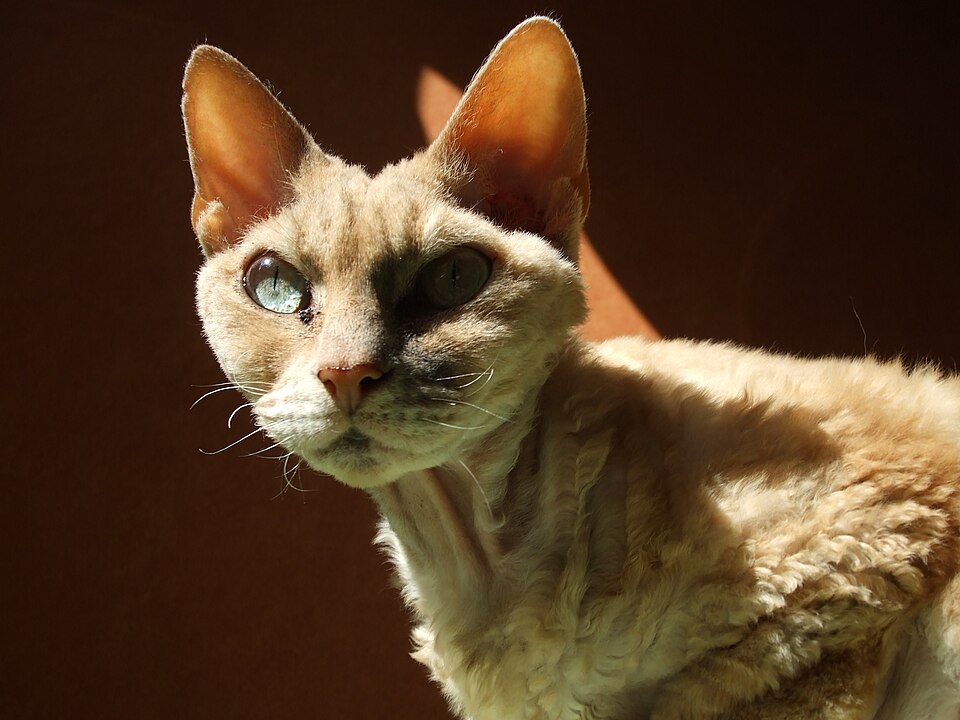
With its huge ears, big eyes and short wavy coat, the Devon Rex is an elfin-faced, people-loving and playful cat. It sheds little and is easy to groom, but dislikes being alone. Blood type B is common in the breed, and an inherited condition that causes muscle weakness has a DNA test.

 Lifespan9–15 yearsrange from vet guides; no large breed study
 Weight6–9 lb (2.7–4.1 kg)males may be a bit larger
 OriginEngland (Devon)a curly kitten born in a garden in 1959
 CoatShort, wavylight shedder; can be fragile
 EnergyHighplayful and clownish
 VoiceSoft-voicedchirps and purrs; not noisy
 With kidsExcellentpatient with family games
 Blood typeType B is commonabout 30% of those tested
With its huge, low-set ears, enormous eyes and wavy coat, the Devon Rex makes people wonder at first glance whether it's really a cat. The CFA says it's virtually impossible to describe the breed without the words "elfin" or "pixie." Its personality is as striking as its looks: playful, curious and deeply attached to its people. On this page we've pulled together its temperament, care needs and health issues from breed registries, animal welfare resources and scientific studies.
- Temperament: Playful, curious and people-loving; it follows you around the house and loves visitors.
- Easy care: Its short, wavy coat sheds little; gentle grooming now and then and an occasional bath are enough.
- Hates being alone: It doesn't enjoy long hours by itself; having someone home or a second cat helps.
- Type B blood is common: This matters for breeding and transfusions, so know your cat's blood type.
- Health: An inherited condition causing muscle weakness (congenital myasthenic syndrome) has been reported; a DNA test exists.
What to know
 What is the Devon Rex like?
In the CFA's words, the Devon Rex is part court jester, part soulmate. It's smart, learns its name, follows you everywhere in the house and often snuggles up next to you in bed. It wants to "help" with everything you do, so don't be surprised if it follows you into the bathroom or the shower. Vet-reviewed sources describe a cat that picks up tricks easily with reward-based training and turns any household object into a toy.
It's talkative but not noisy: its voice is mostly soft chirps, trills and purrs. Every guest is a potential new friend. According to the CFA, it readily accepts dogs and other animals as playmates and gets along very well with children.
There's another side to that devotion: the Devon Rex bonds deeply with its people and dislikes being left alone for long periods. The CFA recommends the breed for people who are comfortable being owned by a cat rather than the other way around.
Every cat is an individual. Breed traits describe general tendencies; how a cat was raised, how much contact it had with people as a kitten and its health shape its personality as much as its breed.
 Who is it a good fit for?
The Devon Rex suits busy, lively households where someone spends time at home and enjoys playing with the cat and having it close. It's easy to groom because it sheds little, but it needs a lot of attention.
| Situation | Good fit? |
|---|---|
| Apartment | Excellent; adapts well to indoor life |
| Family with kids | Excellent; patient with games |
| Other cats and dogs | Usually gets along very well |
| Long hours alone | Hard; it needs attention and company |
| People with cat allergies | No guarantee; sheds little but isn't hypoallergenic |
| First-time cat owners | Good; easy to groom and easygoing |
As with any breed, teach children not to grab the cat and to leave it alone while it rests. If nobody is home for long hours, consider a second cat.
Where does it come from?
According to the CFA, in 1959 a curly-coated male kitten turned up in a litter born in a garden in Devon, England. Beryl Cox adopted him and named him Kirlee. At first, Kirlee was thought to carry the same coat change as the Cornish Rex, which had appeared nine years earlier in neighboring Cornwall, but test breedings showed it was an entirely different genetic change. Kirlee was bred to his own offspring to produce more wavy-coated kittens, and the line was later broadened with other breeds over the years. The CFA notes that this is why the Devon Rex now comes in one of the widest varieties of colors and patterns of any breed.
We now know that the Devon Rex's wavy coat comes from a change in a gene called KRT71. According to a 2022 study of more than 11,000 cats, the Sphynx's hairlessness comes from a different change in the same gene, so the link between the two breeds is genetic as well as historical.
 Appearance and colors
A small-to-medium cat that is surprisingly heavy and muscular for its looks. According to the CFA, it has a broad chest and a slender neck, and often holds its front legs in a slightly bowed, "bulldog" stance. The most striking features of the head are the huge ears set low on the sides, the large eyes and the prominent cheekbones.
- Weight: According to the CFA, adults typically weigh 6–9 pounds (about 2.7–4.1 kg); males may be somewhat larger.
- Coat: Short, soft and loosely waved. Unlike the Cornish Rex, it has some very sparse, short guard hairs. Density and length vary from cat to cat, and because the coat can be fragile, there may be thin or suede-like patches.
- Whiskers and eyebrows: These are curly too, and fragile; they can break off into short stubs.
- Colors: Almost any color and pattern is possible: black, brown, white, tortoiseshell, calico, tabby and more.
Daily care
According to the CFA, the Devon Rex is an easy-care, "wash-and-wear" cat that sheds less than most. A few things still need attention.
- Grooming: It sheds little, but it does shed; the coat is fragile, so keep grooming gentle and brief.
- Baths: With few guard hairs, its skin can look greasy. PetMD suggests an occasional bath with a cat-safe shampoo but warns that bathing too often can break the curls; talk to your vet about how often.
- Skin and ears: In a 2008 study, yeast (Malassezia) was found on 90% of healthy Devon Rex, and the breed was described as prone to greasy, yeast-related skin inflammation. If you notice dark wax, odor or itching in the ears, show your vet.
- Play and enrichment: A smart, playful cat; wand toys, fetch and short reward-based training sessions keep it happy.
- Warmth: It seeks out warm laps and beds; a cozy, warm resting spot is a good idea.
For more ideas, see our articles on cat grooming and playing with an indoor cat.
 Diet and weight
The Devon Rex doesn't need a special food; a complete, balanced cat food suited to its age is enough. The CFA notes that the breed has a hearty appetite and that some show interest in unusual foods. That makes measured feeding important.
- Decide the daily amount with your vet based on your cat's ideal weight, and measure it.
- Avoid feeding from the table; count treats as part of the daily food.
- Serving part of the food in puzzle feeders keeps it busy and slows fast eaters down.
- Weighing your cat once a month shows changes early.
 Health issues to know about
Because the breed was broadened with various other breeds, you might expect few inherited problems in the Devon Rex, but some are well known. The information below is for awareness only; ask your vet about diagnosis and treatment.
Hereditary myopathy (congenital myasthenic syndrome)
An inherited muscle weakness caused by a fault in how signals pass from nerve to muscle. According to Science for Animal Welfare (formerly UFAW), signs start between 3 and 23 weeks of age and usually stabilize at around 9 months: the cat struggles to lift its head, tires quickly, walks with high-stepping front legs, and weakness gets worse with excitement or stress. Some cats have trouble swallowing and are at risk of choking. The disease is inherited recessively and is linked to a change in the COLQ gene; a 2015 study by Gandolfi and colleagues estimated the frequency of this change in Devon Rex at about 2%. A DNA test exists, and Science for Animal Welfare recommends testing every cat that may be bred from.
Type B blood and kitten loss
Cats have A, B and AB blood types, and they are born with antibodies against the other type. In the large 2022 DNA study, 30% of the 446 Devon Rex tested had type B blood. The CFA warns that when a type A male is bred to a type B female, the kittens can die from incompatibility unless they are hand-raised at first. Blood type also matters for choosing the right donor if a transfusion is needed, so ask your vet about your cat's blood type and keep it on record.
Congenital deafness in white cats
In a 2024 study of 40 white Devon Rex, 10% of the cats were born deaf; deafness in one ear and in both ears was equally common. If you're getting a white kitten, ask whether its hearing has been tested.
Other
PetMD notes that kneecap dislocation (patellar luxation) and the heart disease HCM can also occur in the breed.
- Trouble lifting the head, tiring quickly, trembling or collapsing
- Coughing, gagging or trouble swallowing while eating
- Fast or open-mouth breathing
- Limping or holding a leg up while walking
- Red or greasy skin, or odor or itching in the ears
How long does it live?
We couldn't find large lifespan data for the Devon Rex like the UK VetCompass studies. Vet-reviewed sources give an average lifespan range of 9–15 years for the breed. That's a general range, not a precise average; well-cared-for cats at a healthy weight that see the vet regularly can reach the top of that range or go beyond it.
The most concrete ways to extend lifespan are the same for every cat: spaying or neutering, a healthy weight, a safe indoor life, a vet checkup at least once a year and dental care.
 Before you get one
- Consider a shelter: Purebred cats end up in shelters and rescues too. The CFA notes that retired adult Devon Rex are sometimes available and may cost less than kittens.
- Allergies: According to the CFA, the Devon Rex sheds less than most cats and may be well tolerated by some people who are sensitive to cats, but it is not hypoallergenic. If you have allergies, spend time with the breed before deciding.
- Ask the breeder: Request the parents' hereditary myopathy DNA tests and blood types. For white kittens, ask about hearing.
- Be patient: The CFA notes that finding a kitten from a reputable breeder can take time; avoid sellers who rush you, won't show you the mother or can't provide paperwork.
- Registration: Rules vary by country; many places require or recommend microchipping. In Türkiye, owned cats must be microchipped and registered in the PETVET system. See our PETVET and microchip guide for details.
- The first days: Prepare a quiet room with a litter box, water and a place to hide while it settles in. Our guide to the first week with a new cat walks you through it step by step.
Frequently asked questions
Is the Devon Rex hypoallergenic?
No. The CFA says the Devon Rex sheds less than most cats and may be well tolerated by some sensitive people, but that, contrary to popular belief, it is not hypoallergenic. The substances that cause allergies are also found in the skin and saliva.
Do Devon Rex shed?
Yes, but less than most cats. Because the coat is short and wavy, you'll find less hair around the house. The coat is fragile, so avoid stiff brushes.
Is the Devon Rex the same as the Cornish Rex?
No. Both appeared in England, close together in place and time, but different genes shape their coats. The Devon Rex has sparse guard hairs and looser waves, while the Cornish Rex has no guard hairs at all. See our Cornish Rex page for details.
Why does blood type matter so much?
About a third of Devon Rex have type B blood. If a transfusion is needed, the wrong type can cause a serious reaction; in breeding, a mismatch between mother and kittens can mean losing the kittens in their first days. It's a good idea to find out your cat's blood type when you adopt.
Can a Devon Rex be left home alone?
For short periods, yes, but it doesn't like long hours on its own. If you're out all day, a second cat or someone who visits daily will make it happier.
Sources
- CFA (Cat Fanciers' Association) · Devon Rex breed profile and standard
- Science for Animal Welfare (formerly UFAW) · Genetic welfare problems: Devon Rex, hereditary myopathy
- Gandolfi et al. · COLQ variant associated with Devon Rex and Sphynx feline hereditary myopathy, Animal Genetics (2015)
- Abitbol et al. · A COLQ missense mutation in Sphynx and Devon Rex cats with congenital myasthenic syndrome, PLOS ONE (2015)
- Anderson et al. · Genetic epidemiology of blood type, disease and trait variants in over 11,000 domestic cats, PLOS Genetics (2022)
- Bond et al. · Carriage of Malassezia spp. yeasts in Cornish Rex, Devon Rex and domestic short-haired cats, Veterinary Dermatology (2008)
- Kortas et al. · Sensorineural deafness in purebred white Devon Rex cats, Journal of Veterinary Internal Medicine (2024)
- PetMD (vet-reviewed) · Devon Rex cat breed
By Tüylüm · Last checked: November 3, 2026. Compiled from the sources above and written in our own words. Spotted a mistake? Write to [email protected] and we'll fix it right away. Photo from Wikimedia Commons, used under the license shown below it.