 Tüylüm
Cornish Rex
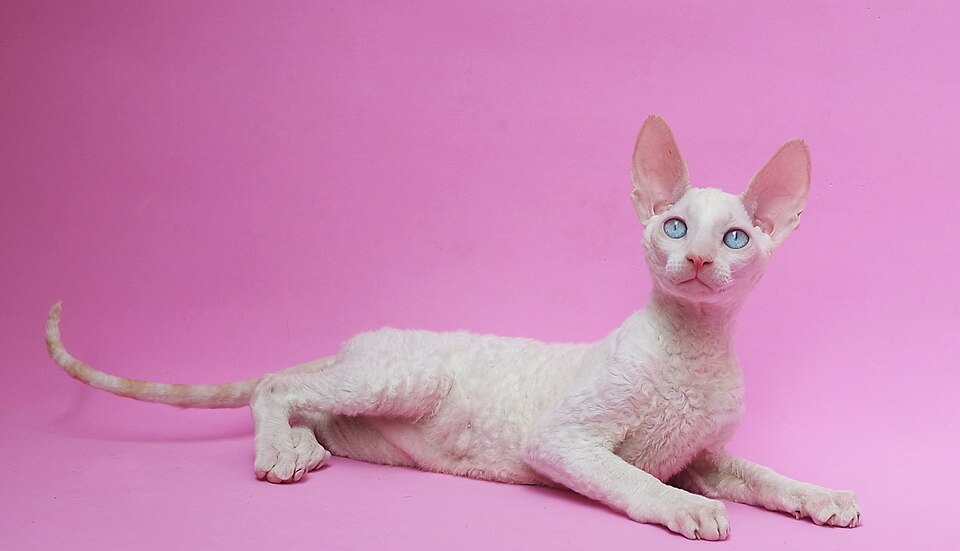
Slim, with an arched back and a very soft coat of tight waves, the Cornish Rex is called the "greyhound of the cat world." A highly active cat that sticks close to its people, it sheds little, but with no guard hairs it is sensitive to cold and sun. Type B blood is common in the breed.

 Lifespan11–15 yearsrange from vet guides; no large breed study
 Weight6–10 lb (2.7–4.5 kg)slim but heavy for its size
 OriginEngland (Cornwall)a curly kitten born on a farm in 1950
 CoatShort, curlyno guard hairs; very soft
 EnergyVery highstays playful as it ages
 SheddingLightbut not hypoallergenic
 With kidsGoodits antics amuse children
 Blood typeType B is commonabout a third of those tested
In the CFA's words, the Cornish Rex combines the racy elegance of a greyhound with the playful personality of a clown, then dresses it up in curls. With its arched back, egg-shaped head, large high-set ears and a wavy coat that feels like cashmere, it can't be mistaken for any other breed. On this page we've pulled together its temperament, care needs and health issues from breed registries, veterinary sources and scientific studies.
- Temperament: Very active, clownish and glued to its people; its free time goes to play or to your lap.
- Easy but different care: Combing is rarely needed; ear cleaning and the occasional bath matter more.
- Delicate coat: With no guard hairs, it gets cold easily and can get sunburned.
- Type B blood is common: About a third of the cats tested have type B; this matters for breeding and transfusions.
- Health: The CFA describes a sturdy breed with no known inherited problems, but a variant linked to a form of blindness (PRA) is common in the breed.
What to know
 What is the Cornish Rex like?
The Cornish Rex is smart, adaptable, adventurous and full of energy. According to the CFA, it is devoted to its people, and its need to stay in physical contact with its favorite person has earned it the nickname "Velcro kitty." When it isn't seeking attention, showing affection or playing, it's probably looking for food.
It keeps its energy well into old age. According to vet-reviewed sources, its powerful hind legs make it an impressive jumper that scales furniture with ease, and it can learn to open cabinets and drawers. It can entertain itself, but its real joy is playing with you: fetch and wand-toy games are classics.
It will make conversation, but it isn't given to unnecessary or loud yowling. It's an outgoing cat that runs to greet visitors when the doorbell rings and readily makes friends with dogs. After play, it looks for a warm lap or a spot under the covers.
Every cat is an individual. Breed traits describe general tendencies; how a cat was raised, how much contact it had with people as a kitten and its health shape its personality as much as its breed.
 Who is it a good fit for?
The Cornish Rex suits lively, active homes and people who love playing with their cat every day and are ready to include it in everything they do. If you want a calm, independent cat, this breed may wear you out.
| Situation | Good fit? |
|---|---|
| Apartment | Good; tall climbing spaces are a must |
| Family with kids | Good; its antics amuse children |
| Other cats and dogs | Usually gets along; enjoys playing with dogs |
| Long hours alone | Hard; it needs attention and play |
| Home full of breakables | Careful; curious and a big jumper |
| First-time cat owners | Possible, but be ready for its energy |
The CFA notes that owning a Cornish Rex means thoroughly child-proofing your home and keeping fragile things behind closed doors. The co-founder of a Cornish Rex rescue told PetMD that some Cornish thrive as the only pet of a single person while others need busy households with several people and pets, so it pays to talk openly about your lifestyle with the breeder or rescue.
Where does it come from?
According to the CFA, the breed's curly coat appeared spontaneously in 1950 in a kitten from a litter of barn cats on Nina Ennismore's farm in Cornwall, England. The cream-colored male was named Kallibunker. After consulting her vet and a geneticist, Ennismore bred Kallibunker back to his mother and got two more curly kittens. Having raised Rex rabbits, she gave the new breed the same name.
Crosses with Burmese, Siamese and British Shorthairs showed that the coat trait is recessive and broadened the breed's gene pool. In 1956, a California breeder bought a pair and took the breed to the United States; the CFA accepted the Cornish Rex for registration in 1962 and granted it championship status two years later.
The genetic cause of the curl was found in 2013: Gandolfi and colleagues showed that a small deletion in a gene called LPAR6 is present in every Cornish Rex and absent in straight-coated cats. The same change is also found in the German Rex.
 Appearance and colors
A slim, long and elegant cat with an arched back, an egg-shaped head, large high-set ears, huge eyes and a prominent "Roman nose." According to the CFA, despite its looks it is surprisingly heavy for its size and feels warm to the touch.
- Weight: According to PetMD, 6–10 pounds (about 2.7–4.5 kg).
- Coat: Short, close-lying and covered with tight "marcel waves." Most cats have three layers of hair, but the Cornish Rex has only the fine, soft undercoat and no guard hairs at all. The CFA standard gives 40 points to the coat alone: besides the curl, it looks for density and softness.
- Colors: The CFA standard accepts a very wide range: solid colors such as white, black, blue, cream, chocolate and lavender, silver and smoke shades, tabby patterns, tortoiseshell, calico, bicolor and pointed cats.
Daily care
Because of its coat, caring for a Cornish Rex is a bit different from other cats. According to the CFA, regular combing isn't needed, but a few things matter.
- Ears: The CFA notes that wax can build up in the ears faster than in other breeds and that they should be cleaned often. Clean them the way your vet shows you, without pushing anything into the ear canal.
- Baths: Some Cornish get greasy over time and need an occasional bath. According to PetMD, needs vary a lot: some are bathed every week or two, others almost never. Towel-dry thoroughly afterward; the CFA warns that a blow dryer will ruin the curls.
- Cold: With no guard hairs, it gets chilly easily. The CFA suggests a sweater in cold weather; a warm bed and blankets help too.
- Sun: Its coat may not protect it enough from the sun, and the CFA reminds owners that cats can get sunburned. Don't let it spend long periods in direct sunlight.
- Eyes: Dirt can collect around the eyes; wipe gently with a soft damp cloth and show your vet any redness or colored discharge.
- Play and space: One or two long play sessions a day, plus tall cat trees and shelves, are a must for this breed.
For ideas, see our articles on cats and high places, playing with an indoor cat and a cat-safe home.
 Diet and weight
The Cornish Rex doesn't need a special food; a complete, balanced cat food suited to its age is enough. The CFA notes that, despite its slim build, the breed has an enormous appetite and will go after foods most cats ignore. That makes measured feeding, and keeping food out of reach, important.
- Decide the daily amount with your vet based on your cat's age, activity and ideal weight.
- Serve several small meals rather than leaving food out all day.
- Smart and dexterous, it enjoys food puzzles.
- It can open kitchen cabinets; keep human food and trash secured.
 Health issues to know about
The CFA describes the Cornish Rex as a sturdy, vigorous breed with no known inherited health issues. Still, a few things are worth knowing. The information below is for awareness only; ask your vet about diagnosis and treatment.
Progressive retinal atrophy (rdAc-PRA)
An inherited eye disease in which the retina slowly degenerates; it starts late and can progress to blindness. It was first described in Abyssinian and Somali cats, and a 2010 study by Menotti-Raymond and colleagues showed that the responsible variant is widespread across many breeds. In a 2022 study of more than 11,000 cats, the variant was found in 31 of the 106 Cornish Rex tested. Cats with one copy don't get sick; the disease appears in cats with two copies. According to PetMD, the first sign is often trouble seeing at night. A DNA test exists, so ask the breeder for the parents' results.
Type B blood
In the same 2022 study, 33% of the Cornish Rex tested had type B blood. Because cats are born with antibodies against the other blood type, this matters for choosing the right donor if a transfusion is needed and for breeding. Ask your vet about your cat's blood type and keep it on record.
Heart disease (HCM)
PetMD notes that HCM, in which the heart muscle thickens, can also occur in this breed. Many cats show no signs for a long time; according to the Cornell Feline Health Center, the disease is detected with a heart ultrasound (echocardiography).
Skin
In a 2008 study, the amount of yeast (Malassezia) on the skin of healthy Cornish Rex was similar to that of ordinary shorthaired cats, while the similar-looking Devon Rex carried noticeably more. Still, show your vet any greasiness, redness or itching on the skin.
- Trouble finding its way in the dark, bumping into things
- Fast or open-mouth breathing, sudden weakness in the hind legs
- Ear odor, dark discharge or frequent head shaking
- Sunburn, redness or crusting on the skin
How long does it live?
We couldn't find large lifespan data for the Cornish Rex like the UK VetCompass studies. Vet-reviewed sources give a lifespan range of 11–15 years for the breed. That's a general range, not a precise average; well-cared-for cats at a healthy weight that see the vet regularly can go beyond it.
The most concrete ways to extend lifespan are the same for every cat: spaying or neutering, a healthy weight, a safe indoor life, a vet checkup at least once a year and dental care.
 Before you get one
- Consider a shelter: Purebred cats end up in shelters and rescues too; some countries even have rescues dedicated to the Cornish Rex. Follow breed groups and adoption listings.
- Allergies: Light shedding doesn't prevent allergies. PetMD points out that allergy-causing substances are also in the skin and saliva, and no cat is truly allergy-free. If you have allergies, spend time with the breed before deciding.
- Ask the breeder: Request the parents' PRA (rdAc) DNA tests and blood types.
- Red flags: Steer clear of sellers who won't show you the mother, always have kittens available, can't provide paperwork or rush you.
- Registration: Rules vary by country; many places require or recommend microchipping. In Türkiye, owned cats must be microchipped and registered in the PETVET system. See our PETVET and microchip guide for details.
Frequently asked questions
Do Cornish Rex shed?
Very little. With no guard hairs and only a fine undercoat, you'll find much less hair around the house. Regular combing usually isn't needed.
Is the Cornish Rex hypoallergenic?
No. Light shedding may make life easier for some people with mild allergies, but allergy-causing substances are also found in the skin and saliva. No cat is completely allergy-free.
Why do some wear sweaters?
With no guard hairs, the coat doesn't protect well against cold. The CFA suggests a sweater in cold weather. Introduce it gradually with rewards; if your cat is uncomfortable, don't force it and offer a warm bed instead.
What's the difference between the Cornish Rex and the Devon Rex?
Both appeared in England, not far from each other, but they come from different genes. The Cornish Rex has no guard hairs at all, tight, even waves and a slim, arched body. The Devon Rex has sparse guard hairs, looser waves and lower-set ears. See our Devon Rex page for details.
Can a Cornish Rex be left home alone?
For short periods, yes, but as a very social and active cat, long hours alone are hard on it. Toys, climbing space and, ideally, a companion help.
Sources
- CFA (Cat Fanciers' Association) · Cornish Rex breed profile and standard
- Gandolfi et al. · To the root of the curl: a signature of a recent selective sweep identifies a mutation that defines the Cornish Rex cat breed, PLOS ONE (2013)
- Anderson et al. · Genetic epidemiology of blood type, disease and trait variants in over 11,000 domestic cats, PLOS Genetics (2022)
- Menotti-Raymond et al. · Widespread retinal degenerative disease mutation (rdAc) discovered among a large number of popular cat breeds, The Veterinary Journal (2010)
- Bond et al. · Carriage of Malassezia spp. yeasts in Cornish Rex, Devon Rex and domestic short-haired cats, Veterinary Dermatology (2008)
- Cornell Feline Health Center · Hypertrophic cardiomyopathy
- PetMD (vet-reviewed) · Cornish Rex cat breed
By Tüylüm · Last checked: November 3, 2026. Compiled from the sources above and written in our own words. Spotted a mistake? Write to [email protected] and we'll fix it right away. Photo from Wikimedia Commons, used under the license shown below it.