Fascinating axolotl facts: the salamander that never grows up and a body that repairs itself
Most salamanders go through a metamorphosis as they grow up, leaving their larval gills and tail fin behind. The axolotl, on the other hand, seems to have chosen to stop halfway through that story. It keeps its gills and tail fin all its life, lives in the water, and grows up and breeds in this form. On top of that, it can rebuild a lost leg, and even part of its spinal cord. That's why scientists are so interested in the axolotl. Below, we've gathered the most fascinating facts about the axolotl, based on reliable scientific sources.
- The salamander that never grows up: The axolotl keeps its larval features all its life, yet it still grows and breeds (RVC).
- A body that repairs itself: It can rebuild its legs, its spinal cord and parts of its brain and heart without leaving a scar (MBL).
- An animal from a single place: In the wild it lives only in Mexico, in the Xochimilco area.
- Critically endangered: On the IUCN Red List it's Critically Endangered; the number of adults in the wild is estimated at between 50 and 1,000.
- A rainbow of colors: Besides its natural dark, speckled coloring, there are white, albino and golden yellow axolotls too.
A salamander that never "grows up"
According to the RVC, the axolotl shows a condition called neoteny: normal metamorphosis doesn't happen, and the animal keeps its larval form. In other words, it doesn't lose its gills or its tail fin, and some features that come with metamorphosis in other salamanders, such as bulging eyes, never develop.
The interesting part is that, in this "childlike" form, the axolotl is much larger than most salamander larvae and can breed. According to the RVC, axolotls can, rarely, go through metamorphosis on their own; but that's the exception, not the rule.
Gills you can see from the outside
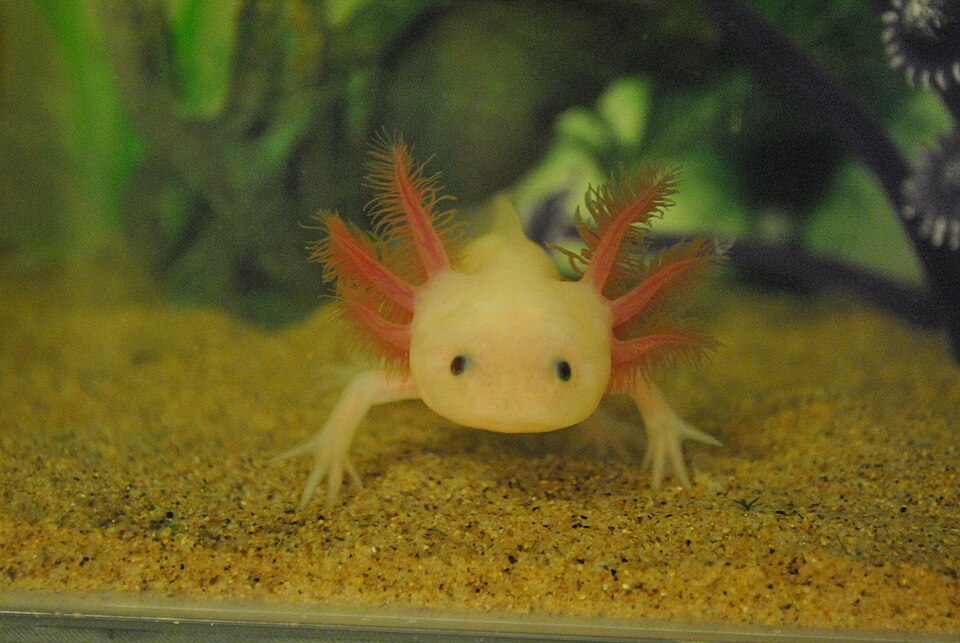
The pink or dark branches that fan out like feathers on either side of the axolotl's head are its gills. According to the RVC, although the axolotl has simple lungs, it breathes mainly through its gills and, to a lesser extent, through its skin.
Having its gills on the outside makes the axolotl look very cute, but it also ties it to the water. That's why water quality matters more than anything when you keep an axolotl at home. More detail: axolotl care.
A body that repairs itself: regeneration
The trait that made the axolotl world-famous is regeneration, its ability to rebuild body parts it has lost. According to the Marine Biological Laboratory (MBL), the axolotl can rebuild many body parts, including its legs, spinal cord and parts of its brain and heart, so that they work again. What's more, it does this without forming scar tissue.
- Why does this matter so much? According to the RVC, the axolotl's extraordinary ability to regenerate and its large, robust embryos have made it an animal widely used in laboratory research.
- What's being studied? Researchers at MBL are studying how axolotl cells respond to injuries to the spinal cord, legs and skin, and how this differs from healing in humans.
- It continues with age: According to a review published in the journal Gerontology, aging reduces the ability to regenerate in most living things, but the axolotl largely keeps this ability throughout its life. According to the same review, age-related diseases are also rare in axolotls.
Regeneration doesn't mean the axolotl doesn't feel pain or that an injury isn't a problem. According to the RVC, the axolotl's skin is sensitive to injury. If you see a wound on your axolotl, damage to its gills or a problem with a leg, call your vet.
Its home in the wild: Xochimilco
According to MBL, in the wild the axolotl is native to a single lake: Lake Xochimilco in Mexico. The IUCN Red List also shows the species' natural range as limited to the area around Mexico's capital, and gives the number of locations where it lives as 3.
Xochimilco isn't an ordinary lake. According to UNESCO, Xochimilco, 28 km south of Mexico City, with its network of canals and artificial islands, bears witness to the Aztec people's efforts to build a place to live in a harsh environment. According to UNESCO, this lake landscape is the only surviving example of traditional pre-Hispanic land use in the lagoons of the Basin of Mexico. These canals, now on the World Heritage List, are also the axolotl's last home.
Critically endangered
According to the IUCN Red List's 2019 assessment, the axolotl is Critically Endangered. According to the same assessment:
| Topic | IUCN data |
|---|---|
| Population trend | Decreasing |
| Number of adults in the wild | 50–1,000 |
| Population status | Severely fragmented |
| Habitat | Its area and quality are continuing to decline |
The threats IUCN lists include housing and urban development, tourism and recreation areas, hunting and collecting, invasive non-native species and diseases, and pollution. Under pollution, it lists domestic and urban wastewater, industrial and agricultural waste, and solid waste.
Axolotls are kept in homes and, according to the RVC, are also widely used in laboratory research; but that doesn't mean the wild population is safe. Never release a pet axolotl, or any pet amphibian, into the wild; we explain why in our article on frogs in your garden and in the wild.
A rainbow of axolotls
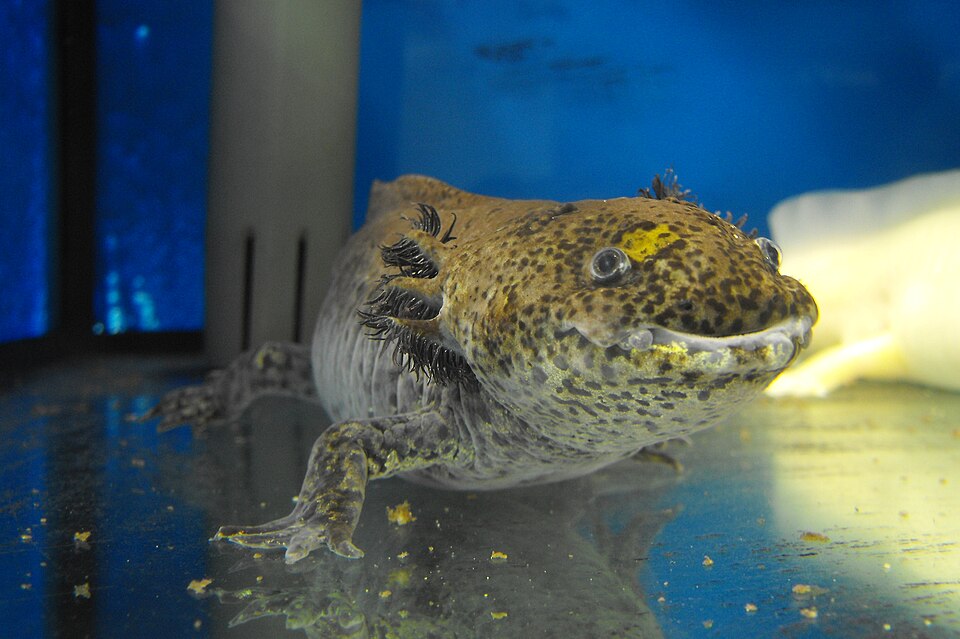
According to the RVC, axolotls are almost transparent in the first weeks of life and can then take on very different colors. According to the descriptions of the Ambystoma Genetic Stock Center (an axolotl genetics center) at the University of Kentucky, the best-known colors are:
| Color | What it looks like |
|---|---|
| Natural color (wild type) | Very dark, with yellowish or greenish speckles |
| White | White, with black eyes and pinkish skin |
| Albino | No pigment |
| Golden albino | Yellow; it looks yellow because it has no black pigment |
| White albino | Similar to a white axolotl, but its eyes are pinkish instead of black |
So a white axolotl with pink gills and a dark, speckled, naturally colored axolotl are members of the same species; according to the genetics center's table, the difference comes from color genes.
From a tiny egg to a long life
According to the RVC, an axolotl starts out as a tiny egg about 2 mm across, surrounded by jelly. It hatches as a larva, and its legs slowly develop over the following weeks. It reaches adult size at 18–24 months; its average length is 25–30 cm.
It also lives a long time: according to the RVC, axolotls usually live 10–12 years, and some have lived beyond 20. According to the RVC, the axolotl has small, cone-shaped teeth it uses to guide food into its mouth, and its body temperature changes along with the temperature of the water around it. That's why it's vital for the water to stay cool and steady.
If you're thinking about living with an axolotl, take a look at our articles on axolotl care and water quality for amphibians first. Other articles: Amphibians.
Frequently asked questions
Can an axolotl really regrow a lost leg?
Yes. According to MBL, the axolotl can rebuild its legs, its spinal cord and parts of its brain and heart without leaving a scar. But that doesn't mean an injury is unimportant; if your axolotl is injured, talk to your vet.
Does an axolotl ever come out onto land like a frog?
Normally, no. According to the RVC, the axolotl doesn't go through metamorphosis; it stays in its larval form and lives in the water. Rarely, some go through metamorphosis on their own; if you notice a change like this, talk to a vet.
How many axolotls are left in the wild?
According to the IUCN Red List's 2019 assessment, the number of adult axolotls in the wild is estimated at between 50 and 1,000, and the population is decreasing.

Keep track of your pet's care in TüylümLog vet visits, vaccine and medication dates, and we'll remind you when it's time. Share it all with your family in Home.
Sources
- IUCN Red List · Ambystoma mexicanum (Axolotl), 2019 assessment
- Royal Veterinary College (RVC) · Axolotl care (care sheet, PDF, December 2024)
- Marine Biological Laboratory (MBL) · Axolotl (research organism)
- Vieira, Wells and McCusker · Advancements to the Axolotl Model for Regeneration and Aging (Gerontology, 2020, abstract)
- University of Kentucky, Ambystoma Genetic Stock Center · Axolotl strains
- UNESCO World Heritage · Historic Centre of Mexico City and Xochimilco
By Tüylüm · Published and last checked: October 24, 2026. Spotted a mistake? Write to [email protected] and we'll fix it right away. Photos are from Wikimedia Commons, used under the license shown below each photo.