A dig box and tunnels for your ferret: setting up a safe play corner at home
If your ferret digs at the corner of the carpet, scatters the soil from your potted plants or carries your socks under the couch, you're not alone. According to the PDSA, ferrets love to dig. Because they're intelligent, playful animals, they need lots of places to hide, tunnel, dig and explore. You can give that instinct a safe outlet at home. In this article, we explain how to set up a play corner at home with a few plastic boxes and pipes. For ferret play language and play biting, see: ferret sleep and play.
- Digging is natural: According to the PDSA, ferrets love to dig. According to the RSPCA, they can become bored and irritable in an environment that lacks stimulation.
- A high-sided box is enough: A large storage box filled with dry rice, soil, plastic balls or crumpled paper (PDSA, AFA, RSPCA Australia).
- Tunnels: Pipes, flexible tubing, cardboard tubes; wide enough that your ferret can't get stuck inside (RSPCA, AFA).
- No rubber: No rubber toys and no rubber balls. Cotton and natural-fiber items can be swallowed too (RSPCA, AFA, RSPCA Australia).
- Rotate and check: Swap toys often and throw out worn ones. Stay with your ferret while it plays (AFA).
Why does it dig so much?
According to the RSPCA's ferret care guide, ferrets are highly motivated to explore tunnels and burrows. The same guide also gives an important warning: ferrets whose surroundings lack stimulation, or whose room to exercise is limited, can become irritable, nervous or bored. Some develop abnormal behaviors such as running the same route over and over.
The urge to dig sometimes ends up in the wrong corners of your home:
- Carpet corners: According to the AFA, scratching is a favorite pastime for many ferrets, especially on carpet in corners or near doorways. The AFA suggests taping down a plastic carpet runner or attaching a carpet remnant in those spots.
- Potted plants: According to the AFA, houseplant soil is a digging opportunity for ferrets too. But your ferret may be exposed to fertilizer and chemicals there. For houseplants, see: ferret-proofing your home.
- Litter box: For a ferret that digs in its litter box, a separate dig box is a good solution. The details are in ferret smell and cleaning.
According to the AFA, a dig box filled with soil can even help curb a ferret's destructive digging of the carpet.
A dig box, step by step
The AFA's play and exercise guide includes a simple recipe for a "dirt dig box." You can set up the same box with rice or another filling, too.
- Pick the box: A large plastic tub or bin. According to the AFA, its sides should be high enough to keep the filling from spilling out during play. The PDSA also suggests a large storage box.
- Add the filling: If you use soil, the AFA recommends soil that hasn't been sprayed or treated with any chemicals. The depth the AFA suggests is about 30 cm (1 foot).
- Add a tunnel if you like: You can fit pipes or tunnels into the sides of the box. The AFA suggests sealing the gaps around the pipe so the soil doesn't spill out.
- Stay with your ferret: According to the AFA, always supervise ferrets while they play in the dirt.
- If it's used as a toilet: According to the AFA, scoop out the dirty part and add fresh soil.
Which filling?
| Filling | What the sources say |
|---|---|
| Dry rice | It should be uncooked rice, not instant ("minute") rice (AFA). The PDSA also suggests a box full of dry rice. According to the AFA, rice also soaks up excess oil from the coat. |
| Soil | Untreated and chemical-free (AFA). RSPCA Australia also lists a large plant pot or a litter tray filled with earth. |
| Plastic balls | Small plastic balls, not rubber. You can bury treats among the balls (AFA). RSPCA Australia lists plastic balls too. |
| Paper | Crumpled paper balls, or a cardboard box filled with shredded paper (RSPCA Australia). |
| Sand and hay | Child-safe sand or hay (RSPCA Australia). |
| Snow | Clean snow works in winter. The details are in ferrets in cold weather. |
The AFA suggests keeping an eye on ferrets that might try to eat the rice. According to the experiences in its guide, people who use this activity haven't come across a ferret interested in eating the rice; still, stay close during the first few days.
- Toilet paper game: The AFA suggests putting whole packages of unscented toilet paper in a large plastic tub, slitting the plastic wrap in a T shape, and leaving it to your ferret to get the rolls out. Watch your ferret while it's around the plastic.
- Buried treats: Bury a few treats in the ball pit or the rice (AFA). According to RSPCA Australia, these treats should come out of your ferret's normal daily food allowance, not be extra.
- A surprise in the box: According to the AFA, adding a few toys to the box keeps things interesting.
Tunnels and mazes
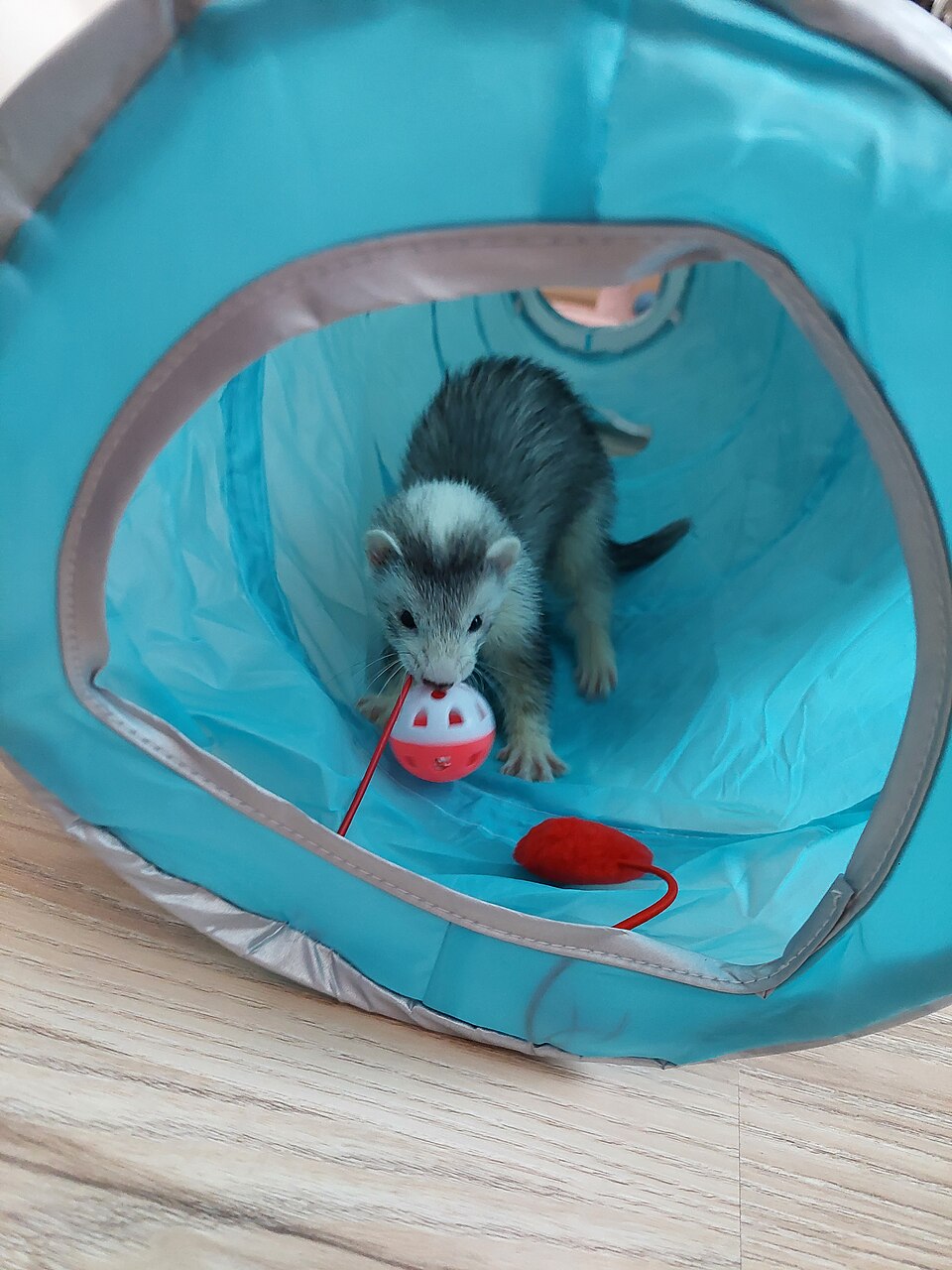
According to the RSPCA, a ferret's space should include cardboard tubes, paper bags and lengths of drainpipe. Choose pipes wide enough that your ferret can't get trapped inside. These tunnels also become refuges where a ferret can get away from another ferret when it wants to.
- Ready-made materials: The AFA suggests PVC pipe, dryer vent tubing (preferably the clear kind) or letting them run under a big rug. RSPCA Australia lists plastic and fabric tunnels, and cardboard or wide ceramic pipes.
- A treat at the exit: According to the AFA, if you put a little treat at the exit end of the tunnel, your ferret will sprint through it. You can also put a jingle ball inside the tunnel.
- Watch the bends: According to the AFA, larger ferrets can get stuck inside a tube, especially where it bends; the inner width tends to be narrower at the bend. Watch play closely.
- Mazes: RSPCA Australia suggests building mazes of boxes and tunnels around and under furniture, and multilevel tunnels with flexible tubing.
- Cardboard boxes and paper bags: According to the AFA, a favorite of ferrets of all ages. First make sure there are no sharp staples, sticky packing tape or Styrofoam peanuts. RSPCA Australia suggests removing the handles from paper bags.
Choosing safe toys
The AFA recommends toys that have no chance of breaking and becoming a chewing or choking hazard: balls with bells inside, plush toys with squeakers and hard plastic balls. According to the RSPCA, ferrets also like to chew, chase and drag toys such as wooden cotton reels. If you're not sure whether a toy is safe, follow the AFA's advice: only give it during playtime when you can supervise.
- Rubber: According to the RSPCA, ferrets should never be given rubber toys; pieces that are chewed and swallowed can cause intestinal blockages. According to the AFA, any object made of rubber is a definite no-no.
- Cotton and natural fibers: According to RSPCA Australia, ferrets often eat these, and they can lead to blockages. Synthetic items should be sturdy and large enough that they can't be swallowed.
- String: According to the AFA, don't hang toys from the top of the cage on string; ferrets have been known to chew and swallow the string.
- Worn toys: According to the AFA, check toys and play equipment often. Throw out damaged ones and replace them.
If you suspect your ferret has swallowed a piece of something, talk to your vet without delay.
The stashing habit: check the hiding spots
Once you set up a dig corner, you'll notice one more thing: ferrets stash what they find. According to the AFA, ferrets will fish toys out of a shallow pool of water and carry them off to stash elsewhere; they may even stash ice cubes. According to the AFA's ferret-proofing guide, the items on your lowest shelf may one day turn up piled in your ferret's hidey-hole.
According to the PDSA, ferrets love hiding food too, so check for sneaky stashes. When you pick up uneaten fresh food each day, take a look in your ferret's favorite corners as well.
Keep the play corner fresh
According to the AFA, routines become dull over time and can make a ferret less eager to play. Swap toys and games often. RSPCA Australia also suggests rotating play items regularly. If you have more than one ferret, put out more than one play item; according to RSPCA Australia, this reduces item guarding and fighting.
If you have the space, the AFA also suggests a large cat tree; most ferrets love to climb up. For climbing and falling hazards, see: ferret-proofing your home.
Tüylüm's Today tab has a ready-made Play / out of cage task for ferrets. You can also add checking the toys or refreshing the dig box filling as your own tasks. With Home, everyone in your household sees the same list.
Frequently asked questions
Will my ferret eat the rice in the dig box?
According to the AFA's guide, people who use this activity haven't come across a ferret interested in eating the rice. Still, the AFA suggests keeping an eye on ferrets that might try. Use uncooked rice, not instant rice.
Will a dig box stop carpet digging?
According to the AFA, a dig box filled with soil can help curb carpet digging. In your ferret's favorite corners, you can tape down a plastic carpet runner or attach a carpet remnant, as the AFA suggests.
Are cat toys OK for ferrets?
It depends on the toy. The AFA recommends jingle balls, plush toys with squeakers and hard plastic balls. Rubber toys (RSPCA, AFA) and cotton or natural-fiber items (RSPCA Australia) aren't suitable. Only give a toy you're unsure about while you're supervising.

Keep track of your pet's care in TüylümLog vet visits, vaccine and medication dates, and we'll remind you when it's time. Share it all with your family in Home.
Sources
- American Ferret Association · Ferret Fitness and Enrichment: Be your Ferrets' Personal Trainer (PDF)
- PDSA · Ferrets as pets
- RSPCA Australia · How can I use environmental enrichment for my ferrets?
- RSPCA Research Animals Department · Ferrets: Good practice for housing and care (2011, PDF)
- American Ferret Association · Your Ferret's Cage (PDF)
- American Ferret Association · Is your home ready for these tenacious weasels? (ferret-proofing guide, PDF)
By Tüylüm · Published and last checked: October 28, 2026. Spotted a mistake? Write to [email protected] and we'll fix it right away. Photos are from Wikimedia Commons, used under the license shown below each photo.