Litter training your ferret: which box, which litter, how many, and what to do about accidents
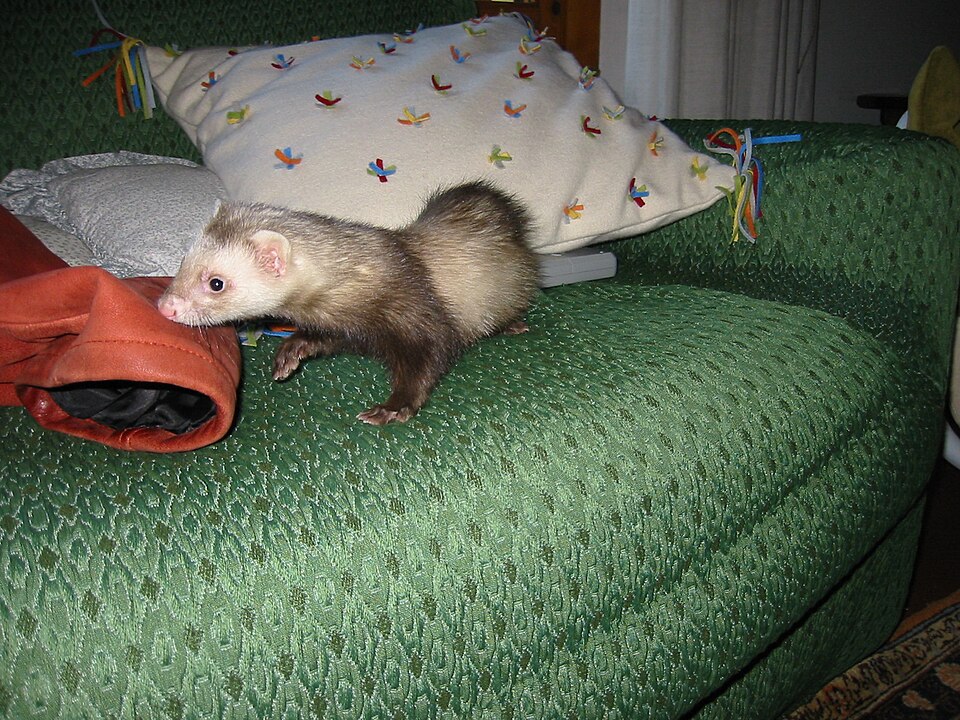
The first time you let a ferret loose, you notice right away: it's most interested in corners. According to the American Ferret Association (AFA), it's a lot like children who want to try every bathroom in a new place; ferrets want to try out every new spot. That makes litter training frustrating at times, but it can be done. Without repeating the smell and cleaning details in ferret odor and cleaning, this article looks at the box, the placement and the litter. Our sources: two AFA education documents, RSPCA Australia, PDSA, an RSPCA care guide and a veterinarian's conference paper (Teresa Bradley Bays, DVM).
- The box: Ferrets squirt soft droppings upward, so high-sided corner boxes work well. But the ferret should be able to get in and out easily.
- The spot: The corner your ferret picks itself. Put a box in every room it roams.
- Litter: Paper or wood pellets; a thin layer is enough. Clay and pine or cedar shavings are not suitable.
- Accidents: No punishment; clean thoroughly and put something else on that spot.
- Time: About a week with rewards according to RSPCA Australia; according to the AFA, patience, consistency and supervision matter most.
What should the box be like?
PDSA recommends high-sided corner trays because a ferret's soft droppings shoot upward. According to Dr. Bays' paper, ferrets back into a corner, raise the tail slightly, and don't bury their droppings. The AFA lists medium cat litter pans, high-sided square boxes and corner-shaped boxes; you may need to try several to see which your ferret prefers. You might even pick one style for the cage and another for a room.
RSPCA Australia's measurements are more concrete: the tray should be large enough for all four feet and for the ferret to turn around, and no more than 10 cm (4 in) high, since taller trays can be hard to enter. If litter gets scattered, the AFA and RSPCA Australia suggest putting puppy pads around the box.
How many boxes, and where?
The AFA says to put the box where your ferret has chosen to go. The RSPCA's care guide also suggests placing the tray in the area the ferret favors. In the cage, RSPCA Australia says to put the litter tray in one corner and food and bedding in the others, because ferrets generally avoid toileting where they eat and sleep.
- One corner in the cage: According to RSPCA Australia, litter in one corner; food and bedding in the others.
- A box in every room: According to the AFA, few ferrets go back to their cage to toilet, so boxes must be available everywhere they roam. RSPCA Australia also recommends a tray in every room where the ferret is allowed out.
- Move it to their spot: If a ferret consistently picks a particular spot, RSPCA Australia suggests moving a tray there.
- Lots of males, lots of boxes: The AFA notes that males urinate in the middle of the box while females go near the edge, so if you have many males you may want more boxes.
Know the accident spots in advance
The AFA says ferrets may mark their "territory" and go in several places, often near doorways, corners or under furniture such as beds and sofas. That can mean multiple boxes, vigilance and cleaning to remove odors. If you don't want a spot used, the AFA suggests placing bedding, blankets, toys, tubes, baskets or even furniture there so it no longer looks like a bathroom.
Which litter?
The AFA and RSPCA Australia recommend recycled paper or wood pellet litters; PDSA recommends wood pellet litter. According to the AFA, pellets are heavy enough to stay in the pan when the ferret steps out, low in dust, absorbent and easy to scoop. RSPCA Australia wants litter that is dust-free and unscented.
| Litter type | What the sources say |
|---|---|
| Paper pellets | Recommended by the AFA and RSPCA Australia; the AFA says low dust and absorbent |
| Wood pellets | Recommended by the AFA, RSPCA Australia and PDSA. The AFA says if you use wood-stove pellets, choose only hardwood pellets and read the label carefully, since some are marked "not for animal use" |
| Plant-based clumping (corn, wheat) | The AFA says clumping litters aren't recommended unless made from plant material; even those can be tasty to some ferrets and track more outside the box |
| Clay litter, clumping clay cat litter | Not recommended by the AFA and RSPCA Australia. According to the AFA it gets thick when wet and can stick to paws, nose and eyes; PDSA says a ferret may eat it |
| Pine or cedar shavings | According to the AFA and RSPCA Australia, they can irritate the respiratory tract |
| Corncob, silica, rabbit food | The AFA advises against corncob (mold, dust, risk of eating) and urges caution with silica litters and rabbit food, which isn't litter |
| Newspaper, puppy pads | The AFA says odor control is weaker but they are easy to use; it suggests a plastic mat or sheet of linoleum underneath and more frequent changes |
Since ferrets don't cover their stool like cats, the AFA says a thin layer, just enough to cover the bottom of the pan, is enough; with more, many ferrets dig it out. RSPCA Australia, on the other hand, suggests filling the tray to at least 5 cm (2 in), about half full. The two sources differ; you can choose by watching how much your ferret digs. For ferrets that dig the litter out, the AFA also suggests laying a folded sheet of newspaper over a thin layer of pellets: the newspaper catches the droppings, and the pellets soak up urine.
Step by step
- Let scent guide them: The AFA and RSPCA Australia suggest putting some droppings in the box.
- To the box on waking or after a meal: According to RSPCA Australia, ferrets usually need to go within 15 minutes of waking or eating, and roughly every 3-4 hours. The AFA also suggests a "pit stop" at the box before out-of-cage time.
- Box first, then play: RSPCA Australia says to let the ferret out to play only after it uses the box.
- Make sure they went, then reward: The AFA and RSPCA Australia note that some ferrets will pretend to go for a treat.
- Clean up accidents: RSPCA Australia suggests an enzymatic cleaner and asks you to check with your veterinarian which products are safe; the AFA wants accidents cleaned thoroughly.
- No punishment: The AFA says ferrets don't connect punishment with the act; RSPCA Australia says it can make them fearful.
- If they resist, shorten the time: Both sources suggest limiting out-of-cage time to 1-2 hours at a stretch.
RSPCA Australia says training can take about a week when supported with rewards. Once your ferret uses the box reliably, you can add an extra box in a corner of the room; when your ferret starts backing into a corner, guide it to the box. We cover the basics of reward training in reward-based training for ferrets.
How often should the box be cleaned?
Here too, the sources don't fully agree:
| Source | Advice |
|---|---|
| AFA | Clean the box daily but leave a small amount of droppings so the ferret remembers it's a toilet. With the newspaper setup, change the newspaper daily and the pellets every 5-7 days, and rinse the box |
| RSPCA Australia | Check the tray daily and scoop out waste, leaving some droppings. Replace all the litter every 2 days, or daily if several ferrets share it |
| PDSA | Clean litter trays daily |
According to the AFA, if the box isn't cleaned often enough, many ferrets will stop using it as a form of protest, and most don't like walking through soiled litter. RSPCA Australia also says ferrets may stop using a full tray. It suggests washing the tray with hot water and unscented soap.
If a ferret that used the box regularly suddenly keeps having accidents, or you notice a change in its droppings, don't write it off as a training problem; ask your veterinarian. The RSPCA recommends checking ferrets closely every day and consulting a veterinarian if behavior becomes a problem. Don't try to guess the cause.
In Tüylüm's Today tab there's a ready-made Toilet cleaning task for ferrets; everyone in My home sees the same list, so it's clear who cleaned the box today. Food & litter supplies also estimates when your litter will run out and reminds you before it does.
Frequently asked questions
My ferret sleeps or plays in the litter box. What should I do?
The AFA says ferrets are burrowing animals by nature and may play or even sleep in the pan. When cleaning the box daily, the AFA suggests leaving a small amount of droppings or used litter so the ferret remembers the box is a toilet. It also suggests a separate dirt, rice or pasta box for digging; we cover that in dig box and tunnels for ferrets.
Can I use cat litter?
Clumping and clay cat litters aren't recommended by the AFA, RSPCA Australia or PDSA. Paper or wood pellet litter is recommended.
My ferret goes everywhere. Did I fail at training?
According to the AFA, ferrets want to try many spots. Adding boxes, cleaning accident spots thoroughly and placing something else on those spots can help. For ferrets that resist training, limiting out-of-cage time to 1-2 hours at a stretch is also recommended.

Keep track of your pet's care in TüylümLog vet visits, vaccine and medication dates, and we'll remind you when it's time. Share it all with your family in Home.
Sources
- American Ferret Association · Just the Right Spot: Litter Training Your Ferret (PDF)
- American Ferret Association · Choosing Litter for Your Ferret (PDF)
- RSPCA Australia · How do I litter train my ferret?
- PDSA · The ideal home for your ferret
- dvm360 · Ferret behavior and enrichment (proceedings, Teresa Bradley Bays, DVM, 2010)
- RSPCA · Ferrets: Good practice for housing and care (2011, PDF)
This article is for general information only; it is not a diagnosis or treatment advice and does not replace a visit to a veterinarian. Talk to your vet about decisions on your pet's health. By Tüylüm · Published and last checked: November 9, 2026. Spotted a mistake? Write to [email protected] and we'll fix it right away. Photos are from Wikimedia Commons, used under the license shown below each photo.