Praying mantis care: a tall enclosure, a daily misting and patience during molting
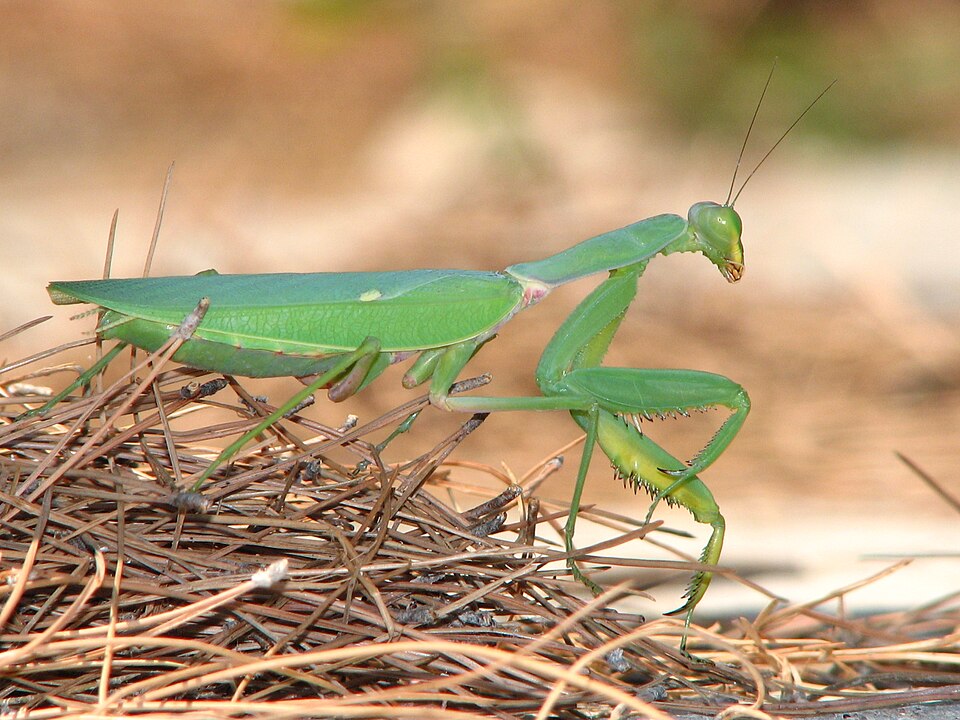
A praying mantis is a hunter that holds its front legs as if in prayer and can turn its head to look at you. According to the University of Kentucky, it can rotate its head 180 degrees, and the spines on its front legs let it grip its prey firmly. According to the Amateur Entomologists' Society (AES), about 2,300 species of mantis have been described; the name "mantis" comes from a Greek word meaning "prophet." It's a pet that's fun to watch, but it's short-lived, has to live alone and is very fragile while it molts. In this article, we explain how to care for a praying mantis at home, with advice from the AES and the University of Kentucky. We covered what it eats and how to feed it separately in our article on live food safety.
- A beginner species: According to the AES, the African mantis (Sphodromantis viridis) is easy to keep; it's about 8 cm (3 in) long.
- On its own: According to the AES, many species are aggressive toward each other; kept together, they may eat one another.
- A tall enclosure: The distance from the top of the branch it hangs from to the floor should be at least four times its body length (AES).
- Temperature and water: According to the AES, 20–25 °C (68–77 °F), as steady as possible, and a misting with clean water once a day.
- Hands off during molting: According to the AES, the new exoskeleton is soft; the animal can't move until it hardens.
- A short life: According to the AES, 12–18 months.
Is a praying mantis right for you?
The first warning on the AES care sheet is clear: never get an animal before researching its needs. Here's what you need to know about a praying mantis:
- It needs live food: According to the AES, young mantises eat fruit flies or aphids, and larger ones eat flies, grasshoppers, crickets and cockroaches. So caring for a mantis also means caring for feeder insects.
- It lives a short life: According to the AES care sheet, it lives 12–18 months. According to the AES page on the order, the average lifespan is twelve months, a little longer in captivity.
- It needs ongoing attention: Daily misting, removing uneaten food and keeping an eye on molts go on for its whole life.
For beginners, the AES recommends the African mantis: it's easy to keep, about 8 cm long, ranges in color from green to light brown and can catch prey as large as itself. According to the AES page on the order, 18 species live in southern and central Europe. The University of Kentucky describes the European mantis (Mantis religiosa) as a pale green species about 3 inches (7.5 cm) long.
The enclosure: height comes first
A praying mantis hangs down from a branch to molt. According to the AES, that's why the enclosure needs a branch or stick it can hang from, and the distance from the top of the branch to the floor of the enclosure must be at least four times the animal's length. For an 8 cm adult, that means at least 32 cm (about 12.5 in).
- Container: The AES says plastic fish tanks work and can be stood on end to gain height. The University of Kentucky recommends a warm, spacious container for young mantises and says a 10-gallon (about 38-liter) terrarium works well.
- Branch: Put a sturdy branch or stick in the enclosure whose top sits high enough.
- Size up as it grows: According to the AES, a mantis should be moved to a larger container as it grows.
- Lid and air: The University of Kentucky's Department of Entomology recommends that enclosures for exotic insects kept at home (cockroaches and tarantulas) have an escape-proof lid with good ventilation to reduce mold.
Temperature, humidity and water
According to the AES, the enclosure should be kept warm; the ideal temperature is 20–25 °C (68–77 °F), as steady as possible. The AES suggests a heat mat with a thermostat for this. For young mantises, the University of Kentucky gives a range of 70–90 °F (21–32 °C) and 40–95% humidity.
The AES advice on water is simple: mist the enclosure once a day with fresh, clean water. This gives the mantis water to drink and raises the humidity. But according to the AES, large water droplets can trap small mantises and drown them. So use a fine mist that doesn't form big droplets.
Molting: hands off, and wait
A young mantis (nymph) looks like a small adult and molts as it grows. According to the University of Kentucky, the wing buds get a little bigger with each molt; according to the AES page on the order, the wings only appear at the final molt.
According to the AES glossary, molting is a critical but vulnerable time for arthropods. The animal takes in water or air and splits its old exoskeleton at weak points. The new exoskeleton is soft; because the muscles are attached to it, the animal can't move until the exoskeleton has dried and hardened.
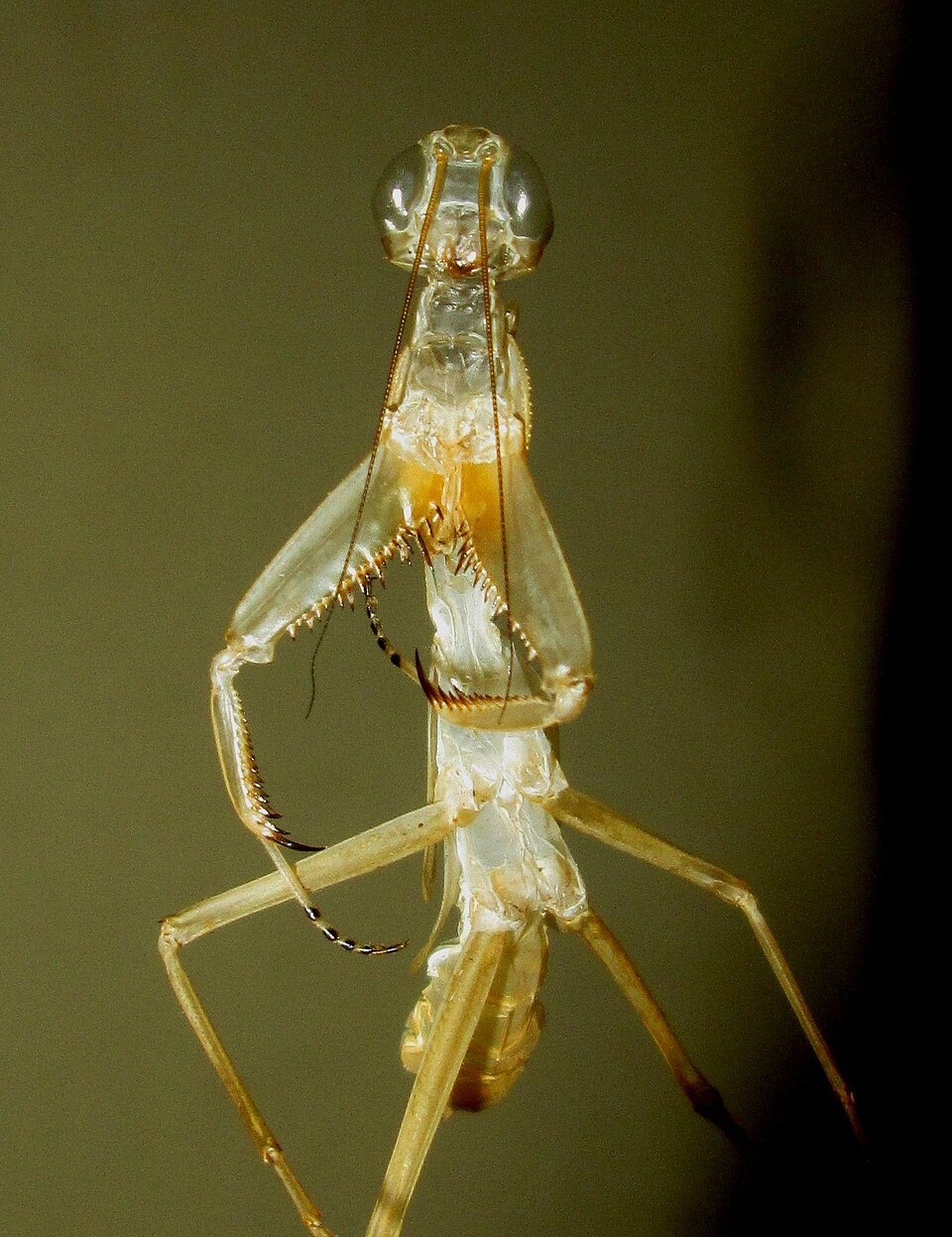
- Humidity: According to the AES, humidity matters during molting. A mantis that struggles to shed its skin may lose a leg; this is often linked to an enclosure that is too dry.
- A place to hang: According to the AES, it has to hang from a branch to shed its skin; check the height and sturdiness of the branch ahead of time.
- No live food: According to the AES, uneaten grasshoppers, crickets and cockroaches can chew a mantis's legs or wings; remove uneaten food.
- Hands off: Because it can't move until its new skin hardens, don't touch it or its branch during this time, and don't try to pick it up.
According to the AES, a lost leg can only grow back at the next molt. Winged adults no longer molt, so a lost leg won't grow back in them.
It lives alone
According to the AES, many mantis species are aggressive toward each other; kept in groups, they may eat one another, especially when one grows larger than the others. According to the University of Kentucky, they eat each other when food is scarce; the first meal of newly hatched young is often a sibling.
According to the AES, young mantises can be kept together for a while in a very large enclosure with plenty of hiding places and more than enough live food, but they need to be separated after their second or third molt.
The egg case
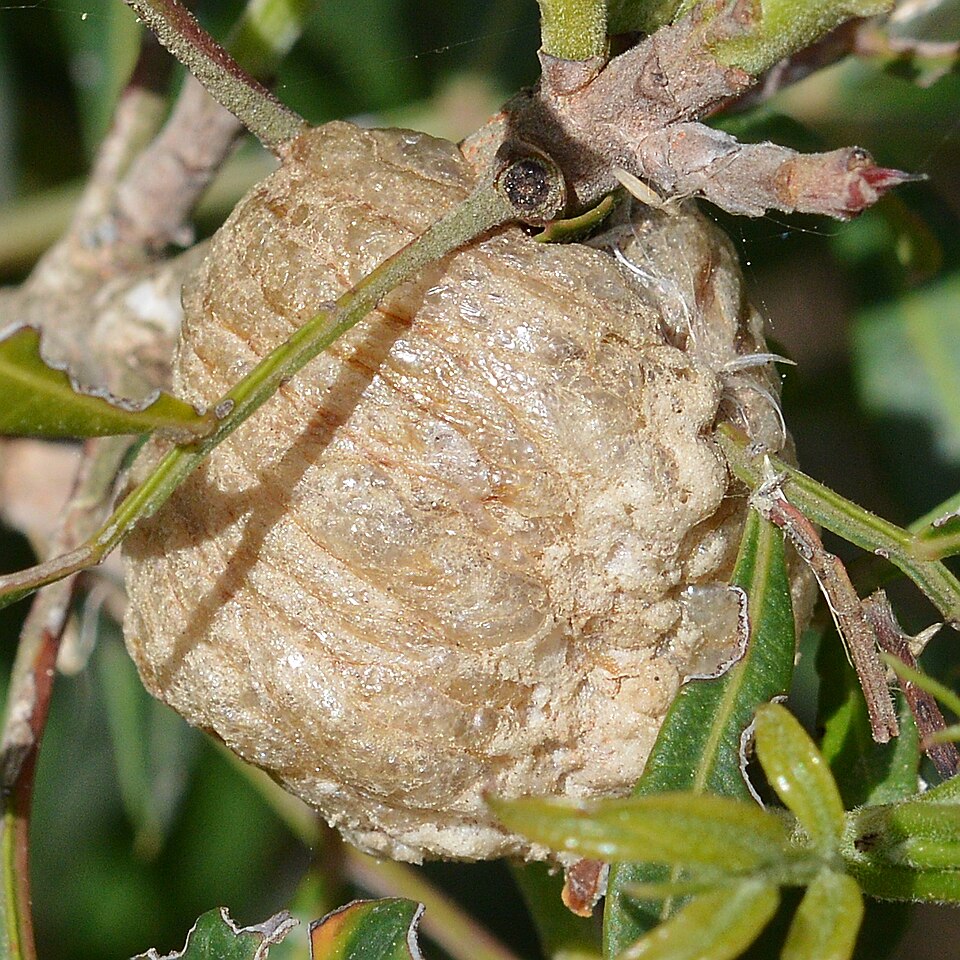
According to the AES, a female mantis lays a frothy egg mass that hardens into a tough case (ootheca). Depending on the species, 30–300 young can hatch from it; the University of Kentucky says each case holds 12–400 eggs. According to the AES, a female usually lays about six cases and only needs to mate once; some species can produce fertile cases without mating. As for the popular belief that the female eats the male, according to the AES page on the order, this is rarely seen in the wild and may be a result of captive conditions.
- Hang it: According to the AES, keep the case suspended at least 5 cm (2 in) above the floor of the enclosure.
- Be patient: According to the AES, hatching usually takes 3–6 months; the young may come out all at once or a few at a time over several weeks.
- Be ready for a crowd: According to the University of Kentucky, anywhere from several dozen to hundreds of young can hatch from a single case. They'll all need food, and later separate enclosures.
- Don't bring a wild case indoors: According to the AES, in places where mantises live naturally, people sometimes bring egg cases they find indoors to "protect" them. According to the University of Kentucky, cases collected in the fall and kept indoors hatch during the winter; according to the AES, young that hatch early in the warmth may find no food. The AES advice is to keep the case in an unheated building, such as a shed, and let the young emerge at the right time.
Don't release an exotic mantis you bought, its young or its egg cases into the wild. In its guide to the Indian walking stick, UC IPM, the University of California's pest management program, asks that these insects and other exotic insects never be released into landscapes or wild areas. It also recommends never tossing cage debris outside, and instead putting it in a securely closed bag and freezing it for a week before throwing it in the trash. We explain why this matters in our article on stick insect care.
If you add your mantis to Tüylüm as an invertebrate, Food, Water dish / humidity and Terrarium cleaning come ready-made as tasks on the Today tab. With Add task, you can add a daily misting task, or the Shedding check task from the suggestions. Add each molt to the Memory book with a photo to watch it grow.
More of our invertebrate guides: Invertebrates.
Frequently asked questions
My mantis is hanging and not moving. What should I do?
It may be molting or getting ready to molt. According to the AES, it has to hang from a branch to molt, and it can't move until its new skin hardens. Don't touch it or its branch, and don't leave live food in the enclosure. If you think there's a health problem, talk to a vet experienced with exotic animals, ideally with invertebrates.
It lost a leg. Will it grow back?
According to the AES, a lost leg can only grow back at the next molt. Winged adults no longer molt, so a lost leg won't grow back in them. According to the AES, leg loss during molting is often linked to an enclosure that is too dry, so don't skip the daily misting.
Can I keep two mantises in the same enclosure?
According to the AES, many species are aggressive toward each other and may eat one another when kept together. Young mantises can stay together for a while in a very large enclosure with plenty of food, but they need to be separated after their second or third molt.

Keep track of your pet's care in TüylümLog vet visits, vaccine and medication dates, and we'll remind you when it's time. Share it all with your family in Home.
Sources
- Amateur Entomologists' Society · Praying mantids caresheet
- Amateur Entomologists' Society · Praying Mantids (Order: Mantodea)
- Amateur Entomologists' Society · Ecdysis (Entomologists' glossary)
- University of Kentucky Department of Entomology · Praying Mantids (ENTFACT-418)
- University of Kentucky Department of Entomology · Exotic Bugs: Care and Feeding
- UC IPM (University of California) · Indian Walking Stick, Pest Notes 74157
By Tüylüm · Published and last checked: October 28, 2026. Spotted a mistake? Write to [email protected] and we'll fix it right away. Photos are from Wikimedia Commons, used under the license shown below each photo.