Why do frogs croak? Understanding the songs of spring nights
Walk past a pond on a spring evening and you'll hear it: sometimes a soft murmur, sometimes a quack that sounds like a duck, sometimes a chorus that fills your ears. Frog calls are among the most familiar sounds in nature. But why do frogs call, why does each species sound different, and why do they go quiet on some nights? In this article, we explain frog calls using information from frog researchers at the Australian Museum and from Froglife, the UK amphibian conservation charity. At the end, you'll also find how to listen to them without disturbing them.
- Mostly males call: According to the Australian Museum, in almost all frog species only the males call.
- Four calls: The love song, the territorial call, the "let go" call and the distress call.
- Each species has its own song: Females are tuned to their own species' call, and you can identify a frog by its call without even seeing it.
- When: Most species call more at night and after rain; but in FrogID records, 39% of calling frogs were recorded during the day.
- Listen, don't touch: According to Froglife, the best thing for amphibians is not to be handled at all: look, don't touch.
Mostly males call
According to Dr Jodi Rowley, a frog researcher at the Australian Museum, in almost all frog species it's the males that call. The chorus you hear at night is really a serenade: males call to advertise themselves to potential mates.
Because most frogs lay their eggs in water and the tadpoles grow up there, males usually call in or near ponds, dams, streams and wetlands. Some call from the water, others from nearby rocks, trees or the ground.
Four different calls
According to another Australian Museum article, frogs don't have just one call; there are four kinds:
| Call | Who makes it | What it means |
|---|---|---|
| Love song | Males | Attracts females; each species' song is different |
| Territorial call | Males only | When many males share a pond, it tells rivals to "keep away"; it defends a good calling and egg-laying spot |
| "Let go" call | Males and females | Males may try to grab any nearby frog; an uninterested frog says "let me go" |
| Distress call | Males and females | Made when a predator attacks; it may startle the predator and help the frog escape |
According to the same article, the territorial call is heard as the final part of the love song when several males are calling from the same pond. The love song can also vary a little from place to place, much like accents in people. Bigger frogs usually have deeper calls, and in warm weather the calling speeds up.
The puffed-up throat: the vocal sac
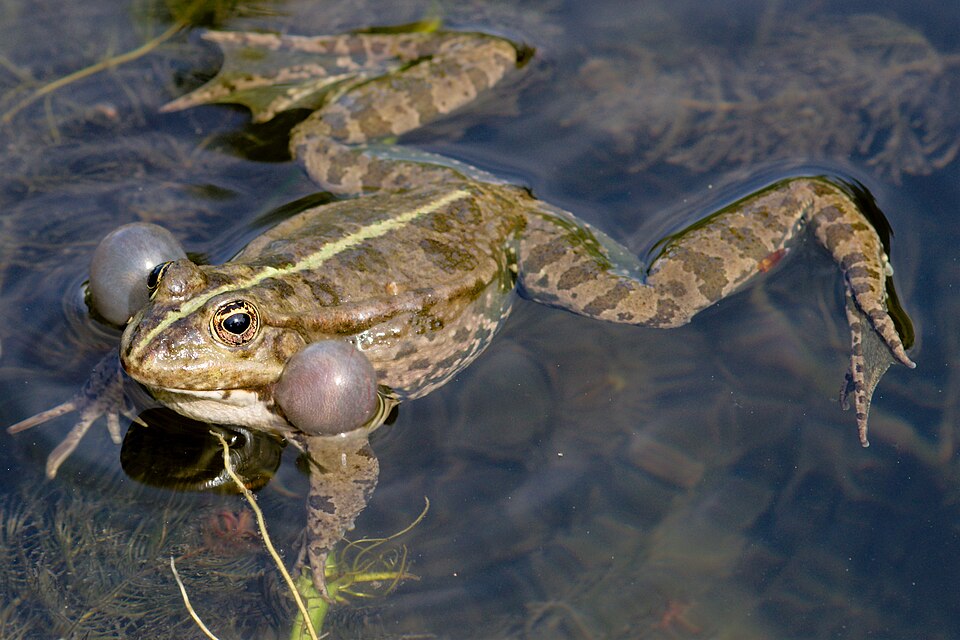
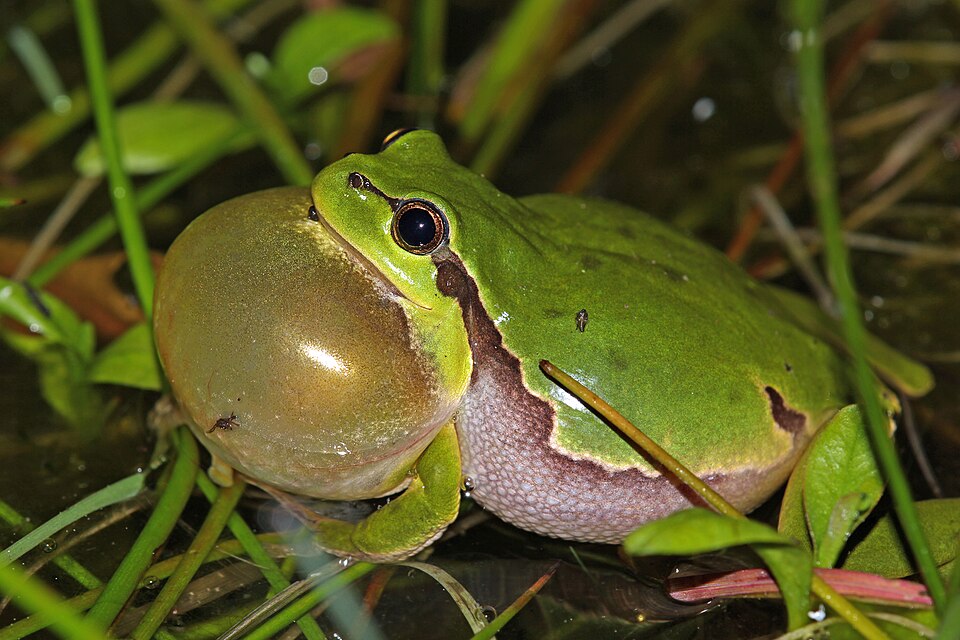
Look at a calling frog and you'll see a pouch puffing up like a balloon on its throat or on both sides of its mouth: the vocal sac. According to Froglife, male common frogs (Rana temporaria) have a single vocal sac under the chin. The marsh frog in the photo above, by contrast, has puffed up a vocal sac on each side of its mouth.
According to Froglife, three UK species sound very different from one another:
- Common frog: A low, smooth, repetitive croak; softer than the UK's toads.
- Common toad (Bufo bufo): Higher-pitched and harsher; a "qwark-qwark-qwark" that could be mistaken for a duck or a goose.
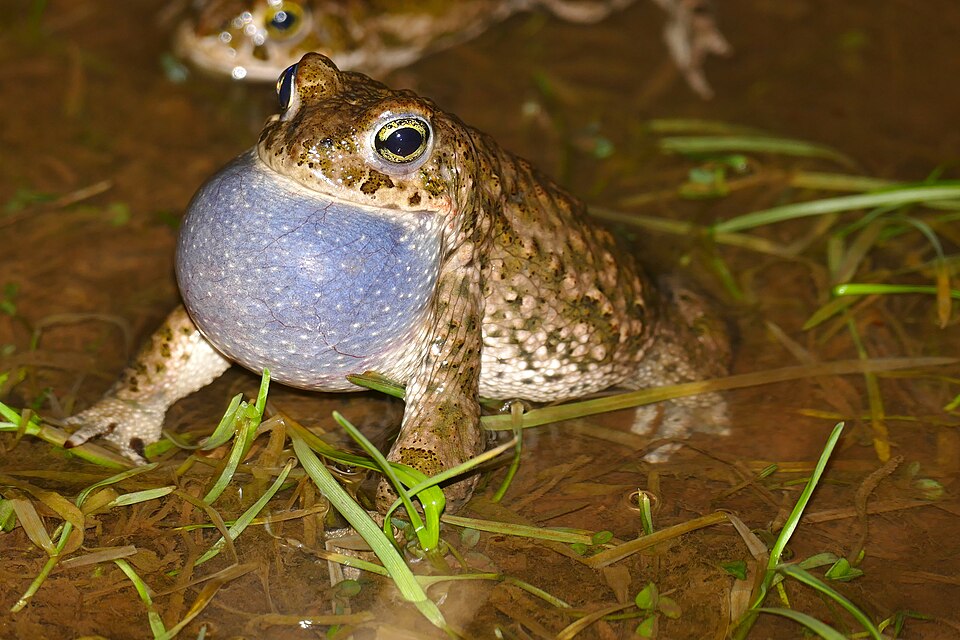
- Natterjack toad (Epidalea calamita): Raspy and higher-pitched than the common frog; in the right conditions it can be heard from up to 2 km (about 1.2 miles) away.
Each species has its own song
According to Rowley, each species in an area has its own distinct call, because males want to attract females of their own species. Females' hearing is tuned to their own species' call, so they can find the right male in a noisy chorus.
That's a gift for us, too: according to the Australian Museum, you can find out which species live around you just by listening to their calls, without disturbing the frogs at all. In Rowley's examples, the sounds range from a high-pitched whirring to a deep "bonk" and an insect-like chirp.
When do they call?
According to Rowley, most frogs are active at night, so night is the best time to listen to them. Calling increases after rain. Because most species breed in spring and summer, the warmer months are usually best, but some species prefer the cooler months. Some frogs breed almost all year round; others breed and call on just a few nights a year. One species, the water-holding frog (Cyclorana platycephala), which also lives in Australia's deserts, calls whenever it rains enough.
According to Froglife, common frogs in the UK start early: in southwest England, spawn can be laid from January onward. In early spring, adults emerge from their overwintering sites and head straight to a pond; a single clump of spawn can contain up to 2,000 eggs.
But frogs don't only call at night. In the Australian Museum's FrogID project, more than 160,000 records of 196 species were analyzed:
| FrogID records | Share |
|---|---|
| Calling frogs recorded between sunrise and sunset | 39% |
| Frogs calling in full daylight, at least 2 hours after sunrise and 2 hours before sunset | 19% |
| Species recorded calling during the day at least once | 71% (140 of 196 species) |
According to the researchers, calling during the day may keep a frog's call from being drowned out by the crowded night chorus. And for small species living in moist, hidden spots, the chance of attracting a mate may be worth the risks of daytime.
Listening to frogs in nature
You don't need to travel far to listen to frogs. In the Australian Museum's examples, some species call in shallow swamps, flooded grassland and even puddles; sometimes a pond near your home is enough.
- Pick your time: According to Rowley, the best time is at night and after rain; the warmer months are usually the liveliest.
- Stay near water: Males mostly call in or around ponds, streams and wetlands.
- Listen quietly: According to the Australian Museum, you can identify species by their calls without disturbing the frogs.
- Look, don't touch: According to Froglife, the best thing for amphibians is not to be handled at all. Even the warmth of a hand affects them, and repeated handling changes their behavior.
- Clean your boots: According to Froglife, the risk of spreading amphibian diseases such as ranavirus, chytrid (Bd) and Bsal remains high; spores can survive on equipment, footwear and vegetation. Clean your boots and gear before moving from one pond to another.
- Apps: Froglife's Dragon Finder app has recordings of UK amphibians; it helps you identify species and report what you see. The Australian Museum's FrogID project also works with frog call recordings collected from all over Australia.
We explain why it matters to leave frogspawn and tadpoles where they are, and how you can help frogs in your yard, in our article on garden and wild frogs. If you really need to move a frog: handling amphibians.
Frequently asked questions
Do female frogs call?
According to the Australian Museum, in almost all species only males sing the love song, and only males make the territorial call. But both males and females can make the "let go" call and the distress call.
Why do frogs call more after rain?
According to the Australian Museum, calling increases after rain. Most frogs lay their eggs in water and their tadpoles grow up there; some desert species call only when it has rained enough.
I heard a frog calling during the day. Is that normal?
Yes. In the Australian Museum's FrogID records, 39% of calling frogs were recorded between sunrise and sunset, and 71% of the species studied were heard calling during the day at least once.

Keep track of your pet's care in TüylümLog vet visits, vaccine and medication dates, and we'll remind you when it's time. Share it all with your family in Home.
Sources
- Australian Museum · Why do frogs call? (Dr Jodi Rowley, 2017)
- Australian Museum · The language of frogs: what are your backyard frogs saying? (2019)
- Australian Museum · Frogs call at night, right? (2020)
- Froglife · Croaks on croaks (2024)
- Froglife · Common frog
- Froglife · Bare hands, gloves or not at all – what's best for amphibians and why? (2024)
By Tüylüm · Published and last checked: October 26, 2026. Spotted a mistake? Write to [email protected] and we'll fix it right away. Photos are from Wikimedia Commons, used under the license shown below each photo.