 Tüylüm
Birman
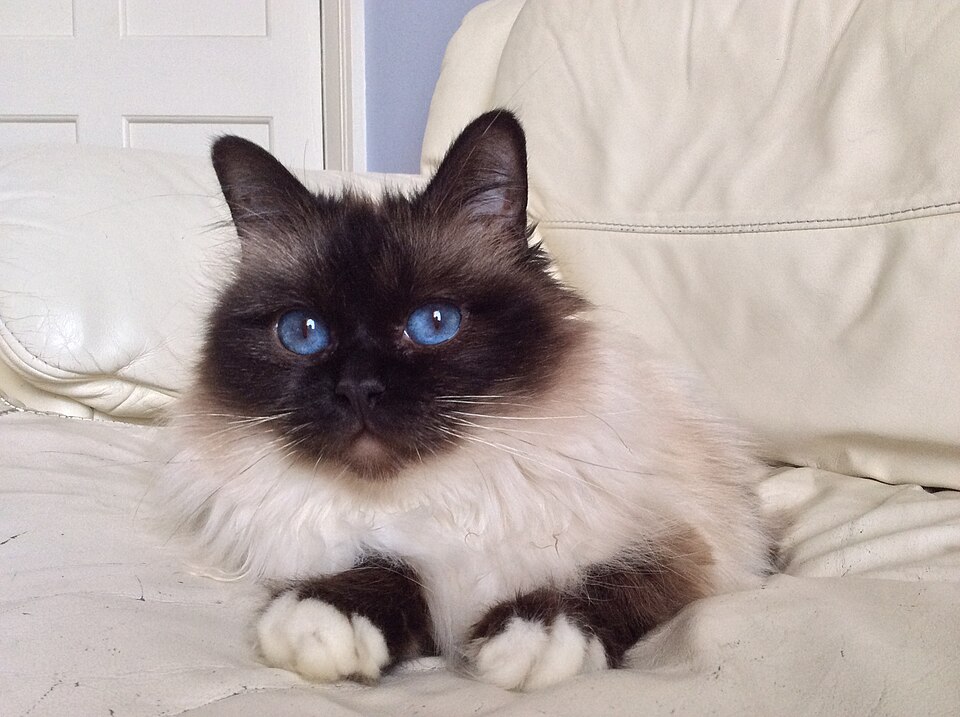
A blue-eyed, pointed cat with a silky coat and pure white "gloves" on all four paws. Patient, people-loving and easygoing, it doesn't like being alone. One of the longest-lived breeds in UK data; ask about kidney values and tests for some inherited diseases.

 Lifespan≈ 14.4 yearsUK 2019 data; among the longest
 Weight≈ 12 lb (5.5 kg)PDSA average; females are smaller
 OriginFrance (Burma)from Burma to France around 1919
 CoatSemi-long, silkyno undercoat, rarely mats
 EnergyModerateloves play, prefers floor to heights
 VoiceQuietsoft chirps; chattier if you answer
 With kidsExcellentpatient and tolerant
 Alone timeDislikes itconsider two cats if you work long hours
The Birman is easy to recognize by its deep blue eyes, silky pointed coat and the pure white "gloves" on all four paws. It's often called the "Sacred Cat of Burma." Patient, affectionate and very attached to its people, it follows you wherever you go in the house. On this page we've pulled together its temperament, care needs and health issues from breed registry standards, animal welfare resources and scientific studies.
- Temperament: Affectionate, patient and people-loving; adapts well to families with children and other pets.
- Alone time: It doesn't like being alone for long; the CFA suggests considering a pair if no one is home for long hours.
- Easy care: With no undercoat, the coat rarely mats; combing once or twice a week is usually enough.
- Health: Healthy Birmans can have higher creatinine (a kidney blood value) than other cats, which matters when reading blood tests. There are DNA tests for some inherited diseases.
- Lifespan: In UK data from 2019, life expectancy was about 14.4 years, one of the longest among the breeds studied.
What to know
 What is the Birman like?
The Birman is a sociable cat that loves being with people. According to the CFA's breed profile, it's intelligent, enjoys learning and responds well to training. It's playful, wants attention and is moderately active; one of its favorite things is "helping" with whatever you're doing. PDSA also notes that a Birman will follow you from room to room to see what you're up to, happily sits on your lap and prefers spending time on the floor to climbing and jumping.
It's a quiet cat. Most have a soft, chirp-like voice. But both sources point out the same thing: if you always answer when it meows, a Birman can become quite a talker over time.
The breed's most notable trait is that it doesn't like being alone. The CFA writes that it doesn't do well alone for long periods, and that if you work outside the home and have no other pets, you may want to consider getting two cats.
Every cat is an individual. Breed traits describe general tendencies; how a cat was raised, how much contact it had with people as a kitten and its health shape its personality as much as its breed.
 Who is it a good fit for?
The Birman is a great fit for families who spend time at home and want a close bond with their cat. If no one is home all day and you're thinking of a single cat, think twice.
| Situation | Good fit? |
|---|---|
| Apartment | Excellent; prefers the floor to climbing |
| Family with kids | Excellent; according to the CFA, patient, even-tempered and tolerant |
| Other cats and dogs | Usually gets along; introduce them slowly |
| Long hours alone | Not a good fit; needs company or attention |
| First-time cat owners | Good; easy to care for and gentle-natured |
Being patient doesn't mean having endless patience. Teach children not to pick the cat up against its will, not to disturb it while it sleeps and to always leave it a way out. If you're thinking about a second cat, our guide to introducing two cats step by step can help.
Where does it come from?
Many folk tales explain how the Birman got its markings, and the "sacred cat" name comes from these legends. Its real history, though, isn't fully known. According to the CFA, here's what we do know: around 1919, a pair of cats was shipped from Burma (today's Myanmar) to France; the female arrived pregnant and became the foundation of the breed in France. The name "Birman" comes from "Birmanie," the French word for Burma.
World War II nearly wiped out the breed: according to the CFA, only one breeding pair was left in Europe by the end of the war. French breeders rebuilt the breed with carefully planned crosses to Persians and Siamese, and by the early 1950s pure Birman litters were being born again. The breed reached the United States in 1959 and was accepted for CFA registration in 1967.
 Appearance and colors
According to the CFA, the Birman is a medium-to-large cat with a long, stocky body and solid bones; the FIFe standard describes it as medium-sized. The head is broad and rounded, the nose is medium-length and slightly arched (a "Roman" nose), and the eyes are almost round and deep blue.
- Weight: PDSA gives an average weight of about 12 pounds (5.5 kg); females are usually smaller than males.
- Points and gloves: The Birman is a pointed cat: the body is pale, while the face, ears, legs and tail are darker. But the breed's real signature is the pure white gloves on all four paws. According to FIFe, the white on the front paws should stop at the joints of the toes, while on the back of the hind paws it extends upward in an inverted V. Symmetrical gloves are prized.
- Golden mist: A faint golden-beige cast can appear on the body, especially on the back and sides; the CFA calls it the "golden mist."
- Colors: At first only seal (dark brown), blue, lilac and chocolate points were recognized; today there are also tabby points and red, cream and tortie points.
- Coat: Medium-long to long and silky, with a full ruff around the neck and slightly curly fur on the belly. There's no undercoat.
According to the CFA, the breed matures at about 3 years. In kittens, the golden mist may not be visible yet.
Daily care
The Birman's coat is long but easy to look after. The CFA notes that because there's no undercoat, it sheds less than most other longhaired cats and doesn't mat easily, and that combing once a week is usually enough. PDSA recommends combing twice a week, and daily in spring when the winter coat sheds. Adjust the routine as you get to know your cat's coat.
- Bathing: Most Birmans don't need regular baths; if one is needed, use a cat shampoo your vet recommends.
- Play: Because it likes to play on the floor, wand toys, balls and hunting games are a great fit. A few short play sessions a day also help meet its need for attention.
- Company: If it will be alone for long stretches, a second cat, food puzzles and a window perch can make the hours easier.
- Claws, ears, eyes: Check them weekly; show your vet any redness, odor or discharge. A sturdy scratching post is a must.
For more ideas, see our articles on cat grooming and playing with an indoor cat.
 Diet and weight
Birmans don't need a special food; a complete, balanced cat food that suits their age and lifestyle is enough. Because it's a calm indoor cat that spends more time on the floor than climbing and jumping, portions matter. In the 2024 study by Teng and colleagues, cats whose weight was further from the median for their breed and sex had shorter lives.
- Measure food instead of eyeballing it; decide the daily amount with your vet based on your cat's ideal weight.
- Count treats as part of the daily food.
- A silky coat can hide weight: being able to feel the ribs under a thin layer of fat is a good sign.
- Always have fresh water available; kidney health matters especially in this breed.
- Weighing your cat once a month shows changes early.
 Health issues to know about
The Birman is a long-lived breed, but there are a few things worth knowing. The information below is for awareness only; ask your vet about diagnosis and treatment.
Kidney values
PDSA notes that blood tests of some young Birmans have shown signs of impaired kidney function. On the other hand, a 2018 study found that creatinine, a blood value used to assess the kidneys, was higher in healthy Birmans than in other breeds; the researchers suggest that looking at another kidney marker, SDMA, together with creatinine can help avoid misreading results in this breed. In short: when your cat has blood work, remind your vet that it's a Birman and discuss the results with that in mind. Regular checkups are the best way to catch kidney problems early.
Feline infectious peritonitis (FIP)
According to the Cornell Feline Health Center, FIP is a serious disease caused by certain strains of feline coronavirus, a very common virus that is usually harmless; young cats are at greater risk. A 2013 study notes that Birmans are highly inbred and have a high rate of FIP; the researchers looked for a genetic predisposition but didn't find a single responsible gene. According to Cornell, the first signs are usually loss of appetite, weight loss, lethargy and fever, and in some cats the belly swells with fluid. This disease, once untreatable, now has treatment options, so acting early matters: if you see these signs, see your vet right away.
Congenital hairlessness (rare)
A 2015 study identified the cause (a change in the FOXN1 gene) of a recessive inherited syndrome in Birmans in which kittens are born hairless and have a short life. About 3% of the Birmans tested in France were healthy carriers. There's a DNA test for it, so ask the breeder.
Heart
The CFA notes that breeders screen for HCM (thickening of the heart muscle) and other conditions, which helps keep the breed's gene pool healthy and diverse. Asking for the parents' heart screening results is a good idea.
- Persistent fever, lethargy or a swollen belly
- Loss of appetite and weight loss
- Fast, labored or open-mouth breathing
- Hiding and inactivity (cats hide pain)
How long does it live?
A 2024 study using the Royal Veterinary College's VetCompass data found a life expectancy at birth of 14.39 years (confidence interval 12.87–15.91) for 38 Birmans that died in the UK in 2019; together with the Burmese, this was the longest life expectancy among the 12 breeds studied, and longer than the 11.89 years for mixed-breed cats. The longest-lived cat in that group was over 22. PDSA also gives an average lifespan of 12 to 16 years for the breed.
That's good news, but every cat's lifespan is different. The same study shows that neutered cats and cats at their ideal weight live longer. In the senior years, regular blood tests, especially kidney monitoring, are particularly important for this breed.
 Before you get one
- Consider a shelter: Purebred cats end up in shelters and rescues too. A calm, people-loving mixed-breed cat can make a similar companion.
- If you buy from a breeder: Ask to meet the parents, and ask for the congenital hairlessness DNA test, heart screening and kidney blood test results, plus vaccination records. PDSA suggests discussing the health history of the parents and grandparents.
- Red flags: Steer clear of sellers who won't show you the mother, can't provide test results, always have kittens available or rush you.
- Plan for alone time: If no one will be home during the day, plan for a second cat or someone to stop by from the start.
- Registration: Rules vary by country; many places require or recommend microchipping. In Türkiye, owned cats must be microchipped and registered in the PETVET system.
Frequently asked questions
How do you tell a Birman from a Ragdoll?
Both are blue-eyed and pointed. In the Birman, white gloves on all four paws are a must, and the FIFe standard describes it as medium-sized. The Ragdoll is a large cat and comes in colorpoint (no white), mitted and bicolor patterns. See our Ragdoll page for details.
Do Birmans shed?
Yes, but according to the CFA, less than most other longhaired cats because they have no undercoat. Shedding picks up in spring as they lose their winter coat; comb more often then.
Can a Birman be left home alone?
It doesn't like being alone for long. If you're out all day, a second cat, toys and someone who stops by during the day make a big difference.
Why do Birman kittens' names start with the same letter?
According to the CFA, many Birman breeders follow a French tradition: all kittens born in the same year get names starting with the same letter. Kittens born in 2023 got names starting with U and those born in 2024 with V; when the alphabet runs out, the cycle starts again.
How long do Birmans live?
In UK data from 2019, life expectancy was about 14.4 years, and PDSA gives an average of 12 to 16 years; one cat in the study group lived past 22. Regular vet checkups and kidney monitoring help support a long, healthy old age.
Sources
- CFA (Cat Fanciers' Association) · Birman ırk tanıtımı ve standardı
- FIFe · Sacred Birman ırk standardı (2026)
- PDSA · Birman ırk bilgisi
- Teng ve ark. · Life tables of annual life expectancy and risk factors for mortality in cats in the UK, Journal of Feline Medicine and Surgery (2024)
- Paltrinieri ve ark. · Serum symmetric dimethylarginine and creatinine in Birman cats compared with cats of other breeds, Journal of Feline Medicine and Surgery (2018)
- Abitbol ve ark. · A deletion in FOXN1 is associated with a syndrome characterized by congenital hypotrichosis and short life expectancy in Birman cats, PLoS One (2015)
- Cornell Feline Health Center · Feline Infectious Peritonitis
- Golovko ve ark. · Genetic susceptibility to feline infectious peritonitis in Birman cats, Virus Research (2013)
- Resmî Gazete · Kedi, Köpek ve Gelinciklerin Kimliklendirilmesi ve Kayıt Altına Alınmasına Dair Yönetmelik (26 Şubat 2018)
By Tüylüm · Last checked: November 3, 2026. Compiled from the sources above and written in our own words. Spotted a mistake? Write to [email protected] and we'll fix it right away. Photo from Wikimedia Commons, used under the license shown below it.