 Tüylüm
Ragdoll
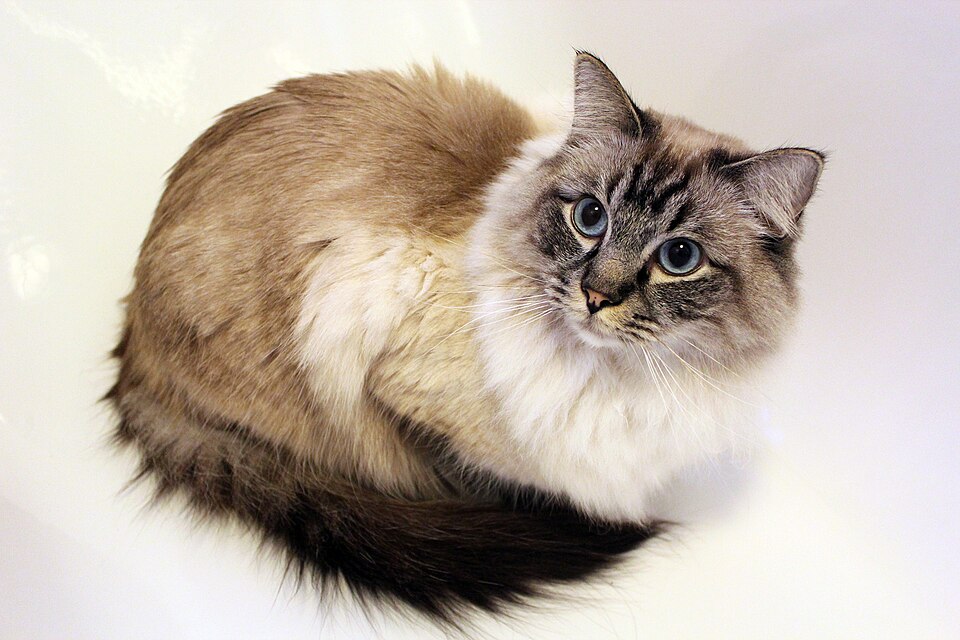
A large, calm cat with blue eyes, a pointed pattern and a semi-long, silky coat. It stays close to its people, greets you at the door and often follows you around. A DNA test and a heart ultrasound for the heart disease HCM are the most important things to check when choosing a kitten.

 Lifespan≈ 10.3 yearsUK 2019 data; PDSA average 11–13
 Weightup to 20 lb (9 kg)mature males; females are smaller
 OriginCalifornia, USA1960s
 CoatSemi-long, silkycomb once or twice a week
 EnergyCalmenjoys play but doesn't insist
 Maturity3–4 yearscolor and size settle slowly
 With kidsVery goodstill, don't let kids carry it around
 Other petsFriendly, trustingintroduce with extra care
The Ragdoll is a large cat known for its bright blue eyes, pointed coat and calm temperament. It's affectionate without being pushy: it greets you at the door, follows you from room to room and often wants to sleep next to you. Its name, which means a floppy cloth doll, comes from the story of a cat that went limp in people's arms. On this page we've pulled together its temperament, care needs and health issues from breed registry standards, animal welfare resources and scientific studies.
- Temperament: Calm, affectionate and people-oriented; rarely aggressive, but its trusting nature can also leave it vulnerable.
- The "ragdoll" reputation: The name comes from a story about a cat that went limp when held; according to the CFA, this isn't typical of most Ragdolls today.
- Care: With little undercoat, the coat doesn't mat easily; combing once or twice a week is usually enough.
- Health: A gene change that causes the heart disease HCM is known in this breed; always ask for the parents' DNA test and heart ultrasound results.
- Lifespan: In UK data from 2019, life expectancy was about 10.3 years; some well-cared-for cats live past 15.
What to know
 What is the Ragdoll like?
The Ragdoll is a calm, gentle and sociable cat. According to the CFA's breed profile, it's loving without being demanding: it greets you when you come home, stays near you during the day, and many sleep next to their owners at night. PDSA also notes that a Ragdoll is rarely far from you in the house and is usually happy to jump onto your lap or slip into your bed.
It isn't a very active breed. It enjoys play but doesn't insist on it; a short session with a wand toy is usually followed by a long rest. The CFA says Ragdolls are also quite trainable: some learn to fetch or to come when called. You'll rarely hear one; it isn't talkative and may simply greet you with a soft mew now and then.
Where does the "ragdoll" name come from?
Ann Baker, who developed the breed, described her foundation cat, Josephine, as so placid that she relaxed every muscle and went limp when picked up; that's where the breed's name comes from. The CFA states plainly that this trait isn't typical of most Ragdolls today. So some Ragdolls do go floppy in your arms, but don't expect it of every one. And remember that even a calm cat isn't always in the mood to be held; let it go when it wants down.
Every cat is an individual. Breed traits describe general tendencies; how a cat was raised, how much contact it had with people as a kitten and its health shape its personality as much as its breed.
 Who is it a good fit for?
The Ragdoll is a great fit for families looking for a calm indoor cat and who enjoy spending time in the same room as their cat. If you want a very active cat that always wants to play, you may want to look at other breeds.
| Situation | Good fit? |
|---|---|
| Apartment | Excellent; according to the CFA, it doesn't need a lot of space |
| Family with kids | Excellent; patient, but teach kids not to carry it around |
| Other cats and dogs | Usually gets along; introduce carefully because it's so trusting |
| Long hours alone | Moderate; likes to stay close to its people and doesn't love being alone |
| First-time cat owners | Good; calm and relatively easy to care for |
The CFA notes that Ragdolls are rarely aggressive or temperamental, which makes them good companions in homes with children. The same source advises introducing them to resident cats or dogs with extra care because they trust people and animals so readily: the other pet may not be as gentle. Teach children not to carry the cat around for long and to support its hind legs when lifting it; a big Ragdoll is heavy. For a step-by-step guide, see our article on introducing two cats.
Where does it come from?
The Ragdoll was developed in the 1960s by breeder Ann Baker in Riverside, California. According to the CFA, the foundation cat was a white domestic longhair named Josephine who carried the colorpoint gene. Baker loved the temperament of Josephine's kittens and created the breed by crossing them with other domestic longhairs, selecting kittens with the look and personality she wanted.
The breed spread quickly. FIFe recognized the Ragdoll in 1991; the CFA accepted it for registration in 1993 and granted championship status in 2000. According to CFA registration statistics, the Ragdoll rose within a few decades to become the most popular cat breed in the world.
 Appearance and colors
The Ragdoll is one of the larger cat breeds, with a broad chest, a long, muscular body and solid bones. Its broad head is shaped like a triangle with equal sides, and its eyes are large, oval and vivid blue. The hind legs are slightly longer than the front legs.
- Weight: According to the CFA, it isn't unusual for mature males to reach or exceed 20 pounds (about 9 kg); females are usually smaller. PDSA gives an average weight of about 12 pounds (5.5 kg).
- Coat: Semi-long, silky and soft; made up mostly of guard hairs, without a thick undercoat. The fur is longest around the neck, where it forms a bib.
- Points: All Ragdolls carry the colorpoint gene: the body is always lighter than the face, ears, legs and tail. The eyes are always blue.
- Patterns: FIFe considers three patterns essential to the breed: colorpoint (no white), mitted (white "mittens") and bicolor (an inverted white V on the face and white legs). The CFA also includes the van pattern, where only the ears, tail and mask are colored.
- Colors: Seal (dark brown), blue, chocolate, lilac, red and cream, plus tortie and tabby (lynx) versions of these.
The breed matures slowly. According to the CFA's breed profile, the coat color settles at about 2 years and full size and weight at 4, while the standard puts full coat and color at about 3 years.
Daily care
A Ragdoll's coat looks long, but it's easier to care for than it looks. The CFA notes that because there's no thick, dense undercoat, the coat sheds and mats less; combing once or twice a week with a metal comb is usually enough to remove loose hair and small tangles. PDSA recommends grooming at least once a week and paying special attention to the armpits and around the neck, where tangles form most often. Like any cat, a Ragdoll sheds more when the seasons change.
- Claws: A sturdy scratching post is a must; if the claws grow long, they can be trimmed the way your vet shows you.
- Ears, eyes and teeth: Check them weekly while grooming; show your vet any redness, odor, discharge or bad breath.
- Play: Even though it's not very active, a few short hunting games a day help keep both its weight and its mood in good shape.
- A safe home: Open windows and balconies are risky for a cat that trusts people and its surroundings so easily; use screens and netting. See our cat-safe home checklist.
For more ideas, see our article on cat grooming.
 Diet and weight
Ragdolls don't need a special food; a complete, balanced cat food that suits their age and lifestyle is enough. The real issue is how much: the CFA notes that the breed is known for its love of food and may be at risk of obesity, so portions should be watched. Being a calm indoor cat also lowers its energy needs. In the 2024 study by Teng and colleagues, cats whose weight was further from the median for their breed and sex had shorter lives.
- Measure food instead of eyeballing it; decide the daily amount with your vet based on your cat's ideal weight.
- Because the breed keeps growing until about age 4, talk to your vet about when to switch from kitten food to adult food.
- Count treats as part of the daily food; food puzzles slow eating down and keep the cat busy.
- A long coat can hide weight: being able to feel the ribs under a thin layer of fat is a good sign.
- Weighing your cat once a month shows changes early.
 Health issues to know about
The CFA considers the Ragdoll relatively healthy thanks to its diverse genetic background, but there is one important known inherited heart disease. The information below is for awareness only; ask your vet about diagnosis and treatment.
Hypertrophic cardiomyopathy (HCM)
HCM is the most common heart disease in cats: the wall of the heart's left ventricle thickens and the heart has trouble filling. The Cornell Feline Health Center lists the Ragdoll among the breeds predisposed to HCM. In 2007, a gene change linked to the disease was found in Ragdolls (the R820W change in the MYBPC3 gene). The researchers noted that it differs from the change known in Maine Coons and arose independently in the two breeds, which is why there's a separate DNA test for Ragdolls.
According to UFAW, about 30% of Ragdolls in the UK carry this change; in the US, 28% were found to be carriers, with 8% carrying two copies. Cats with two copies are affected much more severely: UFAW reports that heart failure and blood clots often start before age 2 in these cats. In a 2014 survey of 236 Ragdolls, the median survival of cats with two copies was 5.65 years; in cats with one copy and in cats without the change, it was over 15 years.
An important detail: according to UFAW, Ragdolls that test negative can still develop HCM, because other, still unknown genes may play a role. That's why an ultrasound of the heart (echocardiography) complements the DNA test. UFAW recommends that every Ragdoll kitten be tested before purchase unless both parents are known to be free of the change, and that the parents should have a clean heart ultrasound. Cornell notes that breathing faster than 35 breaths a minute at rest can be a sign of heart failure.
Polycystic kidney disease (PKD)
PDSA also lists PKD among possible problems in Ragdolls: small fluid-filled sacs (cysts) that are present in the kidneys from birth grow over the years and can damage kidney function. According to PDSA, there's a DNA test for this too, so ask the breeder.
- Fast, labored or open-mouth breathing
- Sudden weakness, paralysis or severe pain in the hind legs
- Fainting, tiredness or a sudden loss of interest in play
- Loss of appetite and hiding (cats hide pain)
How long does it live?
A 2024 study using the Royal Veterinary College's VetCompass data found a life expectancy at birth of 10.31 years (confidence interval 8.86–11.76) for 69 Ragdolls that died in the UK in 2019; the longest-lived cat in that group was over 21. In the same study, mixed-breed cats had a life expectancy of 11.89 years. PDSA gives an average lifespan of 11 to 13 years for the breed.
Life expectancy is strongly affected by cats lost at a young age, so this number doesn't mean "a Ragdoll dies at 10." As the 2014 survey showed, cats carrying two copies of the HCM change may live much shorter lives; choosing a kitten whose parents have been tested reduces this risk. The VetCompass study also shows that neutered cats and cats at their ideal weight live longer.
 Before you get one
- Consider a shelter: Purebred cats end up in shelters and rescues too. A calm, blue-eyed, longhaired mixed-breed cat can make a companion much like a Ragdoll.
- If you buy from a breeder: Ask to meet the parents, and ask for the HCM DNA test (R820W), heart ultrasound and PKD test results. PDSA suggests discussing the health history of the parents and grandparents.
- Red flags: Steer clear of sellers who won't show you the mother, can't provide test results, always have kittens available or promise that "this breed never gets sick."
- Registration: Rules vary by country; many places require or recommend microchipping. In Türkiye, owned cats must be microchipped and registered in the PETVET system.
Frequently asked questions
Do Ragdolls really go limp when you hold them?
Some do, but it isn't a rule. The breed's name comes from the foundation cat, Josephine, who went limp in people's arms; the CFA notes that this trait isn't typical of most Ragdolls today. How relaxed a cat is when held depends on its own personality.
Do Ragdolls shed?
Yes, like every cat, and more so when the seasons change. Because there's no thick undercoat, the CFA says they shed and mat less than many longhaired breeds.
How big do Ragdolls get?
According to the CFA, it's common for mature males to reach or top 20 pounds (9 kg), while females are smaller; PDSA gives an average weight of about 12 pounds (5.5 kg). They reach full size at around age 4. Work out your own cat's ideal weight with your vet.
How do you tell a Ragdoll from a Birman?
Both are blue-eyed and pointed, but white gloves on all four paws are a must in the Birman; the FIFe standard describes the Birman as medium-sized and the Ragdoll as large. Ragdolls come in colorpoint (no white), mitted and bicolor patterns. See our Birman page for details.
Should a Ragdoll go outside?
As the CFA points out, it readily trusts people and animals. A safe home and a netted balcony or yard suit it better than roaming; outdoors there are dangers like traffic and other animals.
Sources
- CFA (Cat Fanciers' Association) · Ragdoll ırk tanıtımı ve standardı
- FIFe · Ragdoll ırk standardı (2026)
- PDSA · Ragdoll ırk bilgisi
- UFAW Genetic Welfare Problems · Ragdoll: Hipertrofik kardiyomiyopati
- Meurs ve ark. · A substitution mutation in the myosin binding protein C gene in ragdoll hypertrophic cardiomyopathy, Genomics (2007)
- Borgeat ve ark. · Association of the myosin binding protein C3 mutation (MYBPC3 R820W) with cardiac death in a survey of 236 Ragdoll cats, Journal of Veterinary Cardiology (2014)
- Cornell Feline Health Center · Cardiomyopathy
- Teng ve ark. · Life tables of annual life expectancy and risk factors for mortality in cats in the UK, Journal of Feline Medicine and Surgery (2024)
- Resmî Gazete · Kedi, Köpek ve Gelinciklerin Kimliklendirilmesi ve Kayıt Altına Alınmasına Dair Yönetmelik (26 Şubat 2018)
By Tüylüm · Last checked: November 3, 2026. Compiled from the sources above and written in our own words. Spotted a mistake? Write to [email protected] and we'll fix it right away. Photo from Wikimedia Commons, used under the license shown below it.