 Tüylüm
Himalayan
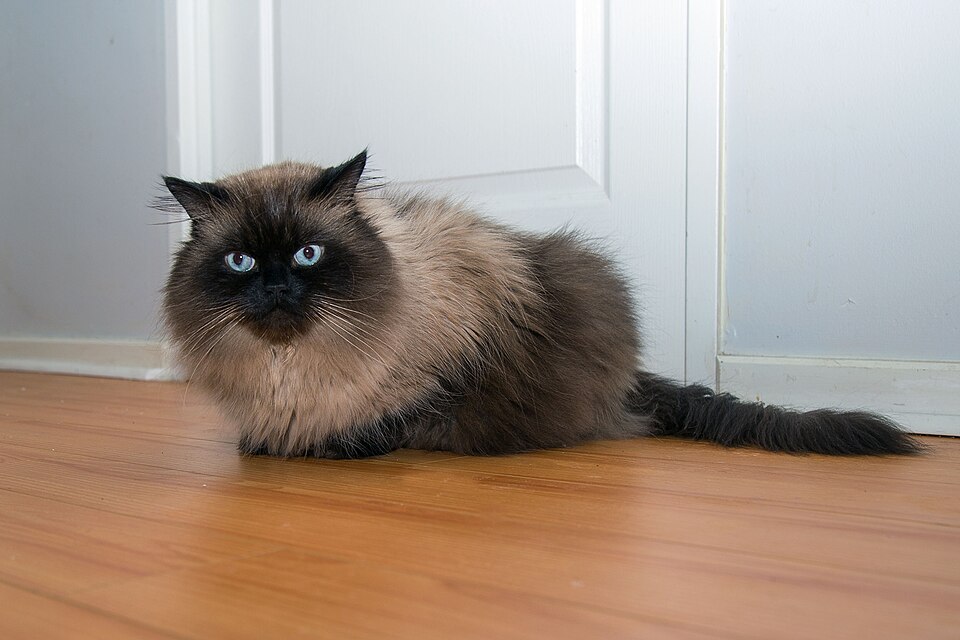
The Persian's long coat and round face, with the Siamese cat's colorpoint pattern and blue eyes. A separate breed in some registries and a color division of the Persian in the CFA. It needs daily combing, and careful choice matters because of flat-face problems and PKD.

 Lifespan≈ 10.9 yearsPersian data, UK 2019
 Weight≈ 8.6 lb (3.9 kg)Persian average (incl. pointed cats)
 OriginUS and Britain1950s
 CoatLong and fullcomb every day
 EnergyCalmloves lap time
 VoiceSoft, melodiouslikes to talk with you
 With kidsGets alongenjoys calm play
 EyesDeep bluetearing is common, wipe daily
The Himalayan combines the long coat and round face of the Persian with the colorpoint pattern and deep blue eyes of the Siamese. With its pale body and dark face mask, ears, legs and tail, it's easy to recognize. Some registries treat it as a separate breed and others as a color variety of the Persian; in terms of health and care, it's almost identical to the Persian. On this page we've pulled together its temperament, care and health issues from breed registry information, animal welfare resources and scientific studies.
- A separate breed? In the CFA it's the Persian's "Himalayan" color division; in TICA it's a separate breed within the Persian breed group.
- Temperament: Calm, people-oriented and soft-voiced; it follows you around and "helps" with whatever you're doing.
- Coat care: Its long coat should be combed every day, and face and eye care are daily jobs too.
- Health: Flat-face breathing, eye and dental problems, PKD and bladder stones; choose a cat with a less flattened face and ask about the PKD DNA test.
- Lifespan: There's no separate data for the Himalayan; for Persians, UK life expectancy in 2019 was about 10.9 years.
What to know
 What is the Himalayan like?
The Himalayan shares the Persian's calm, gentle nature. According to the CFA's 1999 Himalayan article, it isn't a hyperactive cat: it likes to play, but it also loves lap time and always wants to be part of whatever you're doing. Expect a cat ready to "help" while you read the paper, make the bed or work at your desk. The article describes the breed as "people oriented" and notes that it talks in a soft, melodious voice.
According to the CFA's Persian profile, cats in this group don't climb the drapes, prefer to keep all four feet on the ground, get along with children of all ages and can live peacefully with other pets. TICA describes cats in the Persian group as calm most of the day but capable of sudden bursts of energy, racing through the room.
Every cat is an individual. Breed traits describe general tendencies; how a cat was raised, how much contact it had with people as a kitten and its health shape its personality as much as its breed.
 Who is it a good fit for?
The Himalayan suits calm homes with people who can spend time on coat and face care every day and who enjoy having their cat close by.
| Situation | Good fit? |
|---|---|
| Apartment | Excellent; adapts well to indoor life |
| Family with kids | Good; won't join rough games and should be handled gently |
| Other cats and dogs | Usually peaceful; introduce them slowly |
| Long hours alone | Because it's so people-oriented, long stretches alone don't suit it |
| Hot climate | Take care; flat-faced cats struggle to stay cool in the heat |
| First-time cat owners | The temperament fits, but coat and health care take some experience |
Cats Protection reminds owners that flat-faced cats can struggle to keep themselves cool in hot weather and need plenty of water and a cool place to rest. Keep that in mind during hot summers.
Where does it come from?
According to the CFA's Himalayan article, work to develop a colorpoint Persian began in the United States around 1950. The first step was to cross a Siamese with a Persian. Over the following years, the offspring were bred to each other and back to Persians to produce cats with long coats, the colorpoint pattern and something close to Persian type.
In Britain, Brian Sterling-Webb developed the longhaired colorpoint over about ten years, and in 1955 the GCCF recognized it as the "Longhaired Colourpoint." In the United States, the CFA accepted the Himalayan as a separate breed in 1957. In the years that followed, breeders regularly crossed back to Persians to strengthen Persian type, and Himalayans came to look more and more like Persians.
In 1984, the CFA Board of Directors made the Himalayan a color division of the Persian, even though both breed councils had voted against the change. That's why the Himalayan is one of the Persian's seven color divisions in the CFA today. TICA, on the other hand, recognizes the Himalayan as a separate breed within the "Persian breed group," together with the Persian and the Exotic Shorthair. So whether a cat is called a "Himalayan" or a "colorpoint Persian" largely depends on which registry it belongs to.
 Appearance and colors
Its build is the same as the Persian's: cobby, broad-chested, with short, thick legs and a short, full tail. The head is round, the ears small, the nose short and the eyes large and round. In UK vet records, Persians, a group that may include pointed varieties, weighed 8.6 lb (3.9 kg) on average as adults.
- Colorpoint pattern: According to the CFA standard, the body should be pale, while the face mask, ears, legs, feet and tail are darker. The mask extends from above the eyes down through the chin.
- Eyes: In the CFA standard, deep vivid blue in every color; any eye color other than blue is a disqualification.
- Colors: The CFA recognized seal, blue, chocolate and lilac points in 1957; flame (red), tortie, blue-cream, cream and tabby-patterned "lynx" points were added later.
- Darkening with age: The CFA standard allows for darker body color in older cats.
Why are the points dark?
According to the CFA's Himalayan article, the pattern comes from a gene inherited from the Siamese that belongs to the albino gene family. This gene lets pigment build up in the coolest parts of the body: the ears, face, paws and tail. The CFA's color genetics training also describes it as a "temperature sensitive" gene, which is why the warmer parts of the body stay pale.
What does "flat-faced" mean?
The scientific term for a flat face is brachycephaly, meaning "short head." According to UFAW, it comes from an inherited defect in the development of the skull bones, and the flatter the face, the higher the risk of health problems. The CFA's article itself acknowledges that breeders of colorpoint Persians are sometimes criticized for "pushed in faces" and "running eyes." See our Persian page for details.
Daily care
According to the CFA's article, the Himalayan should be groomed daily, and many breeders consider weekly baths normal. Well-raised Himalayans are used to combing and bathing from kittenhood, so they usually don't object much.
- Bathing: The CFA says the coat should always be thoroughly combed and the claws clipped before a bath.
- Teeth: TICA recommends brushing the teeth regularly with a vet-approved cat toothpaste.
- Play: Cats Protection recommends keeping play short and gentle for flat-faced cats, without leaving them out of breath.
For ways to help your cat enjoy grooming, see our article on cat grooming.
 Diet and weight
Himalayans don't need a special food; a complete, balanced cat food suited to their age is enough. TICA notes that cats in the Persian group are more prone to weight gain after spaying or neutering. Cats Protection also points out that keeping a flat-faced cat's weight under control helps reduce breathing problems.
- Measure food, and set an ideal weight with your vet.
- A long coat hides weight gain, so weigh your cat once a month.
- Encourage drinking: according to UFAW, Himalayans are prone to bladder stones, and water intake is one of the factors that affect stone formation. According to TICA, many Persians drink more comfortably from a water fountain. For choosing bowls, see our article on food and water bowls.
- For a cat at risk of stones, choose its food together with your vet.
 Health issues to know about
The Himalayan carries almost all of the Persian's health concerns. In a 2019 UK study of Persians, which may have included pointed cats, the most common problems were coat problems, gum disease, overgrown claws and eye discharge. The information below is for awareness only; ask your vet about diagnosis and treatment.
Problems linked to the flat face
According to UFAW and Cats Protection, the flatter the face, the higher the risk: narrow nostrils and airways can cause snoring and mouth breathing, kinked tear ducts cause constant tearing, bulging eyes are prone to corneal injury, and a shortened jaw can lead to crowded teeth and gum disease.
Polycystic kidney disease (PKD)
An inherited disease in which fluid-filled cysts in the kidneys grow over time. UFAW and the Cornell Feline Health Center note that it occurs in Himalayans as well as Persians. Signs often appear around age 7: increased thirst and urination, poor appetite, weight loss and vomiting. Because the disease can be detected with a DNA test, always ask for the parents' test results.
Calcium oxalate bladder stones
According to UFAW, Himalayans are more prone to calcium oxalate stones than some other breeds, and stones form more often in males. Stones can irritate the bladder and cause blood in the urine and pain. If a stone blocks the urinary tract, especially in a male cat, it's an emergency that needs immediate treatment.
Ehlers-Danlos syndrome
According to UFAW, this is a rare inherited connective tissue disorder in which the skin is so fragile and stretchy that even a small scratch can tear it. It's seen more often in Himalayans than in other breeds. Severely affected kittens usually don't survive; mildly affected cats can live a normal lifespan but may get frequent skin tears. If you notice unexplained tears in your cat's skin, show your vet.
- Straining to pee, frequent trips to the litter box with little urine, or blood in the urine
- Open-mouth breathing or noisy breathing even at rest
- Keeping an eye shut, cloudiness or a dark spot on the eye
- Drinking and peeing a lot, weight loss or vomiting
- Weakness and fast breathing on a hot day
How long does it live?
We couldn't find separate, reliable lifespan data for the Himalayan. In large UK veterinary database studies, colorpoint Persians are usually recorded simply as "Persian." In the 2024 VetCompass study, 80 Persians that died in the UK in 2019 had a life expectancy at birth of 10.93 years (confidence interval 9.63–12.23). In a 2019 study of 2013 data, which notes that it may have included color variants such as the Himalayan, the median age at death of Persians was 13.5 years.
The two figures differ because they're calculated differently: life expectancy at birth includes cats lost at a young age. Daily coat, eye and dental care, a healthy weight, plenty of water and kidney monitoring are the most concrete ways to protect these cats' lifespan and quality of life.
 Before you get one
- Consider a shelter: Purebred cats end up in shelters and rescues too. If you're set on a breed, follow breed groups and adoption listings.
- Choose a less flattened face: UFAW says that, for welfare reasons, it would be better if people chose cats with natural head shapes. Look for a cat with a visible nose, open nostrils, eyes that don't constantly run and no snoring at rest.
- If you buy from a breeder: Ask to meet the parents, and ask for PKD DNA test results, eye exams and vaccination records. Watch the mother's breathing and eyes yourself.
- Not every pointed longhair is a Himalayan: According to the CFA, breeds such as the Birman and the Ragdoll also carry the colorpoint pattern. Ask for the pedigree.
- Registration: Rules vary by country; many places require or recommend microchipping. In Türkiye, owned cats must be microchipped and registered in the PETVET system.
- The first days: Our guide to the first week with a new cat walks you through it step by step.
Frequently asked questions
Is the Himalayan a separate breed?
It depends on the registry. Since 1984, the CFA has treated the Himalayan as a color division of the Persian, while TICA recognizes it as a separate breed within the Persian breed group. In Britain, the GCCF recognized this cat as the "Longhaired Colourpoint" in 1955.
What's the difference between a Himalayan and a Birman or Ragdoll?
All three have the colorpoint pattern and blue eyes, but they're different breeds. The Himalayan has the Persian's flat face and cobby body. According to the CFA, the Birman has white "gloves" on its front paws, and in three of the Ragdoll's four patterns, white areas accompany the pointed markings.
How is the Himalayan related to the Siamese?
According to the CFA's Himalayan article, the breed started with crosses between Siamese and Persian cats. The colorpoint pattern and blue eyes come from a temperature-sensitive gene inherited from the Siamese, while the long coat and body type come from the Persian.
Does it really need combing every day?
Yes. The CFA's article recommends daily grooming for the Himalayan. An uncombed long coat mats and hurts the cat, and tear stains show quickly on a pale coat.
How can I spot bladder stones?
According to UFAW, frequent attempts to pee that produce very little urine, blood in the urine and pain while peeing are important signs. If your cat is straining but can't pee, it's an emergency; see your vet right away.
Sources
- CFA (Cat Fanciers' Association) · Persian ırk tanıtımı ve standardı (Himalaya grubu)
- CFA (Cat Fanciers' Association) · Persian Himalayan Article (1999)
- CFA (Cat Fanciers' Association) · Colors, patterns and genetics (ırk eğitimi sunumu)
- CFA (Cat Fanciers' Association) · Birman ve Ragdoll ırk tanıtımları
- TICA (The International Cat Association) · Persian ırk tanıtımı (Persian ırk grubu: Persian, Himalayan, Exotic Shorthair)
- O'Neill ve ark. · Persian cats under first opinion veterinary care in the UK: demography, mortality and disorders, Scientific Reports (2019)
- Teng ve ark. · Life tables of annual life expectancy and risk factors for mortality in cats in the UK, Journal of Feline Medicine and Surgery (2024)
- UFAW Genetic Welfare Problems · Persian: Brakisefali (basık yüz)
- UFAW Genetic Welfare Problems · Persian: Polikistik böbrek hastalığı (Himalaya dahil)
- UFAW Genetic Welfare Problems · Himalayan: Kalsiyum oksalat taşları
- UFAW Genetic Welfare Problems · Himalayan: Ehlers-Danlos sendromu
- Cornell Feline Health Center · Polycystic kidney disease
- Cats Protection · Brachycephalic (flat-faced) cats
- Resmî Gazete · Kedi, Köpek ve Gelinciklerin Kimliklendirilmesi ve Kayıt Altına Alınmasına Dair Yönetmelik (26 Şubat 2018)
By Tüylüm · Last checked: November 3, 2026. Compiled from the sources above and written in our own words. Spotted a mistake? Write to [email protected] and we'll fix it right away. Photo from Wikimedia Commons, used under the license shown below it.