 Tüylüm
Selkirk Rex
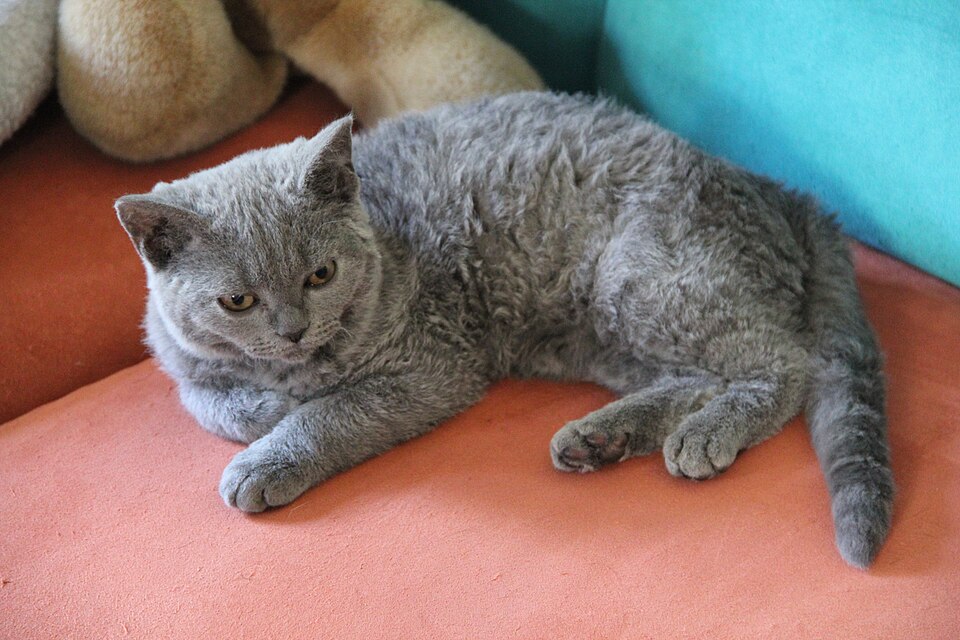
A calm, affectionate cat that looks like a teddy bear, with tousled curls, curly whiskers and a round face. The curl first appeared in a stray cat in the US in 1987. Because the breed carries Persian, Exotic and British blood, asking about PKD, HCM and hip screening matters.

 LifespanNo reliable datanot listed in large lifespan studies
 Weight12–15 lb (5.4–6.8 kg)males (CFA); females a bit smaller
 OriginUS (Montana), 1987
 CoatCurlyshort or long; fluff with your fingers
 EnergyCalm but playfulloves laps
 MaturitySlow, ≈ 2 yearscoat keeps developing until about 2
 With kidsGets alongshould be handled gently
 Other petsGets alongincluding cat-friendly dogs
With its random curls, curly whiskers and round face, the Selkirk Rex looks like a cat caught on a bad hair day. The shorthair resembles a plush teddy bear and the longhair a woolly lamb, which is why it's also called "the cat in sheep's clothing." On this page we look at where the curly coat comes from, along with the breed's temperament, care and health issues, drawing on breed registry information, animal welfare resources and scientific studies.
- Temperament: Calm, affectionate and attention-loving; loves a lap but is always up for a game.
- Curly coat: It comes from a single dominant gene change; two parents of this breed can also produce straight-coated kittens.
- Care: Fluffing the curls with your fingers and regular combing are enough to keep them intact; baths are rarely needed.
- Health: Because the breed carries Persian, Exotic and British Shorthair blood, the CFA recommends screening for PKD, HCM and hip dysplasia.
- Allergies: A curly coat doesn't prevent allergies; there's no scientific evidence that any cat breed is hypoallergenic.
What to know
 What is the Selkirk Rex like?
According to the CFA, the breed's founding cat was named "Miss DePesto" because she pestered people for attention, and her descendants often share the trait: they politely ask for your time and love, and if their needs aren't met soon, they may jump into your lap or onto your bent back. They combine intelligence with a silly streak, such as trying to run up the wall after a laser light.
The CFA says Selkirks tend to be "more interactive than active": you're their focus, and a warm lap is their idea of heaven. They prefer to keep all four feet on the floor but can still charge through the house after a toy. They're not particularly vocal, but if you start a conversation, they'll "talk" back.
According to TICA, the breed's temperament reflects the breeds used to develop it: a laid-back side from the British Shorthair, a cuddly nature from the Persian and an impish playfulness from the Exotic. It's very social and dislikes being left alone for long periods. TICA notes that it can even be taught to walk on a leash.
Every cat is an individual. Breed traits describe general tendencies; how a cat was raised, how much contact it had with people as a kitten and its health shape its personality as much as its breed.
 Who is it a good fit for?
The Selkirk Rex suits families who want to spend a lot of time with their cat and are looking for a calm but attention-loving companion. The CFA and TICA describe the breed as a good choice for families with children and cat-friendly dogs.
| Situation | Good fit? |
|---|---|
| Apartment | Excellent; adapts well to indoor life |
| Family with kids | Good; patient, but children should learn to handle it gently |
| Other cats and dogs | Usually gets along; introduce them slowly |
| Long hours alone | Not a great fit; it's very social and doesn't enjoy being alone |
| First-time cat owners | Good; easy to groom, but ask about health screening |
Everyone wants to touch this coat; the CFA even says it's a coat that "demands to be felt and played with." Still, teach children not to pick the cat up against its will and to always leave it a way out.
Where does it come from?
According to TICA, in 1987 in Montana, one of five kittens born to a blue tortie-and-white stray cat looked unusual. At 9 weeks old, this kitten with curly fur and curly whiskers caught the attention of Persian breeder Jeri Newman, who took her in and named her "Miss DePesto" because she was always pestering for attention. (The CFA dates the same event to 1986.) Her littermates all had normal coats, and there were no other curly cats in the area, which suggested a new gene had appeared.
When Miss DePesto was bred to a black Persian, three of the six kittens were curly. That showed the curly-coat gene was dominant, unlike the genes behind the Cornish and Devon Rex. Newman named the new breed after her stepfather's family name, Selkirk; according to the CFA, it's the only cat breed named after a person. TICA accepted the breed into its new breed program in 1990 and granted championship status in 1994; the CFA accepted it for registration in 1992 and for championship in 2000.
A genetic study published in 2013 showed that the curly coat comes from a change in a keratin gene called KRT71. According to the same study, the breed was extensively crossed to British Shorthairs, Exotic Shorthairs and Persians, both to widen the gene pool and to bring in features such as a round, sturdy body, long hair and a moderately shortened muzzle.
Outcrossing is now being limited: in the CFA, Persian outcrosses applied to kittens born before 2020, and British Shorthair or Exotic outcrosses to kittens born before 2025; Selkirk Rex kittens born on or after January 1, 2025 must have only Selkirk Rex parents. FIFe allows only the British Longhair and British Shorthair as outcrosses.
 Appearance and colors
The Selkirk Rex is a medium-to-large, muscular cat with heavy boning. According to the CFA, adult males weigh 12 to 15 pounds (about 5.4–6.8 kg), and females are somewhat smaller. The head is round with full cheeks, the eyes are round and set well apart, and the ears are medium-sized.
- Coat: According to the CFA, unlike the tight waves of the Cornish Rex or the soft waves of the Devon Rex, the Selkirk has well-defined, individual curls. According to TICA, the curls are most prominent around the neck and tail and on the flanks and underside.
- Shorthair and longhair: In shorthairs the hair is the same length all over; longhairs have a face-framing ruff and a plumed tail.
- Whiskers: Curly and fragile; according to the CFA, they often break off, but the cats seem to manage fine without them.
- Colors: Almost every color and pattern is accepted.
- Straight-coated cats: Because the gene is dominant, two Selkirks can produce straight-coated kittens. FIFe treats them as part of the breed and registers them with a separate code, and the CFA says straight-coated Selkirks can offer the same temperament at a lower price.
A coat that changes
According to TICA, kittens are born curly but may lose their coat at 8 to 10 months and then grow in their adult curly coat. The coat keeps developing until about 2 years of age. That's why it can be normal for a young cat to look "straight" or sparse for a while.
Daily care
Caring for a Selkirk's coat is easier than it looks. The CFA says no special tools are needed and that the curls can be fluffed up with a gentle scratching motion of your fingers. To remove dead hair and prevent mats, the CFA recommends combing once or twice a month, while TICA suggests a couple of times a week; it makes sense to comb more often for longhairs and during shedding.
- Combing: Comb regularly to remove dead hair; for longhairs, the CFA suggests a hair pick to separate large clumps of curls.
- Bathing: According to TICA, it's rarely necessary. If needed, use a moisturizing shampoo and let the coat air-dry in a warm, draft-free place; TICA points out that a blow dryer will make your cat look like a Poodle.
- Claws, ears, teeth: TICA recommends regular claw trims, ear cleaning and tooth brushing with a vet-approved toothpaste.
- Scratching: A tall scratching post is a must.
- Play: Wand toys and chasing games keep this playful cat happy; see our article on playing with an indoor cat for ideas.
For ways to help your cat enjoy grooming, take a look at our article on cat grooming too.
 Diet and weight
According to TICA, the Selkirk Rex has no special nutritional needs; a good-quality wet or dry cat food is enough. Because it's a heavy-boned, calm cat, it's wise to keep an eye on its weight. In the 2024 study by Teng and colleagues, cats whose weight was further from the median for their breed and sex had shorter lives.
- Measure food, and set an ideal weight with your vet.
- Count treats as part of the daily food.
- A curly coat can hide weight changes, so weigh your cat once a month.
- TICA says placing the water bowl a little away from the food bowl, or using a water fountain, can help your cat drink more.
 Health issues to know about
TICA describes the Selkirk Rex as a generally healthy breed, and the CFA says it's known for robust good health, with no known breed-specific health concerns. But a large part of the breed's gene pool comes from the Persian, the Exotic and the British Shorthair, and inherited problems from these breeds can pass to the Selkirk too. That's why, according to the CFA, breeders screen for conditions known in these breeds. The information below is for awareness only; ask your vet about diagnosis and treatment.
Issues that can come from outcrossing
- Polycystic kidney disease (PKD): An inherited disease in which fluid-filled cysts in the kidneys grow over time. According to UFAW, it's most common in Persians and related breeds; the GCCF also says it was once a problem in British cats. It can be detected with a DNA test.
- Hypertrophic cardiomyopathy (HCM): A heart disease in which the heart muscle wall thickens. UFAW notes that the British Shorthair is predisposed. It can be detected with an ultrasound of the heart (echocardiography).
- Hip dysplasia: Abnormal development of the hip joint. The CFA says breeders screen for this as well.
- Blood type incompatibility: According to the CFA, most breeders determine blood type with a genetic test before breeding; problems can arise during nursing between a mother and kittens with mismatched blood types.
Muzzle shape
The 2013 genetic study notes that outcrossing gave the Selkirk a moderately shortened muzzle. It isn't as flat as a Persian's, but it's still worth checking that your cat breathes easily and has clean eyes.
- Fast or open-mouth breathing
- Sudden weakness in the hind legs, limping or difficulty walking
- Drinking and peeing a lot, loss of appetite or weight loss
- Vomiting, weakness or hiding (cats hide pain)
How long does it live?
We couldn't find reliable lifespan data for the Selkirk Rex. In a 2024 VetCompass study of more than 7,900 cats that died in the UK in 2019, the Selkirk Rex wasn't among the 12 groups with at least 15 recorded deaths that could be analyzed separately. For the breeds used to develop it, the same study found a life expectancy of 9.58 years for the British group and 10.93 years for the Persian; for mixed-breed cats, it was 11.89 years.
The same study shows that neutered cats and cats at their ideal weight live longer. Choosing a kitten from health-screened parents, keeping a healthy weight and regular vet checkups are the most concrete things you can do to help your Selkirk live a long, healthy life.
 Before you get one
- Consider a shelter: Purebred cats end up in shelters and rescues too. If you're set on a breed, follow breed groups and adoption listings.
- If you buy from a breeder: Ask to meet the parents, and ask for PKD DNA test results, heart screening (echocardiography), hip evaluations, blood types and vaccination records.
- Consider a straight-coated Selkirk: The CFA says straight-coated Selkirks have the same temperament and can be more affordable.
- Don't get one for allergies: A curly coat doesn't prevent allergies. According to a 2024 review, there's no scientific evidence that any cat breed is hypoallergenic. If you have allergies, spend time with the cat before bringing one home and talk to your doctor.
- Red flags: Steer clear of sellers who won't show you the mother, can't provide paperwork, always have kittens available or rush you.
- Registration: Rules vary by country; many places require or recommend microchipping. In Türkiye, owned cats must be microchipped and registered in the PETVET system.
Frequently asked questions
Why is the Selkirk Rex's coat curly?
According to a genetic study published in 2013, a change in KRT71, one of the keratin genes that shape the hair, produces the curly coat. Because the gene is dominant, a single copy is enough to make the coat curly.
What's the difference between the Selkirk Rex and the Devon or Cornish Rex?
According to the CFA, the Cornish Rex has tight, even waves and the Devon Rex soft waves, while the Selkirk has well-defined individual curls. According to TICA, the Selkirk's curly-coat gene is dominant, unlike those of the Cornish and Devon Rex. The Selkirk is also a medium-to-large, heavy-boned cat with a round face.
Is it good for people with allergies?
No, it has no special advantage. Allergies aren't caused by the hair itself but by proteins in a cat's saliva and skin. Scientific studies haven't shown that any cat breed is hypoallergenic.
Why did my kitten lose its coat?
According to TICA, Selkirk kittens are born curly but may lose their coat at 8 to 10 months and then grow in their adult curls; the coat matures at about 2 years. Still, if you see bald patches, redness or itching, show your vet.
Is a straight-coated Selkirk still a Selkirk?
Yes. Because the curly-coat gene is dominant, two Selkirks can produce straight-coated kittens. FIFe registers these cats as part of the breed under a separate code, and their temperament is the same as their curly siblings'.
Sources
- CFA (Cat Fanciers' Association) · Selkirk Rex ırk tanıtımı ve standardı
- TICA (The International Cat Association) · Selkirk Rex ırk tanıtımı
- FIFe (Fédération Internationale Féline) · Breeding and Registration Rules, 2026 baskısı
- Gandolfi ve ark. · A splice variant in KRT71 is associated with curly coat phenotype of Selkirk Rex cats, Scientific Reports (2013)
- GCCF (Governing Council of the Cat Fancy) · British ırk sayfası (British'lerde sağlık ve PKD)
- UFAW Genetic Welfare Problems · Persian: Polikistik böbrek hastalığı
- UFAW Genetic Welfare Problems · British Shorthair: Hipertrofik kardiyomiyopati
- PawPeds · Blood groups in the cat
- Allergologie Select (2024) · Hypoallergenic animals: A promise of hope for allergic patients?
- Teng ve ark. · Life tables of annual life expectancy and risk factors for mortality in cats in the UK, Journal of Feline Medicine and Surgery (2024)
- Resmî Gazete · Kedi, Köpek ve Gelinciklerin Kimliklendirilmesi ve Kayıt Altına Alınmasına Dair Yönetmelik (26 Şubat 2018)
By Tüylüm · Last checked: November 3, 2026. Compiled from the sources above and written in our own words. Spotted a mistake? Write to [email protected] and we'll fix it right away. Photo from Wikimedia Commons, used under the license shown below it.