 Tüylüm
Korat
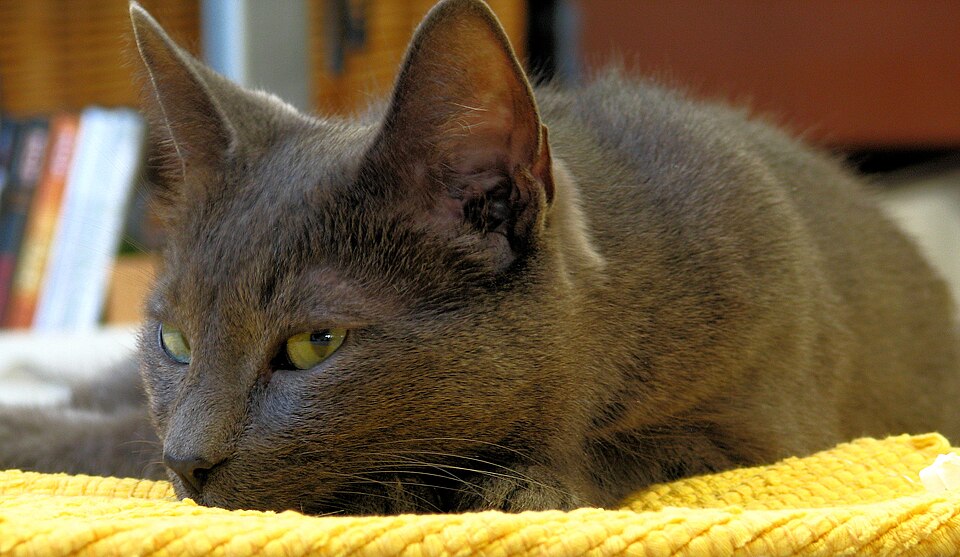
Thailand's "good luck cat," with a silver-tipped blue coat, a heart-shaped face and large green eyes. Smart, deeply bonded to its people and keen to run the household. Ask the breeder for DNA tests for inherited gangliosidosis and a newly described vascular disease.

 Lifespan15–18 yearsGCCF's estimate; no breed-specific study
 Weight6–10 lb (2.7–4.5 kg)GCCF; surprisingly heavy for its size
 OriginThailand
 CoatShort, silver-tipped bluesheds very little
 EnergyMedium-highenergetic but not hyperactive
 Maturity2–4 yearsgreen eye color settles by then
 With kidsRespectful kidslikes a calm home
 Home aloneStrugglesmay get anxious if left too long
The Korat is the cat that has been considered a bringer of good luck in Thailand for centuries. Its coat comes in a single color, blue with silver tips, its face is heart-shaped and its eyes are large and bright green. It looks small, but when you pick one up, it's surprisingly heavy and muscular. On this page we've pulled together its temperament, care needs, and the inherited diseases and DNA tests that matter in this breed, drawing on breed registry standards, veterinary resources and scientific studies.
- Temperament: Very smart, closely bonded to its people and attention-seeking; it likes being the "boss" of the household.
- One color: The Korat only comes in silver-tipped blue; kittens have yellow or amber eyes, and the green color settles at 2 to 4 years.
- Easy care: Its short, glossy single coat sheds very little; brushing once a week is enough.
- Health: There are DNA tests for the fatal inherited diseases GM1 and GM2 gangliosidosis, and a new inherited vascular disease was described in 2025.
- Being alone: It doesn't like long stretches alone; a calm, attentive home is best.
What to know
 What is the Korat like?
The Korat is a very smart cat. According to the CFA's breed profile, it can even learn tricks, but only when it agrees to. Its intelligence needs stimulation: interactive toys, puzzle toys and treats are recommended to keep it busy. It forms a strong bond with its people, seeks out contact and takes a close interest in everything going on at home.
A Korat considers itself the head of the family. The CFA suggests that if a new pet joins the household, you keep your focus on the Korat so its role isn't challenged, which helps prevent jealousy. The GCCF also says it gets along with other cats and dogs but expects to be at the top of the pecking order, can be possessive of its toys and can be stubborn about its likes and dislikes.
Sources differ a little on its voice: the CFA says the Korat can make a wide range of sounds and isn't shy about speaking up when it wants attention, while the GCCF describes it as a generally quiet cat that prefers a calm environment. Both agree that the Korat is energetic and playful, but not hyperactive.
Every cat is an individual. Breed traits describe general tendencies; how a cat was raised, how much contact it had with people as a kitten and its health shape its personality as much as its breed.
 Who is it a good fit for?
The Korat suits people living in a calm home who have time to play with their cat and keep it mentally busy.
| Situation | Good fit? |
|---|---|
| Apartment | Excellent; it likes calm surroundings, but needs play and climbing space |
| Family with kids | Good with calm, respectful children; the GCCF says it tolerates respectful kids |
| Other cats and dogs | Gets along, but wants to be the boss; introduce new pets slowly |
| Long hours alone | Hard; the GCCF says long periods alone can lead to separation anxiety |
| First-time cat owners | Good; easy to care for, as long as it gets attention and stimulation |
If you're thinking about adding a second pet, factor in the Korat's bossy streak; our guide to introducing two cats walks you through it step by step.
Where does it come from?
The Korat is a natural breed named after Thailand's Korat province; according to the CFA, it was first discovered in an area of that province. The CFA says the earliest known record of the breed is a book of cat poems from Thailand's Ayutthaya period (1350–1767) that describes 17 "good luck" cats. According to the GCCF, it is called "Si-Sawat" (greyish-blue) in Thailand and is considered a national cat and a symbol of good fortune. It was traditionally given to brides as a gift and is said to have taken part in rain ceremonies. According to the CFA, the Korat is rare even in Thailand.
The first two Korats were imported to the United States in 1959, and a group of nine more brought from Thailand ten years later strengthened the bloodlines. The CFA granted the breed championship status in 1966. The first Korats reached Britain in 1972, and the GCCF granted championship status in 1984. A large 2008 genetic study placed the Korat in the same group as Southeast Asian breeds like the Siamese, Burmese and Birman, and found it especially closely related to the Birman.
 Appearance and colors
Under the CFA standard, the Korat is a medium-sized, hard-bodied, muscular cat; its body is neither compact nor svelte, and its back is carried in a curve. Its most distinctive feature is its heart-shaped head: the eyebrow ridges form the top curves of the heart, and the cheeks and chin form the point. The ears are large, with rounded tips and a wide base.
- Weight: According to the GCCF, 6–10 pounds (about 2.7–4.5 kg); unusually heavy for its size. The CFA says it's not unusual for mature males to reach or exceed 10 pounds (about 4.5 kg), and that females are smaller.
- Color: Silver-tipped blue only. Each hair is lighter at the root, darkens toward blue and ends in a silver tip, giving the coat a silvery halo. White spots or any other color aren't accepted.
- Kittens: According to the GCCF, kittens are silver-blue from birth, but the silver tipping keeps developing until about two years of age. Faint "ghost" tabby markings in kittens disappear as they mature.
- Eyes: Large, luminous and green. According to the CFA, kittens and young cats can have yellow, amber or amber-green eyes; the true green usually settles at 2 to 4 years.
- Maturity: The CFA says it reaches full maturity at 2 to 4 years; the GCCF says full physical development takes about four years.
Daily care
The Korat is very easy to groom. According to the CFA, its glossy single coat sheds very little; brushing once a week keeps it in good condition and strengthens your bond. The GCCF also recommends gentle brushing or combing followed by stroking with your hand.
- Mental stimulation: For this breed, play matters as much as food. Puzzle toys, food-hiding games and short reward-based training sessions are good for it. Our guide to playing with an indoor cat has ideas.
- Climbing: According to the GCCF, it's an athletic cat that loves to play and climb. Add a cat tree and shelves.
- Teeth, claws and ears: As with any cat, the CFA recommends regular nail trims, tooth brushing and keeping the ears clean.
- A calm space: According to the GCCF, the Korat prefers a calm environment; on noisy days, leave it a quiet corner to retreat to.
 Diet
Korats don't need a special food; a complete, balanced cat food suited to their age is enough. Because it's muscular and heavy for its size, don't let the number on the scale fool you; what matters is your cat's body condition.
- Measure food; decide the daily amount with your vet based on your cat's ideal weight.
- You should be able to feel the ribs under a thin layer of fat.
- Food puzzles feed and entertain this clever breed at the same time.
- Count treats as part of the daily food, and always have fresh water available.
 Health issues to know about
The CFA describes the Korat as a natural and generally healthy breed, and the GCCF says it is generally long-lived. Still, there are a few known inherited diseases in this breed, and DNA tests for them. The information below is for awareness only; ask your vet about diagnosis and treatment.
GM1 and GM2 gangliosidosis
Gangliosidosis is a fatal inherited disease in which fat-like substances build up in nerve cells and the nervous system steadily deteriorates. Two types have been described in the Korat:
- GM1: According to Langford Vets, affected kittens develop tremors at about 3 months of age, followed by blindness and seizures, and die by 9 to 10 months. UFAW also describes the disease as starting at 2 to 3 months, progressing steadily and becoming fatal at around one year.
- GM2: According to Langford, tremors and loss of coordination can begin as early as 4 weeks of age, and kittens die by 8 months.
Both diseases are recessive: a kitten has to inherit one copy from each parent to be affected, while carriers look healthy. According to Langford, both are found at low frequency in Korats. The GCCF says the Korat was the first breed DNA-screened for these two diseases, and that UK lines were tested in 1998 and found clear. When you get a kitten, ask for both parents' GM1 and GM2 results.
Inherited atherosclerosis (hardening of the arteries)
A study published in 2025 described spontaneous atherosclerosis in Korats, a disease in which cholesterol builds up in the artery walls. Affected cats had very high blood cholesterol and showed signs of heart failure, and the disease was fatal. The researchers linked it to a change in a gene called LDLR; in a group of 309 Korats, about 20% were carriers. The GCCF says a genetic test has been available since 2025 and that breeders are testing their lines. This is a new finding, so ask the breeder whether they test for it.
Before anesthesia
The GCCF notes that Korats usually have little body fat, and that it's important for the vet to take this into account when planning anesthesia for surgery. Before a spay, neuter or any other procedure, tell your vet your cat's breed.
- Tremors, wobbling or loss of balance in a kitten
- Difficulty breathing, open-mouth breathing or tiring quickly
- Seizures
- Loss of appetite and hiding (cats hide pain)
How long does it live?
We couldn't find a scientific lifespan study specific to the Korat, and the ranges sources give differ: the GCCF says 15–18 years, while PetMD's vet-reviewed profile says 10–15 years. These are estimates; there's no real breed-specific data. For comparison, in the large UK VetCompass study, mixed-breed cats had a life expectancy at birth of 11.89 years.
Parents tested for inherited diseases, a healthy weight, regular vet checkups and a safe indoor life are the most concrete steps you can take to help your Korat live a long life.
 Before you get one
- Consider a shelter: Purebred cats end up in shelters and rescues too, and plenty of short-haired blue cats are waiting for the same love. Follow adoption listings and rescue groups.
- If you buy from a breeder: Ask to meet the parents, and ask for GM1, GM2 and atherosclerosis DNA results and vaccination records. The CFA recommends asking for health documentation showing the kitten's vaccinations are complete.
- A rare breed: According to the CFA, there are relatively few breeders, so you may have to wait for a kitten. Steer clear of sellers who rush you or can't provide paperwork.
- Registration: Rules vary by country; many places require or recommend microchipping. In Türkiye, owned cats must be microchipped and registered in the PETVET system.
- The first days: Prepare a quiet room with a litter box, water, a hiding place and toys. Our guide to the first week with a new cat walks you through it step by step.
Frequently asked questions
Is the Korat the same as a Russian Blue?
No. Both are blue and short-haired, but the Korat comes from Thailand, has a heart-shaped head and noticeable silver tips in its coat, and its eyes turn bright green at maturity. See our Russian Blue page for details.
Why aren't my kitten's eyes green?
Korat kittens can have yellow, amber or amber-green eyes. According to the CFA, the true green usually settles at 2 to 4 years.
Is the Korat good for people with allergies?
The CFA notes that Korat hair doesn't float off easily when you stroke the cat, but states plainly that this doesn't make the Korat a low-allergen breed. If you have allergies, talk to your doctor and spend time with the cat before adopting.
Can I leave my Korat alone?
For short periods, yes, but the GCCF says long periods alone can lead to separation anxiety in Korats. If you're out for long hours, toys, puzzles and visits from someone you trust help.
Do Korats come in other colors?
No. Registries recognize the Korat only in silver-tipped blue; cats of other colors aren't considered Korats.
Sources
- CFA (Cat Fanciers' Association) · Korat ırk tanıtımı ve standardı
- GCCF (Governing Council of the Cat Fancy) · Korat
- Science for Animal Welfare (UFAW) · Korat: GM1 gangliozidoz
- Langford Vets (Bristol Üniversitesi) · Korat GM1 gangliosidosis genetik testi
- Langford Vets (Bristol Üniversitesi) · Korat GM2 gangliosidosis genetik testi
- Hytönen M. K. ve ark. · A feline model of human low-density lipoprotein receptor-related atherosclerosis, Animal Genetics (2025)
- Lipinski M. J. ve ark. · The ascent of cat breeds: genetic evaluations of breeds and worldwide random-bred populations, Genomics (2008)
- PetMD (veteriner onaylı) · Korat
- Teng ve ark. · Life tables of annual life expectancy and risk factors for mortality in cats in the UK, Journal of Feline Medicine and Surgery (2024)
- Resmî Gazete · Kedi, Köpek ve Gelinciklerin Kimliklendirilmesi ve Kayıt Altına Alınmasına Dair Yönetmelik (26 Şubat 2018)
By Tüylüm · Last checked: November 3, 2026. Compiled from the sources above and written in our own words. Spotted a mistake? Write to [email protected] and we'll fix it right away. Photo from Wikimedia Commons, used under the license shown below it.