 Tüylüm
Norwegian Forest Cat
A big, powerful cat dressed for Scandinavian winters in a water-repellent double coat. Independent but sociable, it loves climbing high and sudden bursts of play. A DNA test for glycogen storage disease type IV and heart screening are the things to ask about when choosing a kitten.

 Lifespan≈ 10 yearsUK 2019 data; based on few cats
 Weight12–16 lbmales (5.4–7.3 kg); females 9–12 lb
 OriginNorwayfarm and forest cats
 CoatSemi-long, doublewater-repellent; heavy spring shed
 EnergyModerateprone to sudden bursts of play
 MaturityUp to 5 yearsvery slow to mature
 With kidsGoodCFA: gets along well with children
 Other petsUsually goodgets along with cats and dogs
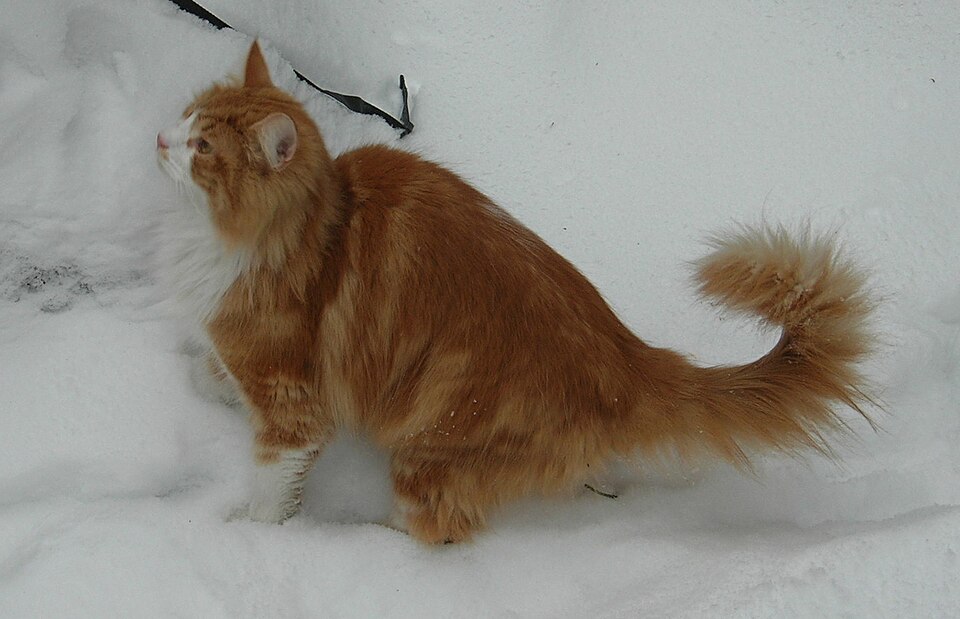
The Norwegian Forest Cat is a big, strong, longhaired cat shaped by the cold forests and farms of the country it's named after. Its water-repellent double coat, full ruff and triangular face make it easy to recognize. It's independent but doesn't like being alone, and it loves climbing high and sudden bursts of play. On this page we've pulled together its temperament, care needs and health issues from breed registry standards and scientific studies.
- Temperament: Independent, smart and friendly; not clingy, but seeks company if left alone too long.
- A climber: It loves heights, so a tall scratching post or cat tree is a must.
- Coat: A water-repellent double coat that's easier to care for than it looks, though it sheds its winter coat heavily in spring.
- Health: There's a DNA test for glycogen storage disease type IV (GSD IV), and heart muscle disease has been reported in the breed. Ask for the parents' test and heart screening results.
- Slow to grow: According to the CFA, it can take up to 5 years to reach full size.
What to know
 What is the Norwegian Forest Cat like?
The Norwegian Forest Cat is independent and intelligent; the CFA links this to the breed's long history of fending for itself. It isn't clingy, but if left alone for too long it will go looking for company. It can be a lap cat, but it always decides for itself when to get on and when to get off. It usually stays near you and tries to "help" with whatever you're doing, until it remembers something more important and wanders off.
According to the CFA, it's moderately active, sensitive, friendly and adaptable, and enjoys being part of the family's daily routine. It's known for sudden bursts of energy: it runs, hides and ambushes its toys, then rests for a long time. Its sounds range from a soft purr to bird-like chirps when it gets excited.
One of its most distinctive habits is climbing high. The CFA warns that if it doesn't get a tall scratching post or cat tree, its favorite spot may end up being the top of your kitchen cabinets.
Every cat is an individual. Breed traits describe general tendencies; how a cat was raised, how much contact it had with people as a kitten and its health shape its personality as much as its breed.
 Who is it a good fit for?
The Norwegian Forest Cat suits families who can make room for climbing, respect its independence and let the cat decide when it wants a lap.
| Situation | Good fit? |
|---|---|
| Apartment | Good, as long as there's vertical space (shelves, a cat tree) |
| Family with kids | Good; according to the CFA, it gets along well with children |
| Other cats and dogs | Usually gets along; introduce them slowly |
| Long hours alone | Moderate; independent, but doesn't enjoy long stretches alone |
| First-time cat owners | Good; even-tempered, with manageable coat care |
Teach children not to pick the cat up against its will and to leave it a high place to escape to. For this breed, a high shelf is both a resting spot and a refuge during noisy moments. For ideas, see our article on why cats love high places.
Where does it come from?
The breed's exact origins aren't known. According to the CFA, these cats lived for a long time in Norway as working farm cats that kept rodents in check. Their Norwegian name, "skogkatt," simply means forest cat. In Norse mythology, the chariot of Freya, goddess of love and fertility, was pulled by two giant cats, and fans of the breed like to see the Norwegian Forest Cat in them. It's also thought that Vikings may have taken these cats aboard their ships to keep rodents away, but that hasn't been proven.
According to the CFA, the breed was nearly lost as a distinct type because of interbreeding with shorthaired strays. In the mid-1970s the first breed club was founded in Norway; its members started a breeding program with carefully selected cats that had no pedigree, and those cats were approved for registration by a panel of judges. FIFe recognized the breed in 1977. The first breeding pair went to the United States in 1979, and the breed earned championship status with the CFA in 1993.
 Appearance and colors
It's a large, sturdy, muscular cat with a broad chest and strong bones. The head is shaped like a triangle with equal sides, and the profile runs straight from the brow to the tip of the nose; this straight profile is one of the features that set it apart from the Maine Coon. The eyes are large and almond-shaped. Because the hind legs are longer than the front legs, the rump sits higher than the shoulders.
- Weight: According to the CFA, mature males weigh 12 to 16 pounds (about 5.4–7.3 kg) and females 9 to 12 pounds (about 4–5.4 kg).
- Coat: A double coat made up of a dense undercoat covered by long, glossy, water-repellent guard hairs. There's a collar at the neck, "mutton chops" on the cheeks and a full ruff on the chest, plus full "britches" on the hind legs. The tail is long and bushy.
- Ears and paws: The ears are well furnished with hair inside and may have lynx tips; the large, round paws have tufts between the toes. The CFA notes that this build protects the cat from wind and snow.
- Colors: Almost every color and pattern is accepted except chocolate, lilac, cinnamon, fawn and pointed (Himalayan) patterns; the FIFe standard allows any amount of white. A yellowish color called amber is unique to the breed: a 2009 genetic study showed that this color, reportedly not seen in other breeds, comes from a recessive gene change.
- Eye color: Green, gold, green-gold or copper; white cats and cats with white may have blue or odd eyes.
The breed matures very slowly: according to the CFA, it can take up to 5 years to reach full size. The FIFe standard notes that kittens can take up to 6 months to grow their guard hairs and that coat length changes with the seasons, so it's normal for the cat to look "slimmer" in summer.
Daily care
This full double coat needs less care than you'd expect. According to the CFA, it's generally tangle-free compared with other longhaired breeds, and regular combing with a metal comb is enough. Some coat textures mat more easily; adjust how often you comb as you get to know your cat's coat.
- Spring shedding: Shedding picks up in spring as the winter coat gives way to a lighter summer coat; the CFA recommends combing more often during this time.
- Bathing: The water-repellent coat takes a long time to get wet and even longer to dry, so baths are a hassle and usually unnecessary. If one is needed, ask your vet.
- Climbing and scratching: A tall, sturdy scratching post, wall shelves and a cat tree are basic needs for this breed.
- Play: Ambush and chase games give it a safe outlet for its sudden bursts of energy.
- Ears, eyes and claws: Check them weekly; show your vet any redness, odor or discharge.
For more ideas, see our articles on cat grooming and why cats scratch.
 Diet and weight
Norwegian Forest Cats don't need a special food; a complete, balanced cat food that suits their age and lifestyle is enough. Because they keep growing for years, talk to your vet about when to switch from kitten food to adult food and how much to feed each day.
A full coat easily hides weight gain. Being able to feel the ribs under a thin layer of fat, and seeing a waist when you look from above, are good signs; trust your hands and a scale rather than your eyes. In the 2024 study by Teng and colleagues, cats whose weight was further from the median for their breed and sex had shorter lives. Measure food, count treats as part of the daily amount and weigh your cat once a month. Climbing and play are the most natural ways to keep its weight in check.
 Health issues to know about
The CFA notes that two inherited problems have occurred in this breed and that breeders routinely test for them. The information below is for awareness only; ask your vet about diagnosis and treatment.
Glycogen storage disease type IV (GSD IV)
An inherited metabolic disease that disrupts how the body stores and uses sugar. According to PawPeds, among cats it has only been seen in the Norwegian Forest Cat. The disease is recessive: a kitten is only affected if both parents carry the change. Most affected kittens are stillborn or die shortly after birth because their blood sugar drops. A very small number seem healthy for their first months, but according to a 2007 study, a progressive nerve and muscle disease begins in these kittens at around 5 months of age.
The same study screened 402 Norwegian Forest Cats and found 58 carriers and 4 affected cats. There's a DNA test for it; according to PawPeds, it has been available in Europe since 2007. Carrier cats are healthy, but two carriers shouldn't be bred together. When buying a kitten, ask for the parents' test results.
Heart muscle disease (cardiomyopathy)
Norwegian Forest Cats are often listed among the breeds predisposed to heart muscle disease. In a 2015 study, mild thickening of the left ventricle was found in a quarter of 53 cats screened by ultrasound, and pedigree records also supported the idea that the disease runs in families. Heart disease may show no signs for a long time, so it's important to ask for the parents' heart ultrasound (echocardiography) results and to keep up with your cat's regular vet checkups.
- Fast, labored or open-mouth breathing
- Sudden weakness or paralysis in the hind legs
- Trembling, unsteadiness or stunted growth in a kitten
- Loss of appetite and hiding (cats hide pain)
How long does it live?
A 2024 study using the Royal Veterinary College's VetCompass data found a life expectancy at birth of 9.95 years for Norwegian Forest Cats that died in the UK in 2019. However, this figure is based on only 15 cats and has a very wide confidence interval (7.55–12.35 years), so read it with caution. The longest-lived cat in that group was over 19. In the same study, mixed-breed cats had a life expectancy of 11.89 years.
Life expectancy is strongly affected by cats lost at a young age, so this number doesn't mean "a Norwegian Forest Cat dies at 10." The same study shows that neutered cats and cats at their ideal weight live longer. Regular vet checkups, heart screening and weight tracking are the most concrete ways to extend this breed's life.
 Before you get one
- Consider a shelter: Purebred cats end up in shelters and rescues too. A big, longhaired mixed-breed cat can make a similar companion.
- If you buy from a breeder: Ask to meet the parents, and ask for GSD IV DNA test and heart ultrasound results, plus vaccination records.
- Red flags: Steer clear of sellers who won't show you the mother, can't provide test results, always have kittens available or rush you. Not every big longhaired cat is a Norwegian Forest Cat; pedigree records and paperwork matter.
- Getting your home ready: A tall, sturdy cat tree, wall shelves and screened windows are the first things to get for this climber.
- Registration: Rules vary by country; many places require or recommend microchipping. In Türkiye, owned cats must be microchipped and registered in the PETVET system.
Frequently asked questions
How do you tell a Norwegian Forest Cat from a Maine Coon?
Both are big and longhaired, but the Norwegian Forest Cat's head is shaped like an equilateral triangle with a straight profile, while the Maine Coon has a squarer head with a slightly concave profile. The Norwegian Forest Cat's hind legs are also noticeably longer. See our Maine Coon page for details.
Do they shed a lot?
Yes. According to the CFA, shedding picks up especially in spring, when the winter coat gives way to a lighter summer coat. Combing more often during this time cuts down both the hair around your home and the hair your cat swallows.
How big do they get?
According to the CFA, mature males weigh about 12 to 16 pounds (5.4–7.3 kg) and females 9 to 12 pounds (4–5.4 kg). Reaching full size can take up to 5 years. Work out your own cat's ideal weight with your vet.
Are they lap cats?
They can be, but they make the call. They usually like being near you and joining in on what you're doing; they climb into your lap when they want to and leave when they want to. Not forcing it builds trust.
Is a GSD IV carrier sick?
No. Because the disease is recessive, a cat carrying one copy is healthy; the problem shows up in kittens when two carriers are bred together. That's why the test matters most in breeding.
Sources
- CFA (Cat Fanciers' Association) · Norwegian Forest Cat ırk tanıtımı ve standardı
- FIFe · Norwegian Forest Cat ırk standardı (2026)
- Fyfe ve ark. · A complex rearrangement in GBE1 causes both perinatal hypoglycemic collapse and late-juvenile-onset neuromuscular degeneration in glycogen storage disease type IV of Norwegian forest cats, Molecular Genetics and Metabolism (2007)
- PawPeds · GSD IV sağlık programı: bilgi
- März ve ark. · Familial cardiomyopathy in Norwegian Forest cats, Journal of Feline Medicine and Surgery (2015)
- Peterschmitt ve ark. · Mutation in the melanocortin 1 receptor is associated with amber colour in the Norwegian Forest Cat, Animal Genetics (2009)
- Teng ve ark. · Life tables of annual life expectancy and risk factors for mortality in cats in the UK, Journal of Feline Medicine and Surgery (2024)
- Resmî Gazete · Kedi, Köpek ve Gelinciklerin Kimliklendirilmesi ve Kayıt Altına Alınmasına Dair Yönetmelik (26 Şubat 2018)
By Tüylüm · Last checked: November 3, 2026. Compiled from the sources above and written in our own words. Spotted a mistake? Write to [email protected] and we'll fix it right away. Photo from Wikimedia Commons, used under the license shown below it.