 Tüylüm
Maine Coon
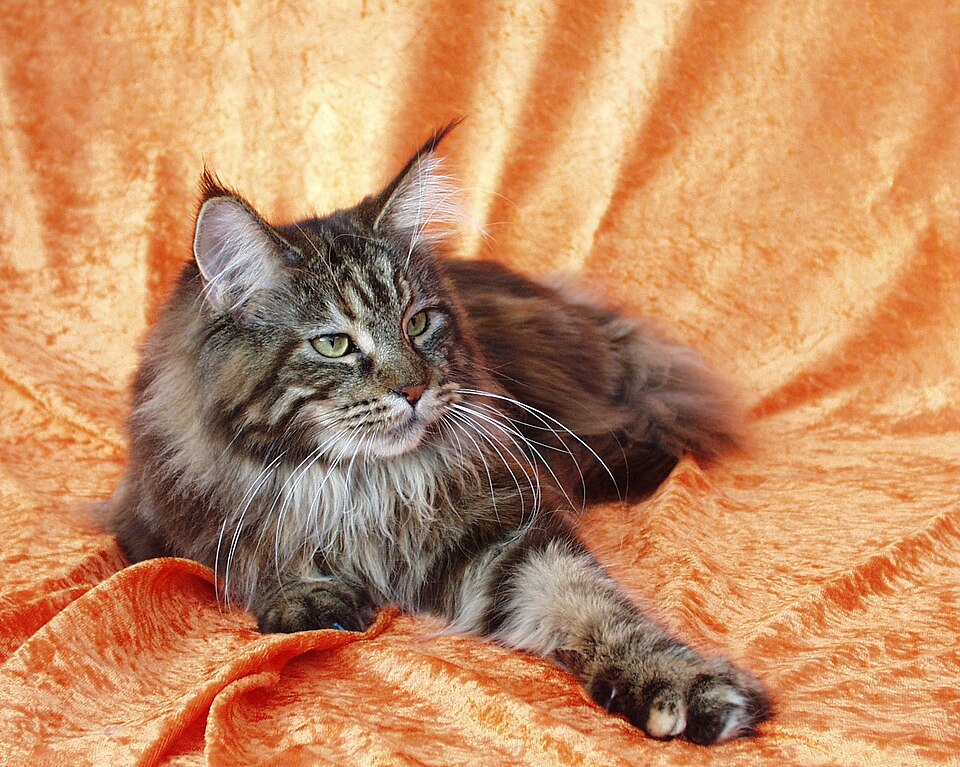
A large, longhaired, easygoing cat descended from the farm cats of the northeastern United States. It takes an interest in everyone in the family and "talks" in chirps and trills. Screening for the heart disease HCM, hip dysplasia and SMA is the most important thing when choosing a kitten.

 Lifespan≈ 9.7 yearsUK 2019 data; PDSA average 12–15
 Weight20 lb (9 kg)+mature males; females are smaller
 OriginNew England, USAfarm cats of the Northeast
 CoatLong and thickcomb 2–3 times a week
 EnergyModerateloves play, also happy to lounge
 MaturityUp to 3 yearsslow to mature
 With kidsGood-naturedits size can be intimidating at first
 Other petsUsually goodintroduce them slowly
The Maine Coon is known as the "gentle giant" of the cat world: a big, muscular, longhaired cat with a calm, friendly temperament. It takes an interest in everyone in the house, loves to play and "talks" more in chirps and trills than in meows. On this page we've pulled together its temperament, care needs and health issues from breed registry standards, animal welfare resources and scientific studies.
- Temperament: Sociable, easygoing and playful; bonds with the whole family without being clingy.
- A big cat: Mature males can top 20 pounds (9 kg) and keep growing until about age 3.
- Coat care: Its long, thick coat can mat if it isn't combed a few times a week.
- Health: HCM (heart disease), hip dysplasia and SMA (a nerve and muscle disease) are known issues in this breed; always ask for the parents' screening results.
- Lifespan: In UK data from 2019, life expectancy was about 9.7 years; some well-cared-for cats live past 15.
What to know
 What is the Maine Coon like?
The Maine Coon is a friendly, loyal and curious cat. According to the CFA's breed profile, it doesn't pick a single favorite person; it spends time with everyone in the family and moves between them. Because it descends from cats that hunted mice on farms, it's smart, and it's no surprise when one finds the toy you hid and picks the game right back up.
Most Maine Coons like being near people but don't demand constant attention. The CFA describes the breed as "fairly independent": it wants your attention when you're home and finds its own entertainment when you're busy. Cats vary a lot when it comes to laps; PDSA notes that many Maine Coons would rather run around on the floor than curl up on your lap. If your cat doesn't climb into your lap, that's not coldness; it's simply showing that it wants to be with you in a different way.
Its voice is one of its best-known traits. Along with the classic meow, it communicates with short chirps, trills and purrs. Even so, it isn't considered a chatty breed. Many are fascinated by water: they watch a dripping faucet, dip a paw into the water bowl or drop their toys in it.
Every cat is an individual. Breed traits describe general tendencies; how a cat was raised, how much contact it had with people as a kitten and its health shape its personality as much as its breed.
 Who is it a good fit for?
The Maine Coon suits families who want to play with their cat, have room for a big one and can spend some time on coat care a few times a week.
| Situation | Good fit? |
|---|---|
| Apartment | Good, as long as there's room to climb and play |
| Family with kids | Good; patient, but teach kids not to carry such a big cat around |
| Other cats and dogs | Usually gets along; introduce them slowly |
| Long hours alone | Moderate; independent, but still needs daily play and attention |
| First-time cat owners | Good; just be ready for coat care and health screening |
The CFA points out that children and other pets may be a little wary of this cat's size at first, but they usually get along well afterward. Teach children never to pick the cat up against its will and to always support its hind legs when lifting it: a 17 to 20 pound (8 to 9 kg) cat is heavy for small arms.
Where does it come from?
The Maine Coon is a natural breed from New England, the region in the northeastern United States that includes the state of Maine it's named after. The FIFe standard traces its origin to the working cats that hunted mice on farms in the area. According to the CFA, its ancestors are thought to be shorthaired ship cats that arrived with the early settlers; its long, thick coat gives it built-in protection against the region's harsh winters.
The "Coon" part of its name comes from a myth inspired by the bushy, ringed tails of brown tabbies: people believed cats had mated with raccoons, which is genetically impossible. Other stories, such as Marie Antoinette's cats or a sea captain named "Coon," have been told to explain the breed's long coat; they're legends.
At the first cat show in the United States, in 1895, a brown tabby Maine Coon named Cosey was chosen Best Cat. The breed faded from view in the early 20th century as other longhaired breeds became popular, then made a comeback thanks to dedicated breeders in the 1960s and 70s and earned championship status with the CFA in 1976. FIFe recognized it in 1982. Today it's one of the best-known cat breeds in the world.
 Appearance and colors
According to the CFA, the Maine Coon is the largest of all pedigreed cats. It has a long, rectangular body, a broad chest and solid bones. The head has a squared-off outline with a medium-length nose; the ears are large and often tipped with lynx-like tufts. The eyes are large and expressive.
- Weight: According to the CFA, it isn't unusual for mature males to reach or exceed 20 pounds (about 9 kg); females are usually smaller. PDSA gives an average weight of about 15 pounds (7 kg).
- Coat: Shorter on the shoulders and longer on the sides, belly and hind legs, ending in a long, plumed tail. There may be a mane-like ruff around the neck.
- Paws: Large, round and tufted between the toes, a build that looks made for walking on snow.
- Colors: Brown, red and silver tabbies, black, white, blue, cream, smoke, shaded, tortoiseshell, calico and patterns with white are all in the standard. The CFA standard doesn't accept chocolate, lavender or the Himalayan (pointed) pattern.
- Eye color: Green, gold, green-gold or copper; white cats and cats with white may have blue or odd eyes.
The breed matures slowly: according to the CFA, it can take up to three years to reach full size. It's normal for a one-year-old Maine Coon to still look young and lanky.
Daily care
The coat is long but silky and falls smoothly, so regular combing keeps it manageable. The CFA recommends combing two or three times a week for 5 to 10 minutes to prevent mats and hairballs, while PDSA says the coat needs a little attention every day. Pay extra attention to the belly and hind legs, where the coat is longest; that's where mats usually start. If you start with short, pleasant sessions while your cat is a kitten, it will learn to see combing as a kind of game.
- Bathing: Most Maine Coons don't need regular baths. If your cat gets dirty or its coat turns greasy, it can be washed with a cat shampoo your vet recommends.
- Claws: A tall, sturdy scratching post is a must; it should be heavy enough not to tip over when a big cat climbs it.
- Litter box: A big cat can't get comfortable in a small box; choose a roomy box that suits its size, with a side it can step over easily.
- Play and climbing: Sturdy shelves, a large cat tree and daily hunting games with wand toys keep both its muscles and its mood in good shape.
- Water: For water-loving cats, a wide, tip-proof water bowl or a cat fountain is a good idea.
For more ideas, see our articles on cat grooming, litter boxes and why cats love high places.
 Diet and weight
Maine Coons don't need a special food; a complete, balanced cat food that suits their age and lifestyle is enough. Two things matter in this breed:
- Slow growth: Because Maine Coons keep growing for years, talk to your vet about when to switch from kitten food to adult food and how much to feed each day.
- Don't confuse size with weight: It's normal for a big-boned cat to be heavy, but the "large breed" idea makes overfeeding easy. A 2019 study of hip dysplasia found an inherited link in this breed between body weight and how severe the dysplasia was, and extra weight also puts strain on the joints.
Being able to feel the ribs under a thin layer of fat, and seeing a waist when you look from above, are good signs. A long coat can hide weight, so trust your hands and a scale rather than your eyes. In the 2024 study by Teng and colleagues, cats whose weight was further from the median for their breed and sex had shorter lives. Measure food, count treats as part of the daily amount and weigh your cat once a month.
 Health issues to know about
Some inherited problems are well known in the Maine Coon, and breeders have screening tests for most of them. The information below is for awareness only; ask your vet about diagnosis and treatment.
Hypertrophic cardiomyopathy (HCM)
HCM is the most common heart disease in cats: the wall of the heart's left ventricle thickens and the heart has trouble filling. The Cornell Feline Health Center lists the Maine Coon among the breeds predisposed to HCM. A gene change linked to the disease has been found in Maine Coons (the A31P change in the MYBPC3 gene), and there's a DNA test for it using a saliva sample. UFAW reports that about a third of Maine Coons, both in the UK and in a multinational study, carry this change.
An important detail: according to UFAW, Maine Coons that test negative can still develop HCM, because other, still unknown genes may cause it. That's why a DNA test isn't enough on its own; an ultrasound of the heart (echocardiography) is the most reliable way to see the disease. UFAW recommends not breeding cats that carry one or two copies of the change or that show HCM on ultrasound. Cornell notes that breathing faster than 35 breaths a minute at rest can be a sign of heart failure.
Hip dysplasia
This is when the hip joint doesn't fit together properly, which can lead to wear and lameness over time. Because cats hide pain, the signs can be subtle: avoiding jumps, reluctance on stairs, stiffness in the hind legs. A 2018 study based on records from the Orthopedic Foundation for Animals (OFA) in the US found hip dysplasia in 24.9% of Maine Coons; a 2019 study using 20 years of data from the Sweden-based PawPeds screening program found 37.4%. The second study showed that dysplasia is inherited and that its severity dropped with selective breeding; the authors also caution against breed standards that reward very large cats. Ask the breeder for the parents' hip X-ray results.
Spinal muscular atrophy (SMA)
An inherited disease in which the loss of motor nerve cells in the spinal cord weakens the muscles of the trunk and legs. According to PawPeds, signs start at 3 to 4 months of age: a swaying walk in the hindquarters, weak jumping and thinning of the hind leg muscles. Affected kittens aren't in pain; they eat and play, and many live comfortably for years as indoor cats. The disease is recessive: a kitten is only affected if both parents carry the change. There's a DNA test for it, so ask the breeder.
Other issues
PDSA also lists kneecap dislocation (patellar luxation) in this breed. Extra toes (polydactyly) are common in some Maine Coon lines; a 2017 study found no obvious harm to welfare. If your cat has extra toes, don't forget them when you trim its claws.
- Fast, labored or open-mouth breathing
- Sudden weakness, paralysis or severe pain in the hind legs
- Limping, avoiding jumps or reluctance to move
- Loss of appetite and hiding (cats hide pain)
How long does it live?
A 2024 study using the Royal Veterinary College's VetCompass data found a life expectancy at birth of 9.71 years (confidence interval 8.42–11.00) for 69 Maine Coons that died in the UK in 2019; the longest-lived cat in that group was over 21. In the same study, mixed-breed cats had a life expectancy of 11.89 years. PDSA gives an average lifespan of 12 to 15 years for the breed.
Life expectancy is strongly affected by cats lost at a young age, so this number doesn't mean "a Maine Coon dies at 10." The same study shows that neutered cats and cats at their ideal weight live longer. Regular vet checkups, heart screening, and keeping an eye on weight and joints are the most concrete ways to extend this breed's life.
 Before you get one
- Consider a shelter: Purebred cats end up in shelters and rescues too. A big, longhaired mixed-breed cat can also make a companion much like a Maine Coon.
- If you buy from a breeder: Ask to meet the parents, and ask for HCM DNA test and heart ultrasound results, hip X-rays and SMA test results. PDSA suggests discussing the health history of the parents and grandparents.
- Red flags: Steer clear of sellers who won't show you the mother, can't provide screening results, always have kittens available or brag about "the biggest kittens." Size is not a sign of health.
- Space and costs: A big cat needs a big litter box, a sturdy scratching post and a roomy carrier.
- Registration: Rules vary by country; many places require or recommend microchipping. In Türkiye, owned cats must be microchipped and registered in the PETVET system.
Frequently asked questions
How big do Maine Coons get?
According to the CFA, it's common for mature males to top 20 pounds (9 kg), while females are smaller; PDSA gives an average weight of about 15 pounds (7 kg). They reach full size by around age 3. Work out your own cat's ideal weight with your vet.
Do Maine Coons shed?
Yes. Their long, thick coat sheds. The CFA recommends combing two or three times a week to keep shedding and hairballs under control, which also prevents mats.
Do they like being held?
It depends on the cat. Some move from lap to lap, but many prefer to sit beside you or play on the floor. Always support the hind legs when you lift one.
Do Maine Coons have extra toes?
Extra toes (polydactyly) are common in some breeding lines; a 2017 study found no obvious harm to welfare. The CFA standard, however, calls for five toes in front and four in back on show cats.
If the HCM test is negative, is the heart healthy?
Not always. According to UFAW, Maine Coons that test negative can still develop HCM. Regular heart ultrasounds tell you more than the DNA test alone; ask your vet how often to have one.
How do you tell a Maine Coon from a Norwegian Forest Cat?
Both are big and longhaired, but the Maine Coon has a squarer head, a medium-length nose and a slightly concave profile, while the Norwegian Forest Cat has a triangular face and a straight profile. See our Norwegian Forest Cat page for details.
Sources
- CFA (Cat Fanciers' Association) · Maine Coon Cat ırk tanıtımı ve standardı
- FIFe · Maine Coon ırk standardı (2026)
- PDSA · Maine Coon ırk bilgisi
- UFAW Genetic Welfare Problems · Maine Coon: Hipertrofik kardiyomiyopati
- Cornell Feline Health Center · Cardiomyopathy
- Loder ve Todhunter · Demographics of hip dysplasia in the Maine Coon cat, Journal of Feline Medicine and Surgery (2018)
- Low ve ark. · Demography, heritability and genetic correlation of feline hip dysplasia and response to selection in a health screening programme, Scientific Reports (2019)
- PawPeds · Spinal Muscular Atrophy in Maine Coon Cats (SMA)
- Hamelin ve ark. · Clinical characterisation of polydactyly in Maine Coon cats, Journal of Feline Medicine and Surgery (2017)
- Teng ve ark. · Life tables of annual life expectancy and risk factors for mortality in cats in the UK, Journal of Feline Medicine and Surgery (2024)
- Resmî Gazete · Kedi, Köpek ve Gelinciklerin Kimliklendirilmesi ve Kayıt Altına Alınmasına Dair Yönetmelik (26 Şubat 2018)
By Tüylüm · Last checked: November 3, 2026. Compiled from the sources above and written in our own words. Spotted a mistake? Write to [email protected] and we'll fix it right away. Photo from Wikimedia Commons, used under the license shown below it.