 Tüylüm
Scottish Longhair (Highland Fold and Straight)
The longhaired branch of the Scottish line: a round-faced, soft-eyed cat with a heavy coat. The folded-ear version (Highland Fold) comes from a gene tied to a painful joint disease; the straight-eared version (Highland Straight) is the one not expected to carry it, but that still needs confirming with DNA testing.

 LifespanNo datawe found no lifespan study for this line
 WeightMedium-sizedfemales a bit smaller (CFA)
 OriginScotland
 CoatMedium-long, ruffedweekly, watch for mats
 EnergyCalmcurious, up for play
 VoiceQuietrarely vocal
 With kidsUsually patientmay be reserved with strangers
 Alone timeDislikes itshouldn't be alone for long
The Scottish Longhair is the longer-coated cat from the same line as the Scottish Fold and the Scottish Straight. Registries call it by different names: Highland Fold (folded ears) and Highland Straight (straight ears) are the most common, while the CFA simply says "longhair Scottish Fold." It has the same round face and soft gaze, plus a fluffy coat. We cover both varieties on this one page, and we state plainly that the folded-ear gene causes a painful joint disease, because it is the most important thing to know before you bring one home.
- Temperament: Calm, affectionate, attached to its people; can be a little reserved with strangers.
- Coat care: Weekly combing is usually enough, but the long coat can mat; pay extra attention to the ruff and the hind legs.
- Two varieties: The folded-ear cat (Highland Fold) carries a joint-disease risk; the straight-eared cat (Highland Straight) is the one not expected to carry the gene.
- Testing is a must: Even for a straight-eared cat, ask for the TRPV4 DNA test results of the parents and the kitten.
- Registration: In Türkiye, microchipping and PETVET registration are mandatory for cats.
What to know
 What is the Scottish Longhair (Highland Fold and Straight) like?
Our temperament information rests on the CFA's description of the Scottish Fold, and the longhair variety is part of the same breed. According to the CFA these cats are affectionate, calm and people-oriented. They are quiet and curious, usually patient with children, and can learn simple tricks. They may be reserved with strangers and with other cats.
The CFA also notes that they don't cope well with long stretches alone. They suit someone who is home during the day, or who can set aside regular time for play and chat.
This temperament information is for the breed overall; the longhair variety hasn't had its own personality study. Every cat is an individual, and the home it grows up in and its early contact with people matter as much as breed.
 Who is it a good fit for?
It suits a calm home, with people who want time with their cat and are willing to keep up a longhaired cat's grooming routine.
| Situation | A good fit? |
|---|---|
| Apartment | Yes; a calm house cat |
| Family with children | Usually; patient, but it needs a corner to retreat to |
| Other cats and dogs | May be reserved; introduce slowly |
| Long hours alone | Not ideal |
| First-time cat owners | Possibly, if you take grooming and health testing seriously |
Where does it come from?
The story begins in 1961 in Scotland's Tayside region: according to the CFA, Susie, a white farm cat with folded ears, and her daughter Snooks laid the foundation of the breed. Breeders crossed this line with domestic cats and British Shorthairs.
Organizations classify the cat differently:
- CFA: The longhair Scottish Fold gained championship status in 1992; since then the breed has been split into shorthair and longhair divisions. Since 2022 the straight-eared cats have been in championship classes too. The CFA page doesn't use the name "Highland."
- WCF: Registers the Highland Fold and Highland Straight separately. Its code list shows the Highland Fold recognized by WCF, CFA, TICA, ACF, CCCA, NZCF, SACC and LOOF, and the Highland Straight by WCF, TICA, LOOF, ACF, CCCA and NZCF.
- FIFe: Doesn't register or show cats with folded ears or cats descended from one with osteochondrodysplasia.
For the shorthaired line, see our Scottish Straight and Scottish Fold pages.
 Appearance and colors
A medium-sized, round-faced cat with full cheeks. According to the CFA, females may be somewhat smaller; no weight range is given for the breed. In the straight-eared variety the ears are medium to small, rounded at the tips and set apart; in the folded variety they fall forward.
- Coat: In the longhair variety the CFA looks for a medium-long to long coat with a noticeable ruff around the neck.
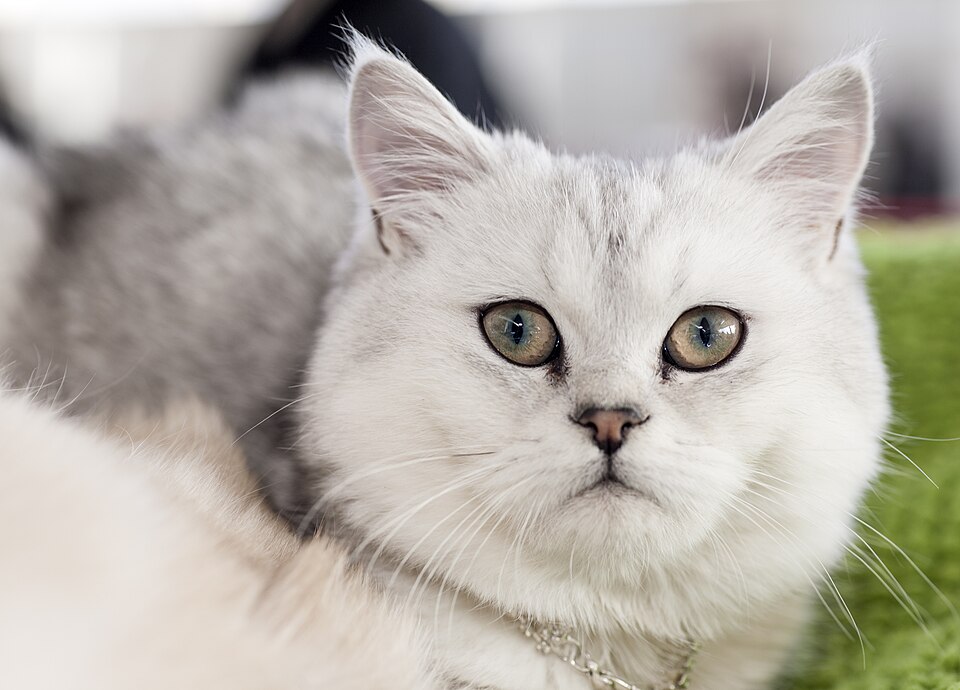
- Colors: Every genetically possible color and pattern is accepted: solids, tabbies, tortoiseshells, bi-colors, smokes, shadeds and pointed patterns. The silver tabby point pattern in this page's photo is one of them.
- Eye color: Tied to coat color; some white and bi-color patterns can have blue or odd eyes.
Daily care
According to the CFA, both varieties get by with weekly combing, but longhaired cats need more attention to keep the coat from matting. They shed a little all year and more in spring and fall.
- Combing: Once a week, more often during shedding. Check the places where tangles form; don't try to cut out a tight mat yourself, show it to your vet or a groomer.
- Nails: A scratching post is a must; trim nails the way your vet shows you.
- Ears: International Cat Care says redness, itching, head shaking, discharge or odor means the ears should be checked by a vet.
- Play: Short hunting games and safe high places; a cat tree and a window perch are things this breed likes.
For details see cat grooming and why cats love high places.
 Diet and weight
We found no source saying a special food is needed; a balanced, complete cat food suited to its age and lifestyle is enough. Measure the food, subtract treats from the daily amount, work out the daily amount with your vet and weigh your cat once a month. A long coat can hide weight gain, so the scale is the most reliable measure. Ask your vet about the importance of ideal weight in a line that has joint concerns.
 Health issues to know about
The information below is for general awareness; for diagnosis and treatment, talk to your veterinarian.
The fold gene and osteochondrodysplasia
What folds the Highland Fold's ears is a dominant change in a gene called TRPV4. The same change disrupts cartilage and bone development and can cause a progressive, painful joint disease called osteochondrodysplasia. According to UFAW the changes can be seen on x-rays from 7 weeks of age, the disease lasts for life and has no cure. Cats Protection writes that it can show up as short, thick legs, a stiff tail, swollen ankles and joint inflammation. For a detailed account, see our Scottish Fold page.
Severity varies a lot from cat to cat: in a small 2023 study in Italy, only one of the 12 Scottish Folds carrying the gene showed clinical signs. But because cats hide pain, no visible signs doesn't mean no pain. UFAW recommends that fold-eared cats not be bred, Cats Protection suggests choosing a cat without folded ears, and a 2025 review in the journal Animal Welfare reaches the same conclusion.
The straight-eared Highland Straight
According to UFAW, straight-eared kittens from a mating between a fold-eared and a straight-eared cat don't carry the gene and don't show the disease. In the 2023 Italian study none of the 5 Scottish Straights tested carried it. But a 2026 study in Japan showed that seven cats born with folded ears had their ears straighten as they grew and all carried the gene ("cryptic folds"). So straight ears alone aren't a guarantee; DNA testing is needed. Cats Protection also doesn't fully rule out risk in straight-eared cats from Scottish Fold lines.
Another 2026 study in Japan shows that testing works: from 2017 to 2024 the share of Scottish Folds with two copies of the gene (the most severely affected) fell from 14.2% to 1.9%. In other words, careful testing can stop such cats from being born.
How can you spot joint pain?
Cats hide pain very well. If yours jumps or climbs less than before or struggles to, moves stiffly, doesn't want to use the litter box, hides more or gets grumpy when touched, show your vet.
Other topics
- Ear health: If you notice discharge, odor, head shaking or itching, show your vet, as International Cat Care advises.
- Heart and kidneys: We found no evidence of a breed-specific heart disease for the Scottish Longhair. For polycystic kidney disease (PKD), Cats Protection writes that Scottish Folds are at higher risk; ask the breeder for that test result.
- Fast or open-mouth breathing
- Limping, not using a leg, or sudden weakness in the back legs
- Stopping jumping or moving altogether
- Drinking or urinating a lot, loss of appetite or weight loss
- Hiding and reacting when touched (cats hide pain)
How long does it live?
We found no lifespan study for the Scottish Longhair, so we're not giving a number. Ideal weight, regular vet checkups, neutering and a safe home matter most. In fold-eared cats, joint disease can be the main factor in quality of life, which is why spotting pain early is important.
 Before you get one
- Consider a shelter too: Purebred cats and longhaired look-alike mixes end up in shelters; it's worth looking there as well.
- If you buy from a breeder: Ask to see the parents. If you're considering the folded variety, weigh the welfare views above; even if you want the straight-eared variety (Highland Straight), ask for the TRPV4 DNA results. The CFA recommends pairing fold-eared cats only with straight-eared ones and checking every pairing with DNA testing; stay away from breeders who mate two fold-eared cats.
- Red flags: Sellers who won't show the mother, offer no paperwork, rush you to buy now or promise a "healthy" kitten without test results.
- Legal registration: In Türkiye, microchipping and PETVET registration are mandatory for cats. Details in our PETVET registration and microchip post.
- First days: Our first week with a new cat post walks you through it.
Frequently asked questions
What's the difference between the Highland Fold and the Highland Straight?
The only difference is the ears: the Highland Fold's fold forward, the Highland Straight's stand upright. The folded one has a joint-disease risk; the straight-eared one is expected not to carry the gene, but it should be tested.
Is the Scottish Longhair the same as the British Longhair?
No. The Scottish line was developed in part by crossing with British Shorthairs, but it has its own pedigree and standard. FIFe doesn't register offspring of a cat with osteochondrodysplasia as British even when their ears are straight. See our British Longhair page for details.
Does it shed a lot?
According to the CFA it sheds a little all year and more in spring and fall. Weekly combing is the basics; step it up in shedding season.
Can it be left home alone?
The CFA says they don't cope well with long stretches alone. Play, attention and an enriched environment are a must; for long absences, someone you trust should drop in every day.
How big does it get?
The CFA gives no weight range for the breed; it describes a medium-sized cat and says females can be a little smaller. Work out the ideal weight with your vet.
Sources
- CFA (Cat Fanciers' Association) · Scottish Fold ırk tanıtımı ve standardı (uzun tüylü çeşit dahil)
- WCF (World Cat Federation) · EMS kodları (Highland Fold ve Highland Straight kayıtları)
- Science for Animal Welfare (UFAW) · Scottish Fold: Osteokondrodisplazi
- Cats Protection · Cats with folded ears
- Sartore ve ark. · Osteochondrodysplasia and the c.1024G>T variant of TRPV4 gene in Scottish Fold cats: genetic and radiographic evaluation, Journal of Feline Medicine and Surgery (2023)
- Matsumoto ve ark. · Straightened Small Pinnae in TRPV4 c.1024G>T Heterozygous Cats, Animal Genetics (2026)
- Animal Genetics (2026) · Genetic Evidence of a Recent Decline and Crossbreed Distribution of TRPV4 c.1024G>T Variant in Domestic Cats
- FIFe (Fédération Internationale Féline) · Breeding and Registration Rules, 2026 baskısı
- Animal Welfare dergisi (2025) · A framework to refocus the conversation around the welfare of UK purebred cats
- International Cat Care · Ear problems in cats
- Resmî Gazete · Kedi, Köpek ve Gelinciklerin Kimliklendirilmesi ve Kayıt Altına Alınmasına Dair Yönetmelik (26 Şubat 2018)
By Tüylüm · Last checked: November 10, 2026. Compiled from the sources above and written in our own words. Spotted a mistake? Write to [email protected] and we'll fix it right away. Photo from Wikimedia Commons, used under the license shown below it.