 Tüylüm
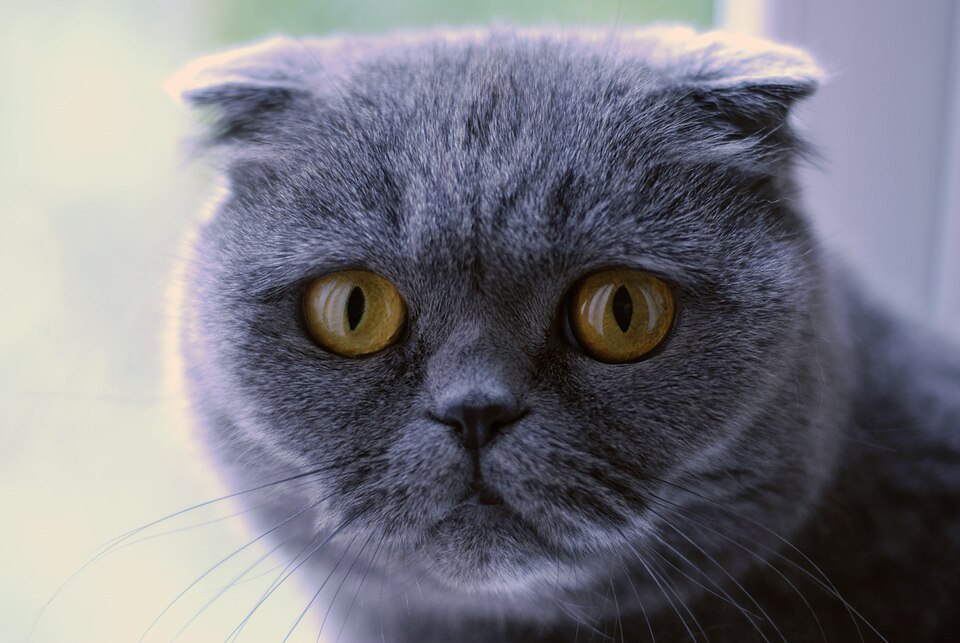
Scottish Fold
Its forward-folded ears come from an inherited change that disrupts cartilage and bone development; according to welfare sources, every folded-ear cat is affected to some degree. If you share your home with a Scottish Fold, watching for signs of pain and regular vet checks matter most.

 LifespanNo reliable datanot listed separately in large lifespan studies
 WeightMedium-sizedCFA: females slightly smaller
 OriginScotland, 1961
 CoatShort or longcomb shorthairs weekly
 EnergyLooks calmcalmness can also be a sign of pain
 VoiceQuietsoft, rarely meows
 With kidsPatienthandle its joints gently
 Legal statusBanned in some countriesbreeding and trade banned in the Netherlands
With its forward- and downward-folded ears, round head and big eyes, the Scottish Fold is instantly recognizable. Behind those endearing ears, though, is an inherited condition that disrupts the development of cartilage and bone throughout the body. On this page we cover the breed's history, temperament and, above all, its health, drawing on animal welfare organizations, breed registries and scientific studies. Our goal isn't to blame anyone: it's to help you care for a Scottish Fold you already have, or make an informed choice if you're looking for a new cat.
- Why the ears fold: The gene change that folds the ear (in a gene called TRPV4) causes osteochondrodysplasia, a disorder of cartilage and bone development.
- All are affected: According to UFAW and Cats Protection, every folded-ear cat is affected to some degree; in severe cases the joints are painful and movement is limited.
- No cure: The condition doesn't go away, but vet care and pain management can improve a cat's quality of life.
- Registries and laws: The GCCF and FIFe don't register the breed; in the Netherlands it is illegal to breed folded-ear cats and to keep ones born after 2026.
- If you have one: Learn the signs of pain, schedule regular checkups, make high places easy to reach and get your cat spayed or neutered.
What to know
 What is the Scottish Fold like?
The CFA describes the Scottish Fold as a calm, soft-voiced, people-oriented cat. It follows you around the house and enjoys attention without demanding it, and it doesn't do well when left alone for long periods. It's curious, too: when something catches its interest, it's known for sitting bolt upright on its hind legs to take a look. It can be reserved with strangers and other cats at first.
There's an important caveat here. Cats Protection points out that some of the Scottish Fold's much-praised "calm, laid-back" temperament may actually come from pain: a cat with sore joints jumps less, plays less and seems more sedentary. Cats are very good at hiding pain. So a Scottish Fold that seems "very calm" may be showing a health sign, not just a personality trait.
Ears are an important part of how cats communicate with each other. Cats Protection notes that folded ears can make it harder for a cat to signal its feelings to other cats, and the CFA mentions that other cats may read the folded ears as a sign of hostility.
Every cat is an individual. Breed traits describe general tendencies; how a cat was raised, how much contact it had with people as a kitten and its health shape its personality as much as its breed.
 Who is it a good fit for?
This section is different from our other breed pages. UFAW, International Cat Care and Cats Protection say clearly that folded-ear cats should not be bred. In 2024, 12 organizations, including the GCCF, the RSPCA and the British Small Animal Veterinary Association (BSAVA), issued a joint statement objecting to the breed being featured in a film. That's why we don't recommend this breed if you're looking for a new cat.
| Situation | What to do? |
|---|---|
| Looking for a new cat | Buying a folded-ear kitten supports more breeding; consider another breed or a shelter cat |
| Saw a Scottish Fold at a shelter | Giving a home to a cat that already exists doesn't support breeding; be ready for health costs |
| Already have a Scottish Fold | Watch for pain, schedule regular vet checks, adapt your home |
| Family with kids | Patient, but its joints may hurt, so it should be handled gently |
| Apartment | Fine; add ramps and steps to help it reach high places |
Cats Protection also points out that Scottish Folds can be more expensive to care for and to insure because of their health problems.
Where does it come from?
According to the CFA, in 1961 a shepherd named William Ross spotted a white, copper-eyed female cat with forward-folded ears on a farm in the Tayside region of Scotland. Snooks, one of the kittens of this cat, Susie, was bred first to a domestic cat and then to a British Shorthair, laying the foundation of the breed. The folded ear is caused by a dominant gene change that arose spontaneously.
In Britain, the GCCF recognized the breed only briefly. According to UFAW, the GCCF had removed it from its list of recognized breeds by 1974 because of the severe deformities seen in the legs and tail. FIFe doesn't recognize the breed either: under its 2026 rules, cats with osteochondrodysplasia, or with such a cat in their ancestry, can't be registered, bred or shown with FIFe, and the Scottish Fold's breed abbreviations were deleted from its list in 2012.
Breeders in the United States kept the breed going. The CFA granted championship status to the shorthaired Scottish Fold in 1978 and to the longhair in 1992, and accepted straight-eared cats in 2022.
 Appearance and colors
"Round" is the word most often used to describe this breed. The head is round, the eyes are big and round, the neck is short, and the body is medium-sized and well padded. The ears are small and fold forward like a cap.
- Ears: Kittens are born with straight ears. According to UFAW and the CFA, the ears start to fold at 3 to 4 weeks of age, so you can't tell in the first weeks whether a kitten's ears will fold.
- Straight-eared cats: When a folded-ear cat is bred to a straight-eared cat, about half of the kittens have folded ears. The straight-eared cats are called Scottish Straights or Scottish Shorthairs.
- Coat: Dense and plush in shorthairs; semi-long to long in longhairs.
- Colors: According to the CFA, any genetically possible color and pattern is accepted.
- Tail: The CFA standard calls for a flexible, tapering tail and disqualifies a tail that is thick, shortened or lacks flexibility. A stiff tail is one of the early signs of the joint disease described below.
Daily care
Caring for a Scottish Fold should focus on protecting its joints and spotting pain early.
- Coat: According to the CFA, combing once a week is enough for shorthairs; longhairs need more frequent combing to prevent mats. Cats Protection notes that cats with joint pain struggle to groom, especially their back, tail and hind legs, so tell your vet if the coat starts to look unkempt.
- Ears: Cats Protection recommends checking the ears regularly for debris, odor and irritation. If cleaning is needed, use a product your vet recommends.
- Home setup: Ramps, low steps and cat trees help a cat that struggles to jump still reach its favorite spots. For ideas, see our article on why cats love high places.
- Easy access: Cats Protection recommends putting steps up to favorite resting spots and using a litter box with low sides for cats with joint pain. Starting to avoid a high-sided litter box can itself be a sign of pain.
- Tail check: Gently hold the tail and check its flexibility; if you notice stiffness or discomfort when it's touched, tell your vet.
- Play: Choose short games close to the ground that don't involve jumping.
 Diet and weight
A Scottish Fold doesn't need a special food; a complete, balanced cat food suited to its age is enough. Weight matters especially for this breed, though: every extra ounce means more load on joints that are already affected. The 2024 study by Teng and colleagues showed that cats whose weight was further from the median for their breed and sex lived shorter lives.
- Measure food, and set an ideal weight with your vet.
- Cats Protection recommends asking your vet about special diets or supplements that may help the joints; don't start supplements on your own.
- Weigh your cat once a month; a cat that moves less gains weight easily.
- Always have fresh water available.
 Health issues to know about
The information below is for awareness only; ask your vet about diagnosis and treatment.
Scottish Fold osteochondrodysplasia
Osteochondrodysplasia is an inherited disorder that affects the development of cartilage, and with it bone, throughout the body. According to UFAW, it's also why the ear folds: the ear cartilage can't support the ear's weight. The same disorder has far more serious effects in the leg bones, joints and tail. A genome study in 2016 linked the folded ear and osteochondrodysplasia to a single change in a gene called TRPV4, which plays a role in how cartilage cells respond to pressure and movement.
- Which cats are affected? According to UFAW, in cats carrying two copies of the gene, the disease starts early and is severe; in cats with one copy it progresses more slowly and ranges from mild to severe. There are no unaffected carriers: every folded-ear cat is affected to some degree.
- When does it start? According to Cats Protection, changes can be seen on X-rays of kittens as young as 7 weeks, and signs such as limping can begin at 4 to 6 months. The condition worsens with age and doesn't go away.
- What does it cause? Short, thick legs, a thick and inflexible tail, swollen ankles and wrists, bony growths and painful joint inflammation (arthritis).
There is some debate around the details. A 2023 study of Australian veterinary records found a confirmed osteochondrodysplasia diagnosis in only 1.1 percent of 1,131 Scottish Folds and a suspected one in about 5.7 percent, though the authors note that the records may be incomplete. In a small 2023 study in Italy, only one of 12 Scottish Folds carrying the gene showed clinical signs. So severity varies a great deal from cat to cat. But because cats hide pain well, not seeing signs doesn't mean there's no pain, which is why welfare organizations agree the breed should not be bred.
There's no cure. Your vet can discuss options for reducing pain; Cats Protection mentions that a vet-supervised trial of pain relief can show whether a cat becomes more active.
How can you tell if your cat is in pain?
According to Cats Protection, cats are very good at hiding joint pain and are less likely than dogs to limp obviously; changes start subtly. Watch for:
- Jumping less, avoiding high places or struggling to get up
- Stiffness after rest that eases with movement
- Grooming less, with an unkempt coat on the back and tail
- Avoiding the litter box or going next to it
- Hiding more, playing less or getting irritable when touched
- A stiff tail or swollen ankles
Learning to read your cat's body language helps a lot with this breed; our article on cat body language can help.
Other health issues
- Polycystic kidney disease (PKD): According to Cats Protection, Scottish Folds are at greater risk of this inherited kidney disease, and there's a test for the gene that causes it. In a Japanese study published in 2025, 70 of 300 cats carrying the PKD gene were Scottish Folds.
- Flat-face problems: According to Cats Protection, some Scottish Folds have short noses, which can lead to breathing, dental and eye problems.
- Limping, not using a leg or obvious difficulty walking
- Stopping jumping or moving altogether
- Fast or open-mouth breathing
- Drinking and peeing a lot, loss of appetite or weight loss
- Hiding and reacting when touched (cats hide pain)
How long does it live?
There's no reliable lifespan data for the Scottish Fold. In a 2024 VetCompass study of more than 7,900 cats that died in the UK in 2019, the Scottish Fold wasn't among the 12 groups with at least 15 recorded deaths that could be analyzed separately (the GCCF doesn't register the breed in the UK).
For this breed, the real question isn't "how long does it live?" but "how does it live?" Osteochondrodysplasia doesn't kill a cat directly, but lifelong pain and limited movement can deeply affect quality of life. UFAW notes that some severely affected cats are euthanized at a young age for welfare reasons. Regular checkups, pain management, a healthy weight and a cat-friendly home setup are the most concrete things you can do to help your Scottish Fold live more comfortably.
 Before you get one
- Think twice about buying a kitten: UFAW, International Cat Care and Cats Protection want the breeding of folded-ear cats to stop. According to studies cited by UFAW, if no folded-ear cats were bred from, the disease would disappear within a generation.
- If it's the temperament you want: UFAW cites researchers who suggest that people who want the same gentle temperament consider straight-eared cats that don't carry the gene. Shelter cats come in every temperament, too.
- Banned in some countries: Breeding folded-ear cats was already illegal in the Netherlands, and since January 1, 2026 keeping them is banned as well. Cats born before that date and microchipped may live out their lives but can't be shown; violations can bring an administrative fine of €1,500. According to Cats Protection, breeding Scottish Folds in Scotland likely breaches the conditions of breeding licenses.
- Registries: The GCCF and FIFe don't register the breed; the CFA does, and advises breeding folded-ear cats only to straight-eared cats, along with DNA testing. Rules vary by country.
- If you already have a Scottish Fold: Get your cat spayed or neutered (Cats Protection notes this stops the gene being passed on), schedule regular checkups and learn the signs of pain.
- Registration: Rules vary by country; many places require or recommend microchipping. In Türkiye, owned cats must be microchipped and registered in the PETVET system.
Frequently asked questions
Do folded ears affect a cat's hearing?
According to the CFA, folded ears don't affect hearing. The real problem isn't the ear but the fact that the same gene change affects cartilage and bone in the legs, joints and tail.
Does every Scottish Fold get sick?
According to UFAW and Cats Protection, every folded-ear cat is affected by osteochondrodysplasia to some degree. Severity varies widely: some cats have very mild signs, while others develop severe pain and loss of mobility. Because cats hide pain, regular vet checks are important.
Are straight-eared Scottish cats (Scottish Straights) affected too?
According to UFAW, the straight-eared kittens of a folded-ear and a straight-eared cat don't carry the disease-causing gene. Cats Protection, however, says the risk of early-onset arthritis shouldn't be dismissed even in straight-eared cats bred from Scottish Folds. If you're getting a straight-eared cat, talk to your vet.
Is the Scottish Fold the same as the British Shorthair?
No. The British Shorthair was used to develop the Scottish Fold, so their faces look alike. Under FIFe rules, kittens descended from a cat with osteochondrodysplasia can't be registered as British, even if their ears are straight. See our British Shorthair page for details.
How can I tell if my Scottish Fold is in pain?
Jumping less, avoiding high places, limping, a stiffening tail, grooming less and hiding more are important signs. If you notice any of them, take your cat to the vet.
Sources
- UFAW Genetic Welfare Problems · Scottish Fold: Osteokondrodisplazi
- Cats Protection · Cats with folded ears
- International Cat Care · UK animal charities share concerns over Scottish Folds in 'Argylle' (ortak açıklama, 2024)
- Cats Protection · Arthritis in cats
- CFA (Cat Fanciers' Association) · Scottish Fold ırk tanıtımı ve standardı
- FIFe (Fédération Internationale Féline) · Breeding and Registration Rules, 2026 baskısı
- Rijksoverheid (Hollanda hükümeti) · Vanaf 1 januari 2026 ingang houdverbod vouwoorkatten en naaktkatten (31 Ekim 2025)
- Journal of Feline Medicine and Surgery (2023) · Osteochondrodysplasia and the c.1024G>T variant of TRPV4 gene in Scottish Fold cats: genetic and radiographic evaluation
- BMC Veterinary Research (2023) · An estimation of osteochondrodysplasia prevalence in Australian Scottish Fold cats: a retrospective study using VetCompass data
- Teng ve ark. · Life tables of annual life expectancy and risk factors for mortality in cats in the UK, Journal of Feline Medicine and Surgery (2024)
- Journal of Veterinary Medical Science (2025) · Life table analysis of feline polycystic kidney disease in Japan
- Resmî Gazete · Kedi, Köpek ve Gelinciklerin Kimliklendirilmesi ve Kayıt Altına Alınmasına Dair Yönetmelik (26 Şubat 2018)
By Tüylüm · Last checked: November 3, 2026. Compiled from the sources above and written in our own words. Spotted a mistake? Write to [email protected] and we'll fix it right away. Photo from Wikimedia Commons, used under the license shown below it.