African clawed frog care: deep water, a secure lid and a quiet corner
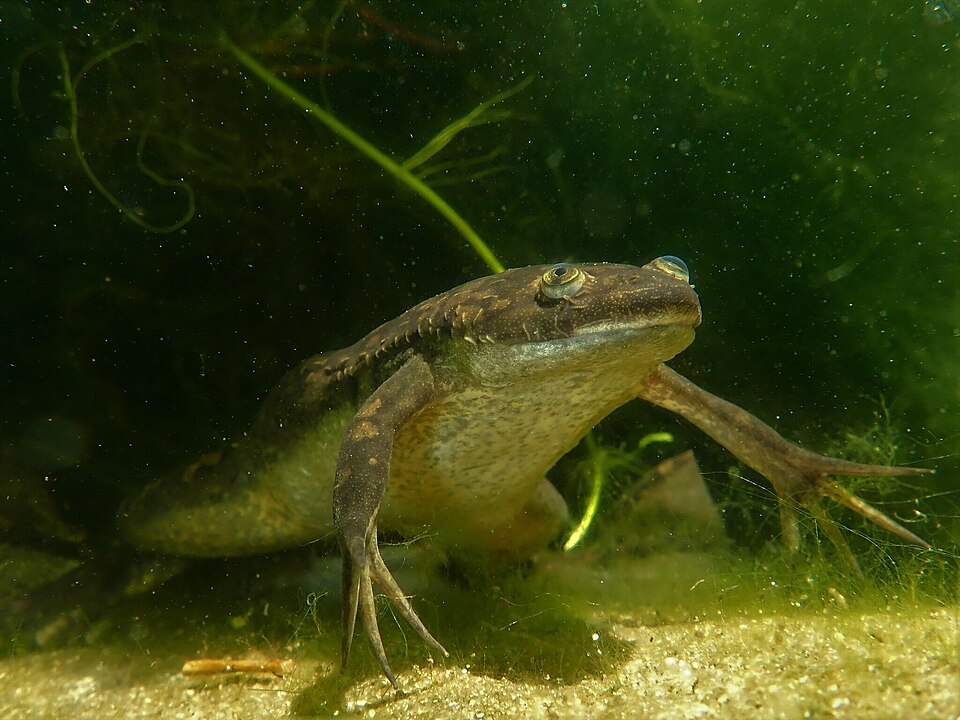
An African clawed frog can rest at the bottom of the tank with its arms spread wide, barely moving for a long time. Then a bit of food drops into the water and it suddenly springs to life. This frog is different from most of its relatives: according to the RSPCA, under normal conditions it never leaves the water, but it has well-developed lungs and comes to the surface to breathe. Because it's widely used in laboratories, the most detailed information on its care comes from there. In this article, we've adapted what we learned from two RSPCA guides written for laboratories, the US Geological Survey (USGS) and the Merck Veterinary Manual for a home aquarium.
- Fully aquatic: According to the RSPCA, it normally never leaves the water, but it must be able to reach the surface to breathe.
- Long life: According to the RSPCA, it usually lives 10–15 years; it has been suggested it can live 25–30 years.
- Deep water: The RSPCA's 2005 guide recommends a water depth of at least 8 inches (about 20 cm) for adults.
- Cool water: The water shouldn't drop below 16 °C (61 °F) or go above 24 °C (75 °F); ideally 18–22 °C (64–72 °F).
- No gravel, yes lid: A bare bottom is better than gravel; the tank needs a mesh lid.
- Never release it: According to USGS, it has become established and invasive in many countries.
Meet the African clawed frog
According to the RSPCA, the African clawed frog (Xenopus laevis) comes from southern Africa. In the wild it usually lives in stagnant pools, ponds, lakes and ditches with a thick layer of mud on the bottom. Females are larger than males: females grow up to 15 cm (6 in) from snout to rear, males up to 10 cm (4 in).
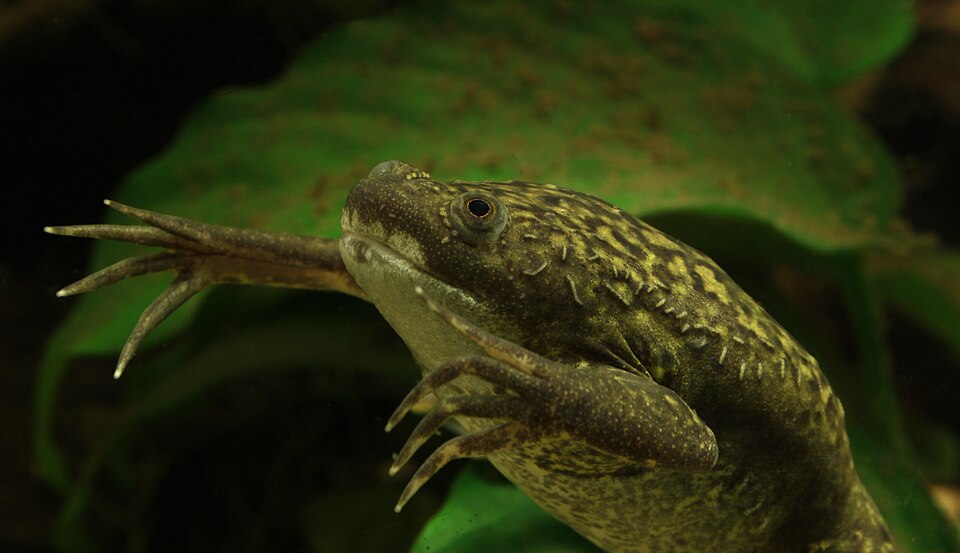
Because it's active at night and lives in murky water, sight isn't its most important sense. According to the RSPCA, like fish, it has a lateral line: a set of sensory organs along its back, head and around its eyes that let it feel movements in the water. Its sense of smell is also very strong; when it smells food, it swims around until it touches it. According to USGS, it has no tongue and its eyes sit on top of its head.
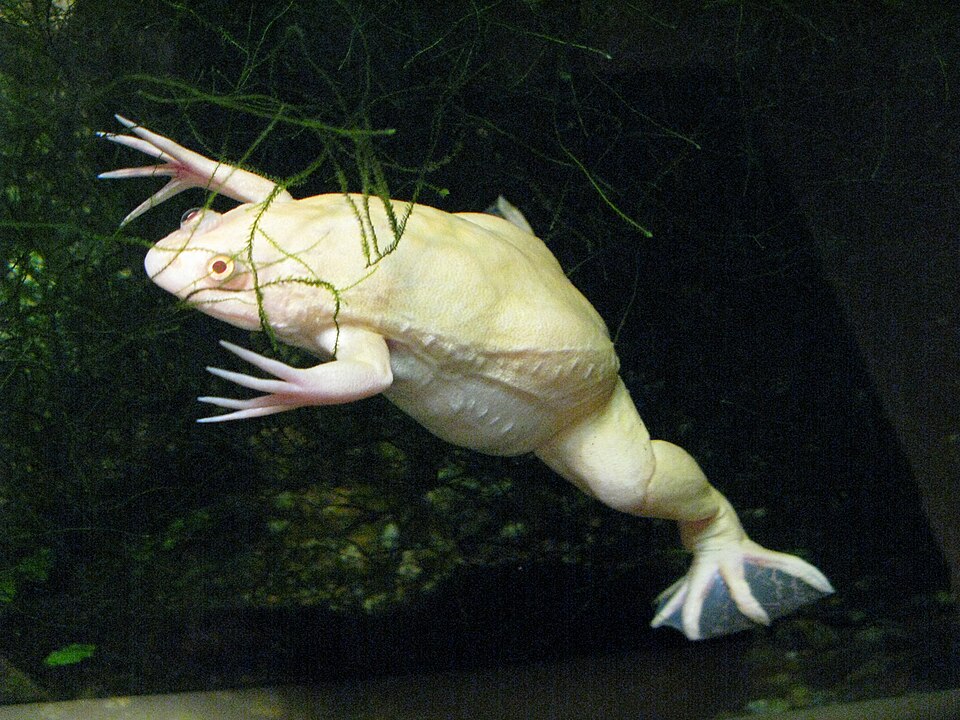
The claws that give it its name are on its hind feet. According to the RSPCA, the inner three toes of each hind foot end in small claws, which it uses to dig through mud and tear large pieces of food apart. It uses its short front limbs to push food into its mouth. According to the RSPCA's 2005 guide, its ears aren't visible from outside, but its hearing is highly developed: these frogs communicate with each other underwater using "clicks."
The tank: deep water and a secure lid
According to the RSPCA, clawed frogs kept in shallow water startle more often and try to escape more. The water should be deep and wide enough for the frog to lie fully submerged well away from the surface, swim when it wants to and turn around easily in any direction. The RSPCA's 2005 guide recommends a water depth of at least 8 inches (about 20 cm) for adults.
- Mesh lid: According to the RSPCA's 2005 guide, a well-fitting wire or nylon mesh cover keeps the frog from jumping out. Don't cover the tank completely with a solid lid; the air quality suffers.
- If it escapes: According to the same guide, clawed frogs that escape from tanks at night are often found dehydrated, weak or dead by morning.
- Keep the surface open: According to the RSPCA, a clawed frog will drown if it's prevented from breathing air, because the oxygen it takes in through its skin isn't enough. Leave a gap between the water surface and the lid.
- Dark bottom: According to the RSPCA, clear tanks that let light in from every side can stress the frog. At the very least, the tank floor shouldn't let light through; even setting the tank on a dark surface helps.
- Hiding spots: The RSPCA recommends plastic tubes, plastic caves or smooth plastic rocks. Floating plastic leaves on the surface also give shade, but make sure the frog can still reach the surface to breathe.
- A quiet corner: According to the RSPCA, these frogs are very sensitive to vibration and noise around them. Avoid moving your hands or objects over the tank unnecessarily.
Substrate: a bare bottom instead of gravel
According to the RSPCA, a bare bottom isn't natural, but it's better than a substrate of small gravel: gravel can be swallowed by accident, and choice tests show the frogs don't like gravel floors. The Merck Veterinary Manual also recommends that gravel be either too large to swallow or small enough to pass through the digestive tract. According to the RSPCA, anything you put in the tank should have no sharp edges, be easy to clean and not affect water quality.
Water: temperature, chlorine and cleaning
| Topic | According to the RSPCA's 2005 guide |
|---|---|
| Temperature | Not below 16 °C (61 °F) or above 24 °C (75 °F); ideally 18–22 °C (64–72 °F) |
| Sudden change | Avoid abrupt, large swings in room or water temperature |
| Chlorine | Water must be completely dechlorinated before use |
| pH | Stable, between 6.5 and 8.5 |
| Light | 12–14 hours of light, with a gradual 20–30 minute transition morning and evening |
| Sun | The tank shouldn't be exposed to direct sunlight or very bright light |
According to the RSPCA, chlorine damages the slimy layer that protects the frog's skin. Merck recommends changing at least 10% of the water weekly in an established aquatic tank and testing temperature, pH, ammonia, nitrite and nitrate once a week. The RSPCA, for its part, notes that very frequent water changes can disturb the frogs: plan cleaning so it stresses the animal as little as possible. More: amphibian water quality.
Feeding
According to the RSPCA, the clawed frog is carnivorous with a big appetite: it will attack almost anything that passes in front of it. In the wild it mostly eats small insects, slugs, worms and aquatic invertebrates; remains of fish, birds and other amphibians have also been found in their stomachs. Thanks to its strong sense of smell, it can, unusually for a frog, also find and eat food that isn't alive.
- What: The guidelines the RSPCA compiled include ready-made frog food (pellets) and worms; some facilities give maggots and crickets as enrichment.
- How often: Most facilities feed adults 2–5 times a week. According to Council of Europe guidelines, daily feeding isn't advisable for adults; 1–3 times a week is recommended.
- When: The RSPCA recommends feeding toward the end of the day, so you can see the frog eat and then leave it alone to digest.
- Afterward: Don't disturb the frog or its water for 3–5 hours after feeding; a startled frog may bring its food back up. Remove uneaten food at the end of that time.
Company
According to the RSPCA, keeping clawed frogs in groups is beneficial: a group triggers "feeding frenzies," which are normal behavior, and reduces the frogs' fear responses. But each frog needs enough room; in a crowded tank, frogs can injure each other while feeding.
Frogs in the same tank should be similar in size. According to the RSPCA, if their sizes differ a lot, the bigger one may eat the smaller one; according to USGS, this frog is a generalist predator that can eat its own species' tadpoles and even other adults. Keep in mind that it may see small tankmates as prey.
Handling
According to the RSPCA, a clawed frog should be handled only when it's truly necessary. Its skin is very delicate: according to the RSPCA's 2005 guide, traces of hand lotion, cologne or ointment can harm it and may even kill it, and some amphibians have been seen to die after being handled by someone who smokes. If you do handle it, your hands should be thoroughly clean and moistened with water. In laboratories, the RSPCA recommends powder-free gloves and a deep, soft mesh net to lift the frog out of the water.
According to the CDC, wash your hands with soap and water after touching an amphibian or its tank, and pour tank water down the toilet, not the sink. More: handling amphibians.
Never release it
According to USGS, the African clawed frog is now established in the wild in California, Arizona and Washington in the US, as well as in Mexico, Chile, the United Kingdom, France, Italy, Portugal, Japan and China. The aquarium trade, its use in laboratories and its former use in human pregnancy tests all played a part in this spread. According to the RSPCA, some frogs also multiplied in new places after being released from laboratories or as unwanted pets.
According to USGS, native amphibians reproduce less where it has settled, and this frog can carry ranavirus and chytrid fungus (Bd). In Chile, it spreads 3.1–3.9 km (about 2–2.4 miles) a year by migrating over land and through irrigation canals. If you can no longer care for it, never release it into a lake, stream or canal. We explain how to find it a new home in our article on garden and wild frogs.
According to the RSPCA, clawed frogs are prey animals that find it hard to show when something is wrong. If you notice any change in your frog's behavior, appetite or skin, talk to a vet experienced with amphibians without delay.
You can track feeding days and the weekly water test as daily care tasks on Tüylüm's Today tab. Food & litter supplies calculates when your frog food will run out and reminds you before it does.
More articles: Amphibians.
Frequently asked questions
Does an African clawed frog need a land area?
According to the RSPCA, it's fully aquatic under normal conditions and doesn't come out onto land. But it must always be able to reach the surface to breathe; leave a gap between the water surface and the lid.
Can I put gravel in the tank?
The RSPCA doesn't recommend it: small gravel can be swallowed by accident, and the frogs don't prefer gravel floors. A bare bottom is better. According to Merck, substrate stones should be either too large to swallow or small enough to pass through the digestive tract.
How long does an African clawed frog live?
According to the RSPCA, usually 10–15 years; it has been suggested they can live 25–30 years. USGS mentions a recorded lifespan of over 30 years. Be ready for a long-term companion.

Keep track of your pet's care in TüylümLog vet visits, vaccine and medication dates, and we'll remind you when it's time. Share it all with your family in Home.
Sources
- RSPCA Research Animals Department · African clawed frogs: Good practice for housing and care (3rd edition, May 2011, PDF)
- RSPCA (Barney T. Reed) · Guidance on the housing and care of the African clawed frog Xenopus laevis (2005, PDF)
- USGS Nonindigenous Aquatic Species · African Clawed Frog (Xenopus laevis) – Species Profile
- Merck Veterinary Manual · Housing for Amphibians (pet owner version)
- CDC · Reptiles and Amphibians (Healthy Pets, Healthy People)
By Tüylüm · Published and last checked: October 26, 2026. Spotted a mistake? Write to [email protected] and we'll fix it right away. Photos are from Wikimedia Commons, used under the license shown below each photo.