Guppy care: a small, colorful fish that breeds fast
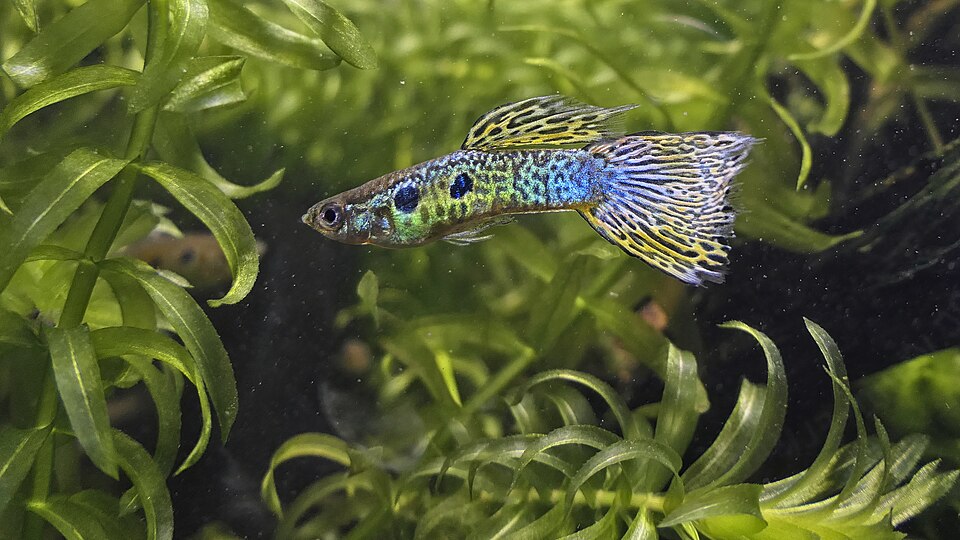
With their brightly colored tails, guppies are some of the most familiar aquarium fish. According to OATA, guppies originally come from Central and South America; today, most of those sold in the aquarium trade are captive bred rather than taken from the wild. They're small, peaceful and usually easy to keep. But you need to be ready for two things: guppies are tropical fish, so they need a heater; and because they give birth to live young, they breed very fast. In this article we've gathered, with sources, what you need to know when setting up a guppy tank.
- Tropical fish: The water should be 20–28 °C (68–82 °F) according to OATA and 22–28 °C (72–82 °F) according to the RSPCA; you need a heater all year round.
- Tank: OATA recommends at least 45 liters (about 12 gallons) for a small group; according to RSPCA Australia, the minimum volume for tropical fish is 50 liters (about 13 gallons). A filter is always essential.
- Group: According to OATA, at least three guppies, with two females for every male.
- Fast breeding: According to OATA, breeding is "almost a certainty"; a female can give birth to 20–80 fry after a pregnancy of 24–30 days.
- Food: According to OATA, once a day, as much as they can eat within a few minutes.
Getting to know the guppy
There's a huge variety of colors and patterns, but according to OATA the fish we call guppies are only ever one of two species: the traditional guppy (Poecilia reticulata) grows to about 5 cm (2 in), while the smaller Endler guppy (Poecilia wingei) reaches about 2.5 cm (1 in). According to OATA, guppies can live several years in a well-matured tank with good water quality.
Telling males from females is easy. According to OATA, the male is smaller and more colorful; his anal fin has also developed into a special structure used for mating, called a gonopodium. The female's anal fin is triangular.
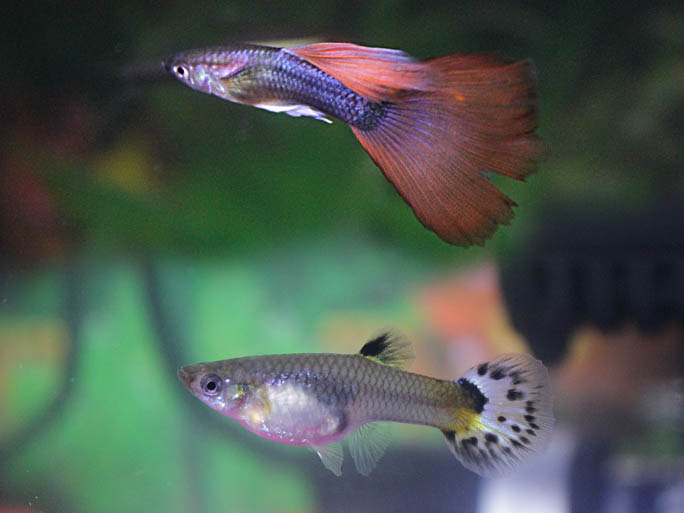
Guppies are "livebearers": instead of laying eggs, they give birth to young that can already swim. According to the RSPCA, livebearers (guppies, platies, mollies and swordtails) live at every depth of the tank.
The tank: heated, filtered and planted
OATA's general rule is to buy the largest aquarium you reasonably can. The larger the tank, the more stable the temperature and water quality.
- Volume: OATA recommends at least 45 liters (about 12 gallons) for a small group of guppies; the more groups you have, the larger the volume you need. According to RSPCA Australia, the minimum tank for tropical fish is 50 liters (about 13 gallons). RSPCA Australia also points out that livebearers such as guppies can breed prolifically, and that this needs to be considered when you set up the tank: the more fish you have, the larger the tank you'll need.
- Heater: According to OATA, a heater is needed to keep the temperature suitable all year round. According to the RSPCA, guppies tolerate 22–28 °C (72–82 °F), and all heaters should be controlled by a thermostat. More details: aquarium temperature.
- Filter and a gentle current: According to OATA, a filter is essential whatever the size of the tank. Because guppies are small and have long fins, the current should be gentle.
- Plants and hiding places: OATA recommends a gravel or sand substrate and, ideally, live plants for cover. If you don't use live plants, you can add plastic plants and ornaments such as plant pots or caves. But avoid anything with sharp or very rough edges so long fins don't get torn. Don't forget to leave room to swim. To get started with live plants: live plants in the aquarium.
- Location: According to OATA, the tank should be away from drafts, heat sources, direct sunlight, loud noise and vibration; overhead lighting keeps a proper day-night cycle.
If the tank is newly set up, don't add the guppies right away. According to OATA, ammonia and nitrite should be zero before you add any fish, and the number of fish should be increased slowly. The steps: setting up your first aquarium.
How many, and in what ratio?
According to OATA, guppies need companionship: at least three should be kept together, with two females for every male. OATA says this ratio reduces stress on the females and on other fish in the tank. You can keep more guppies, as long as you add them in the same ratio.
Guppies don't have to live in a tight shoal the way tetras do. According to the RSPCA, livebearers don't need to be kept in shoals of their own kind. If you're curious how they differ from shoaling fish: why shoaling fish live in groups
When choosing tankmates, OATA warns:
- No fin nippers: Guppies shouldn't be kept with species that might nip their fins, such as barbs.
- Watch out for tiny Endlers: Endler guppies shouldn't be kept with any species large enough to eat them.
Fast breeding: plan ahead
Perhaps the most important question to ask before you get guppies is this: "What will I do if there are babies?" According to OATA, when you keep guppies together, breeding is almost a certainty. A female can give birth to 20 to 80 fry after a pregnancy lasting 24–30 days.
According to OATA, fry are unlikely to survive in a community tank without a lot of plant growth, because other fish may eat them. If you want to raise the fry, OATA recommends:
- A breeding net: Move the pregnant female into a suitably large breeding net to protect the fry from the other fish in the tank.
- Separate the mother: After the birth, separate the female from the newborn fry, or she may eat them.
- Raise the fry separately: Feed the fry on specialist foods in a separate space until they're big enough to feed freely and not be easily eaten.
If you raise every brood, the number of fish can quickly outgrow your tank. So make your plan from the start. According to the University of Florida's (UF/IFAS) publication on responsible fishkeeping, for fish you can no longer keep you can try: returning or exchanging them at the store where you bought them, trading with another responsible fishkeeper, or asking a local aquarium society for help. According to UF/IFAS, a school or an animal care center may also take them in.
According to UF/IFAS, releasing aquarium fish into the wild or flushing them down the toilet harms both the environment and the animal. Don't release extra fry, or a guppy you can no longer care for, into a lake, a stream or a pond.
Food: a little, and regularly
According to OATA, guppies are omnivores. Recommended feeding:
- Staple food: A good-quality flake or granule with a high algae content.
- Now and then: Small live or frozen foods such as daphnia, small bloodworm or tubifex. For Endler guppies, OATA suggests smaller frozen foods such as cyclops.
- How much: According to OATA, once a day, as much as they can eat within a few minutes. RSPCA Australia recommends only what can be eaten in under two minutes. According to OATA, uneaten food builds up, breaks down and releases toxic waste into the water.
- Make sure everyone eats: RSPCA Australia suggests that if you have more than one fish, you spread the food in two or more places.
More: overfeeding fish.
Water care
According to OATA, guppies can be stressed by even the smallest amounts of ammonia and nitrite. That's why regular care is essential:
- Weekly water changes: OATA strongly recommends a partial water change of 25% at least once a week; the new water should be treated with a tap water conditioner that removes chlorine and chloramine. How to do it: aquarium water changes.
- Weekly tests: OATA recommends testing ammonia, nitrite, nitrate, pH and water hardness every week.
- Filter: Rinse the filter media lightly in water you've taken out of the tank during a water change, not under the tap, so the beneficial bacteria aren't killed.
If you notice a change in how your guppies swim, in their color, their breathing or their appetite, test the water first. If you're still worried, talk to a vet who treats fish without delay.
In Tüylüm's Today tab there are ready-made tasks for fish: Food, Water change (weekly), Water test (weekly) and Filter cleaning (monthly). With Food & litter supplies you can also track when the fish food will run out and get a reminder before it does.
Frequently asked questions
Can I keep just one guppy?
OATA doesn't recommend it: guppies need companionship. OATA recommends keeping at least three guppies together, with two females for every male.
Can guppies live without a heater?
Guppies are tropical fish. According to OATA, a heater is needed to keep the temperature suitable all year round; according to the RSPCA, guppies tolerate 22–28 °C (72–82 °F). Make sure the heater runs on a thermostat and check the temperature every day.
My guppies have had too many babies. What should I do?
Never release them into the wild. According to UF/IFAS, you can try returning or exchanging the fish at the store where you bought them, trading with another responsible fishkeeper, or asking a local aquarium society for help. Going forward, talk to your retailer about how many fish your tank can hold.

Keep track of your pet's care in TüylümLog vet visits, vaccine and medication dates, and we'll remind you when it's time. Share it all with your family in Home.
Sources
- OATA · How to look after guppies & mollies
- RSPCA · Choosing an aquarium for pet fish
- RSPCA · Understanding pet fish behaviour
- RSPCA Australia · How should I care for my tropical fish?
- UF/IFAS Extension · The Ornamental Fish Trade (FA124)
By Tüylüm · Published and last checked: October 26, 2026. Spotted a mistake? Write to [email protected] and we'll fix it right away. Photos are from Wikimedia Commons, used under the license shown below each photo.