 Tüylüm
Abyssinian
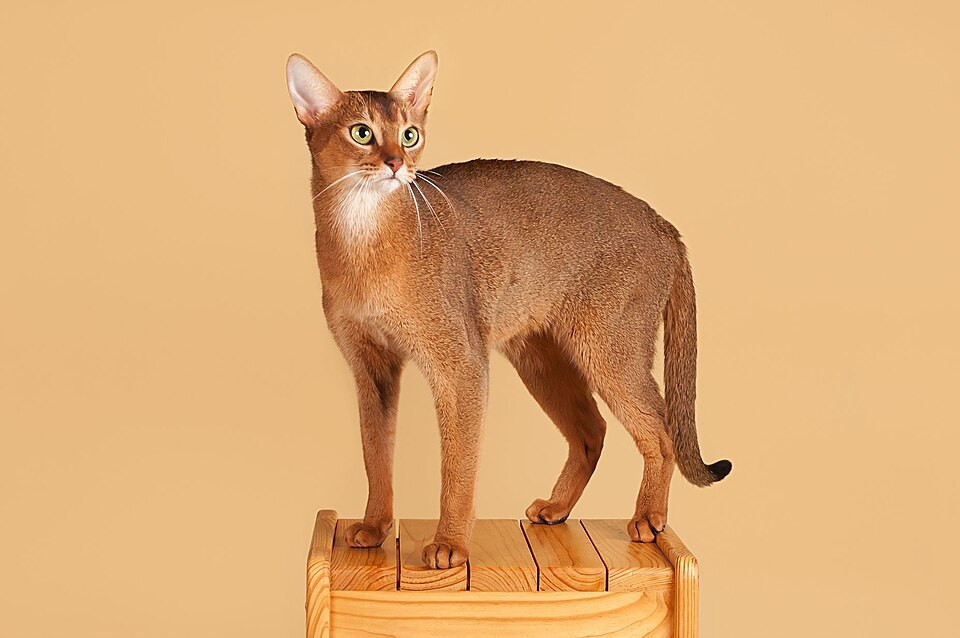
A slim, muscular cat whose coat glows thanks to bands of color on every hair, the Abyssinian is extremely curious and active. It rarely stays in your lap for long but is deeply attached to its people. PK deficiency, a form of blindness (PRA) and kidney amyloidosis have been reported in the breed.

 Lifespan9–13 yearsrange from vet guides; no large breed study
 Weight8–12 lb (3.6–5.4 kg)medium-sized, slim and muscular
 OriginDeveloped in Englandancestors from the Indian Ocean coast
 CoatShort, tickeda few combings a month
 EnergyVery highalways on the move unless asleep
 VoiceQuietuses body language to ask
 With kidsExcellentan eager partner for hunting games
 Time aloneDislikes ita second cat is advised in quiet homes
The Abyssinian is one of the oldest cat breeds and, according to the CFA, one of the most intelligent. Its "ticked" coat, with light and dark bands on every hair, gives it a wild, glowing look, and its slim, muscular body makes it seem to stand on tiptoe. But the first thing people who know the breed mention is its curiosity and energy. On this page we've pulled together its temperament, care needs and health issues from breed registries, animal welfare resources and scientific studies.
- Temperament: Very curious, smart and active; it explores every corner and rarely stays in your lap for long, but it's deeply attached to its people.
- Easy care: A few combings a month are enough for its short coat; dental care matters.
- Hates being alone: It doesn't like long stretches on its own; a second cat is recommended in quiet homes.
- Health: PK deficiency (which causes anemia) and a form of blindness (rdAc-PRA) have DNA tests; kidney amyloidosis has no test.
- Good for families: The CFA says its active nature makes it an excellent choice for families with children.
What to know
 What is the Abyssinian like?
The Abyssinian is sociable, super-inquisitive and extremely active. According to the CFA, it leaves no inch of its surroundings unexplored and is constantly on the move unless it's asleep. If it doesn't have enough toys, it invents its own. It loves solving problems; a closed door or cabinet is just another puzzle.
It's affectionate but doesn't linger in laps: it may settle in for a moment and then get right back to business. That's not a lack of love, it's an excess of energy. When it wants attention, it often lets you know with a gentle paw rather than its voice. According to the CFA, it's not particularly talkative and is good at getting its wishes across without much noise.
It adores high places and likes to survey its home from above. Well-socialized Abyssinians adapt easily to change, and some even enjoy outings on a harness. Vet-reviewed sources also note that many Abyssinians love water.
Every cat is an individual. Breed traits describe general tendencies; how a cat was raised, how much contact it had with people as a kitten and its health shape its personality as much as its breed.
 Who is it a good fit for?
The Abyssinian suits people and families with an active household who enjoy playing with their cat every day and aren't expecting a calm lap cat.
| Situation | Good fit? |
|---|---|
| Apartment | Good; climbing shelves and daily play are a must |
| Family with kids | Excellent; loves hunting games with children |
| Other cats and dogs | Usually gets along; a playmate does it good |
| Long hours alone | Hard; it gets bored and dislikes being alone |
| First-time cat owners | Good; easy to groom, but be ready for its energy |
The CFA suggests that quieter homes consider two cats instead of one. Vet-reviewed sources also consider the Abyssinian a good choice for first-time cat owners because it's easy to care for, as long as you can set aside time every day for play and mental stimulation.
Where does it come from?
The name comes from Abyssinia, the former name of Ethiopia. But according to the CFA, that doesn't mean the breed is African: the first Abyssinians shown in England had been imported from Ethiopia, and the name stuck. Because it resembles the hunting cats in ancient Egyptian art, it was long thought to descend from them; genetic research, however, points to origins along the Indian Ocean coast and in Southeast Asia. It was most likely brought to England by returning soldiers.
The first Abyssinian seen at a cat show was "Zula," exhibited at London's Crystal Palace in 1871. The breed reached the United States in the early 1900s and was among the original breeds registered by the CFA in 1906.
 Appearance and colors
A medium-sized, slim but muscular cat with a gracefully arched neck that seems to stand on tiptoe. Its ears are large and cupped, and its eyes are almond-shaped and very expressive.
- Weight: According to PetMD, 8–12 pounds (about 3.6–5.4 kg).
- Coat: Short, dense and resilient. Each hair has light and dark bands of color, called "ticking," which gives the breed its wild, shimmering look.
- Colors: According to the CFA, the most popular is "ruddy," a burnished red-brown; cinnamon, blue and fawn also exist.
- Eye color: According to the CFA standard, gold or green; the eyes are accented by a fine dark line encircled by a lighter area.
Daily care
Grooming is easy. According to the CFA, combing or brushing a few times a month is enough to control shedding, and rubbing the dry coat with a chamois cloth adds shine. Baths usually aren't needed.
- Dental care: The CFA notes that some breeders teach new owners how to brush their cat's teeth to help prevent problems like gingivitis. Getting a kitten used to toothbrushing with short, rewarding sessions is the easiest approach.
- Climbing space: Tall shelves and cat trees are a must; watching its home from above helps it feel at ease.
- Play: A few hunting games a day (wand toys, balls, fetch) and food puzzles channel its energy in a positive way.
- Safety: Curious and clever, it needs screens on windows and hazardous products kept in closed cabinets.
For more ideas, see our articles on playing with an indoor cat and cats and high places.
 Diet and weight
The Abyssinian doesn't need a special food; a complete, balanced cat food suited to its age is enough. The CFA says Abyssinians love their owners, their toys and "all food," so even an active cat benefits from measured feeding.
- Decide the daily amount with your vet based on your cat's ideal weight, and measure it.
- Serving part of the food in puzzles or hiding it around the house is a safe outlet for hunting instincts.
- Count treats as part of the daily food.
- Keep an eye on water intake: if your cat starts drinking noticeably more, tell your vet (see the kidney section below).
 Health issues to know about
Some inherited diseases are well known in the Abyssinian, and several have DNA tests. The information below is for awareness only; ask your vet about diagnosis and treatment.
Pyruvate kinase deficiency (PK deficiency)
A recessively inherited disease that makes red blood cells break down early and causes anemia. In a 2008 study by Kohn and Fumi that followed 25 affected Abyssinian and Somali cats, 11 never showed signs; in the others, signs started anywhere from a few weeks to 5 years of age: lethargy, diarrhea, pale gums, poor appetite, dull coat, weight loss and jaundice. In a 2009 study in Australia, 5% of 60 Abyssinians and Somalis were affected and 28% were carriers. A DNA test exists, and the CFA notes that breeders can now easily remove carriers from their breeding programs.
Progressive retinal atrophy (rdAc-PRA)
An inherited eye disease in which the retina slowly degenerates; it starts late and can progress to blindness. It was first described in Abyssinian and Somali cats. The disease appears in cats that carry two copies of the variant. In a 2022 study of more than 11,000 cats, the variant was found in 18 of the 167 Abyssinians tested. A DNA test exists. A second, early-onset form of PRA linked to a different gene has also been reported in Abyssinians.
Kidney amyloidosis
A disease in which abnormally folded proteins (amyloid) build up, mainly in the kidneys, and damage kidney function. According to Science for Animal Welfare (formerly UFAW), it's more common in Abyssinians than in most breeds and runs in families, but the mode of inheritance is unknown and there's no DNA test. Signs usually start between 1 and 5 years of age: drinking and urinating a lot, dehydration, a dull coat, gum inflammation, lethargy, poor appetite and weight loss. In a five-year follow-up study published in 2015, 7 of 14 cats in one cattery had the disease while none did in the other, suggesting it clusters in certain lines. Science for Animal Welfare advises against breeding from affected cats and from cats with severely affected close relatives.
Blood type
Barrs and colleagues write that type B blood is common in Abyssinians and Somalis worldwide, while in the large 2022 DNA study none of the 214 Abyssinians tested had type B. Because results can vary by country and bloodline, the safest approach is to have your cat's blood type tested before any transfusion or breeding.
- Pale or yellowish gums, marked lethargy
- Drinking and urinating a lot, weight loss
- Trouble finding its way in the dark, bumping into things
- Red or bleeding gums, or bad breath
How long does it live?
We couldn't find large, recent lifespan data for the Abyssinian like the UK VetCompass studies. Vet-reviewed sources give a lifespan range of 9–13 years for the breed. That's a general range, not a precise average; well-cared-for cats can go beyond it.
Kidney health is one of the factors most likely to affect lifespan in this breed. A vet checkup at least once a year, blood and urine tests when recommended, a healthy weight and dental care are the most concrete steps.
 Before you get one
- Consider a shelter: Purebred cats end up in shelters and rescues too. Follow breed groups and adoption listings.
- Ask the breeder: Request the parents' PK deficiency and rdAc-PRA DNA tests. Since amyloidosis has no test, ask openly whether kidney disease or early kidney failure has occurred in the line.
- Consider two cats: If you're out all day, a playmate eases an Abyssinian's loneliness and boredom. Our guide to introducing two cats walks you through it.
- Red flags: Steer clear of sellers who won't show you the mother, always have kittens available, can't provide paperwork or rush you.
- Registration: Rules vary by country; many places require or recommend microchipping. In Türkiye, owned cats must be microchipped and registered in the PETVET system. See our PETVET and microchip guide for details.
Frequently asked questions
Does the Abyssinian come from Ethiopia?
Its name does, but the cat most likely doesn't. According to the CFA, the first show cats in England were imported from Ethiopia, which is how the breed got its name; genetic research traces its origins to the Indian Ocean coast and Southeast Asia.
Is it a lap cat?
Not really. It's affectionate and attached to its people, but its high energy means it doesn't stay in laps for long. It usually shows love by staying close, watching you and asking to play.
Do Abyssinians shed?
Like any shorthaired cat, yes. According to the CFA, a few combings a month are enough to keep shedding under control.
What's the difference between an Abyssinian and a Somali?
The Somali is the longhaired version of the Abyssinian; their personalities and health issues are very similar. The Somali has a medium-length coat and a full, fox-like tail. See our Somali page for details.
Can an Abyssinian live in an apartment?
Yes, but activity matters more than space. With tall shelves, cat trees, daily play and ideally a feline companion, it can be happy in an apartment too.
Sources
- CFA (Cat Fanciers' Association) · Abyssinian breed profile and standard
- Science for Animal Welfare (formerly UFAW) · Genetic welfare problems: Abyssinian, amyloidosis
- Menotti-Raymond et al. · Widespread retinal degenerative disease mutation (rdAc) discovered among a large number of popular cat breeds, The Veterinary Journal (2010)
- Kohn and Fumi · Clinical course of pyruvate kinase deficiency in Abyssinian and Somali cats, Journal of Feline Medicine and Surgery (2008)
- Barrs et al. · Erythrocytic pyruvate kinase deficiency and AB blood types in Australian Abyssinian and Somali cats, Australian Veterinary Journal (2009)
- Grahn et al. · Erythrocyte pyruvate kinase deficiency mutation identified in multiple breeds of domestic cats, BMC Veterinary Research (2012)
- Paltrinieri et al. · Serum and urine SAA and proteinuria in Abyssinian cats with familial amyloidosis: a five-year longitudinal study, Journal of Veterinary Internal Medicine (2015)
- Anderson et al. · Genetic epidemiology of blood type, disease and trait variants in over 11,000 domestic cats, PLOS Genetics (2022)
- PetMD (vet-reviewed) · Abyssinian cat breed
By Tüylüm · Last checked: November 3, 2026. Compiled from the sources above and written in our own words. Spotted a mistake? Write to [email protected] and we'll fix it right away. Photo from Wikimedia Commons, used under the license shown below it.