 Tüylüm
Egyptian Mau
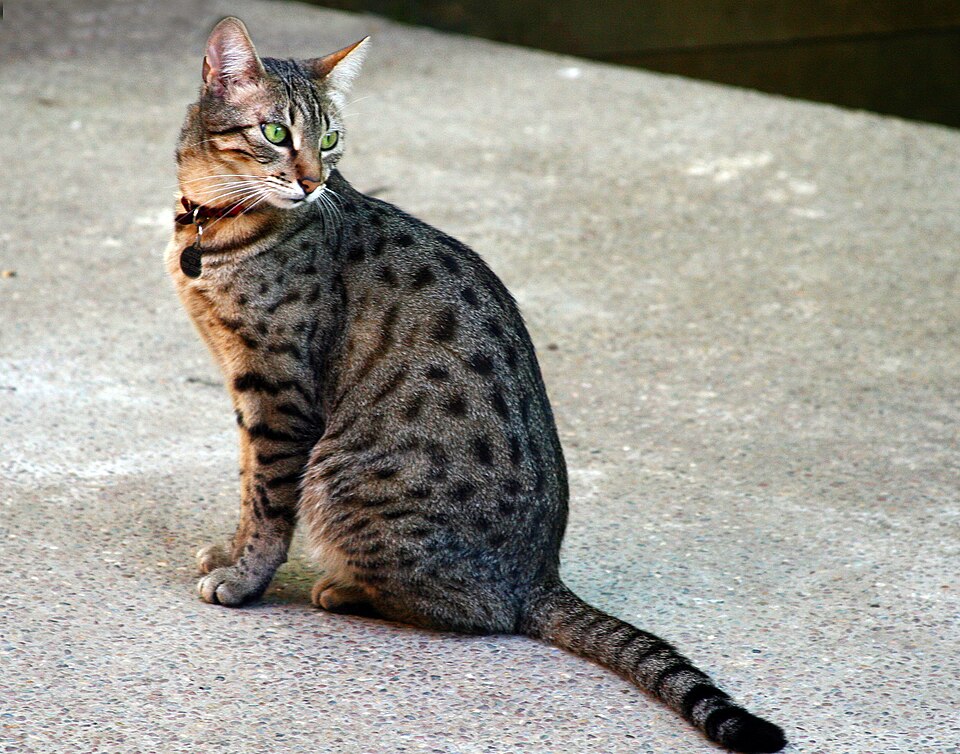
A medium-sized, highly active cat known for its naturally spotted coat, gooseberry-green eyes and athletic build. It bonds deeply with its people and can be reserved with strangers. A marked tendency toward urate bladder stones and a test for an inherited type of anemia are the things to know.

 LifespanNo breed dataPetMD says 9–20 years; not measured data
 Weight7–14 lb (3.2–6.4 kg)GCCF and PetMD ranges; males larger
 OriginEgyptmodern breed founded in the US and Europe
 CoatShort, spottedcomb once a week
 EnergyVery activejumps, climbs and wants to play
 VoiceSoft, melodiousgreets you with chirps
 With kidsGoodvery attached to its family
 With other petsUsually goodenjoys feline company
The Egyptian Mau is a medium-sized, muscular and extremely agile cat whose spots are natural. The CFA describes it as the only naturally occurring spotted domestic cat breed, and it's famous for resembling the spotted cats in ancient Egyptian art. On this page we've pulled together its temperament, care needs and, especially, what to know about bladder stones, drawing on breed registry profiles and scientific studies.
- Temperament: Clever, active and deeply attached to its family; can be reserved with strangers at first.
- Looks: Randomly scattered spots on a silver, bronze or smoke background, and gooseberry-green eyes.
- Energy: Loves jumping, climbing and play; tall climbing spaces are a must.
- Health: A Canadian study found a much higher risk of urate stones than in other cats; a DNA test exists for an inherited type of anemia (pyruvate kinase deficiency).
- Easy care: The short coat needs combing once a week; it sheds little.
What to know
 What is the Egyptian Mau like?
According to the CFA's breed profile, the Egyptian Mau is very intelligent and intensely devoted to its owners; it expects to be treated as an essential member of the household. Its senses of smell, hearing and sight are very sharp, and it's aware of everything going on around it. It's also sensitive to its owner's moods. It loves interactive games and fetch, and some can learn to walk on a harness.
It's an active, agile cat: it rides on shoulders, watches the house from the top of the fridge and wakes you up in the morning. According to the CFA, it's strong-willed; it decides who can pick it up and when, and it can be cautious with strangers. With its own people, though, it's affectionate, loyal and fearless. Its voice is soft and melodious, and it greets you with chirps and chatter. The GCCF adds that Maus enjoy playing with water, and some even put their heads under a running tap.
Every cat is an individual. Breed traits describe general tendencies; how a cat was raised, how much contact it had with people as a kitten and its health shape its personality as much as its breed.
 Who is it a good fit for?
The Egyptian Mau suits families who can give an active cat time and space and enjoy playing with it. If you're looking for a calm cat that naps in your lap, this breed may feel too energetic. According to PetMD's vet-reviewed profile, most Maus aren't lap cats, but they're always around for play and exploration.
| Situation | Good fit? |
|---|---|
| Apartment | Good; with tall climbing spaces and daily play |
| Family with kids | Good; per PetMD, usually gets along with children |
| Other cats and dogs | Usually good; per the GCCF, it wants feline company |
| Long hours alone | Use caution; needs human and feline company |
| Busy home with frequent guests | Use caution; can be reserved with strangers at first |
It can take time to get used to new people, so ask guests not to force it into their arms. A high spot to retreat to and a quiet room make the home feel safe for it.
Where does it come from?
According to the CFA, the word "mau" meant cat in ancient Egyptian. Papyri and wall paintings dating back as far as 1550 BC show spotted cats resembling today's Mau, which is why it's considered one of the oldest cat breeds. Even so, the modern breed was rebuilt from just a few cats.
As the CFA tells it, Nathalie Troubetskoy, a Russian princess living in Rome, was so taken with a Mau that came into her hands that she sought out others and started a breeding program. When she emigrated to the US in 1956, three Maus came with her. The CFA began registering the breed in 1970 and granted championship status in 1977. According to the GCCF, the breed was first brought to the UK in 1998, and the GCCF fully recognized it in 2006.
 Appearance and colors
According to the CFA standard, the Egyptian Mau is a medium-sized, muscular and graceful cat; males are larger than females. The head is a slightly rounded wedge, and the ears are medium to large and alert. The large, almond-shaped eyes are gooseberry green; the "mascara" lines around the eyes give it its familiar, slightly worried expression.
- Spots: Randomly scattered across the coat, varying in size and shape. According to the CFA, the spots occur naturally, and no outcrosses to other breeds are allowed today.
- Colors: Three colors are accepted for showing: silver, bronze and smoke. Black and dilute kittens can also be born; they can be registered but not shown.
- Skin flap: A loose fold of skin runs from the flank to the knee of the hind leg; the CFA says it gives freedom of movement when twisting and jumping.
- Gait: The hind legs are slightly longer than the front legs, giving it a cheetah-like walk.
- Weight: According to the GCCF, 7 to 9 pounds (about 3.2–4.1 kg); PetMD's vet-reviewed profile gives a wider range of 8 to 14 pounds (about 3.6–6.4 kg). Males are usually larger.
Daily care
According to the CFA, Maus shed little; a quick weekly combing is enough to cut down on shedding and hairballs. Regular baths aren't needed.
- Room to move: The GCCF notes that because it's so athletic, a tall cat tree is a big help. Shelves and window perches work too; our article on why cats love high places has ideas.
- Play: Several hunting games a day, fetch and puzzle toys are a must for this energetic breed. For ideas, see our article on playing with an indoor cat.
- Safe home: An agile, curious cat needs secure windows, balconies and cupboard doors.
- Skin: According to the GCCF, some Maus have sensitive, itchy skin, especially around the head and neck; the cause isn't clear. If you notice constant scratching or hair loss, see your vet.
- Claws: Provide a scratching post; if the claws grow long, trim them the way your vet shows you.
 Diet and weight
Egyptian Maus don't need a special food; a complete, balanced cat food that suits their age is enough. The GCCF notes that Maus enjoy their food and their intake may need monitoring.
- Measure food; decide the daily amount with your vet based on your cat's ideal weight.
- Count treats as part of the daily food.
- Water matters a lot: Because this breed has a high risk of bladder stones, make it easy for your cat to drink plenty. Put water bowls in different spots around the home; since Maus love playing with water, running water may help too. See our article on food and water bowls for details.
- If your cat has or has had bladder stones, your vet decides how it should be fed; don't change its food on your own.
 Health issues to know about
The CFA describes the Mau as a healthy, natural breed that can live a long life with proper care, but some inherited problems have been reported. The information below is for awareness only; ask your vet about diagnosis and treatment.
Bladder stones (urate stones)
This is the biggest issue for the Mau. In a study of more than 10,000 feline bladder stones sent to a Canadian laboratory between 1998 and 2007, Egyptian Maus were about 118 times more likely to have urate stones than other cats; the researchers called this association "remarkable." A larger 2016 study confirmed that Maus were over-represented among urate stones. The CFA also notes that urinary stones can occur in the breed. A stone can block the urinary tract, which is a life-threatening emergency, especially in male cats.
Pyruvate kinase deficiency (PK deficiency)
An inherited disease that can make red blood cells break down easily and lead to anemia; signs range from mild to severe. In a 2022 study that genetically screened more than 11,000 cats, 12 of the 51 Egyptian Maus tested (about 24%) carried the gene change linked to this disease. The GCCF says some Maus test positive but that, so far, it doesn't appear to affect their health, and the issue is being researched. According to the CFA, breeders are diligent about this test. A DNA test is available; ask for the parents' results.
Umbilical hernia
The GCCF notes that some lines are prone to umbilical hernias. If you notice a soft swelling at a kitten's belly button, see your vet, who will assess it.
- Straining in the litter box with little or no urine (an emergency, especially in males)
- Blood in the urine or frequent trips to the litter box
- Lethargy, weight loss or jaundice (yellowing of the whites of the eyes or the gums)
- Loss of appetite and hiding (cats hide pain)
How long does it live?
We couldn't find a breed-specific life expectancy for the Egyptian Mau calculated from a large data source like VetCompass. PetMD's vet-reviewed profile gives a very wide range of 9 to 20 years and stresses that lifespan depends on diet, home environment, exercise and where the cat came from. That's not measured data.
The things that help cats live longer in general apply to this breed too: in a 2024 UK study, neutered cats and cats at their ideal weight lived longer. For the Mau, catching urinary signs early and having regular urine tests also matter.
 Before you get one
- Consider a shelter: Purebred cats end up in shelters and rescues too, and many spotted tabby mixed-breed cats are waiting for homes.
- If you buy from a breeder: Ask to meet the parents, and ask for PK deficiency DNA test results, any family history of bladder stones and vaccination records. The CFA also suggests asking the breeder about the health history of the lines.
- Red flags: Steer clear of sellers offering "Maus" without papers, who won't show you the mother or who rush you to "buy now." Not every spotted cat is a Mau.
- Registration: Rules vary by country; many places require or recommend microchipping. In Türkiye, owned cats must be microchipped and registered in the PETVET system.
- Waiting: According to the CFA, there aren't enough breeders to meet demand, so you may have to wait for a kitten.
Frequently asked questions
Is every spotted cat an Egyptian Mau?
No. The spotted tabby pattern is common in mixed-breed and street cats too. The Mau is a breed with pedigreed parents and its own build, eye color and standard. See our page on mixed-breed cats for more.
Is the Egyptian Mau the same as the Bengal?
No, they're separate breeds. According to the CFA, the Mau's spots occur naturally; its eyes are gooseberry green and its spots are randomly scattered. See our Bengal page for the Bengal's background and traits.
Do Egyptian Maus shed?
A little. According to the CFA, a quick weekly combing is enough to cut down on hairballs and hair around the home.
Are Maus lap cats?
Usually not. According to PetMD, most Maus don't stay in a lap for long, but they're always around for play and exploration and are very attached to their family.
How can I lower the risk of bladder stones?
Make it easy for your cat to drink plenty of water, keep an eye on its urination and the litter box, and ask for a urine test at yearly checkups. If you notice a problem, your vet will plan the diet and treatment.
Sources
- CFA (Cat Fanciers' Association) · Egyptian Mau ırk tanıtımı ve standardı
- GCCF (Governing Council of the Cat Fancy) · Egyptian Mau ırk tanıtımı
- Appel ve ark. · Feline urate urolithiasis, Canadian Veterinary Journal (2010)
- Houston ve ark. · Evaluation of 21 426 feline bladder urolith submissions to the Canadian Veterinary Urolith Centre (1998–2014), Canadian Veterinary Journal (2016)
- Anderson ve ark. · Genetic epidemiology of blood type, disease and trait variants, and genome-wide genetic diversity in over 11,000 domestic cats, PLOS Genetics (2022)
- PetMD (veteriner hekim onaylı) · Egyptian Mau
- Teng ve ark. · Life tables of annual life expectancy and risk factors for mortality in cats in the UK, Journal of Feline Medicine and Surgery (2024)
- Resmî Gazete · Kedi, Köpek ve Gelinciklerin Kimliklendirilmesi ve Kayıt Altına Alınmasına Dair Yönetmelik (26 Şubat 2018)
By Tüylüm · Last checked: November 3, 2026. Compiled from the sources above and written in our own words. Spotted a mistake? Write to [email protected] and we'll fix it right away. Photo from Wikimedia Commons, used under the license shown below it.