 Tüylüm
Ocicat
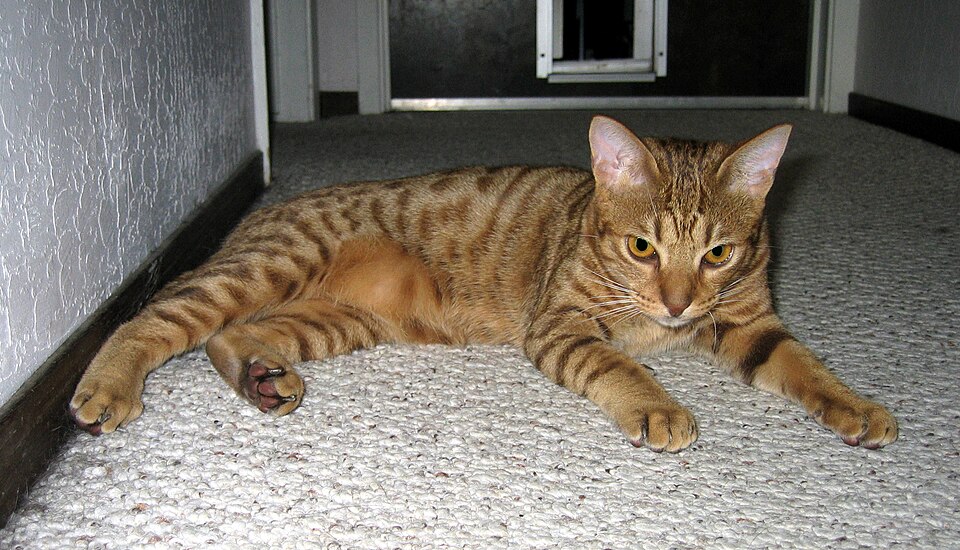
Despite large, bold spots that recall a wild jungle cat, the Ocicat comes entirely from domestic breeds. It's a muscular, outgoing cat with a dog-like personality. Easy to train and easy to groom, it doesn't like being left alone for long.

 Lifespan12–18 yearsrange from vet guides; no large breed study
 Weight6–15 lb (2.7–6.8 kg)muscular; heavy for its size
 OriginUnited StatesAbyssinian × Siamese, then American Shorthair
 CoatShort, glossylight shedder; a chamois wipe is enough
 EnergyEnergeticplayful, but less so than an Abyssinian
 VoiceModeratespeaks up now and then for attention
 TrainingQuick learnerfetch, leash walking, voice commands
 Time aloneDislikes itbest with other pets or someone home
People seeing an Ocicat for the first time often ask, "Is this one of the new wild hybrids?" As the CFA stresses, the answer is no: there's no wild cat anywhere in the Ocicat's ancestry. It's a 100% domestic breed, developed from three domestic breeds to resemble the spotted wild cats of Central and South America. Its large, thumbprint-shaped spots may look wild, but its temperament is just the opposite: outgoing, adaptable and people-oriented. On this page we've pulled together its temperament, care needs and health issues from breed registries, veterinary sources and scientific studies.
- Temperament: Outgoing, smart and dog-like; devoted to its people without being clingy or demanding.
- Takes to training: Many play fetch, walk on a harness and respond to voice commands.
- Easy care: It sheds little; an occasional rubber brush or chamois wipe is enough.
- Hates being alone: Happier in homes with other pets or someone around during the day.
- Health: Ask the breeder about heart disease (HCM), amyloidosis and PRA, which can come from its ancestor breeds.
What to know
 What is the Ocicat like?
The Ocicat is often described as having a dog-like personality. According to the CFA, it is devoted to its people but neither clingy nor demanding. A natural extrovert, it welcomes even strangers, probably hoping to find a new playmate. It responds very well to training: many Ocicats play fetch, walk on a leash, learn voice commands and easily adapt to household rules. The CFA adds that they make excellent travelers.
It's alert, agile and athletic; energetic but not overly active. According to the CFA, its base activity level is lower than that of an Abyssinian or Siamese. It values human interaction but doesn't crave it constantly. It will speak up now and then to get your attention, without being annoying about it. Vet-reviewed sources note that it's a bit less vocal than its Siamese ancestor but often has something to say.
Every cat is an individual. Breed traits describe general tendencies; how a cat was raised, how much contact it had with people as a kitten and its health shape its personality as much as its breed.
 Who is it a good fit for?
The CFA describes the Ocicat as a companion that fits well into almost any type of household. It does best in homes with other pets or with someone home during the day, because it doesn't like being left alone for long periods.
| Situation | Good fit? |
|---|---|
| Apartment | Good, with climbing space and daily play |
| Other cats and dogs | Usually gets along with proper introductions |
| People who work from home | Excellent; it enjoys human interaction |
| Long hours alone | Hard; another pet or someone at home helps |
| People who want to train their cat | Excellent; learns quickly with rewards |
| First-time cat owners | Good; easy to groom and even-tempered |
Vet-reviewed sources note that, with proper introductions, Ocicats get along well with cats and dogs and may prefer homes with another pet, especially while their people are at work. If there are children in the home, teach them, as with any breed, not to grab the cat and to leave it alone while it rests.
Where does it come from?
The Ocicat was a happy accident. According to the CFA, in 1964 a breeder in the United States crossed an Abyssinian with a Siamese, hoping to produce a Siamese with Abyssinian-colored points. Instead, a spotted male kitten was born; the breeder's daughter thought he looked like an ocelot (a spotted wild cat of Central and South America), and so he became the "Ocicat." Vet-reviewed sources name the breeder as Virginia Daly.
The first Ocicat, "Tonga," was neutered and placed in a pet home, but his picture appeared in a Detroit newspaper. Geneticist Dr. Clyde Keeler saw it and expressed interest in producing domestic cats that resembled vanishing wild species. The breeding was repeated, other breeders tried the same "recipe," and the American Shorthair was added to broaden the gene pool. The CFA first accepted the Ocicat for registration in 1966, but developing consistent type took time, and the breed didn't reach championship status until 1987.
 Appearance and colors
A strong, medium-to-large cat. According to the CFA, it's so muscular that even females feel heavy for their size. The head is a modified wedge with a broad, slightly squared muzzle, which adds to its wild look.
- Weight: According to PetMD, 6–15 pounds (about 2.7–6.8 kg).
- Spots: Large, thumbprint-shaped and in strong contrast to the lighter background. Show-quality cats have a "bull's-eye" pattern on each side, with a spot circled by other spots; there are also large spots on the shoulders, hindquarters and legs.
- Coat: Short, glossy and dense. Except at the tip of the tail, each hair has several bands of color; spots form where these bands line up.
- Colors: According to the CFA, there are 12 colors. The most common are tawny, chocolate and cinnamon; lighter and silver shades such as lavender silver and fawn silver are also accepted. A cat's color is determined by the color of its tail tip.
Daily care
The Ocicat is easy to care for. According to the CFA, it isn't a heavy shedder and needs only minimal grooming. Some owners occasionally use a rubber brush to remove dead hair; for very light shedders, wiping the coat with a chamois is enough. A chamois removes loose hair, adds shine and can be used as often as you like. Baths usually aren't needed unless the cat is being shown.
- Play: A few hunting games and rounds of fetch a day keep its energy balanced.
- Training: Short, reward-based sessions (coming when called, harness walking) are great enrichment for a smart cat.
- Climbing: Cat trees and high shelves make your home more interesting for it.
- Travel: According to the CFA, it's an excellent traveler; still, getting it used to the carrier ahead of time with rewards makes everything easier. Our guide to carrier training walks you through it.
For play ideas, see our article on playing with an indoor cat.
 Diet and weight
The Ocicat doesn't need a special food; a complete, balanced cat food suited to its age is enough. Because it's a muscular, heavy cat, track its weight with a scale rather than by eye.
- Decide the daily amount with your vet based on your cat's age, activity and ideal weight.
- Vet-reviewed sources suggest scheduled meals instead of leaving food out all day, with an occasional food puzzle.
- Count treats, especially training treats, as part of the daily food.
- Keep an eye on water intake; if your cat starts drinking noticeably more, tell your vet.
 Health issues to know about
According to the CFA, coming from three different breeds gives the Ocicat good genetic diversity, and breeders share genetic testing information. Still, some health issues found in its ancestor breeds can show up in Ocicats. The information below is for awareness only; ask your vet about diagnosis and treatment.
Hypertrophic cardiomyopathy (HCM)
The most common heart disease in cats, in which the heart muscle thickens abnormally. The CFA suggests asking the breeder about any history of HCM in the line. Many cats show no signs for a long time; according to the Cornell Feline Health Center, the disease is detected with a heart ultrasound (echocardiography), and as it progresses there may be fast or open-mouth breathing, lethargy and sudden weakness in the hind legs.
Amyloidosis
A disease in which abnormally folded proteins build up in organs and disrupt their function. The CFA notes that in Ocicats it can affect the kidneys or the liver. It's known to be more common in the Abyssinian, one of the ancestor breeds, and to run in families; according to Science for Animal Welfare (formerly UFAW), there's no DNA test. Drinking and urinating a lot, weight loss and poor appetite are the signs to watch for.
Progressive retinal atrophy (PRA)
An inherited eye disease in which the retina slowly degenerates, leading to blindness. A 2010 study by Menotti-Raymond and colleagues showed that the rdAc variant, first described in the Abyssinian, has spread to many breeds and is very common in Siamese cats; the Ocicat descends from both. According to the CFA, genetic testing has made this a minor concern in Ocicats today.
Other findings
In a 2012 study by Grahn and colleagues, none of the 69 Ocicats tested carried the variant linked to PK deficiency. In the large 2022 DNA study, all 76 Ocicats tested had type A blood. These are encouraging, but they don't replace asking the breeder for its own test results.
- Fast, labored or open-mouth breathing
- Sudden weakness or pain in the hind legs
- Drinking and urinating a lot, weight loss
- Trouble finding its way in the dark, bumping into things
How long does it live?
We couldn't find large lifespan data for the Ocicat like the UK VetCompass studies. Vet-reviewed sources give a lifespan range of 12–18 years for the breed. That's a general range, not a precise average; actual lifespan depends on care, weight and health screening.
The most concrete ways to extend lifespan are the same for every cat: spaying or neutering, a healthy weight, a safe indoor life, a vet checkup at least once a year and dental care.
 Before you get one
- Consider a shelter: Purebred cats end up in shelters and rescues too. Follow breed groups and adoption listings.
- Ask the breeder: As the CFA suggests, ask about any history of HCM, amyloidosis and PRA in the line, and request the parents' test results.
- Not a wild hybrid: Unlike the Bengal or Savannah, the Ocicat isn't a wild hybrid; it may look like a wild cat, but there's no wild cat in its ancestry. Think of it as a domestic cat in terms of care and temperament.
- Red flags: Steer clear of sellers who won't show you the mother, always have kittens available, can't provide paperwork or rush you.
- Registration: Rules vary by country; many places require or recommend microchipping. In Türkiye, owned cats must be microchipped and registered in the PETVET system. See our PETVET and microchip guide for details.
- A companion: If you're out all day, consider a second cat; our guide to introducing two cats walks you through it.
Frequently asked questions
Does the Ocicat have wild cat ancestry?
No. According to the CFA, the Ocicat is 100% domestic: it was developed from Abyssinian, Siamese and American Shorthair cats. Its spotted look was selectively bred to resemble wild cats.
What's the difference between an Ocicat and a Bengal?
Both are spotted, but the Bengal has a wild cat, the Asian leopard cat, in its ancestry, while the Ocicat comes only from domestic breeds. Bengals are generally more active. See our Bengal page for details.
Do Ocicats shed?
Lightly. According to the CFA, it isn't a heavy shedder; an occasional rubber brush or chamois wipe is enough.
Can an Ocicat be trained?
Yes, most respond very well. According to the CFA, many Ocicats play fetch, walk on a leash and learn voice commands. Short, rewarding sessions work best.
Can an Ocicat be left home alone?
For short periods, yes, but it doesn't like long hours on its own. The CFA recommends homes with other pets or someone who works from home.
Sources
- CFA (Cat Fanciers' Association) · Ocicat breed profile and standard
- PetMD (vet-reviewed) · Ocicat cat breed
- Grahn et al. · Erythrocyte pyruvate kinase deficiency mutation identified in multiple breeds of domestic cats, BMC Veterinary Research (2012)
- Anderson et al. · Genetic epidemiology of blood type, disease and trait variants in over 11,000 domestic cats, PLOS Genetics (2022)
- Menotti-Raymond et al. · Widespread retinal degenerative disease mutation (rdAc) discovered among a large number of popular cat breeds, The Veterinary Journal (2010)
- Science for Animal Welfare (formerly UFAW) · Genetic welfare problems: Abyssinian, amyloidosis
- Cornell Feline Health Center · Hypertrophic cardiomyopathy
By Tüylüm · Last checked: November 3, 2026. Compiled from the sources above and written in our own words. Spotted a mistake? Write to [email protected] and we'll fix it right away. Photo from Wikimedia Commons, used under the license shown below it.