 Tüylüm
Singapura
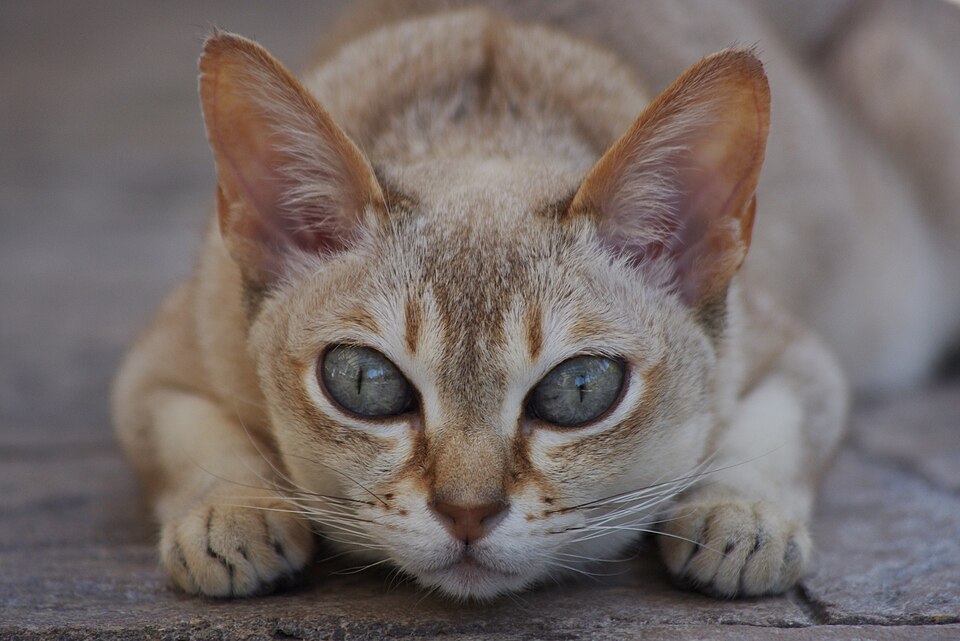
One of the smallest purebred cats: big eyes, big ears, an ivory coat ticked with sepia bands and energy that never runs out. Its gene pool is very narrow; ask for the parents' DNA tests for PK deficiency, which causes anemia, and the eye disease PRA.

 Lifespan9–15 yearsGCCF's range; no breed-specific study
 Weight4–8 lb (1.8–3.6 kg)among the smallest breeds; females smaller
 OriginSingaporeorigin is debated
 CoatShort, fine, tickedone color: sepia agouti
 EnergyHighkeeps playing as it ages
 VoiceUsually quietcan be surprisingly loud
 With kidsGoodhappy in busy families too
 Home aloneStrugglesgets lonely if left too long
The Singapura is one of the smallest purebred cats: females often weigh around 4 to 5.5 pounds (2 to 2.5 kg). But that small body holds enormous curiosity, an endless appetite for play and a close bond with its people. It's easy to recognize by its big eyes, large ears and a coat in which every hair carries light and dark bands that shimmer in the sun. On this page we've pulled together its temperament, its debated origin, its care needs and the health issues that come with a narrow gene pool, drawing on breed registry standards, veterinary resources and scientific studies.
- Temperament: Outgoing, curious and playful; it "helps" with everything around the house and keeps playing as it ages.
- Small but sturdy: Males weigh about 6–8 lb (2.7–3.6 kg) and females 4–6 lb (1.8–2.7 kg); small, but muscular.
- One color: Only one color is recognized, called "sepia agouti": an ivory base with dark ticking.
- Narrow gene pool: In genetic studies, it is among the least diverse breeds; there are DNA tests for PK deficiency and PRA.
- Being alone: It doesn't like long stretches on its own; it thrives on attention and company.
What to know
 What is the Singapura like?
The Singapura is an outgoing, curious and very playful cat. According to the CFA's breed profile, it feels compelled to investigate everything around it, especially whatever has your attention at the moment; whatever you're doing at home, it's right there with you, and at night it likes to snuggle up close. Its love of play continues into adulthood, and its energy rarely fades with age. The GCCF also describes Singapuras as cats that enjoy human company and are true lap cats.
It's confident in familiar surroundings, but according to the CFA, it can become wary if something big changes at home. At times like that, giving it time to adjust and calmly showing that everything is fine helps.
As for its voice: the CFA and GCCF describe Singapuras as generally quiet cats with soft voices, but the CFA adds that when they decide to speak up about something, they can be surprisingly loud.
Every cat is an individual. Breed traits describe general tendencies; how a cat was raised, how much contact it had with people as a kitten and its health shape its personality as much as its breed.
 Who is it a good fit for?
The Singapura suits people and families who enjoy spending time with their cat, can offer play and attention, and want a companion that is fairly quiet but very active.
| Situation | Good fit? |
|---|---|
| Apartment | Excellent; small, but it needs space to climb and play |
| Family with kids | Good; PetMD says it can be happy in busy families with children and other pets |
| Other cats and dogs | Can be good company, but no substitute for human attention |
| Long hours alone | Hard; the GCCF and PetMD say it dislikes being left alone for long |
| First-time cat owners | Good; easy to care for, as long as it gets attention and play |
Because it's such a small cat, teach young children to hold it gently, never squeeze it and always leave it a way out.
Where does it come from?
The Singapura's origin is debated. According to the official story told by the CFA, the breed comes from the street cats of Singapore; its name is the Malay word for Singapore, and at home it is called "Kucinta, the Love Cat." Hal and Tommy Meadow, an American couple who had been working in Singapore, brought five cats with them when they returned to the United States in 1975; one more arrived in 1980, and the breed was built on this small group. The CFA accepted the breed for registration in 1981 and granted championship status in 1988. According to the CFA and GCCF, it is recognized in Singapore as a "living national monument."
There is another view, though. The GCCF notes suggestions that the breed is a Burmese and Abyssinian hybrid, and PetMD reports that the Singapore Tourism Board speculates that local street cats were taken to the U.S. earlier and crossed there with Abyssinians and Burmese. In a large 2008 genetic study, the Singapura and the Burmese couldn't be told apart with the genetic markers used, and the researchers cited the pair as an example of recently derived breeds. There's no final answer, but the genetic data clearly show a very close link between the Singapura and the Burmese.
 Appearance and colors
Under the CFA standard, the Singapura is a small-to-medium, sturdy and muscular cat. The head is rounded with a short, blunt nose; the ears are large, deep-cupped and wide at the base; and the eyes are large and almond-shaped. Dark lines running from the inner corner of the eyes down the sides of the nose give it what's called "cheetah lines."
- Weight: According to the CFA, adult males weigh 6–7 pounds (about 2.7–3.2 kg) and females 4–5 pounds (about 1.8–2.3 kg). The GCCF gives 6–8 pounds for males and 5–6 for females.
- Color: Only one color is recognized, which the CFA calls "sepia agouti": an old-ivory base with dark sepia bands. According to the GCCF, each hair has at least two dark bands separated by light bands, while the muzzle, chest, belly and inner legs are unticked, light ivory. This banding makes the coat shimmer in sunlight.
- Eye color: Hazel, green or yellow; no other color is allowed.
- Coat: Short, fine, silky and close-lying.
Daily care
The Singapura is very easy to groom. According to the CFA, its short, close-lying coat doesn't shed heavily; combing once a week removes dead hair and strengthens your bond. Baths usually aren't needed unless the cat is being shown, and if one is needed, use products made for cats, not human shampoo.
- Climbing and exploring: Small but agile and very curious; a cat tree, shelves and a window perch are musts. See our article on why cats love high places.
- Play: A few hunting games and food puzzles a day. Our guide to playing with an indoor cat has ideas.
- Give it time with changes: Don't rush it through big changes like a move, a new housemate or new furniture.
- Eyes: PetMD says its large eyes don't need special care, but recommends seeing your vet if you notice discharge, redness or cloudiness.
 Diet
Singapuras don't need a special food; a complete, balanced cat food suited to their age is enough. PetMD points out that indoor cats tend to gain weight because they're less active, and in such a small cat, even a few ounces make a real difference.
- Measure food; decide the daily amount with your vet based on your cat's ideal weight.
- Weighing your cat once a month on a kitchen scale shows small changes early.
- Count treats as part of the daily food.
- Always have fresh water available.
 Health issues to know about
The CFA says that thanks to their street-cat ancestry, most Singapuras are vigorous and healthy, very few health problems have been recorded, and breeders do genetic testing. Still, the narrow gene pool brings a few things to know about. The information below is for awareness only; ask your vet about diagnosis and treatment.
A narrow gene pool
The breed was founded on very few cats. In a 2008 genetic study, the Singapura and the Burmese had the lowest genetic diversity and the strongest signs of inbreeding of all breeds studied, and the researchers wrote that breeders of both breeds should be concerned about genetic diversity. The GCCF shares this concern and notes that a program to bring new bloodlines into the breed was approved in the UK in 2013. A narrow gene pool makes recessive inherited diseases more likely to appear, which is why the tests below matter.
Pyruvate kinase deficiency (PK deficiency)
A shortage of an enzyme that red blood cells need to produce energy, leading to anemia. Langford Vets lists the Singapura among breeds at risk, and the GCCF also says the disease has been found in Singapuras. According to Langford, the anemia is often mild and intermittent, and some cats never show signs, so affected cats may not be identified until they've had many kittens. Lethargy and poor appetite are the signs to watch; rarely, a sudden, severe anemia can develop. The disease is recessive, and there's a DNA test.
Inherited retinal disease (PRA, rdAc)
This disease causes the light-sensing layer of the eye to gradually break down, leading to blindness. Langford Vets lists the Singapura among breeds at risk of the rdAc gene change, and the CFA suggests asking the breeder about any history of PRA in the lines. Affected cats are born with normal vision; blindness often develops by 3 to 5 years. There's a DNA test.
Birthing difficulties
According to the GCCF, Singapura females can have weak uterine contractions (uterine inertia), which may require a cesarean section, and litters are usually small, about two or three kittens. If you aren't planning to spay your cat, discuss this with your vet ahead of time.
- Lethargy, poor appetite or pale gums (possible signs of anemia)
- Bumping into things or trouble finding the way in dim light
- Prolonged labor that isn't progressing in a cat giving birth
- Hiding and withdrawing from play (cats hide pain)
How long does it live?
We couldn't find a scientific lifespan study specific to the Singapura. The GCCF and PetMD's vet-reviewed profile give a range of 9–15 years; that's an estimate, not a real measurement. For comparison, in the large UK VetCompass study, mixed-breed cats had a life expectancy at birth of 11.89 years.
Parents with completed genetic tests, a healthy weight, regular vet checkups and a safe indoor life are the most concrete steps you can take to help your Singapura live a long life.
 Before you get one
- Consider a shelter: Purebred cats end up in shelters and rescues too. If you're set on a breed, follow breed groups and adoption listings.
- If you buy from a breeder: Ask to meet the parents, and ask for PK deficiency and PRA (rdAc) DNA results and vaccination records. The GCCF also recommends making sure the parents were tested for PK deficiency.
- A rare breed: According to the CFA, there are relatively few breeders, so you may have to wait for a kitten. Steer clear of sellers who rush you, won't show you the mother or can't provide paperwork.
- Registration: Rules vary by country; many places require or recommend microchipping. In Türkiye, owned cats must be microchipped and registered in the PETVET system.
- The first days: Prepare a quiet room with a litter box, water, a hiding place and toys. Our guide to the first week with a new cat walks you through it step by step.
Frequently asked questions
Is the Singapura the smallest cat in the world?
It's one of the smallest purebred breeds. According to the CFA, adult females weigh about 4–5 lb (1.8–2.3 kg) and males about 6–7 lb (2.7–3.2 kg). It's small, but sturdy and muscular.
Does the Singapura really come from Singapore?
According to the official story, it descends from Singapore's street cats and is considered a "living national monument" there. But its origin is debated: some sources suggest crosses with Burmese and Abyssinians, and genetic studies show it is very closely related to the Burmese.
Do they shed a lot?
No. Their short, close-lying coat doesn't shed heavily; combing once a week is enough.
Can a Singapura be left home alone?
For short periods, yes, but it gets lonely if left alone for long. If you're out for long hours, toys, climbing space and visits from someone you trust help.
What's the difference between a Singapura and an Abyssinian?
Both have ticked coats, but the Singapura is much smaller, has a rounder head and is recognized in only one color. See our Abyssinian page for details.
Sources
- CFA (Cat Fanciers' Association) · Singapura ırk tanıtımı ve standardı
- GCCF (Governing Council of the Cat Fancy) · Singapura
- Lipinski M. J. ve ark. · The ascent of cat breeds: genetic evaluations of breeds and worldwide random-bred populations, Genomics (2008)
- Langford Vets (Bristol Üniversitesi) · Pyruvate kinase deficiency genetik testi
- Langford Vets (Bristol Üniversitesi) · Progressive Retinal Atrophy (rdAc) genetik testi
- PetMD (veteriner onaylı) · Singapura
- Teng ve ark. · Life tables of annual life expectancy and risk factors for mortality in cats in the UK, Journal of Feline Medicine and Surgery (2024)
- Resmî Gazete · Kedi, Köpek ve Gelinciklerin Kimliklendirilmesi ve Kayıt Altına Alınmasına Dair Yönetmelik (26 Şubat 2018)
By Tüylüm · Last checked: November 3, 2026. Compiled from the sources above and written in our own words. Spotted a mistake? Write to [email protected] and we'll fix it right away. Photo from Wikimedia Commons, used under the license shown below it.