 Tüylüm
Alaskan Malamute
Often called the strongest of the northern sled dogs, this big breed was built to haul heavy loads slowly and tirelessly over long distances. Affectionate and people-friendly, but stubborn, with a strong prey drive, heavy shedding and real sensitivity to heat. It takes experience and time.

 Lifespan≈ 11.3 yearsmedian, UK 2024 data; the breed club says ~10 years
 Weightabout 75–85 lb34–38 kg; FCI ideal sizes, natural range
 Height23–25 in58.5–63.5 cm at the shoulder; ideal sizes
 OriginNorthwestern Alaskafreight dog of the Mahlemiut people
 SheddingHeavythe undercoat blows out twice a year
 Exercise2+ hours a daypulling, long hikes, backpacking
 With kidsLoving but bignever leave alone with young children
 TrainingChallengingsmart but stubborn; needs patience and consistency
The Alaskan Malamute is one of the oldest Arctic sled dogs. Where the Siberian Husky carries light loads fast, the Malamute was developed to haul heavy loads slowly and tirelessly over long distances. The result is a big, heavy-boned, very strong dog that is also extremely affectionate with people. That strength and independence can be a challenge for owners who don't know the breed well. We've put this page together from breed registry standards, the national breed club, animal welfare resources and scientific studies.
- Temperament: Affectionate and playful; bonds with the whole family rather than one person, and isn't a guard dog.
- Strength and stubbornness: Smart but independent and willful; early socialization and patient, consistent training are a must.
- With other animals: Strong prey drive; may have trouble with dogs of the same sex.
- Care: The Royal Kennel Club recommends daily grooming and more than 2 hours of exercise a day.
- Health: Inherited conditions such as polyneuropathy and chondrodysplasia exist; ask for the parents' test results.
- Lifespan: A large 2024 UK study found a median lifespan of 11.3 years.
What to know
 What is the Alaskan Malamute like?
According to the FCI standard, the Malamute is an affectionate, friendly dog, not a "one-man" dog. It is loyal and devoted, playful in invitation, and takes on a dignified bearing as it matures. The AKC notes that because Malamutes tend to be friendly with everyone, they aren't especially suited to be guard dogs.
It is also a very independent dog. The AKC describes Malamutes as highly intelligent but independent and willful, often to the point of stubbornness. In a profile published by the Canadian Kennel Club (CKC), a longtime breeder explains that Malamutes learn quickly, get bored easily and will make up their own rules if their owner falls a step behind. The same piece describes how a Malamute without enough exercise and mental stimulation can turn to destructive behavior and howling.
- Digging: The AKC says digging is one of the behaviors that may be impossible to train out of a Malamute, so fencing should extend into the ground.
- Prey drive: According to the CKC piece, Malamutes have a high prey drive. One can get along with a household cat it was raised with from puppyhood, but neighborhood cats and small animals are fair game.
- Other dogs: The same piece notes that, being highly attuned to pack hierarchy, Malamutes can be aggressive toward dogs of the same sex; in multi-dog homes, a male and a female often make a successful pair.
Every dog is an individual. Breed traits describe general tendencies; how well a puppy was socialized, its training, its daily life and its health shape its personality as much as its breed.
 Who is it a good fit for?
The Malamute suits people who love spending time outdoors in all weather, are patient and consistent, and don't need their home and yard to look perfect at all times. The breeder in the CKC piece calls it a challenging breed for any owner, and especially for first-time owners.
| Situation | Good fit? |
|---|---|
| Apartment | Hard; the Royal Kennel Club recommends a large house and a large yard |
| Family with kids | Loving but big and strong; never leave it alone with young children |
| Other dogs | Needs care; may have problems with dogs of the same sex |
| Cats and small pets | Risky; not recommended unless raised together from puppyhood |
| Long hours alone | Hard; when bored it digs and may howl |
| First-time dog owners | Challenging; support from someone experienced helps |
| Hot climates | Needs care; the routine has to change in summer |
On children, the CKC piece is frank: a well-socialized Malamute is affectionate with kids, but its big paws and exuberance can knock a small child over without meaning to. If you have children at home, the rules in our article on kids and dogs help a lot.
Where does it come from?
According to the AKC, the breed's name comes from the Mahlemiut, an Inuit people who settled long ago around Kotzebue Sound in northwestern Alaska. The Mahlemiut developed this dog to work in packs, hauling heavy loads at low speeds over long distances. As the AKC sums it up: huskies are racers, Malamutes are freighters. Malamutes also served as hunting partners and pack carriers.
The FCI describes the Malamute as "one of the oldest Arctic sledge dogs"; the United States holds the breed standard, and the FCI places it in Group 5 among the Nordic sled dogs. The Royal Kennel Club calls it the strongest of the sled dogs and notes that it is built to sleep outdoors in all weathers, with even the insides of its ears furred.
Appearance and colors
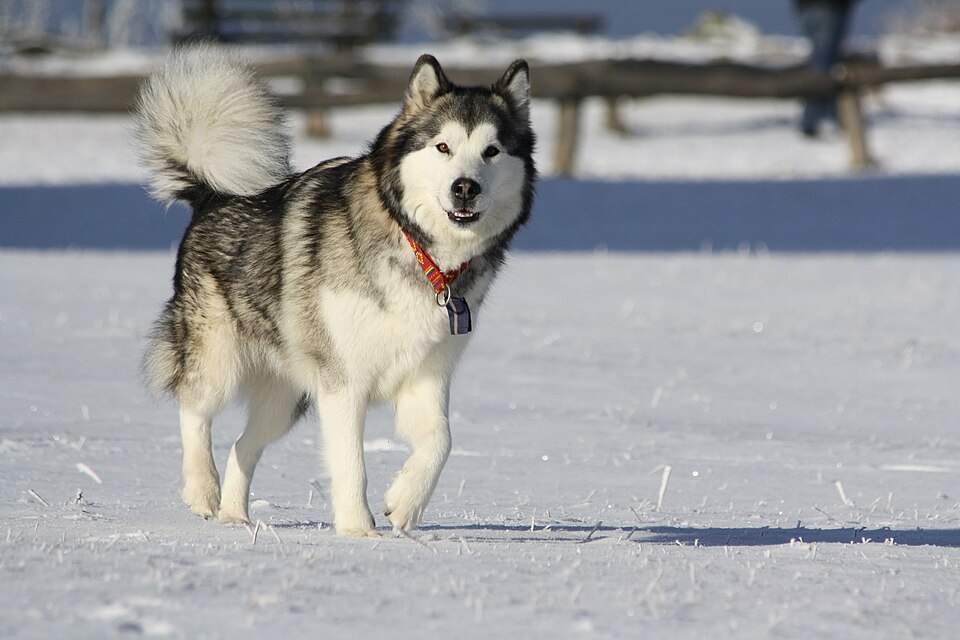
According to the FCI standard, the Malamute is a powerful, substantially built dog with a deep chest and a strong, well-muscled body. The head is broad, the triangular ears stand erect, and the muzzle is large and bulky. The large, tight "snowshoe" feet are made for the north. When it isn't working, the well-furred tail is carried over the back like a waving plume.
- Size: There is a natural range in size. The FCI's "desirable freighting sizes" are 25 in (63.5 cm) and 85 lb (38 kg) for males and 23 in (58.5 cm) and 75 lb (34 kg) for females, and the AKC lists 75–85 pounds. The standard says size should not outweigh type, proportion and movement; bigger is not better.
- Eyes: Almond-shaped and brown. Blue eyes are a disqualifying fault in the standard; if you see a "blue-eyed Malamute," ask questions.
- Coat: A coarse, thick guard coat over a dense, oily, woolly undercoat 1–2 in (2.5–5 cm) deep. Per the FCI, the coat is usually shorter and less dense in summer.
- Colors: Shades of gray from light gray to black, plus sable and red; the only solid color allowed is all white. Face markings such as a cap and mask are a hallmark of the breed.
 Daily care
The AKC says the Malamute's thick, waterproof double coat is beautifully adapted to Arctic life but needs constant upkeep, and the Royal Kennel Club recommends daily grooming. The AKC suggests checking for mats and "hot spots" (moist, inflamed patches of skin) while brushing, and adding an undercoat rake during the twice-yearly shedding seasons. A pet Malamute can often go 6 to 8 weeks between baths.
- Nails and paws: Trim nails regularly and check the hair between the toes and the pads for cracks.
- Ears and teeth: The AKC recommends checking the ears regularly and brushing the teeth regularly.
- Shaving: This is debated. PDSA suggests considering a clip for heavy-coated dogs in hot weather, while the breeder in the CKC piece argues against shaving unless it's medically necessary. According to the University of Minnesota's dermatology handbook, hair can fail to grow back fully for months, sometimes 1–2 years, after clipping in dense-coated breeds. Talk to your vet before deciding.
In hot weather
According to PDSA, thick-coated dogs are among the groups most at risk of heatstroke, and nearly three quarters of cases develop during play or exercise. In hot summers, move walks to early morning and evening, provide a cool room, shade and plenty of water during the day, and never leave your dog in a car. See our article on dogs in hot weather for more.
Training and exercise
The Royal Kennel Club recommends more than 2 hours of exercise a day. According to the AKC, the Malamute wasn't bred for racing but for work, and it has tremendous endurance. Romping in a well-fenced area, hiking, running and swimming can cover daily needs. If you have the time and interest, agility, obedience, weight pulling, backpacking and sledding are a great fit for the breed.
Patience is essential in training. The AKC says socialization and obedience training are necessary to keep a Malamute from becoming pushy with children and other pets. According to the AKC, fairness and patience can produce a devoted, trustworthy companion. Because Malamutes learn fast and bore easily, the CKC piece suggests that short, varied sessions work better.
- The fence must be solid and extend into the ground; per the AKC, digging may never fully go away with training.
- The breeder in the CKC piece doesn't consider off-leash dog parks a good idea for this breed; keep meetings with unfamiliar dogs controlled.
- Mental work is tiring too: sniffing games are a great addition to the daily routine.
 Diet and weight
According to the AKC, a Malamute does well on a high-quality food suited to its life stage (puppy, adult or senior); some are prone to weight gain, so calories and weight should be watched. Treats are important in training, but too many lead to obesity.
- Set the daily amount with your vet based on your dog's ideal weight and actual activity level, and count treats as part of it.
- You should be able to feel the ribs under a thin layer of fat and see a waist when looking from above.
- Don't give vitamin or mineral supplements on your own. According to the University of Minnesota's dermatology handbook, reduced intestinal absorption of zinc has been found in some Malamutes; in cases like this, the decision belongs to your vet.
- Clean, fresh water should always be available.
 Health issues to know about
The information below is for awareness only; ask your vet about diagnosis and treatment. According to the AKC, responsible breeders screen for hip and elbow dysplasia, thrombopathia (a blood-clotting disorder), chondrodysplasia, an underactive thyroid, inherited polyneuropathy, von Willebrand's disease (another bleeding disorder) and day blindness.
Polyneuropathy (AMPN)
According to the breed club, the AMCA, this is an inherited, recessive disease that damages the nerves. It usually starts between 7 and 18 months of age; signs can include hind-leg weakness, a "bunny-hopping" gait, muscle loss, exercise intolerance and, if the larynx is affected, a change in voice. The first signs can be very subtle, such as a dog that no longer jumps up or lies down to eat. The gene was identified in 2011, and a DNA test is now available. The Royal Kennel Club lists this test as a minimum requirement for breeding.
Chondrodysplasia (dwarfism)
According to an article published by the AMCA, chondrodysplasia is an inherited, recessive skeletal disorder that disrupts bone development. Affected dogs can have noticeably short, bowed front legs, and the condition comes with a type of anemia. Carriers look completely normal, which is why pedigree checks matter. In puppies, diagnosis by X-ray is most reliable between 5 and 12 weeks of age.
Eyes and joints
Day blindness (cone degeneration) is an inherited disease that impairs vision in bright light; the Royal Kennel Club recommends a DNA test for it, plus an eye exam and hip and elbow screening.
Zinc-responsive dermatosis
According to the University of Minnesota's handbook, among dogs on balanced diets this rare skin condition is seen most often in Siberian Huskies and Alaskan Malamutes. Redness, stuck-on scales, crusting and hair loss around the eyes and mouth, on the chin and on the ears are typical signs.
- Nonstop fast panting in the heat, drooling, vomiting, weakness or collapse (possible heatstroke; move your dog somewhere cool and start cooling right away)
- Hind-leg weakness, wobbling or a change in voice in a young dog
- Short or bowed front legs in a puppy
- Bleeding that won't stop or bruising easily
- Crusting and hair loss on the face, around the eyes and mouth
How long does it live?
In a 2024 study by McMillan and colleagues that analyzed records of more than 584,000 dogs in the UK, the Alaskan Malamute had a median lifespan of 11.3 years (confidence interval 11.1–11.8), based on 842 deaths. Mixed-breed dogs in the same study had a median lifespan of 12 years.
In the same study, large breeds had a shorter median lifespan (11.9 years) than small breeds (12.7 years). The breed club, the AMCA, gives an average of about 10 years, and the AKC gives a range of 10–14 years. An ideal weight, regular vet checkups, protection from heat and parents that were health-screened are the most concrete ways to extend this breed's life.
 Before you get one
- Consider shelters and breed rescues: Purebred dogs end up in shelters and rescues too. With an adult Malamute, you already know how it does with other dogs and cats, which makes a good match easier.
- If you buy from a breeder: Ask to meet the parents, and ask for DNA tests for polyneuropathy (AMPN) and day blindness plus hip, elbow and eye screening. The AMCA stresses that the purchase price is just the beginning, and that choosing a puppy whose ancestors were health-screened matters.
- Red flags: Steer clear of sellers who won't show you the mother, always have puppies available, can't provide health paperwork or charge extra for a "giant Malamute" or a "blue-eyed Malamute."
- Preparation: Get a solid fence reinforced against digging, a sturdy harness and leash, and a cool space for summer.
- Registration: Rules vary by country; many places require or recommend microchipping. In Türkiye, owned dogs must be microchipped and registered in the PETVET system.
Frequently asked questions
What's the difference between a Malamute and a Husky?
Both are northern sled dogs, but they were bred for different jobs. According to the AKC, the Husky is a "racer" that carries lighter loads faster, while the Malamute is a "freighter" that hauls heavy loads slowly. The Malamute is bigger, heavier-boned and heavier, and its eyes are brown in the standard. See our Siberian Husky page for details.
Can a Malamute live in a hot climate?
It can, but summer calls for a special routine: exercise early in the morning and in the evening, provide a cool room, shade and plenty of water during the day, and never leave it in a car. If you see fast panting, weakness or vomiting in the heat, cool your dog down right away and call your vet.
Can a Malamute live with a cat?
According to the CKC piece, it can get along with a household cat it was raised with from puppyhood, but because of its high prey drive, outdoor cats and small animals are at risk. If you're bringing an adult Malamute into a home with a cat, be sure to learn its history first.
Does a Malamute make a good guard dog?
Usually not. The AKC says that because Malamutes tend to be friendly with everyone, they aren't especially suited to be guard dogs. Its size may deter people, but don't choose one for that purpose.
Is there a separate "giant Malamute"?
There is no separate "giant" type in the FCI standard; it gives about 25 in (63.5 cm) and 85 lb (38 kg) as the ideal for males and says size should not outweigh type, proportion and movement. Be wary of sellers who charge extra for size.
Sources
- FCI · Alaskan Malamute ırk standardı No. 243 (2023)
- AKC (American Kennel Club) · Alaskan Malamute ırk tanıtımı
- The Royal Kennel Club · Alaskan Malamute ırk sayfası (egzersiz, sağlık taramaları)
- Alaskan Malamute Club of America · About Malamutes
- Alaskan Malamute Club of America · Polyneuropathy
- Alaskan Malamute Club of America · Chondrodysplasia (L. M. Dowdy)
- Canadian Kennel Club · Meet the Alaskan Malamute (The Dish, Ocak 2022)
- McMillan ve ark. · Longevity of companion dog breeds: those at risk from early death, Scientific Reports (2024)
- University of Minnesota · Small and Large Animal Dermatology Handbook: Canine zinc responsive dermatosis
- University of Minnesota · Small and Large Animal Dermatology Handbook: Canine post-clipping alopecia
- PDSA · Heatstroke in dogs
- Resmî Gazete · Kedi, Köpek ve Gelinciklerin Kimliklendirilmesi ve Kayıt Altına Alınmasına Dair Yönetmelik (26 Şubat 2018)
By Tüylüm · Last checked: November 3, 2026. Compiled from the sources above and written in our own words. Spotted a mistake? Write to [email protected] and we'll fix it right away. Photo from Wikimedia Commons, used under the license shown below it.