 Tüylüm
Burmese
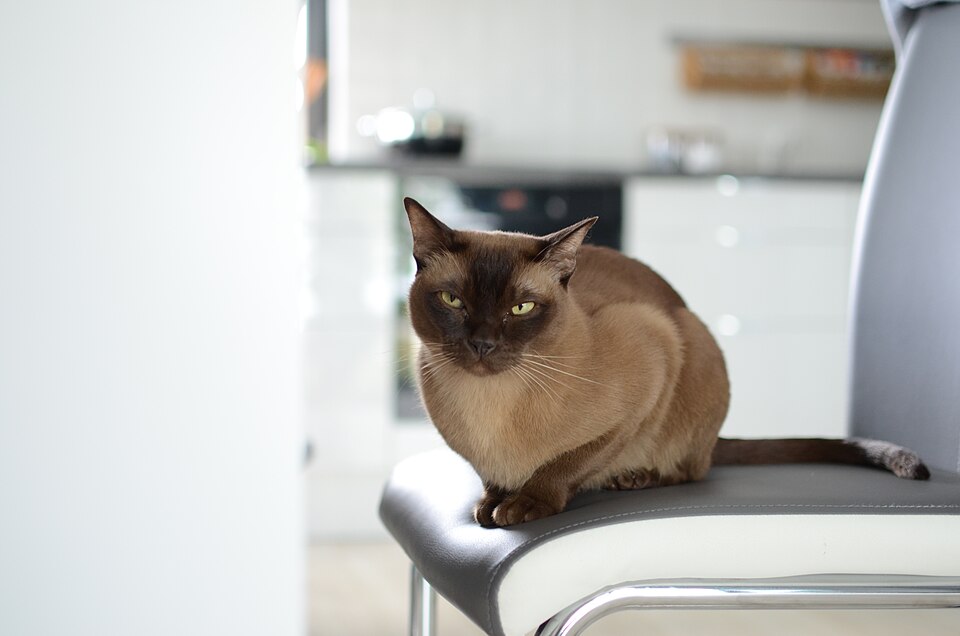
A medium-sized, muscular cat with a glossy satin coat, golden eyes and a temperament so people-focused it's called the "Velcro kitty." It had one of the longest life expectancies in UK data; diabetes, inherited low potassium and, in some lines, a head malformation are the issues to know.

 Lifespan≈ 14.4 yearslife expectancy, UK 2019; longest in the study
 Weight12 lb (5.4 kg)+males, per the CFA; females are smaller
 OriginSE Asia, USAbreed founded in the US in the 1930s
 CoatVery short, satinyrubber brush once a week
 EnergyActivestill playful in old age
 Maturity≈ 18 monthsreaches full size, per the CFA
 With kidsVery goodloves play and attention
 Time aloneNeeds companycan amuse itself but seeks its people
The Burmese is a muscular, glossy-coated cat that looks small but feels surprisingly heavy when you pick it up. It's so attached to its people that it's often called a "Velcro kitty." On this page we've pulled together its temperament, care needs, the difference between the American and European types and the health issues to know about, drawing on breed registry standards, animal welfare resources and scientific studies.
- Temperament: Very people-oriented, curious and playful; follows you from room to room and loves a lap.
- Two types: The American Burmese is rounder and more compact and comes in 4 colors; the European Burmese is more moderate in build and comes in 10 colors.
- Easy care: The very short, satiny coat just needs a rubber brush once a week.
- Health: A predisposition to diabetes, inherited low potassium (hypokalemia) and, in some lines, a fatal head malformation have been reported; DNA tests exist for the last two.
- Lifespan: In UK data from 2019, life expectancy was about 14.4 years, the longest of the 12 groups studied.
What to know
 What is the Burmese like?
The Burmese is a curious, clever cat that is deeply attached to human company. According to the CFA's breed profile, it doesn't save its affection for one person but shares it with everyone in the household; it follows you from room to room, looks for a warm lap and, if allowed, wants to sleep in your bed. It readily learns games like fetch.
Kittens are full of energy; adults mellow a little, but the CFA notes the breed stays playful well into old age. Burmese are generally soft-spoken, but if something is wrong, they will definitely let you know. They have a confident streak and tend to believe it's their job to run the house.
A cat this people-focused thrives on attention. The CFA notes it can amuse itself when it has to, but it may not be the best breed for a cat that will spend most of the day alone.
Every cat is an individual. Breed traits describe general tendencies; how a cat was raised, how much contact it had with people as a kitten and its health shape its personality as much as its breed.
 Who is it a good fit for?
The Burmese is a great fit for families who really want to spend time with their cat and have someone home for part of the day. If you're looking for a cat that keeps to its own corner, this breed may want more attention than you expect.
| Situation | Good fit? |
|---|---|
| Apartment | Good; adapts well indoors with climbing and play space |
| Family with kids | Excellent; per the CFA, good with children and loves to play |
| Other cats and dogs | Usually good; often accepts the family dog, introduce slowly |
| Long hours alone | Use caution; thrives on attention, a second cat can help |
| First-time cat owners | Good; easy to groom, but plan for its need for attention |
Teach children not to hold the cat against its will, not to disturb it while it sleeps and to use a toy, not their hands, during play. Burmese join in games quickly; giving the cat a high spot to retreat to when it's had enough keeps the home safe for everyone.
Where does it come from?
The breed takes its name from Burma (today's Myanmar). According to the CFA, cats of this type occur naturally in Southeast Asia, on the Malay Peninsula, but most of today's Burmese trace back to a single cat: Wong Mau, a small, dark walnut-brown female. According to the GCCF, Wong Mau was brought from Burma to the United States in 1930 by a San Francisco doctor, Joseph Thompson. Wong Mau was bred to Siamese cats, and the solid dark brown kittens became the foundation of the breed. The CFA began registering these cats in 1936, and the breed reached championship status in 1959.
Starting in 1949, American cats exported to England developed in a different direction. According to the CFA, brown Burmese were recognized in England in 1952; blue, red, cream, chocolate and lilac followed. That is how the type now called the European Burmese came about. It spread through Europe, Africa, Australia and New Zealand, and the CFA began registering it as a separate breed in 1993. So in the CFA today there are two distinct breeds: the Burmese and the European Burmese.
 Appearance and colors
A medium-sized cat that is "heavier than it looks": the CFA compares the breed to a small bulldog and stresses how much muscle and weight it packs into its frame. The coat is very short, fine, close-lying and glossy like satin. Eye color ranges from yellow to gold, and to deep amber in the European type; both CFA standards count green eyes as a fault.
- American Burmese: Round head, short broad muzzle and a compact body. The CFA accepts four colors: sable (dark brown), champagne, blue and platinum.
- European Burmese: A more moderate, medium-length body, a head shaped like a short, blunt wedge and large eyes with a gently curved top line. According to the CFA, it comes in ten colors: brown, blue, chocolate, lilac, red, cream and four tortoiseshell varieties of these.
- Weight: According to the CFA, adult males can reach or exceed 12 pounds (about 5.4 kg); females are usually smaller.
- Growth: The CFA says the Burmese reaches full size at about 18 months. Kittens can be lighter in color than adults.
The difference between the two types matters for health too: the head malformation described below is seen mostly in round-headed American lines.
Daily care
The Burmese sheds little and is one of the easiest breeds to groom. The CFA recommends a weekly rubber brush to remove dead hair and keep the coat glossy; regular baths aren't needed.
- Play: Several short hunting games a day (wand toys, fetch) are a must for this energetic breed. Puzzle toys and hide-the-food games help too.
- Vertical space: A cat tree, shelves and a window perch let an active cat burn off energy indoors.
- Claws: A scratching post is a must; if the claws grow long, they can be trimmed the way your vet shows you.
- Mouth and teeth: Check the teeth and gums regularly; a pain syndrome linked with mouth problems has been reported in this breed (see below).
- Company: If no one is home all day, a second, compatible cat or someone who drops by can make a real difference to this breed's well-being.
For more ideas, see our article on playing with an indoor cat.
 Diet and weight
Burmese don't need a special food; a complete, balanced cat food that suits their age and lifestyle is enough. Weight matters twice as much in this breed because a predisposition to diabetes has been reported. According to the resource from Science for Animal Welfare (formerly UFAW), obesity and inactivity are important risk factors for diabetes in cats, and the CFA also recommends regular checkups for aging Burmese and keeping an eye on carbohydrates in the diet.
- Measure food instead of eyeballing it; decide the daily amount with your vet based on your cat's ideal weight.
- Count treats as part of the daily food.
- Being able to feel the ribs under a thin layer of fat, and seeing a waist when you look from above, are good signs.
- Weighing your cat once a month shows changes early; needs may drop after spaying or neutering.
- Always have fresh water available, and notice how much your cat drinks: a sudden increase in drinking can be one of the first signs of diabetes.
We cover where to put food and water bowls in our article on food and water bowls.
 Health issues to know about
The Burmese is a long-lived breed, but some inherited problems have been reported. The information below is for awareness only; ask your vet about diagnosis and treatment.
Diabetes
According to Science for Animal Welfare, Burmese cats in the UK, Australia and New Zealand are predisposed to diabetes; Australian data found diabetes in about 10% of Burmese over eight years old. International Cat Care also lists diabetes among the conditions Burmese are predisposed to. The same predisposition doesn't seem to apply to Burmese in the US, which Science for Animal Welfare links to genetic differences between the two populations. The disease usually starts after age eight. Drinking a lot, urinating a lot, losing weight despite eating well and walking flat on the hocks of the back legs are signs to watch for. If you notice any of them, see your vet.
Inherited low potassium (hypokalemia)
When potassium in the blood drops, the muscles become weak. According to International Cat Care, the inherited form seen in this breed usually starts in kittens 2 to 6 months old: the cat can't lift its head, the neck droops forward and it walks stiffly and reluctantly. Signs can last a few days, fade and then come back. A 2012 genetic study showed that a change in a gene called WNK4 causes the disease and that cats with two copies of the change are affected; in that study the disease had not been reported in US Burmese. A DNA test is available; ask the breeder for the parents' results.
Head and face malformation (Burmese head defect)
According to Science for Animal Welfare, a change in a gene called ALX1 disrupts the development of the head and face while the kitten is in the womb. Kittens with two copies are born with severe facial malformations and cannot survive. Cats with one copy don't have this severe defect but do have a rounder head and a shorter face; because a round head is considered desirable by some, carriers can multiply without anyone intending it. The change is found mostly in round-headed "contemporary" lines in the US. A DNA test is available, and mating two carriers is advised against.
Feline orofacial pain syndrome (FOPS)
A painful condition of the mouth and face. In a study of 113 cats, 100 were Burmese; affected cats showed exaggerated licking and chewing movements and pawed at their mouths. Most cases had a history of mouth problems, and in some the first signs appeared while the adult teeth were coming in; the condition can recur. If your cat keeps pawing at its mouth, see your vet.
Urinary stones
In a study of more than 21,000 feline bladder stones sent to a Canadian laboratory between 1998 and 2014, Burmese and Tonkinese cats were among the breeds associated with calcium oxalate stones. If you see frequent trips to the litter box with little urine, blood in the urine or straining, see your vet; a cat that can't pass urine is an emergency.
- Inability to lift the head, a drooping neck or sudden muscle weakness
- A sudden increase in drinking and urinating
- Straining in the litter box without passing urine
- Lethargy, vomiting or loss of appetite
- Constant pawing at the mouth, or injuries to the tongue or mouth
How long does it live?
A 2024 study using the Royal Veterinary College's VetCompass data found a life expectancy at birth of 14.42 years (confidence interval 12.91–15.93) for 45 Burmese cats that died in the UK in 2019. That was the longest life expectancy among the 12 groups studied, with the Birman close behind at 14.39 years. In the same study, mixed-breed cats had a life expectancy of 11.89 years, and the longest-lived Burmese in the group was over 21.
This number is an average, not a promise, and the group was small. The same study shows that neutered cats and cats at their ideal weight live longer. In this breed, tracking weight and having regular blood and urine checks in later life are the most concrete ways to catch diabetes early.
 Before you get one
- Consider a shelter: Purebred cats end up in shelters and rescues too. If you're set on a breed, follow breed groups and adoption listings.
- If you buy from a breeder: Ask to meet the parents, and ask for hypokalemia DNA test results, the head defect test for American-type cats and whether there's any diabetes in the family. Ask for vaccination records and when the kitten will be ready to go home.
- Red flags: Steer clear of sellers who won't show you the mother, always have kittens available, can't provide test results or paperwork or rush you to "buy now."
- Registration: Rules vary by country; many places require or recommend microchipping. In Türkiye, owned cats must be microchipped and registered in the PETVET system.
- The first days: Prepare a quiet room with a litter box, water, a place to hide and plenty of toys. Our guide to the first week with a new cat walks you through it step by step.
Frequently asked questions
Is the Burmese the same as the Birman?
No. In Turkish both are called "Burma" cats, which causes confusion. The Burmese has a very short, solid-colored coat; the Birman is a separate breed with a medium-length coat, blue eyes, darker face, legs and tail, and white paws. See our Birman page for details.
Do Burmese shed?
A little. According to the CFA, the coat is very short, fine and close-lying, so a weekly rubber brush is usually enough. Still, saying they "don't shed at all" isn't accurate; like every cat, they shed their coat.
Are Burmese lap cats?
Most Burmese love laps and close contact; the CFA describes the breed as physically possessive of its people. Every cat is different, though, and letting the cat come to you is always best.
How do I choose between the American and European Burmese?
Their personalities are similar; the differences are mostly in head shape and colors. The American type has a rounder head, and the head malformation is seen mostly in those lines; inherited hypokalemia, on the other hand, has been reported in lines outside the US. Whichever you choose, ask for the parents' DNA test results.
Can a Burmese be left home alone?
Short stretches are fine, but this breed is very attached to its people. If you're out for long hours, a second cat, an enriching home and someone who drops by during the day will help.
Sources
- CFA (Cat Fanciers' Association) · Burmese ırk tanıtımı ve standardı
- CFA (Cat Fanciers' Association) · European Burmese ırk tanıtımı ve standardı
- GCCF (Governing Council of the Cat Fancy) · Burmese ırk tanıtımı
- Teng ve ark. · Life tables of annual life expectancy and risk factors for mortality in cats in the UK, Journal of Feline Medicine and Surgery (2024)
- Science for Animal Welfare (eski adıyla UFAW) · Genetic Welfare Problems: Burmese, baş gelişim bozukluğu (Burmese head defect)
- Science for Animal Welfare (eski adıyla UFAW) · Genetic Welfare Problems: Burmese, diabetes mellitus
- Gandolfi ve ark. · First WNK4-hypokalemia animal model identified by genome-wide association in Burmese cats, PLoS ONE (2012)
- International Cat Care · Hypokalaemia in cats
- International Cat Care · Inherited disorders in cats
- Rusbridge ve ark. · Feline orofacial pain syndrome (FOPS): a retrospective study of 113 cases, Journal of Feline Medicine and Surgery (2010)
- Houston ve ark. · Evaluation of 21 426 feline bladder urolith submissions to the Canadian Veterinary Urolith Centre (1998–2014), Canadian Veterinary Journal (2016)
- CFA (Cat Fanciers' Association) · Birman ırk tanıtımı
- Resmî Gazete · Kedi, Köpek ve Gelinciklerin Kimliklendirilmesi ve Kayıt Altına Alınmasına Dair Yönetmelik (26 Şubat 2018)
By Tüylüm · Last checked: November 3, 2026. Compiled from the sources above and written in our own words. Spotted a mistake? Write to [email protected] and we'll fix it right away. Photo from Wikimedia Commons, used under the license shown below it.