 Tüylüm
Tonkinese
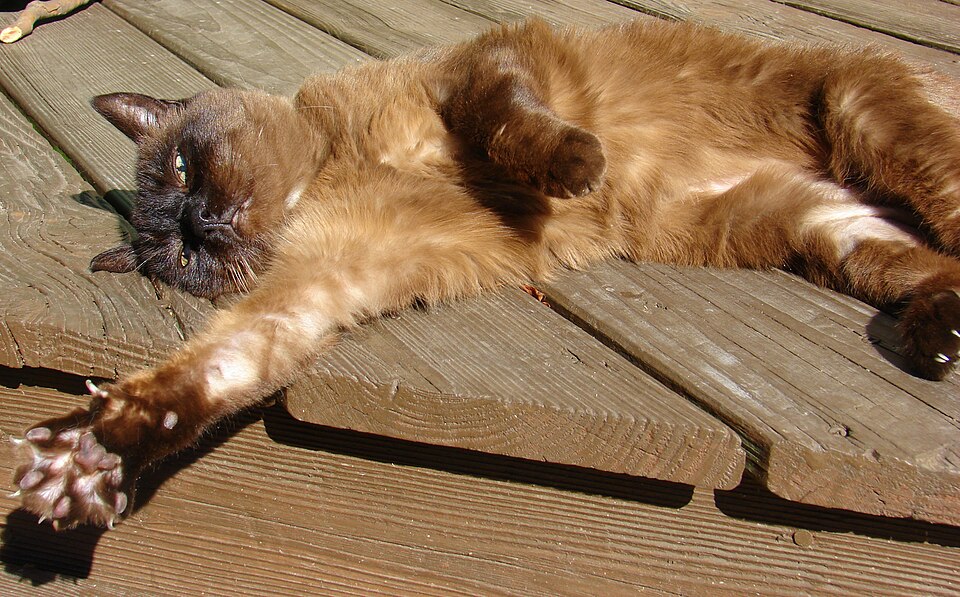
A medium-sized, muscular, very social cat halfway between the Siamese and the Burmese. Known for its aqua-eyed "mink" pattern, it loves people and feline friends and dislikes being alone. Gum health in later life and a DNA test for inherited low potassium are the things to know.

 Lifespan≈ 15 yearsaverage given by the GCCF; no study data
 Weight6–12 lb (2.7–5.4 kg)per the GCCF; males are larger
 OriginThailand, N. Americadeveloped from Siamese and Burmese
 CoatShort, silkyrubber brush once a week
 EnergyActiveloves play and climbing
 VoiceChattylikes to hold a conversation
 With kidsVery goodgreat with kids who respect animals
 Time aloneStruggleswants a human or feline friend
The Tonkinese is a short-coated, muscular cat developed as a middle ground between the slender elegance of the Siamese and the compact build of the Burmese. The CFA calls it a "happy medium": not as long and fine as a Siamese, not as round as a Burmese. On this page we've pulled together its temperament, its three color patterns, its care needs and the health issues to know about, drawing on breed registry profiles, animal welfare resources and scientific studies.
- Temperament: Very social, curious and playful; climbs into your lap or onto your shoulder and supervises everything you do.
- Time alone: Needs human or feline company; the GCCF recommends a cat companion.
- Three patterns: Aqua-eyed "mink," blue-eyed pointed (Siamese-style) and green to yellow-green-eyed solid (Burmese-style).
- Easy care: The short, silky coat needs a rubber brush once a week; watch gum health in later life.
- Health: Generally considered robust; a DNA test exists for the inherited low potassium that can come from its Burmese roots.
What to know
 What is the Tonkinese like?
The Tonkinese is a smart, outgoing, people-loving cat. According to the CFA's breed profile, it likes to settle in your lap or on your shoulder and keep a close eye on everything going on at home. It has an excellent memory and quickly learns what's off-limits, though it may test those rules while you're at work. It's sensitive to its owner's mood and is the kind of cat that shows up purring on a bad day.
This is an energetic cat. Fans describe it as part puppy and part monkey, and the CFA adds part elephant, for the noisy gallop through the house. It usually gets along well with dogs, other pets, children and guests, and it greets visitors at the door. It likes to communicate with its voice: according to the CFA, it doesn't just meow but speaks in "sentences" that expect a reply. Still, one breeder told PetMD that Tonks aren't as noisy as their reputation suggests.
Every cat is an individual. Breed traits describe general tendencies; how a cat was raised, how much contact it had with people as a kitten and its health shape its personality as much as its breed.
 Who is it a good fit for?
The Tonkinese suits a lively home that's ready to play, talk and spend time with its cat. According to the GCCF, it can live happily as an indoor cat with enough stimulation and a companion, and it stresses that the breed needs feline company.
| Situation | Good fit? |
|---|---|
| Apartment | Good; happy indoors with climbing space and play |
| Family with kids | Excellent; gets along with children taught to respect animals |
| Other cats and dogs | Very good; gets along with other cats and cat-friendly dogs |
| Long hours alone | Difficult; can get bored alone, a second cat helps |
| First-time cat owners | Good; easy to groom, but needs lots of attention and play |
If no one will be home for long stretches, consider starting with two cats. If you're adding a new cat, our guide to introducing two cats step by step can help.
Where does it come from?
The GCCF's breed profile traces the breed back to old Thai cat poem books, and early breeders noticed cats imported from Malaysia with darker bodies and greenish-blue eyes. An interesting detail: Wong Mau, considered the ancestor of the Burmese breed, was actually a Tonkinese. According to the CFA, this cat, brought to the US in 1930, had a natural "mink" pattern; when she was bred to Siamese cats, some kittens looked like her, some looked Siamese and some were solid brown.
Today's Tonkinese was rebuilt from the late 1950s onward by North American breeders who deliberately crossed Siamese and Burmese cats. The breed was first recognized in Canada. The CFA began registering it in 1982; mink-patterned cats reached championship status in 1984, and pointed and solid colors followed in 2002. In the UK, the GCCF recognized the breed in 1991.
 Appearance and colors
According to the CFA, the Tonkinese is a medium-sized, muscular cat that feels heavier than expected when you pick it up. The head is a gently rounded wedge, slightly longer than it is wide; the ears sit as much on the sides of the head as on top, and the eyes are almond-shaped. The coat is short, fine, soft and glossy.
The most striking thing about this breed is its color patterns. The color patterns of the Burmese and the Siamese come from two different changes in the same gene (TYR). Because the Tonkinese was developed from these two breeds, kittens with different patterns can turn up in the same litter:
| Pattern | Look | Eye color |
|---|---|---|
| Mink | Dark points, slightly lighter body; soft transition | Aqua |
| Pointed | Pale body with clearly darker points (like a Siamese) | Blue |
| Solid | Body and points in almost the same shade (like a Burmese) | Green or yellow-green |
- Colors: The CFA accepts four colors: natural (brown), champagne, blue and platinum, each possible in all three patterns. The GCCF also accepts tortoiseshell and tabby varieties.
- Weight: According to the GCCF, 6 to 12 pounds (about 2.7–5.4 kg); males are noticeably larger and females more delicate.
- Color development: According to the CFA, body color darkens with age, and full color in the dilute shades can take up to 16 months to develop.
Daily care
The short, silky coat makes grooming easy. The GCCF recommends a rubber brush once a week, and the CFA notes that the breed sheds seasonally rather than year-round. Regular baths aren't needed.
- Teeth: The CFA notes that older Tonkinese tend toward gum inflammation (gingivitis) and that getting a kitten used to toothbrushing may help prevent it. Brush the way your vet shows you, using cat-specific products.
- Play: Several hunting games a day, puzzle toys and games of fetch keep this curious breed happy.
- Vertical space: A cat tree and shelves are a must; it loves watching the house from up high. Our article on why cats love high places has ideas.
- Safe home: For a curious, agile cat, securing windows and balconies matters; see our cat-safe home checklist.
- Claws: Provide a scratching post; if the claws grow long, trim them the way your vet shows you.
For play ideas, see our article on playing with an indoor cat.
 Diet and weight
Tonkinese don't need a special food; a complete, balanced cat food that suits their age is enough. Even though it's an active breed, neutered cats living indoors can gain weight, and PetMD's vet-reviewed profile also lists obesity among the things to watch in this breed.
- Measure food; decide the daily amount with your vet based on your cat's ideal weight.
- Count treats as part of the daily food; serving some meals in puzzle toys helps with both weight and boredom.
- Being able to feel the ribs lightly and seeing a waist from above are good signs.
- Always have fresh water available; drinking enough also matters for urinary health.
 Health issues to know about
The CFA says that because it was developed from two breeds, the Tonkinese is genetically diverse and robust, and the GCCF doesn't report any breed-specific health problems. Still, there are a few things to know. The information below is for awareness only; ask your vet about diagnosis and treatment.
Inherited low potassium (hypokalemia)
An inherited disease seen in Burmese cats that causes muscle weakness. International Cat Care lists the Tonkinese among the Burmese-related breeds in which it can occur, and a 2015 review notes that the gene can be eliminated from breeds carrying Burmese lines, such as the Tonkinese. Signs usually start in kittens 2 to 6 months old: being unable to lift the head, a drooping neck and a stiff, reluctant walk. In a 2012 genetic study, the change wasn't found in 10 US Tonkinese, but lines vary from country to country. A DNA test is available; ask the breeder for the parents' results.
Gum disease
The CFA's only breed-specific health note is a tendency toward gum inflammation in older cats. If you notice bad breath, drooling, red gums or difficulty eating, see your vet. Always ask for a mouth exam at the yearly checkup.
Urinary stones
In a study of more than 21,000 feline bladder stones in Canada, the Tonkinese was among the breeds associated with calcium oxalate stones. Frequent trips to the litter box with little urine, blood in the urine or straining are the signs to watch for.
- Inability to lift the head, a drooping neck or sudden muscle weakness
- Straining in the litter box without passing urine
- Bad breath, drooling or pain while eating
- Lethargy, loss of appetite or hiding (cats hide pain)
How long does it live?
We couldn't find a breed-specific life expectancy for the Tonkinese calculated from a large data source like VetCompass. The GCCF's profile gives an average lifespan of 15 years and says it's not unusual for cats to reach 19 or 20; PetMD's vet-reviewed profile gives a range of 15 to 20 years. These are general ranges from organizations, not measured data.
The things that help cats live longer in general apply to this breed too: in a 2024 UK study, neutered cats and cats at their ideal weight lived longer. Regular vet checkups, dental care and weight tracking are the most concrete steps.
 Before you get one
- Consider a shelter: Purebred cats end up in shelters and rescues too. If you're set on a breed, follow breed groups and adoption listings.
- If you buy from a breeder: Ask to meet the parents, and ask for hypokalemia DNA test results and vaccination records. Find out when the kitten will be ready to go home; avoid kittens separated from their mother too early.
- Red flags: Steer clear of sellers who won't show you the mother, always have kittens available, can't provide test results or paperwork or rush you to "buy now."
- Registration: Rules vary by country; many places require or recommend microchipping. In Türkiye, owned cats must be microchipped and registered in the PETVET system.
- A companion: If no one will be home during the day, consider adopting two cats together.
Frequently asked questions
How is the Tonkinese different from the Siamese and the Burmese?
The Tonkinese sits between the two: its body is neither as long and fine as a Siamese nor as compact as a Burmese. See our Siamese and Burmese pages for more.
Why are there different-colored kittens in the same litter?
The Tonkinese was developed from the Siamese and the Burmese, whose color patterns come from different versions of the same gene. That's why mink-patterned parents can have mink, pointed and solid kittens; the breed's ancestor Wong Mau had litters like this too. The CFA now accepts all three patterns.
Do Tonkinese shed?
A little. According to the CFA, they shed mostly seasonally rather than year-round; a weekly rubber brush is usually enough.
Can a Tonkinese be left home alone?
This breed doesn't enjoy being alone. The GCCF says the Tonkinese needs feline company; if you're out for long hours, a second cat, an enriching home and someone who drops by during the day will help.
Are Tonkinese chatty?
According to the CFA, they like to communicate with their voice and will "answer" you. But one breeder told PetMD they're not as noisy as their reputation suggests; this varies from cat to cat.
Sources
- CFA (Cat Fanciers' Association) · Tonkinese ırk tanıtımı ve standardı
- GCCF (Governing Council of the Cat Fancy) · Tonkinese ırk tanıtımı
- International Cat Care · Hypokalaemia in cats
- Malik ve ark. · Periodic hypokalaemic polymyopathy in Burmese and closely related cats: a review including the latest genetic data, Journal of Feline Medicine and Surgery (2015)
- Gandolfi ve ark. · First WNK4-hypokalemia animal model identified by genome-wide association in Burmese cats, PLoS ONE (2012)
- Lyons ve ark. · Tyrosinase mutations associated with Siamese and Burmese patterns in the domestic cat, Animal Genetics (2005)
- Houston ve ark. · Evaluation of 21 426 feline bladder urolith submissions to the Canadian Veterinary Urolith Centre (1998–2014), Canadian Veterinary Journal (2016)
- Teng ve ark. · Life tables of annual life expectancy and risk factors for mortality in cats in the UK, Journal of Feline Medicine and Surgery (2024)
- PetMD (veteriner hekim onaylı) · Tonkinese
- Resmî Gazete · Kedi, Köpek ve Gelinciklerin Kimliklendirilmesi ve Kayıt Altına Alınmasına Dair Yönetmelik (26 Şubat 2018)
By Tüylüm · Last checked: November 3, 2026. Compiled from the sources above and written in our own words. Spotted a mistake? Write to [email protected] and we'll fix it right away. Photo from Wikimedia Commons, used under the license shown below it.