 Tüylüm
Bengal
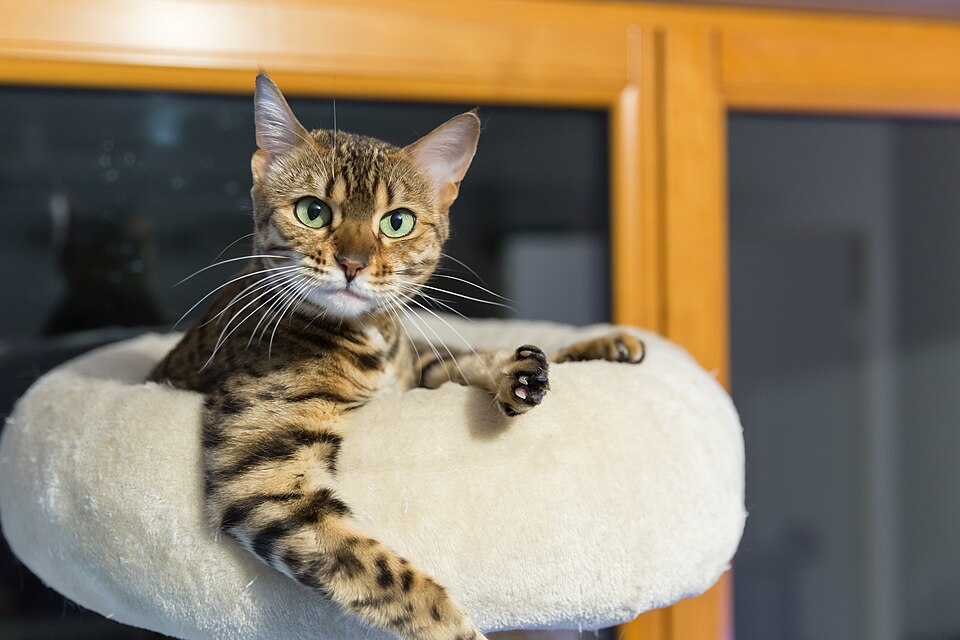
A breed descended from the Asian leopard cat, known for its glossy spotted coat, athletic build and seemingly endless energy. Very playful and smart, it needs long play sessions every day. Early generations are legally restricted in some countries; only later generations suit life as a house cat.

 Lifespan≈ 8.5 yearslife expectancy, UK 2019 data; some live past 21
 Weight8–12 lb (3.6–5.4 kg)later generations; early ones up to 15 lb (6.8 kg)
 OriginUnited StatesAsian leopard cat × domestic cat, 1960s
 CoatShort, silkylight shedder; brush once a week
 EnergyVery highneeds daily play and climbing
 VoiceVariessome are chatty, some quiet
 With kidsIt dependsmost dislike being held
 With other petsUse cautionstrong prey drive; risky with birds and rodents
The Bengal began with crosses between domestic cats and the Asian leopard cat, a small wild cat, and has become one of the world's most popular breeds. Its spotted or marbled, glossy coat turns heads, but its defining trait is energy: it climbs, runs, plays with water and invents its own games when bored. On this page we've pulled together its temperament, care needs, health issues and the legal questions that come with its hybrid background, drawing on breed registries, veterinary sources and scientific studies.
- Temperament: Very energetic, smart and curious; less a lap cat than a play and activity partner.
- Needs your time: Without long daily play, climbing space and mental challenges, it gets bored and gets into mischief.
- Generation matters: Only later-generation Bengals (F4, F5 and beyond) suit a home; early generations need a license or are banned in some countries.
- Health: The heart disease HCM, a form of blindness (PRA-b) and PK deficiency, which causes anemia, have been reported; the last two have DNA tests.
- Lifespan: In UK data from 2019, life expectancy was about 8.5 years, shorter than for mixed-breed cats.
What to know
 What is the Bengal like?
The Bengal is a confident, curious and very active cat. According to the CFA's breed profile, it keeps its kitten energy well into its senior years, wants to investigate everything in the house and is fascinated by water: don't be surprised if it shows up at the sink while you brush your teeth, or even tries to join you in the shower. It's smart and quick to learn; many Bengals learn tricks and can get used to walking on a harness.
It usually shows affection by staying close and playing with you. Vet-reviewed sources stress that Bengals generally don't enjoy being held and have strong hunting instincts. How chatty they are varies a lot: the CFA notes that some Bengals "talk" all day while others barely make a sound.
All that energy becomes a problem if it isn't channeled. A Bengal without enough play and activity will open cabinets, knock things over and scratch furniture. That isn't a "bad habit," it's a sign of an unmet need.
Every cat is an individual. Breed traits describe general tendencies; how a cat was raised, how much contact it had with people as a kitten, its generation and its health shape its personality as much as its breed.
 Who is it a good fit for?
The Bengal suits people who spend time at home, are willing to play actively with their cat every day and are ready to set up their home with climbing shelves and toys. If you want a calm cat that naps in your lap, this breed may wear you out.
| Situation | Good fit? |
|---|---|
| Apartment | Yes, but vertical space and intense daily play are a must |
| Family with kids | It depends; easier with older, calm kids, and it dislikes being held |
| Other cats and dogs | Often gets along with a proper introduction |
| Birds, hamsters, fish | Risky; strong prey drive, never leave them in the same room |
| Long hours alone | Hard; it gets into mischief when bored |
| First-time cat owners | Better suited to experienced owners |
The CFA writes that, when properly introduced, Bengals get along with other pets and that their curious, affectionate nature can suit families with children. Still, according to a veterinarian quoted on PetMD, the Bengal isn't always the best choice for homes with small children, because it doesn't like being held and has a strong hunting instinct. Teaching kids not to grab the cat and to play with a wand toy rather than their hands is the safest approach for everyone.
Where does it come from?
The Bengal's story starts in the United States in the 1960s. According to the CFA, in 1963 Jean Mill crossed a black domestic tom with an Asian leopard cat, a small tree-dwelling wild cat. Around the same time, Dr. Willard Centerwall was producing similar crosses to study the leopard cat's natural resistance to feline leukemia. Mill later obtained cats from his program and, together with spotted domestic cats, developed the breed; her goal was a cat with a wild look and a domestic temperament.
The breed was gradually recognized by cat associations. When the CFA accepted Bengals for registration in 2016, it required five generations of purely domestic ancestry; the breed advanced to championship status in 2018.
What do F1, F4 and F5 mean?
In Bengals, the "F" number shows how many generations a cat is from its wild ancestor. An F1 has a leopard cat as a parent; an F2 has one as a grandparent, and so on. With each generation, cats get smaller and their temperament moves closer to a domestic cat's. Most Bengals sold as pets today are from later generations.
 Appearance and colors
A medium-to-large, long and muscular cat; according to the CFA standard, its hindquarters sit slightly higher than its shoulders and its tail is thick with a rounded tip. The head is slightly small for the body, the eyes are large and the nose is wide. Males are noticeably larger than females.
- Weight: According to PetMD, later-generation Bengals usually weigh 8–12 pounds (about 3.6–5.4 kg); early generations can reach 15 pounds (about 6.8 kg).
- Pattern: The best known is the two-toned, dark-outlined "rosette" spot; there's also a looser, flowing marbled pattern.
- Colors: Brown tabby is the most common; silver, the light "snow" shades (lynx point, mink, sepia), charcoal, melanistic and smoke are also in the standard.
- Coat: Short, dense, very soft and silky; some cats have a sparkle at the hair tips called "glitter." The CFA also recognizes longhaired Bengals.
Daily care
Grooming is easy: according to the CFA, the Bengal coat is unlikely to mat and sheds less than other shorthairs. Brushing once a week with a soft brush is enough, and baths usually aren't needed. The real work is in environment and play.
- Vertical space: Floor-to-ceiling cat trees, wall shelves and window perches aren't a luxury for this breed, they're a need.
- Daily play: A few 10 to 15 minute hunting games a day (wand toys, fetch) turn its energy in a positive direction.
- Mental challenges: Food puzzles, hidden treats and short reward-based training sessions keep boredom away.
- Safe outdoor time: Veterinary sources advise never letting a Bengal roam outside off-leash; harness walks or an enclosed catio are safe alternatives.
- Home safety: It can learn to open cabinets; lock away cleaning products and put screens on windows.
For more ideas, see our articles on playing with an indoor cat, cats and high places and a cat-safe home.
 Diet and weight
Bengals don't need a special food; a complete, balanced cat food suited to their age is enough. Even an active cat can gain weight living indoors, and in the 2024 study by Teng and colleagues, cats whose weight was further from the median for their breed had shorter lives.
- Decide the daily amount with your vet based on your cat's ideal weight, and measure it.
- Serving part of the food in puzzle feeders or hiding it around the house is a safe outlet for hunting instincts.
- Count treats as part of the daily food.
- Since many Bengals love playing with water, they may tip over the water bowl; a heavy bowl or a water fountain helps.
 Health issues to know about
The Bengal is generally considered a sturdy cat, but some inherited problems have been reported. The information below is for awareness only; ask your vet about diagnosis and treatment.
Hypertrophic cardiomyopathy (HCM)
HCM is the most common heart disease in cats: the heart muscle thickens abnormally. The Cornell Feline Health Center lists the Bengal among the breeds where it is more common. Many cats show no signs for a long time; as it progresses, there may be fast or open-mouth breathing, lethargy and sudden weakness in the hind legs. The disease is found with an ultrasound of the heart (echocardiography), and the CFA notes that most breeders have their breeding cats scanned by a cardiologist at regular intervals.
Progressive retinal atrophy (PRA-b)
A form of blindness specific to Bengals. A 2015 study by Ofri and colleagues showed that the disease appears in kittens that inherit two copies (recessive inheritance), can be seen on an eye exam at 9 weeks of age, and that vision loss is obvious from behavior by 1 year. A DNA test exists, and a 2022 study of more than 11,000 cats found the variant in a sizable share of the Bengals tested.
Pyruvate kinase deficiency (PK deficiency)
An inherited disease that makes red blood cells break down early and causes anemia. A 2012 study by Grahn and colleagues found the associated variant in Bengals as well and recommended testing for the breed. Signs can include lethargy, pale gums, poor appetite and weight loss; some cats never show any.
- Fast, labored or open-mouth breathing
- Sudden weakness or pain in the hind legs
- Bumping into things or trouble finding its way in the dark
- Pale gums, marked lethargy or loss of appetite
When buying a kitten, ask for the parents' heart screening results and their DNA tests for PRA-b and PK deficiency.
How long does it live?
A 2024 study using the Royal Veterinary College's VetCompass data found a life expectancy at birth of 8.51 years (confidence interval 7.12–9.90) for 73 Bengals that died in the UK in 2019; the longest-lived cat in the group was over 21. In the same study, mixed-breed cats had a life expectancy of 11.89 years, and the Bengal had the second-shortest life expectancy of the 12 breeds analyzed. The authors note that earlier UK data had also placed the Bengal among the shorter-lived breeds.
That doesn't mean "Bengals die at 8": cats lost young pull the average down, and many well-cared-for Bengals live past 15. The same study found that neutered cats and cats at their ideal weight lived longer. Regular vet checkups, heart screening and a safe home are the most concrete ways to extend this breed's life.
 Before you get one
- Consider a shelter: Purebred cats end up in shelters and rescues too. Following breed groups and adoption listings is a good place to start.
- Ask about the generation: As a pet, choose only a later-generation Bengal (at least F4, ideally F5 or beyond) and ask for pedigree papers that prove it. Veterinary sources also recommend later generations for homes.
- Laws vary by country: The Asian leopard cat is listed by CITES (populations in Bangladesh, India and Thailand in Appendix I, all others in Appendix II). Austria, relying on EU trade rules, treats Bengals up to the fourth generation as wild animals and bans keeping them; in the UK, first-generation (F1) hybrids require a dangerous wild animal license; and Australia only allows Bengals in if pedigree papers show the cat is at least five generations removed from the leopard cat. In the US, rules vary by state.
- In Türkiye: Keeping and trading wild animals requires official documents. We couldn't find a provision that clearly sets out how hybrid cats, especially early generations, are treated under these rules. If you plan to get an early-generation cat or bring one from abroad, check first with the Ministry of Agriculture and Forestry's General Directorate of Nature Conservation and National Parks (Doğa Koruma ve Milli Parklar Genel Müdürlüğü).
- Health paperwork: Ask for the parents' heart screening and their PRA-b and PK deficiency DNA results; avoid sellers who won't show you the mother, can't provide paperwork or push you to "buy now."
- Registration: Rules vary by country; many places require or recommend microchipping. In Türkiye, owned cats must be microchipped and registered in the PETVET system. See our PETVET and microchip guide for details.
Frequently asked questions
Is a Bengal a wild cat?
The Bengals living in homes today are domestic cats several generations removed from their leopard cat ancestor; the CFA requires five generations of domestic ancestry for registration. Early generations (F1 to F3) can behave more like their wild ancestors and are legally restricted in many countries.
Do Bengals shed?
Yes, but lightly. According to the CFA, the coat doesn't mat and sheds less than other shorthairs. Brushing once a week with a soft brush is enough.
Can a Bengal live in an apartment?
Yes, but activity matters more than square footage. With climbing shelves, several play sessions a day and mental challenges, a Bengal can be happy in an apartment; without them, it gets bored and turns your home into its playground.
Do Bengals like water?
Many do. The CFA notes that Bengals are fascinated by water, like to watch it run and may even try to join you in the shower. Use a heavy water bowl so it doesn't get tipped over.
Is a Bengal the same as a Savannah?
No. Both come from crosses between a wild cat and a domestic cat, but the Bengal's wild ancestor is the Asian leopard cat, while the Savannah's is the serval from Africa. Savannahs are larger and longer-legged. See our Savannah page for details.
Sources
- CFA (Cat Fanciers' Association) · Bengal breed profile and standard
- Teng et al. · Life tables of annual life expectancy and risk factors for mortality in cats in the UK, Journal of Feline Medicine and Surgery (2024)
- Ofri et al. · Characterization of an early-onset, autosomal recessive, progressive retinal degeneration in Bengal cats, Investigative Ophthalmology & Visual Science (2015)
- Grahn et al. · Erythrocyte pyruvate kinase deficiency mutation identified in multiple breeds of domestic cats, BMC Veterinary Research (2012)
- Anderson et al. · Genetic epidemiology of blood type, disease and trait variants in over 11,000 domestic cats, PLOS Genetics (2022)
- Cornell Feline Health Center · Hypertrophic cardiomyopathy
- PetMD (vet-reviewed) · Bengal cat breed
- Species+ (UNEP-WCMC / CITES) · Prionailurus bengalensis, CITES listing
- State of Lower Austria · Ban on keeping hybrid cats (Verbot der Haltung von Hybridkatzen)
- legislation.gov.uk · Dangerous Wild Animals Act 1976, Schedule (UK)
- Dickman et al. · Assessing risks to wildlife from free-roaming hybrid cats: the proposed introduction of pet Savannah cats to Australia as a case study, Animals (2019)
- Ministry of Agriculture and Forestry (Türkiye) · Regulation on keeping, breeding and trading game and wild animals
By Tüylüm · Last checked: November 3, 2026. Compiled from the sources above and written in our own words. Spotted a mistake? Write to [email protected] and we'll fix it right away. Photo from Wikimedia Commons, used under the license shown below it.