 Tüylüm
Indian Ringneck Parakeet
A long-tailed, green, medium-sized parrot, and some individuals talk well. The real issues are its lifespan and its voice: it can live 20–30 years and its scream is piercing. It needs a roomy cage, flight every day, mental work that matches its intelligence, and strict escape-proofing.

 Lifespan≈ 20–30 yearsMerck up to 20, WPT 25–30
 Length≈ 16 in (40 cm)tail included
 OriginAfrica and Asiafrom India to the Sahel
 VoiceLoudcan talk, but the scream is piercing
 Social lifeFlock birdwild flocks number in the thousands
 CageVery roomysafe flight every day is a must
 DietPellets + veggiesseed-based diets not recommended
 LegalNot in CITESescapees live wild in Türkiye
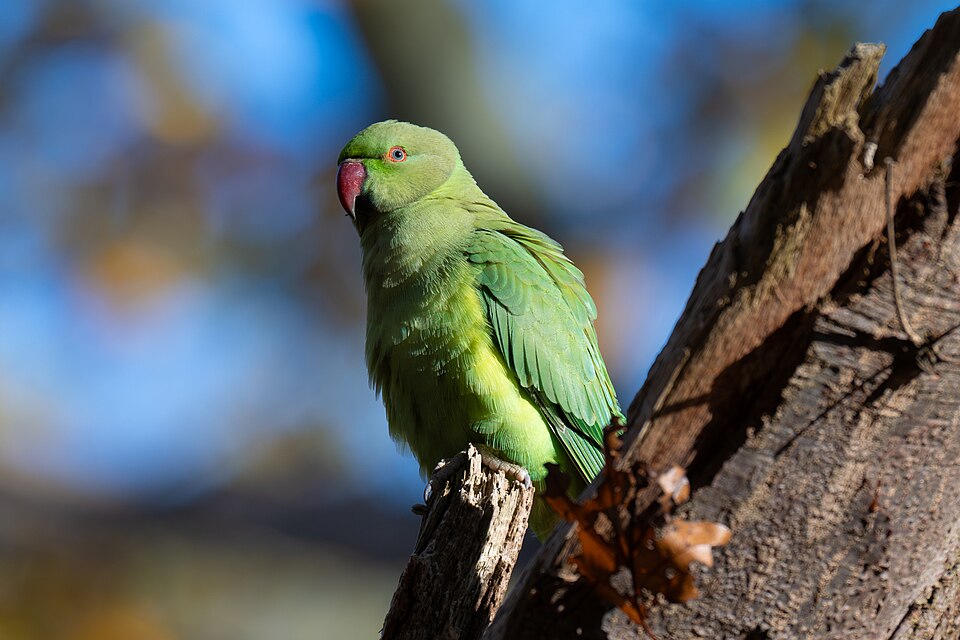
The Indian ringneck parakeet, also called the rose-ringed parakeet, is a long-tailed, bright green, medium-sized parrot. It stands out for its intelligence and for the ability of some individuals to talk, but it also comes with a decades-long commitment, a strong voice and a real need for daily attention. On this page we pulled together its needs from veterinary sources, animal welfare organizations and conservation data.
- Long life: Sources give 20 to 30 years, and one well-kept captive bird is reported to have reached 34. It is a lifetime commitment.
- Noise: Merck says its screams are piercing but that it screams less than many parrots. If you share a wall with neighbors, still think it through.
- Talking: Many individuals are good, quiet talkers, but there is no guarantee.
- Space: Its long tail calls for a wide, long cage and safe out-of-cage flight every day.
- Escape risk: Escaped ringnecks have set up wild populations in Europe and Türkiye, so window and door precautions are vital.
- Legal status: The parrot order is covered by CITES, but this species is excluded from the lists. Still, ask where the bird came from.
What to know
 What is the Indian Ringneck Parakeet like?
The ringneck is a smart, curious and social bird. The World Parrot Trust writes that outside the breeding season the species is very social, does not defend territory and forms flocks in the thousands. Animal Diversity Web adds that it lives in groups that share the same roost all year. At home, that becomes seeing you and your family as its flock: it calls to you, wants to join in on what you do and gets bored when left alone.
Merck Veterinary Manual says the Psittacula group (Indian ringneck and Alexandrine) is medium-sized, that its screams are piercing but fewer than in many parrots, and that many are good, quiet talkers; with enough attention and care they can be very affectionate. Treat talking as a possibility, not a promise. In a 2011 survey of avian veterinarians and parrot owners by Gaskins and Bergman, the most common problems were aggression, screaming and feather picking, all behaviors that can show up when a bird's needs are not met.
Wanting a talking bird is not a good reason on its own. A parrot is a smart, social animal: left alone all day it can get bored, scream or harm itself. You need to have the time to prevent that.
Who is it a good fit for?
The ringneck suits people who can spend long periods with their bird every day, accept a 20–30 year responsibility and tolerate noise. RSPCA Australia reminds readers that birds can live from 10 to 50 years depending on the species, that noise levels vary greatly by species and individual, that an experienced bird vet can be hard to find, and that while the purchase price may be low, setup and ongoing costs can add up quickly. RSPCA's advice: do not impulse buy.
| Situation | A good fit? |
|---|---|
| Apartment | Difficult; loud and needs space |
| Family with kids | If kids stay calm and supervised; bites and screams can happen |
| Home with a cat or dog | Be careful; never leave a bird alone with a cat or dog |
| Often away from home | Not suitable; loneliness raises the risk of feather picking and screaming |
| First-time bird owners | Usually not suitable; starting with a budgie or cockatiel is safer |
Where does it come from?
According to Animal Diversity Web, the species lives across a wide area, from Senegal to Ethiopia and Uganda in Africa and from Afghanistan, India, Nepal and Pakistan to Sri Lanka in Asia; it is most often seen in cities but also lives in desert, savanna, forest and farmland. The IUCN Red List rates it Least Concern.
Thanks to escaped or released birds, wild populations have formed in many parts of the world. According to Per's (2018) article on the parrot trade to Türkiye, ringnecks and Alexandrine parakeets have set up breeding populations in Türkiye; the author considers this undesirable and recommends banning the sale of the species as a cage bird. In Ważna and colleagues' (2024) study of parrots in Polish cities, about 59% of the species' records were escapees, and some owners reportedly release birds expecting them to return. Securing windows and doors protects both the bird and nature.
Appearance and colors
According to the World Parrot Trust, it is about 16 in (40 cm) long, tail included, and weighs 4.1–5 oz (116–140 g); Animal Diversity Web says the tail can reach 10 in (25 cm) and puts the average weight at about 4.8 oz (137 g). The wild form is green, and other color mutations exist in captivity. It has a strong, curved beak and a long tail. The long tail matters when you plan a cage and flight space, because the bird's length is measured with the tail.
 Daily care
- Flight: Free flight in a safe room every day. Windows, doors and chimneys closed, fans and heaters off, toxic plants removed.
- Mental work: Merck lists lack of mental stimulation among the main behavioral causes of feather picking. Rotate toys and set up foraging games.
- Consistent attention: Merck recommends regular, consistent interaction. Set aside time at the same hours every day.
- Sleep: Merck stresses uninterrupted nights and a steady day-night rhythm. RSPCA suggests a separate night cage instead of covering the day cage.
- Bathing: A mister or shallow dish regularly; frequency varies by species.
- Back stroking: Merck notes that stroking the back can stimulate sexual behavior in some birds.
Also see bonding with your bird and toys and enrichment for birds.
 Cage and living space
RSPCA Australia's rule for a pair: the width should be at least three times the combined wingspan of the two birds, the height at least three times the head-to-tail length of the largest bird, and there should be at least two wingbeats of room between perches. For a bird about 16 in (40 cm) long with the tail, that means a height of roughly 4 ft (120 cm), and bigger is always better. Birds fly horizontally, so a long cage beats a tall one. RSPCA writes that birds confined to cages risk obesity, arthritis, soft bones and boredom behaviors such as feather picking, screaming, aggression and repetitive movements, so a cage alone is not enough: a flight aviary or regular safe flight is a must.
- Material: Powder-coated or stainless steel. Poorly galvanized wire can cause zinc poisoning. Merck also lists metal cages, galvanized wire and old paint as sources of heavy metals and prefers stainless steel.
- Perches: Natural, non-toxic branches in different thicknesses. Avoid metal pipe, cotton-rope and sandpaper-covered perches.
- Bowls: Stainless steel, glass or glazed ceramic; keep food and water apart and not under a perch.
- Floor: Newspaper or paper towel; not sand, wood shavings, corn cob or crushed nut shells.
- Location: In a corner of the room, away from traffic and constant noise, at chest height. See the cage placement guide.
- Cleaning: The cage and furnishings at least weekly, ideally every 1–2 days; replace the liner at least twice a week.
Diet
According to Merck Veterinary Manual, a diet built around seeds and nuts is high in fat, lacks many vitamins and minerals and is linked to liver, kidney, respiratory, bone and reproductive problems. Birds can pick the tasty seeds and leave the pellets. The recommended base is a complete formulated pellet plus a smaller amount of fresh vegetables and fruit; work out the proportions with a vet who sees birds. Switch gradually. Animal Diversity Web says about 80% of wild birds' diet is seeds and grains, but that describes a varied wild diet, not a reason to feed only seed at home.
- Fresh water every day.
- Merck lists vitamin A-rich produce such as cantaloupe, papaya, sweet potato and dark leafy greens.
- For harmful foods, see foods that are harmful to birds.
- Do not mix powdered supplements into the water; Merck notes they can change the taste and reduce drinking.
 Health issues to know about
Merck says birds hide illness so as not to look weak to predators, so knowing your bird's normal behavior matters. What follows is for information; for diagnosis and treatment, talk to a veterinarian who sees birds.
- Diet-related problems: Vitamin A deficiency is common and often missed in seed-fed birds; obesity also strains the liver and joints.
- Feather picking: Merck says there can be medical (skin inflammation or infection, nutrition, toxins) or psychological (stress, boredom) causes and that medical causes should be ruled out first. According to Gaskins and Bergman, feather picking was the most common behavior problem avian vets saw.
- Chlamydia (psittacosis): The bacterium Chlamydia psittaci spreads through droppings, nasal discharge and feather dust and can pass to people. Merck lists testing new birds, isolating sick birds, gloves, hand washing and daily disinfection of the cage and bowls. If you develop flu-like symptoms, tell your doctor you keep a bird.
- Fume and gas poisoning: Overheated nonstick coatings (pans, self-cleaning ovens, air fryers, hair dryers), aerosol sprays, room fresheners and burning plastic can kill birds quickly. Keep the bird away from the cooking area.
- Heavy metals: Metal toys, galvanized wire, old paint and lead weights can be dangerous; vomiting, excessive thirst and weakness can occur.
- Open-mouth breathing, tail bobbing or wheezing
- Fluffed feathers and sitting low on the perch or the cage floor
- Loss of balance or weakness
- Marked change in appetite or droppings, vomiting
- Exposure to smoke, spray or nonstick pan fumes (move to fresh air first, then go to the vet at once)
See taking your bird to the vet for getting your bird used to a carrier.
How long does it live?
Sources do not give the same range: Merck says up to 20 years for the Psittacula group, the World Parrot Trust says 25–30 years, and Animal Diversity Web reports a captive bird that reached 34. Lifespan in the wild is unknown. What is clear: a young bird bought today will still be in your home years from now. Build "who will care for my bird if I can't" into your plans. The expert panel in Chalmers and colleagues (2024) lists the lack of a life plan for birds (moves, illness, rehoming) among the priority welfare issues for pet parrots.
 Before you get one
- Rescues and shelters: Look for organizations that rehome pet birds; long-lived birds often outlast their first homes.
- Legal status: The EU list (aligned with CITES) covers the whole parrot order but explicitly excludes Psittacula krameri, so this species does not need a CITES permit. Still ask the seller where the bird came from and whether it was bred in captivity.
- Avoid wild-caught birds: The World Parrot Trust writes that the species is trapped and sold in Asia and that the pressure is growing. Choose a bird with a known, documented breeding source.
- Assess the seller: Look for sellers who know the species, give health and diet information, and offer returns or support if there is a problem. Avoid crowded places that feed only dry seed.
- Vet check: See a vet who treats birds right after purchase, and find out ahead of time whether there is one near you.
- Against escapes: Keep doors and windows closed and always watch the bird when it is out of the cage.
Frequently asked questions
Does an Indian ringneck talk?
Many are good talkers; Merck says most of this group are quiet and good at talking. But not every bird talks, and vocabulary varies from bird to bird.
Is it noisy?
Its scream is piercing; Merck says it screams less than most parrots. As a flock bird it can get louder when bored or alone. Think about this if you live close to neighbors.
Can it live alone?
It is a social bird. RSPCA writes that birds are flock animals, that their companion is either another bird or you, and that a single bird needs real time from you. Chalmers and colleagues rank lifelong social isolation second among parrot welfare problems.
What happens if it escapes?
Escaped pet parrots can live and breed in cities; in the Polish data, more than half of the species' records were escapees. So window and door precautions are a must whenever the bird is out of its cage.
Do I need a CITES permit?
The species is kept outside CITES coverage. Still ask about the bird's legal origin.
Sources
- Merck Veterinary Manual · Choosing a Pet Bird
- Merck Veterinary Manual · Nutritional Disorders of Pet Birds
- Merck Veterinary Manual · Disorders Affecting Multiple Body Systems of Pet Birds (psittacosis, fume and gas poisoning, heavy metals)
- Merck Veterinary Manual · Illness in Pet Birds
- Merck Veterinary Manual · Skin and Feather Disorders of Pet Birds (feather picking)
- Animal Diversity Web (University of Michigan) · Psittacula krameri
- World Parrot Trust · Rose-ringed Parakeet
- RSPCA Australia Knowledgebase · What kind of enclosure does my bird need?
- RSPCA Australia Knowledgebase · Are birds the right companion animals for me?
- Per, E. (2018) · The state of the parrot trade from tropical forests to Türkiye, Turkish Journal of Forestry
- Ważna et al. (2024) · Parrots in the wild in Polish cities, PLoS One
- EU Regulation (EU) 2017/160, Annexes A and B (Psittaciformes exclusion; legislation.gov.uk copy)
By Tüylüm · Last checked: November 10, 2026. Compiled from the sources above and written in our own words. Spotted a mistake? Write to [email protected] and we'll fix it right away. Photo from Wikimedia Commons, used under the license shown below it.