 Tüylüm
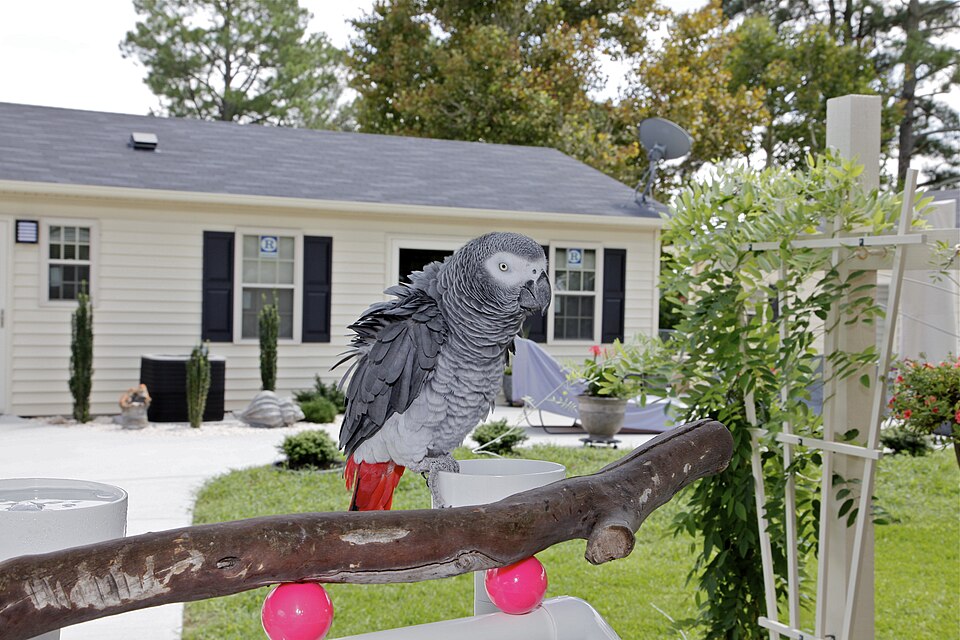
African Grey Parrot
Very smart and skilled at imitating words and sounds, but it can live 50–60 years, is social and copes poorly with loneliness. Prone to behavior problems such as feather picking. Endangered in the wild: CITES Appendix I, so a legal, documented source is essential. Not suited to first-time bird owners.

 Lifespan≈ 30–60 yearsMerck 30–50, WPT 50–60
 Length≈ 13 in (33 cm)about 14 oz (400 g)
 OriginWest and Central Africarainforests
 VoiceMimicmore imitation and growls than screams
 Social lifeFlock birdloneliness can lead to feather picking
 CageAviary sizeWPT: at least 10 ft (3 m) long
 DietPellets + veggiesseed-only risks low calcium
 LegalCITES App. Ibuying without papers is not legal
The African grey is one of the best-known smart parrots, but the same intelligence brings big needs: stimulation, social bonds and a calm environment. This page is for people who want to look at it not as a "pet" but with open eyes: the long lifespan, behavior problems, its status in the wild and the legal paperwork are all laid out honestly.
- Very long life: Merck says 30–50 and the World Parrot Trust 50–60 years; Animal Diversity Web reports a captive average of 45 and a maximum of 60. It can outlive its owner.
- Intelligence and attention: Merck says the grey needs a lot of time and attention and is prone to behavior problems.
- Feather picking: A common problem in pet parrots, linked to loneliness, boredom and a lack of foraging.
- Status in the wild: Endangered on the IUCN Red List; capture from the wild is a major threat.
- Legal status: CITES Appendix I (since 2017). Do not buy any bird without a documented, legal origin.
- Not for: First-time bird owners, people away from home for long stretches, or anyone who wants a quiet household.
What to know
 What is the African Grey Parrot like?
Merck Veterinary Manual describes the grey as a medium-to-large, very capable mimic with "possibly the largest vocabulary" of the parrots; it tends to growl rather than scream and may go quiet around strangers. The same source says it needs a lot of time and attention and is prone to behavior problems. Animal Diversity Web writes that in the wild greys form large, noisy flocks made up only of greys and that young birds stay with the family group for years, learning survival skills from older birds. So the need for a flock continues at home.
The expert panel in Chalmers and colleagues (2024) ranked lifelong social isolation, limited chances to express natural behavior and a lack of foraging among the priority welfare issues for pet parrots. All of these headings apply to a smart, social species like the grey.
A smart bird does not stay "well-behaved" when bored; it can react with feather picking, screaming and aggression. If you lack the time and patience, this species is not for you.
Who is it a good fit for?
The grey suits people who are ready to learn bird behavior, are home most of the time, can make a long-term life plan and can reach a bird vet. RSPCA Australia reminds readers that birds can live 10 to 50 years depending on the species and that owners should plan care even for travel or hospital stays; it adds that a bird vet can be hard to find. Merck also lists large, smart parrots as birds that demand attention.
| Situation | A good fit? |
|---|---|
| Apartment | Difficult; can be loud and needs lots of space |
| Family with kids | Be careful; likes calm, and can bite |
| Home with a cat or dog | Be careful; never leave a bird alone with a cat or dog |
| Often away from home | Not suitable; loneliness raises the risk of feather picking |
| First-time bird owners | Not suitable; gain experience with a smaller species first |
Where does it come from?
The grey lives in the rainforests of West and Central Africa. Animal Diversity Web says it uses moist lowland forests, forest edges, mangroves and farmland and nests in tree holes.
Its status in the wild is worrying. The IUCN classifies the species as Endangered; according to the World Land Trust, more than 1.3 million wild-caught birds entered the international trade between 1982 and 2014, and many more died in transit or were taken illegally. The loss of large trees is also shrinking nest sites. So not buying a wild-caught bird is a direct way to protect the species. According to Per (2018), the grey was the parrot species most often imported into and re-exported from Türkiye between 1982 and 2016.
Appearance and colors
According to Animal Diversity Web it is about 13 in (33 cm) long and weighs up to 14 oz (407 g); the World Parrot Trust says about 14 oz (400 g). The body is gray, the face whitish and the tail red. There are two subspecies, the Congo grey and the smaller Timneh; sources sometimes treat them as separate species, so when buying ask for the exact species name and its paperwork.
 Daily care
- Flight and movement: Out-of-cage time in a safe room every day. Window, door, fan and heater precautions; toxic plants removed.
- Foraging: In van Zeeland and colleagues' (2023) study of 21 greys, both healthy and feather-damaging birds chose to work for food even though the same food sat free in bowls; the authors treat foraging as a behavioral need of greys and recommend making food-finding toys a standard part of housing.
- Enrichment: The World Parrot Trust suggests bathing (a mister or shallow dish), foot toys, chewable and non-chewable toys, foraging toys and natural branches; introduce new items carefully because greys are sensitive to novelty.
- Sleep: Merck values a steady day-night rhythm and uninterrupted nights. See how birds sleep.
- Consistent attention: Keep a routine; spend time at the same hours every day.
- Back stroking: Merck notes this can stimulate sexual behavior in some birds.
Also see bonding with your bird and toys for birds.
 Cage and living space
For a grey, the World Parrot Trust suggests an aviary or hanging cage at least 10 ft (3 m) long. RSPCA Australia's rule for a pair is a width of at least three times the combined wingspan of the two birds, a height of at least three times the head-to-tail length of the largest bird, and at least two wingbeats of room between perches. RSPCA writes that birds kept in cages risk obesity, arthritis, soft bones, feather picking, screaming and aggression, so a cage alone is not enough: regular safe flight is a must.
- Material: For aviary wire, RSPCA suggests strong 1.6–1.8 mm wire for birds of 200–500 g; fine chicken-wire-style mesh can be chewed and swallowed by a large parrot. Poorly galvanized wire can poison with zinc; Merck prefers stainless steel.
- Perches: Natural branches in different thicknesses; avoid metal pipe, cotton-rope and sandpaper-covered perches.
- Bowls: Stainless steel, glass or glazed ceramic; keep food and water apart.
- Floor: Newspaper or paper towel.
- Location: In a corner, at chest height, away from traffic and constant noise. See the cage placement guide.
- Cleaning: At least weekly, ideally every 1–2 days.
Diet
According to Merck Veterinary Manual, pellets (a complete formulated bird food) should be the base, with a smaller amount of fresh vegetables and fruit; work out proportions with a bird vet. Seed-and-nut-heavy diets are fatty and lack many vitamins and minerals. One point matters especially for greys: greys fed only seed are prone to dangerously low blood calcium, which can cause weakness, tremors and seizures. Sunlight or a bird-appropriate UV light also matters for bone health. This is not treatment advice but a warning: set up the diet with your vet.
- Vitamin A deficiency is common and often missed in seed-fed birds.
- Do not mix powdered supplements into the water; Merck notes they can change the taste and reduce drinking.
- For harmful foods, see foods that are harmful to birds.
 Health issues to know about
Merck says birds hide illness and that by the time you notice signs the illness may be advanced. What follows is for information; for diagnosis and treatment, talk to a veterinarian who sees birds.
- Feather picking (feather-destructive behavior): Merck says medical causes (skin inflammation, nutrition, toxins) should be ruled out first, then psychological causes (stress, boredom, sexual frustration) considered; seed-heavy diets, lack of sunlight and a disrupted day-night cycle can also contribute. In Gaskins and Bergman's (2011) survey, feather picking was the behavior problem avian vets saw most. Van Zeeland and colleagues (2023) found that feather-damaging greys used foraging devices less than healthy birds, though the sample is small and results are not conclusive.
- Low calcium: Merck says greys on seed-heavy diets are prone to this problem.
- Chlamydia (psittacosis): A disease that can spread through droppings, nasal discharge and feather dust and pass to people. Merck lists testing new birds, isolating sick birds, gloves and hand washing. If you develop flu-like symptoms, tell your doctor you keep a bird.
- Fume and gas poisoning: Overheated nonstick coatings, aerosol sprays and room fresheners can kill birds quickly.
- Heavy metals: Galvanized wire, metal toys and old paint can be risky.
- Open-mouth breathing, tail bobbing or wheezing
- Fluffed feathers and sitting low on the perch or the cage floor
- Loss of balance, weakness or tremors
- Marked change in appetite or droppings, vomiting
- Exposure to smoke, spray or nonstick pan fumes (move to fresh air first, then go to the vet at once)
How long does it live?
Merck says 30–50 years and the World Parrot Trust 50–60. Animal Diversity Web gives a wild average of 22.7 years, a captive average of 45 and a highest report of 60. In practice, a grey can be with a person for their whole adult life, or even outlive them. Chalmers and colleagues list the lack of a life plan for birds (who will care for them, moves, rehoming) among the priority welfare issues. Put that in writing before you get one.
 Before you get one
- Legal status: The grey has been in CITES Appendix I since 2017 (the EU also moved the species into its Annex A); the World Parrot Trust writes that Appendix I tightly restricts international commercial trade. Ask for papers showing the bird's legal origin and do not buy from a seller who cannot show them. Confirm the details for Türkiye with the relevant official authorities; we do not give penalties or permit names here.
- Avoid wild-caught birds: Wild-caught birds add to the species' decline; buy only from a documented breeding source.
- Rescues and shelters: Look for organizations that rehome pet birds; long-lived birds are often left behind.
- Assess the seller: One who knows the species and its lineage, gives diet and health information, and offers returns or support. Do not decide on impulse; RSPCA says "Don't impulse buy."
- Vet: First find out whether a bird vet is available near you, and see one right after you bring the bird home.
Frequently asked questions
Does a grey really talk?
Merck says the grey is a very capable mimic and possibly the parrot with the largest vocabulary, but it may go quiet around strangers. Not every bird talks.
Can a grey live alone?
It is a social bird: Animal Diversity Web says wild greys form large flocks made up only of greys. If you keep a single bird, you need to give it your daily time and attention. Chalmers and colleagues rank lifelong isolation among the biggest parrot welfare problems.
Why is it plucking its feathers?
Merck says causes can be medical or psychological, so a vet exam comes first. Do not guess: take a bird that starts plucking to a veterinarian who sees birds.
Is it legal to buy a grey?
The species is in CITES Appendix I; do not buy a bird without papers or of unknown origin. Confirm the details for Türkiye with the relevant authorities.
Is it okay in a home with kids?
It is a smart, sensitive bird; do not let a child squeeze it, and never leave the two alone together.
Sources
- Merck Veterinary Manual · Choosing a Pet Bird
- Merck Veterinary Manual · Nutritional Disorders of Pet Birds (low calcium, vitamin A)
- Merck Veterinary Manual · Skin and Feather Disorders of Pet Birds
- Merck Veterinary Manual · Disorders Affecting Multiple Body Systems of Pet Birds
- Merck Veterinary Manual · Illness in Pet Birds
- Animal Diversity Web (University of Michigan) · Psittacus erithacus
- World Parrot Trust · Grey Parrot
- World Land Trust · Grey Parrot
- van Zeeland et al. (2023) · Contrafreeloading Indicating the Behavioural Need to Forage in Healthy and Feather Damaging Grey Parrots, Animals
- Gaskins and Bergman (2011) · Surveys of avian practitioners and pet owners regarding common behavior problems in psittacine birds, J Avian Med Surg
- Chalmers et al. (2024) · What are the priority welfare issues facing parrots in captivity?, Animal Welfare
- RSPCA Australia Knowledgebase · Are birds the right companion animals for me?
- EU Regulation (EU) 2017/160, Annex A (Psittacus erithacus (I)) and 2017/128 (transfer from Appendix II to Appendix I; legislation.gov.uk copies)
- Per, E. (2018) · The state of the parrot trade from tropical forests to Türkiye, Turkish Journal of Forestry
By Tüylüm · Last checked: November 10, 2026. Compiled from the sources above and written in our own words. Spotted a mistake? Write to [email protected] and we'll fix it right away. Photo from Wikimedia Commons, used under the license shown below it.