 Tüylüm
Japanese Bobtail
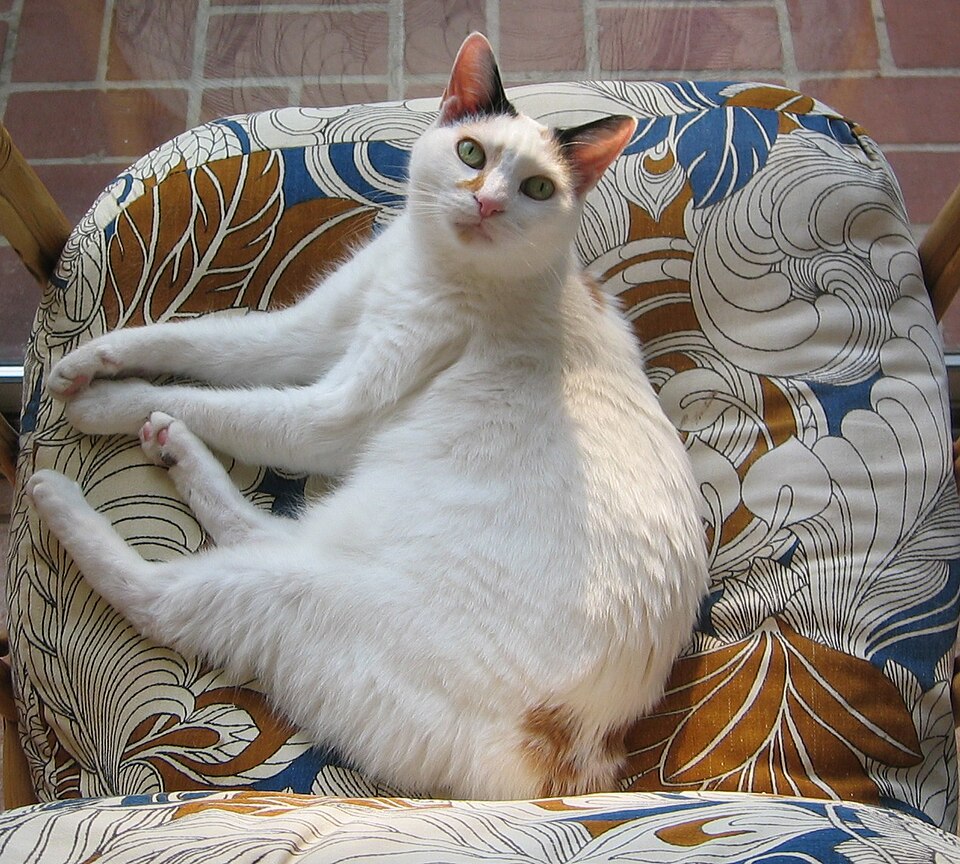
A medium-sized, very active cat known for its pom-pom tail, long legs and triangular face. Its tail comes from a different gene than the Manx's (HES7) and isn't linked to any known disease; still, the tail is sensitive and should be handled gently. A playful, curious breed that wants attention.

 LifespanNo breed datano measured data found
 BuildMedium, slenderCFA: muscular but fine; males larger
 OriginJapanin Japanese art for centuries
 CoatShort or longno undercoat, sheds little
 EnergyVery activejumps, climbs and wants to play
 VoiceSoft, variedchats without being noisy
 With kidsGoodper the CFA, with kids of all ages
 With other petsGood with dogsother cats may need time
The Japanese Bobtail is a medium-sized, slender and very active cat known for its short, curled tail that looks like a rabbit's, its long legs and its triangular face. It has appeared in Japanese paintings, prints and carvings for centuries. Its short tail comes from a different gene than the Manx's, and that gene isn't linked to any known disease. On this page we've pulled together its temperament, care needs and what's known about its tail, drawing on breed registry profiles and scientific studies.
- Temperament: Active, curious, clever and affectionate; it needs plenty of attention and play, and will ask for it if it doesn't get it.
- Tail: Every cat's tail is as unique as a fingerprint; it isn't docked, it's short from birth. It's sensitive and should be handled gently.
- Genetics: The short tail comes from a gene called HES7; it has nothing to do with the Manx's T gene, and cats with two copies are born healthy.
- Easy care: With no undercoat, it sheds little; combing a few times a month is enough.
- Health: The CFA reports no breed-specific health problems; but the breed is small in number, and some organizations want more data.
What to know
 What is the Japanese Bobtail like?
According to the CFA's breed profile, the Japanese Bobtail is always on the move but always engaged and affectionate. It will come to your lap but probably won't stay long; it's curious, clever and loves solving problems. Its powerful back legs let it jump to amazing heights, especially when it's after a toy. It's a self-sufficient, natural hunter.
Its activity level is high and its attention span short, which makes it an entertaining companion. According to the CFA, it needs a fair amount of attention and interaction to thrive, and if it doesn't get enough, it will ask for it. Its voice is soft but it makes a wide variety of sounds, chatting with you without being noisy.
Every cat is an individual. Breed traits describe general tendencies; how a cat was raised, how much contact it had with people as a kitten and its health shape its personality as much as its breed.
 Who is it a good fit for?
The Japanese Bobtail suits families who are ready to play with an active cat and give it climbing space and time. If you're looking for a calm cat that naps in your lap for hours, this breed may feel too energetic.
| Situation | Good fit? |
|---|---|
| Apartment | Good; with tall climbing space and daily play |
| Family with kids | Good; per the CFA, gets along with children of all ages |
| Dogs | Good; per the CFA, gets along well with dogs |
| Other cats | Use caution; per the CFA, some cats need time to get used to this "new" cat without a tail |
| Long hours alone | Use caution; needs attention and interaction |
Cats rely heavily on their tails when communicating with each other, so another cat in your home may misread the Bobtail's tail signals at first. Take introductions slowly. We explain what cats say with their tails in our article on cat body language.
Where does it come from?
According to the CFA, short-tailed cats appear in Japanese scrolls, prints and carvings dating back to the Middle Ages, and they're thought to have been brought from Korea as early as the sixth century. For a long time only members of the court could keep them, until an imperial edict in 1602 ordered all cats released into the streets because rodents were threatening the silk industry. While hunting the rodents and protecting the silkworms, they spread across the country and mixed with street cats, and the dominant short tail gradually became a familiar look for many Japanese cats.
A 2016 genetic study notes that short, kinked-tailed cats are still common in Southeast and East Asia, that Charles Darwin recorded them in the Malay Archipelago in 1868, and that the Japanese Bobtail's ancestors may have come from that region. According to the CFA, the first Japanese Bobtails were brought to the US in 1968; shorthairs reached CFA championship status in 1976 and longhairs in 1993.
 Appearance and colors
According to the CFA standard, the Japanese Bobtail is a medium-sized cat, muscular but not massive, with clean lines and a slender build; males are somewhat larger than females. The head forms an almost equilateral triangle, with high cheekbones and a long nose. The ears are large and upright, and the eyes are large, oval and set at a noticeable slant. The legs are long and slender, with the hind legs longer than the front.
- Tail: According to the CFA, it isn't docked; it comes from a dominant gene and is different in every cat. Some tails are rigid, others flexible, and the fur fans out into a pom-pom. For showing, the tail must not extend more than 3 inches (about 7–8 cm) from the body, though it may be longer when uncurled. The 2016 study reports that it's about 10 cm (4 in) long when extended.
- Coat: There are shorthaired and longhaired types; neither has an undercoat.
- Colors: According to the CFA, all colors are accepted. In the early years the most popular were bicolors and the tricolored "mi-ke" (calico).
Daily care
According to the CFA, the Japanese Bobtail has no undercoat and sheds very little. For shorthairs, combing with a fine-toothed comb a few times a month is enough; longhairs need combing more often, but their coats don't tangle or mat.
- Be careful with the tail: The CFA stresses that every Bobtail's tail is sensitive and should always be handled with care. Never pull it, and teach children not to touch it.
- Vertical space: It loves leaping up high; a sturdy, tall cat tree, shelves and window perches are a must. Our article on why cats love high places has ideas.
- Play: Because its attention span is short, short but frequent play sessions, puzzle toys and rotating toys work well. According to the CFA, the breed excels at feline agility. For ideas, see our article on playing with an indoor cat.
- Safe home: For an agile, curious cat, securing windows and balconies matters.
- Claws: Provide a scratching post; if the claws grow long, trim them the way your vet shows you.
 Diet and weight
Japanese Bobtails don't need a special food; a complete, balanced cat food that suits their age is enough. Even though it's an active breed, neutered cats living indoors can gain weight, and extra weight may not be obvious on a slender cat.
- Measure food; decide the daily amount with your vet based on your cat's ideal weight.
- Count treats as part of the daily food; serving some meals in puzzle toys helps with both weight and boredom.
- Being able to feel the ribs lightly and seeing a waist from above are good signs.
- Always have fresh water available.
 Health issues to know about
The CFA describes the Japanese Bobtail as a sturdy, natural breed with no specific health concerns and says there are no known abnormalities associated with its tail. Scientific studies largely support this picture, but there are some details worth knowing. The information below is for awareness only; ask your vet about diagnosis and treatment.
The short tail and the spine
The Japanese Bobtail's short tail comes from a different genetic change than the Manx's. In the Manx, the changes that shorten the tail are in a gene called T; a 2015 study showed that the Japanese Bobtail's tail doesn't come from that gene. Two studies published in 2016 then found the responsible change in HES7, a gene involved in forming the vertebrae. One important difference: in the Manx, two copies of the gene are lethal, but all purebred Japanese Bobtails examined carried two copies of the HES7 change; in other words, two copies don't kill the cat in this breed. A 2022 study that screened more than 11,000 cats also found that every Japanese Bobtail tested carried two copies.
The 2015 X-ray study showed that most kink-tailed cats had a slightly different number of vertebrae than normal (most were missing one chest vertebra) and that the tail kinks contained half-formed vertebrae. But the researchers reported that these differences weren't associated with illness or death.
Where organizations stand
The CFA recognizes the breed. The GCCF in the UK doesn't recognize the Japanese Bobtail yet; it wants genetic and veterinary information before recognition and says this is meant to ensure a low risk of spinal, bladder or bowel problems for owners. So there's no evidence that the tail gene causes a syndrome like the Manx's, but some organizations want to see more data.
Gene pool
According to the CFA, because the breed is small in number, breeders take care to keep the gene pool diverse; US breeders can bring Japanese street cats into their programs for this purpose, and genetic testing is used to help head off problems.
- Pain when the tail is touched, a tail that doesn't move at all or swelling around the tail
- Weakness or wobbliness in the hind legs
- Urinary or fecal incontinence, or straining in the litter box
- Loss of appetite and hiding (cats hide pain)
How long does it live?
We couldn't find a breed-specific lifespan for the Japanese Bobtail, either calculated from a large data source like VetCompass or given by a registry, so we're not giving a number.
The things that help cats live longer in general apply to this breed too: in a 2024 UK study, neutered cats and cats at their ideal weight lived longer. Regular vet checkups, weight tracking, vaccinations and a safe home are the most concrete steps.
 Before you get one
- Consider a shelter: Purebred cats end up in shelters and rescues too. There are short-tailed mixed-breed cats as well; follow adoption listings.
- If you buy from a breeder: Ask to meet the parents, and ask about genetic tests done and vaccination records. Check that the kitten walks comfortably and doesn't seem bothered when its tail is touched.
- A rare breed: According to the CFA, the breed is rare and you may have to wait for a kitten. That's one more reason to be wary of sellers who rush you.
- Red flags: Steer clear of sellers offering "Japanese Bobtails" without papers, who won't show you the mother, always have kittens available or rush you to "buy now." A cat with a docked tail is not a Japanese Bobtail.
- Registration: Rules vary by country; many places require or recommend microchipping. In Türkiye, owned cats must be microchipped and registered in the PETVET system.
Frequently asked questions
Is the Japanese Bobtail the same as the Manx?
No. Both have short tails, but from different genes: the T gene in the Manx and the HES7 gene in the Japanese Bobtail. In the Manx, the gene can affect the spine and spinal cord ("Manx syndrome"); no such syndrome has been reported in the Japanese Bobtail. See our Manx page for details.
Is the tail docked?
No. The CFA stresses that the Bobtail's tail comes from a gene and isn't the result of docking; every cat's tail is unique.
Does the tail hurt?
There's no known pain problem; the 2015 study reports that the vertebral differences in the tail weren't associated with illness. Still, the CFA points out that the tail is sensitive; be gentle, and if your cat reacts when its tail is touched, see your vet.
Do Japanese Bobtails shed?
A little. According to the CFA, shedding is minimal because there's no undercoat; combing shorthairs a few times a month is enough.
Can a Japanese Bobtail be left home alone?
Short stretches are fine, but according to the CFA it needs a fair amount of attention and interaction to thrive. If you're out for long hours, an enriching home, toys and someone who drops by during the day will help.
Sources
- CFA (Cat Fanciers' Association) · Japanese Bobtail ırk tanıtımı ve standardı
- Pollard ve ark. · Japanese Bobtail: vertebral morphology and genetic characterization of an established cat breed, Journal of Feline Medicine and Surgery (2015)
- Xu ve ark. · Whole genome sequencing identifies a missense mutation in HES7 associated with short tails in Asian domestic cats, Scientific Reports (2016)
- Lyons ve ark. · Whole genome sequencing in cats, identifies new models for blindness in AIPL1 and somite segmentation in HES7, BMC Genomics (2016)
- Anderson ve ark. · Genetic epidemiology of blood type, disease and trait variants, and genome-wide genetic diversity in over 11,000 domestic cats, PLOS Genetics (2022)
- GCCF (Governing Council of the Cat Fancy) · Unrecognised breeds (tanınmayan ırklar)
- Buckingham ve ark. · Multiple mutant T alleles cause haploinsufficiency of Brachyury and short tails in Manx cats, Mammalian Genome (2013)
- Teng ve ark. · Life tables of annual life expectancy and risk factors for mortality in cats in the UK, Journal of Feline Medicine and Surgery (2024)
- Resmî Gazete · Kedi, Köpek ve Gelinciklerin Kimliklendirilmesi ve Kayıt Altına Alınmasına Dair Yönetmelik (26 Şubat 2018)
By Tüylüm · Last checked: November 3, 2026. Compiled from the sources above and written in our own words. Spotted a mistake? Write to [email protected] and we'll fix it right away. Photo from Wikimedia Commons, used under the license shown below it.