 Tüylüm
Manx
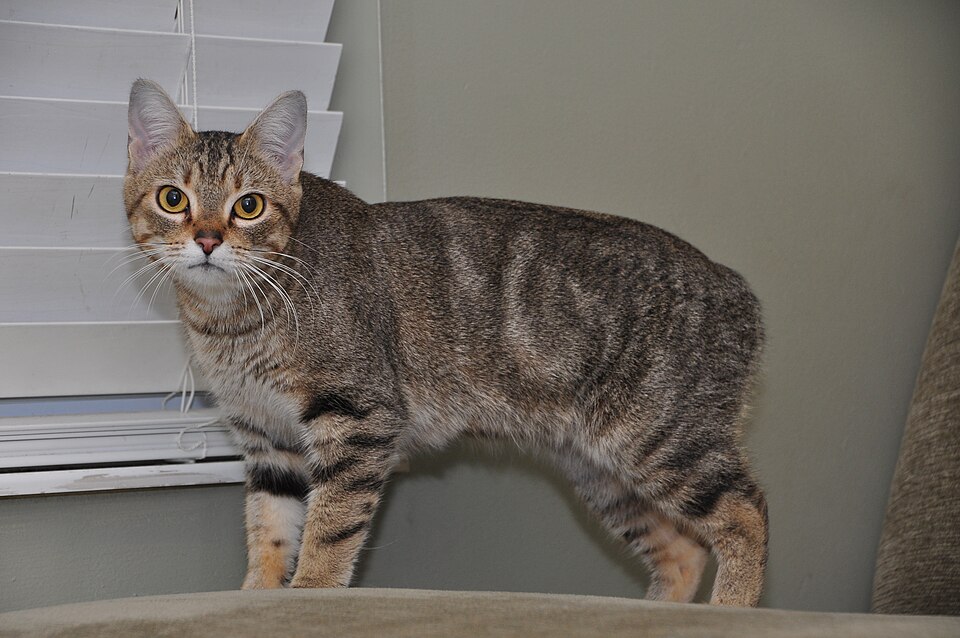
A round, muscular and often tailless cat from the Isle of Man. Calm, affectionate and playful, but the gene behind its missing tail can also affect the spine and spinal cord ("Manx syndrome"). If you get a kitten, wait until it's at least four months old and have it examined by a vet.

 Lifespan≈ 12–14 yearsrange given by the GCCF; no study data
 Weight10–12 lb (4.5–5.4 kg)males, per the CFA; females smaller
 OriginIsle of Manbetween Great Britain and Ireland
 CoatDouble, denseshort and long coat types
 EnergyCalm, playfulsudden bursts of play
 VoiceChatty but softchirps, trills and purrs
 With kidsPatientprefers to slip away when squeezed
 With other petsGoodgets along with dogs and cats
The Manx is an old breed from the Isle of Man in the Irish Sea, known for its round shape, muscular build and, above all, its missing tail. It's a calm, affectionate house cat that bonds closely with its family. But the gene behind the breed's defining feature can also affect the development of the spine and spinal cord, which is why the Manx is a breed animal welfare organizations watch closely. On this page we've put together a balanced look at its temperament, care needs and what to know about "Manx syndrome," drawing on breed registry profiles, animal welfare resources and scientific studies.
- Temperament: Calm, affectionate and playful; bonds strongly with one or two people and can learn to fetch.
- Tail: Changes in a gene called T shorten the tail or prevent it from forming; tail length varies even within a litter.
- Manx syndrome: The same gene can affect the spine and spinal cord; hind-leg weakness, a rabbit-like hopping gait and urinary and fecal incontinence can occur. Signs usually show up in the first four months.
- Getting one: Don't take a kitten home before it's four months old, and ask for a vet exam. Fully tailed Manx don't carry this problem.
- Care: The dense double coat needs regular combing; weight control and litter box habits matter.
What to know
 What is the Manx like?
According to the CFA's breed profile, the Manx is mostly a calm, gentle companion, but it also has a playful streak that can send it chasing invisible objects late in the evening. It spends much of the day on the couch or in a lap, then may leap to the top of the refrigerator in a single bound. It's clever and affectionate and usually bonds very strongly with one or two family members, so it can take a while to warm up to newcomers.
Because it loves fetch and interactive games, it's often called "doglike"; it will politely bring you a toy it wants thrown. It usually gets along well with dogs and other cats. It's talkative but not loud, communicating with chirps, trills, purrs and the occasional head bump. The GCCF also describes the breed as playful, intelligent, sociable and inclined to avoid conflict.
Every cat is an individual. Breed traits describe general tendencies; how a cat was raised, how much contact it had with people as a kitten and its health shape its personality as much as its breed.
 Who is it a good fit for?
The Manx suits people who want a calm but playful cat that's devoted to its family. A healthy Manx isn't hard to care for, but anyone adopting a tailless cat should know the signs of Manx syndrome and be ready for veterinary care if needed.
| Situation | Good fit? |
|---|---|
| Apartment | Good; a calm house cat that needs play and climbing space |
| Family with kids | Good; per the CFA, patient with children of all ages |
| Other cats and dogs | Good; usually gets along well |
| Busy home with frequent guests | Use caution; can take time to warm up to new people |
| First-time cat owners | Good for a healthy adult; be sure to learn its health history |
According to the CFA, when a child holds a Manx too tightly, it will usually squirm free with its powerful back legs rather than lash out. Still, teach children not to hold the cat against its will and to be especially gentle around its rear and the base of the spine.
Where does it come from?
According to the CFA, the Manx is an old breed that arose on the Isle of Man in the Irish Sea; tailless cats were first recorded there by visiting sailors in the 16th century. The story of a cat losing its tail in the closing door of Noah's Ark is a charming legend; in reality, taillessness most likely began with a gene change in the island's shorthaired cats and spread through the isolated island population. The longhaired type is thought to have appeared with cats that arrived during the Viking era.
The Manx appeared at the first cat shows in Great Britain and was among the first breeds registered when the CFA was founded in 1906. A 2013 genetic study found four different changes that shorten the tail in separate Manx lines from the US and the Isle of Man; all were in the T (Brachyury) gene, which plays a role in spinal development.
 Appearance and colors
According to the CFA standard, the overall impression of a Manx is roundness: a round head, full cheeks, a broad chest, a short back and a round rump. The hind legs are noticeably longer than the front legs, so the rump sits higher than the shoulders. It's heavier than it looks when you pick it up. The CFA jokingly calls it a "bowling ball with fur."
- Tail types: The GCCF lists four types: the "rumpy" with no tail at all, the "rumpy riser" with a small knob of bone at the base of the spine, the short-tailed "stumpy" and the Manx with a normal or near-normal tail. According to Science for Animal Welfare (formerly UFAW), the vertebrae are abnormal in the first three types.
- Coat: Both shorthaired and longhaired cats have a dense, well-padded double coat. The longhaired type is called the Cymric by some organizations.
- Weight: According to the CFA, males average 10 to 12 pounds (about 4.5–5.4 kg), and females are slightly smaller.
- Colors: Many colors and patterns are accepted; the CFA and GCCF don't accept certain colors that suggest crossbreeding with other breeds (such as chocolate, lilac or pointed patterns).
- Development: According to the CFA standard, Manx may be slow to mature.
Daily care
According to the CFA, the Manx coat isn't prone to matting, but because it's dense it should be combed regularly. For longhairs, a weekly combing with a wide-toothed comb is recommended, paying attention to spots where mats start, like under the legs and the sides of the face; for shorthairs, two or three times a month. The GCCF notes that older cats that groom themselves less may need help.
- Rear-end hygiene: In tailless cats, check the base of the spine and the area around the anus regularly; if you notice soiling, redness or odor, see your vet.
- Litter box: Keep track of litter box habits and urine and stool patterns; changes can be an important warning sign in this breed. Our litter box guide helps you set up a good routine.
- Play: Fetch and hunting games keep this playful breed happy; our article on playing with an indoor cat has ideas.
- Claws: Provide a scratching post; if the claws grow long, trim them the way your vet shows you.
For grooming tips, see our article on cat grooming too.
 Diet and weight
Manx don't need a special food; a complete, balanced cat food that suits their age is enough. The GCCF notes that the breed matures slowly and should eat kitten food for its first year while its bones develop. The thick coat and round build can make extra weight easy to miss.
- Measure food; decide the daily amount with your vet based on your cat's ideal weight.
- Count treats as part of the daily food.
- Being able to feel the ribs lightly is a good sign; because the coat is thick, check with your hands, not your eyes.
- Constipation is something to watch for in this breed, so make it easy for your cat to drink plenty; if its stool habits change, talk to your vet about its diet.
 Health issues to know about
The information below is for awareness only; ask your vet about diagnosis and treatment. First, the key point: the gene behind the missing tail and most of the problems below can't be separated.
How does the tailless gene work?
According to Science for Animal Welfare, the tail is shortened by a dominant gene that needs only one copy, and every Manx carries a single copy of it. Kittens that inherit two copies die very early in the womb. That's why Manx don't "breed true": some kittens born to two Manx have normal tails and don't carry the gene at all. The GCCF also notes that two copies usually result in pregnancy loss and that breeders generally avoid mating two completely tailless Manx.
Manx syndrome
According to Science for Animal Welfare, the same gene can disrupt the development of the spine and spinal cord; the most common problem is spina bifida, in which the spinal canal doesn't close completely. Signs depend on severity: a rabbit-like hopping gait, walking flat on the hocks, urinary and fecal incontinence, loss of sensation around the base of the spine, constipation and an enlarged colon (megacolon). Some cats show no signs at all, while severely affected kittens can't survive. In a 1979 study, 7 of 44 kittens (16%) had severe congenital abnormalities, and all of them were completely tailless. Science for Animal Welfare notes that the syndrome usually can't be treated and is lifelong.
Signs can be present at birth, or appear over weeks or months when the spinal cord stays tethered to the growing spine. According to the CFA, the syndrome is usually noticed before a kitten is four months old, which is why good breeders don't place kittens before that age.
The tail's job, and pain
A 2025 animal welfare paper notes that cats use their tails for balance and communication (such as a friendly tail-up greeting) and that how much taillessness affects these hasn't been studied. Most research on the Manx dates back to the 1970s and didn't look at pain; the paper reports a recommendation that Manx cats routinely be assessed for pain. The GCCF and PetMD note that cats with short (stumpy) tails may be prone to painful arthritis.
Other reported issues
PetMD and the GCCF report a predisposition to an inherited disorder of the clear front layer of the eye (corneal dystrophy); according to PetMD, signs usually begin at around 4 months of age. The GCCF also mentions a tendency toward inflammation in the skin fold at the base of the spine.
- Urinary or fecal incontinence, or being unable to use the litter box
- No stool for a few days, straining or a swollen belly
- Weakness in the hind legs, a hopping gait or falling
- Cloudiness, tearing or squinting in an eye
How long does it live?
We couldn't find a breed-specific life expectancy for the Manx calculated from a large data source like VetCompass. The GCCF's profile gives 12 to 14 years and PetMD's vet-reviewed profile 10 to 14 years, noting that this is shorter than the average cat. These are general ranges, not measured data.
The general rules apply to a healthy Manx: in a 2024 UK study, neutered cats and cats at their ideal weight lived longer. In cats with Manx syndrome, however, Science for Animal Welfare says life expectancy can be severely reduced; mildly affected cats can live well in a protected environment with close attention.
 Before you get one
- Know the welfare debate: Science for Animal Welfare notes that because the gene causing these problems is the breed's defining feature, the problems will continue as long as Manx are bred, and that the ethics of continuing the breed should be seriously considered. International Cat Care also lists the Manx among breeds whose defining feature rests on a gene change that harms health, and reminds buyers that they create demand for breeding.
- Consider a shelter: Many cats, tailed or tailless, are looking for homes; follow adoption listings.
- If you buy from a breeder: Don't take a kitten home before it's at least four months old; see its gait, litter box habits and rear end for yourself, and ask for a vet exam before you buy. Ask about the parents' health history and whether Manx syndrome has occurred in the line. The CFA also suggests talking to the breeder about any possibility of Manx syndrome in the lines.
- A tailed Manx: According to Science for Animal Welfare, Manx with normal tails don't carry the gene and aren't affected by the syndrome. The CFA also notes that adopting a tailed Manx, which has the same personality, is an option; short-tailed (stumpy) cats, however, do carry the gene.
- Registration: Rules vary by country; many places require or recommend microchipping. In Türkiye, owned cats must be microchipped and registered in the PETVET system.
Frequently asked questions
Is every Manx born without a tail?
No. Tail length varies even within a litter: completely tailless, short-tailed and normal-tailed kittens can be born. The ones with normal tails don't carry the gene.
Does every tailless cat have Manx syndrome?
No. Some Manx never show any signs. But according to Science for Animal Welfare, problems are most common in completely tailless (rumpy) cats, and because every tailless Manx carries the gene, it can produce affected kittens.
Is the Japanese Bobtail's short tail caused by the same gene?
No. Research has shown that the Japanese Bobtail's short tail doesn't come from the T gene behind the Manx tail; a different gene called HES7 plays a role in that breed. See our Japanese Bobtail page for details.
Do Manx shed?
Yes; the coat is dense and double-layered. The CFA recommends regular combing to keep shedding under control: once a week for longhairs, two or three times a month for shorthairs.
I have a tailless Manx. What should I watch for?
Keep an eye on its litter box routine, stool and urine habits, gait and the area around the base of the spine. If you notice constipation, incontinence or weakness in the hind legs, see your vet, and ask for a spinal and neurological exam at the yearly checkup.
Sources
- Science for Animal Welfare (eski adıyla UFAW) · Genetic Welfare Problems: Manx, Manx sendromu
- CFA (Cat Fanciers' Association) · Manx ırk tanıtımı ve standardı
- GCCF (Governing Council of the Cat Fancy) · Manx ırk tanıtımı
- International Cat Care · Inherited disorders in cats
- International Cat Care · Position Statement on the Breeding of Pedigree Cats
- Roberts ve ark. · A framework to refocus the conversation around the welfare of UK purebred cats, Animal Welfare (2025)
- Buckingham ve ark. · Multiple mutant T alleles cause haploinsufficiency of Brachyury and short tails in Manx cats, Mammalian Genome (2013)
- Pollard ve ark. · Japanese Bobtail: vertebral morphology and genetic characterization of an established cat breed, Journal of Feline Medicine and Surgery (2015)
- Xu ve ark. · Whole genome sequencing identifies a missense mutation in HES7 associated with short tails in Asian domestic cats, Scientific Reports (2016)
- PetMD (veteriner hekim onaylı) · Manx
- Teng ve ark. · Life tables of annual life expectancy and risk factors for mortality in cats in the UK, Journal of Feline Medicine and Surgery (2024)
- Resmî Gazete · Kedi, Köpek ve Gelinciklerin Kimliklendirilmesi ve Kayıt Altına Alınmasına Dair Yönetmelik (26 Şubat 2018)
By Tüylüm · Last checked: November 3, 2026. Compiled from the sources above and written in our own words. Spotted a mistake? Write to [email protected] and we'll fix it right away. Photo from Wikimedia Commons, used under the license shown below it.