 Tüylüm
Neva Masquerade
The blue-eyed, color-pointed variety of the Siberian cat. Genetically it's the same cat, but some registries treat it as a separate "sister breed" and others as a Siberian color. Marketing it as "hypoallergenic" is wrong: there's no scientific evidence for that claim for any cat breed.

 Lifespan12–15 yearsGCCF's Siberian description; not research data
 Weight8–18 lb (3.6–8 kg)CFA Siberian standard (female 8–12, male 12–18 lb)
 OriginRussiacolorpoint variety of the Siberian
 CoatDense, triplea few combings a week
 EnergyModerate, playfulcurious and social
 Maturity3–5 yearsslow to mature
 With kidsPatientCFA: usually gets along well
 Other petsUsually finegets along with dogs too (CFA)
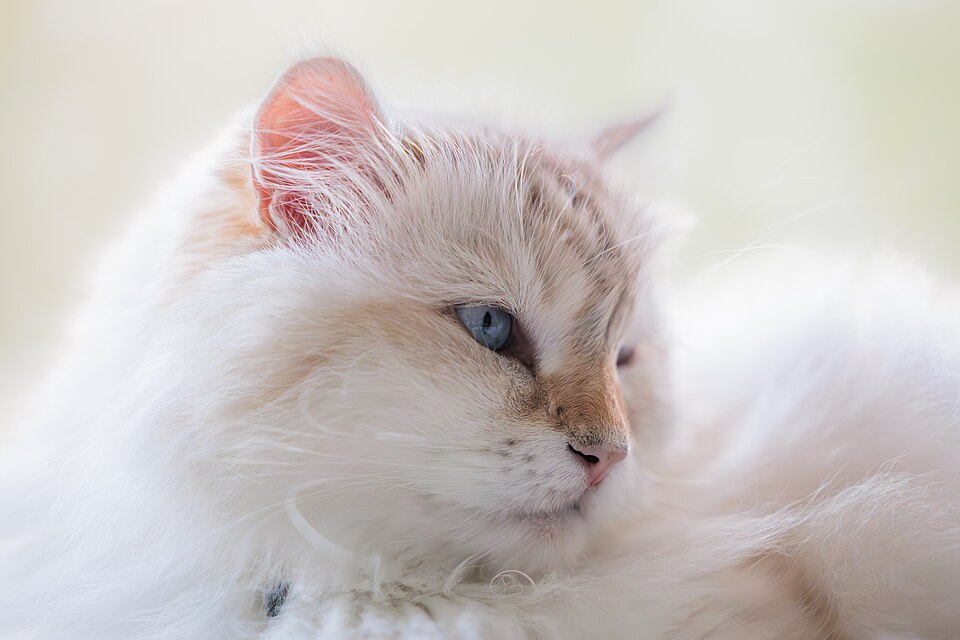
The Neva Masquerade is the Siberian cat's blue-eyed variety with dark points. It has a Siamese-style pattern, with a face, paws, ears and tail darker than the body, but it's very different from a Siamese: a big, heavy-boned, thick-coated forest cat. On this page we cover how it differs from the Siberian, how registries classify it and a common myth about allergies. For general care and health information, see our Siberian page too.
- The same as the Siberian: Genetically from the same pool; the difference is only two copies of the color-point gene (cs). Blue eyes are an inseparable part of the pattern.
- Registries differ: FIFe treats it as a separate sister breed, while TICA, CFA, the GCCF and WCF accept it as a variety of the Siberian.
- Slow to mature: According to the CFA it reaches full size at around 3 years, and the standard says it can take up to 5.
- Not hypoallergenic: Siberians and Nevas are said to produce fewer allergens, but there is no scientific proof; if you're allergic, get tested and talk to your doctor before choosing a breed.
- Registration: In Türkiye, microchipping and PETVET registration are mandatory for cats.
What to know
 What is the Neva Masquerade like?
We found no personality research separating the Neva Masquerade from the Siberian; since they come from the same gene pool, we use descriptions of the Siberian. According to the CFA the Siberian is an intelligent, curious, sociable, easygoing cat. It wants to be near its people, generally gets along with dogs, other animals and children, and is fond of a loud purr. The GCCF describes it as energetic, playful and intelligent, but also loyal, gentle and patient; some Siberians love playing with water.
Every cat is an individual. Breed traits describe general tendencies; the home it grows up in and its early contact with people shape its character at least as much as breed does.
 Who is it a good fit for?
It suits families who like play, are ready to spend time with their cat and will keep up the grooming routine of a big, dense-coated cat.
| Situation | A good fit? |
|---|---|
| Apartment | Yes, but it needs places to climb and play |
| Family with children | Yes; the GCCF says they're patient and gentle |
| Other cats and dogs | Usually fine (CFA) |
| Long hours alone | It's people-loving; long stretches alone may not suit it |
| First-time cat owners | Possibly, if you take grooming and health testing seriously |
Where does it come from?
According to the CFA the Siberian is Russia's native forest cat and is considered Russia's national cat, with a recorded history there going back about a thousand years. The breed's first standard was written in the late 1980s by a Russian cat club called Kotofei. The first international standard to include the color-pointed variety was approved by the WCF in 1991. The first Siberians came to the US in 1990; the CFA began registering the breed in 2000 and granted championship status in 2007.
Color-pointed cats are traditionally called "Neva Masquerade," a name that nods to the River Neva. According to a 2026 review in the journal Genes, Siberians and Neva Masquerades share the same gene pool and differ only in how the color-point gene is expressed. Organizations treat the cat differently:
- FIFe: Registers the Neva Masquerade (NEM) separately as the Siberian's "sister breed." Under FIFe's rules, crossing with other breeds is prohibited and only crossing with the Siberian is allowed; chocolate-, lilac-, cinnamon- and fawn-pointed patterns aren't accepted. The novice class is open only to cats born in the former USSR.
- TICA, CFA, GCCF and WCF: According to the review they accept the color-pointed variety as part of the Siberian standard and don't count it as a separate breed.
- ACF and CCCA (Australia): Treat it as a separate sister breed, like FIFe.
- NZCF (New Zealand): Recognizes the color-pointed variety neither as part of the Siberian nor as a sister breed.
Crosses between Siberians and Nevas are allowed in most of these organizations and keep the shared gene pool.
 Appearance and colors
A large, solidly built, rounded cat. According to the CFA mature males run about 12 to 18 pounds (5.4 to 8.2 kg) and females 8 to 12 pounds (3.6 to 5.4 kg); it matures slowly, reaching full size at around 3 years, and the standard says it can take up to 5. The GCCF's Siberian page gives somewhat larger ranges; don't fixate on one number, and work out your own cat's ideal weight with your vet.
- Coat: Dense, thick and triple-layered; heavier in cold months and lighter in summer.
- Color points: According to the Genes review, the trait comes from the cs allele of the tyrosinase gene, which is recessive, so two copies are needed. Kittens are born nearly white and the points show up as they grow. In cats with black pigment the color is called "seal" rather than black. Tabby-patterned points are called "lynx" in some registries.
- Eye color: Always blue, linked to the color-point gene. It's a direct result of incomplete pigment production and a desired trait.
- Colors: For the Siberian the CFA accepts seal, blue, flame, cream, tortie and blue-cream points, plus lynx points.
Daily care
According to the CFA, mats form most often on the underside, tail and britches, and it suggests checking those areas several times a week. The GCCF recommends combing with a steel comb a few times a week, and daily combing during the heavy shedding of spring and autumn.
- Nails: A scratching post is a must; trim nails the way your vet shows you.
- Play and space: An active, curious cat; give it a cat tree, high shelves and hunting games.
More in our posts on cat grooming and why cats love high places.
 Diet and weight
We found no special diet recommendation for the Neva Masquerade. A balanced, complete cat food suited to its age and lifestyle is enough. Measure the food rather than eyeballing it, subtract treats from the daily amount, work out the daily amount with your vet and weigh your cat once a month; a thick coat hides weight, so the scale is the most reliable measure.
 Health issues to know about
The information below is for general awareness; for diagnosis and treatment, talk to your veterinarian.
We found no separate health research on the Neva Masquerade; since it shares a gene pool with the Siberian, information on the Siberian can be considered relevant, though not with certainty.
Hypertrophic cardiomyopathy (HCM)
The GCCF writes that HCM has been recorded in the Siberian. HCM is the most common heart disease in cats: the muscle of the heart's left ventricle thickens. According to the Cornell Feline Health Center, most cats show no signs at first; as it progresses you may see fast or labored breathing, lethargy, loss of appetite, or sudden hind-leg lameness or paralysis. The gold standard for diagnosis is a heart ultrasound (echocardiography). The Siberian isn't on Cornell's list of predisposed breeds, but the GCCF reports it; it makes sense to ask the breeder for the parents' heart ultrasound results. The CFA also notes that breeders test for HCM, polycystic kidney disease (PKD) and several recessive conditions.
The "hypoallergenic" myth
The often-repeated "hypoallergenic" claim for Siberians and Nevas isn't backed by science. A 2024 review in Allergologie Select says there's no scientific evidence for a hypoallergenic cat breed, and that even hairless Sphynx cats produce the main cat allergen, Fel d 1. A 2026 review in Clinical and Translational Allergy says some breeds, such as Siberians and Balinese, are believed to produce lower levels of Fel d 1, but that every cat studied so far produces this allergen. If you're allergic to cats, talk to an allergist before getting one and, if possible, spend time with that cat first.
- Fast or open-mouth breathing
- Sudden weakness, limping or pain in the back legs
- Drinking or urinating a lot, loss of appetite or weight loss
- Hiding and reacting when touched (cats hide pain)
How long does it live?
We found no independent lifespan study for the Neva Masquerade. The GCCF gives 12 to 15 years for the Siberian; that's an expectation in the registry's description, not research data. Ideal weight, regular vet checkups, heart monitoring and a safe home affect lifespan the most.
 Before you get one
- Consider a shelter too: Large longhaired cats end up in shelters. If you want a Neva Masquerade or something like it, follow adoption listings as well.
- If you buy from a breeder: Ask to see the parents; ask for heart ultrasound and PKD test results and vaccination records. Stay away from sellers who market the cat as "hypoallergenic." The GCCF notes that the Siberian reaches reproductive maturity early and that kittens should be neutered in good time.
- Red flags: Sellers who won't show the mother, always have kittens, offer no paperwork, promise it "won't trigger allergies" or rush you to buy now.
- Legal registration: In Türkiye, microchipping and PETVET registration are mandatory for cats. Details in our PETVET registration and microchip post.
- First days: International Cat Care advises starting a new cat in a single room, leaving a hiding place it can retreat to and letting it come to you rather than forcing contact. Our first week with a new cat post walks you through it.
Frequently asked questions
Are the Neva Masquerade and the Siberian the same breed?
Genetically they come from the same gene pool; the difference is in how the color-point gene is expressed. Registries see it differently: FIFe treats it as a separate sister breed, while TICA, CFA, the GCCF and WCF accept it as a variety of the Siberian.
Is the Neva Masquerade hypoallergenic?
No. There's no scientific evidence for a hypoallergenic cat breed; some breeds like the Siberian are thought to produce less Fel d 1, but every cat studied produces this allergen. If you're allergic, talk to your doctor first.
Why are its eyes always blue?
According to the Genes review, blue eyes are a direct result of the color-point gene: when pigment production is incomplete, the eyes stay blue. It's an inseparable and desired part of the pattern.
How big does it get?
According to the CFA males run 12 to 18 pounds (5.4 to 8.2 kg) and females 8 to 12 pounds (3.6 to 5.4 kg). It reaches full size at around 3 years, and up to 5 according to the standard.
Does the coat need a lot of care?
A moderate amount. It has a dense, triple-layered coat; expect a few combings a week, and more often in spring and fall.
Is it a good fit for a home with children?
According to the CFA and the GCCF it usually gets along well with children and other animals. Still, keep introductions supervised and slow.
Sources
- Górska ve ark. · Colour Variants in Siberian Cats: A Comprehensive Review of Phenotype, Genetics, and Breed Registry Standards, Genes (2026)
- FIFe (Fédération Internationale Féline) · Breeding and Registration Rules, 2026 baskısı (NEM ve SIB bölümleri)
- CFA (Cat Fanciers' Association) · Siberian ırk tanıtımı ve standardı
- GCCF (Governing Council of the Cat Fancy) · Siberian
- Cornell Feline Health Center · Cardiomyopathy
- Allergologie Select (2024) · Hypoallergenic animals: A promise of hope for allergic patients?
- Clinical and Translational Allergy (2026) · Allergy to Cats: Current Perspectives and Therapeutic Options
- International Cat Care · Helping your new cat or kitten settle in
- Resmî Gazete · Kedi, Köpek ve Gelinciklerin Kimliklendirilmesi ve Kayıt Altına Alınmasına Dair Yönetmelik (26 Şubat 2018)
By Tüylüm · Last checked: November 10, 2026. Compiled from the sources above and written in our own words. Spotted a mistake? Write to [email protected] and we'll fix it right away. Photo from Wikimedia Commons, used under the license shown below it.