 Tüylüm
Peterbald
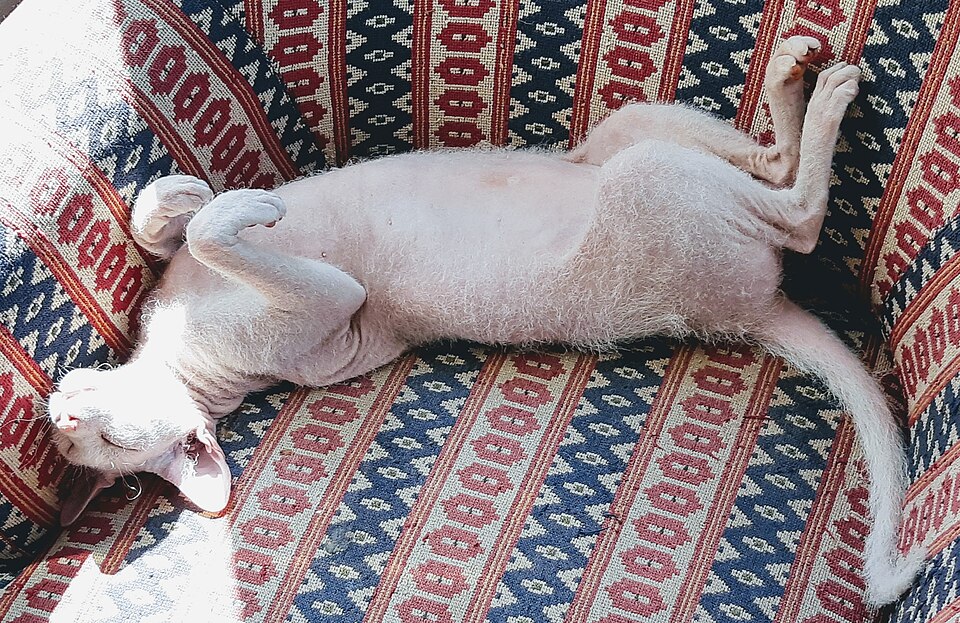
A Russian-origin breed known for a long, slim, elegant body and huge ears, with a coat that ranges from bald to brush-coated. Skin, sun and warmth care are needed; the GCCF and International Cat Care argue that breeding hairless cats is problematic because of health concerns.

 LifespanNo datano breed-specific lifespan study found
 WeightNo datano weights in the standard we opened
 OriginRussiafrom the Don Sphynx and Oriental breeds
 CoatBald to brushcan change over a lifetime
 EnergyNo datastandard says only "elegant and intelligent"
 TemperatureMay get coldin hairless cats (GCCF, about the Sphynx)
 With childrenNo datasources we opened do not say
 Alone timeNo datasources we opened do not say
The Peterbald belongs to one of the most debated breeds in the cat world: a long, slim, elegant body, enormous ears, and a coat unlike what you would expect on a cat. Some Peterbalds are completely bare, some feel like velvet, and some are born with a sparse, wiry coat; the coat of one cat can change over the years. This page tells you where the breed comes from, how its coat and skin need to be cared for, and openly covers the contested points about health. To compare it with the Sphynx, see our Sphynx page too.
- Looks: A long, slim, muscular body, an inverted-triangle head, very large ears, almond eyes and a long, whippy tail.
- Coat: Bald, suede-like, velvety (flock), brush, or normal straight; it can change over a lifetime.
- Origin: Of Russian origin, reported to descend from the Don Sphynx and Oriental breeds; the hairless gene is dominant.
- Controversy: The GCCF says it will not recognize more hairless breeds, and International Cat Care says hairless cats should not be bred.
- Care: Skin, sun, cold and ear care are needed; ask your veterinarian what suits your cat.
- Registration: In Türkiye, microchipping and PETVET registration are mandatory for cats.
What to know
 What is the Peterbald like?
The registry documents we opened say very little about the Peterbald's temperament. The ACF's standard (sourced from FIFe) describes the ideal Peterbald as "an elegant and intelligent cat" and stresses its graceful movement; beyond that there is not a word about children, other animals or being left alone. So we are not writing phrases like "very social" or "very calm." When you meet a kitten, look at how its mother and father relate to people, how they react to household noise and how curious the kitten is. Temperament is largely individual.
Every cat is an individual. Breed traits describe general tendencies; meeting people and household sounds as a kitten shapes character at least as much as breed does.
 Who is it a good fit for?
Households that can spend time on skin care and protection from sun and cold, can keep the cat indoors, and make the decision knowing the debate over health. For people with cat allergies, being hairless or sparsely coated is not a solution: cat allergens come mainly from saliva.
| Situation | A good fit? |
|---|---|
| Apartment | Yes; indoor life is preferable for this breed |
| Family with children | No breed-specific information found; introduce slowly |
| Other cats and dogs | No breed-specific information found |
| A cold home | Take care; a hairless cat can get cold easily (GCCF, about the Sphynx) |
| A sunny balcony or garden | Take care; skin can sunburn (GCCF, about the Sphynx) |
| People with allergies | Not hypoallergenic; spend a long time with the cat first |
Where does it come from?
The Peterbald is reported to be of Russian origin and to descend from the Don Sphynx (Donskoy) crossed with Oriental-type breeds. The registry documents do not say this directly, but their rules point to this ancestry: FIFe's registration rules allow breeding to Balinese, Oriental Longhair and Shorthair and Siamese, while the ACF standard allows breeding to Siamese and Oriental Shorthair and lets the Don Sphynx join only through imported cats. We could not verify dates or who developed the breed in registry documents, so we leave them out.
Recognition:
- FIFe: The Peterbald is a recognized breed. FIFe also writes that it will accept no new preliminary recognition applications for hairless or partially hairless breeds other than the Sphynx, Don Sphynx and Peterbald, and that it will not support breeding cats with congenital abnormalities such as hairlessness outside these three breeds.
- GCCF: It does not recognize the breed. According to the GCCF, the Peterbald falls under "no acceptance by current policy terms"; the GCCF says it has no plans to recognize more hairless breeds and cites health problems linked to hairlessness. It lists FIFe, SACC and TICA as the bodies that recognize the Peterbald and suggests the Sphynx as an alternative.
- ACF (Australia): It publishes a standard sourced from FIFe.
 Appearance and colors
The ACF standard describes the Peterbald as a cat with a sturdy, long, lean body that moves gracefully.
- Head: A long inverted triangle (wedge) measured from ear tip to ear tip to the blunted muzzle; a flat forehead and flat, high cheekbones. The muzzle is strong and slightly blunt. If whiskers are present they can be crinkly and may appear broken; the standard says curly whiskers are the main sign that a newborn kitten is a Peterbald.
- Ears: Extra large, pointed, broad at the base and slightly flared.
- Eyes: Medium in size, almost almond-shaped and obliquely set; eye color is independent of coat color. Blue or odd eyes are allowed only for white cats or cats with a lot of white; pointed cats have blue eyes.
- Body: Medium-sized, long and graceful; shoulders and hips equal in width. Legs are fine-boned with firm muscles, hind legs slightly longer than the front. The feet are oval with long, agile toes. The tail is long, strong and whippy.
- Colors: All colors and patterns are allowed except amber; any amount of white is allowed.
Coat types
The standard calls the coat a "unique and important" feature of the breed. A Peterbald may have a single coat type or a combination, and the coat it is born with may change several times over its life. Because the hairless gene is dominant, normal-coated kittens can also be born to two hairless parents (FIFe). Think of the main types as points along a continuum:
- Naked: Soft, warm, elastic skin that can feel sticky or be covered in silk-like fine hair.
- Chamois: Dry, very soft, with a suede or peach-fuzz texture.
- Flock: FIFe uses this term for cats with residual hair of no more than 2 mm on the body.
- Brush: According to FIFe, fine wavy, often wiry hair longer than 2 mm over the body, with bald areas on the head, upper neck or back. According to the ACF, the skin may be visible through the coat, which can be dense, wiry, short, wavy or kinky, and should not look or feel like a normal coat.
- Straight: A normal-coated cat; it does not carry the hairless gene and will not lose its coat. It can be used in breeding but competes only in the "any other variety" class at shows.
The coat can change from kittenhood: according to the ACF, kittens born with a coat may lose it starting on top of the head or the nape and working down the body, then regrow it, and this loss-and-growth phase generally settles into a permanent coat by about age three. The standard treats any sign of artificial hair removal as grounds for disqualification. The standard we opened gives no weight.
Daily care
We found no care guide specific to the Peterbald. The most detailed information on caring for hairless and sparsely coated cats is on the GCCF's Sphynx page; because the Peterbald's coat is so variable, ask your veterinarian how to adapt this to your cat. For the Sphynx, the GCCF says:
- Skin and baths: With no coat to absorb them, body oils build up, so regular bathing is needed. Ears and feet collect wax and dirt; when cleaning, do not push cotton buds into the ear canal.
- Sun: They can sunburn easily, so keeping the cat indoors is best. Supervised outdoor time on a harness or in a secure enclosure is an option.
- Warmth: They feel warmer to the touch, but their body temperature is not higher. They do not need extra heating, which would make them sweat more; a normal bed with a blanket is enough. They usually need slightly more food to keep warm.
- Allergies: Not hypoallergenic; cat allergens come mainly from saliva.
The skin and cold needs of a flock, brush or straight-coated Peterbald may differ from those of a bald one. Have your veterinarian look at your cat as a kitten and set the care routine together. For grooming, see cat grooming, and for home safety see a cat-safe home. Do nail, ear and dental care the way your veterinarian shows you.
 Diet and weight
We found no special diet advice for the Peterbald. A balanced, complete cat food suited to age and lifestyle is enough. Measure the food, subtract treats from the daily amount, set the daily amount with your veterinarian, and weigh your cat monthly. The GCCF says Sphynx cats need slightly more food to keep warm; work out with your veterinarian how much your Peterbald needs.
 Health issues to know about
The following is for information only; ask your veterinarian for diagnosis and treatment.
Health is a contested subject for this breed, and it is only fair to be direct.
- Registries' positions: The GCCF says it will not recognize more hairless breeds and cites health problems linked to hairlessness. International Cat Care argues that a coat is essential for a cat and that hairless cats should not be bred. FIFe says it will not support breeding hairless cats outside the three recognized breeds (Sphynx, Don Sphynx, Peterbald).
- Peterbald-specific data: We found no breed-specific health or lifespan study for the Peterbald. A 2024 UK study (VetCompass, 12 breeds) did not include it. In that study the Sphynx had the shortest life expectancy at birth of the breeds analyzed (6.68 years). That is not a result for the Peterbald, but it shows why health data for a hairless breed matters.
- Retinal disease testing: FIFe requires Peterbalds to be DNA tested for CEP290 (PRA-rdAC) before mating unless both parents are proven not to carry it. PRA is an eye disease in which the retina degenerates over time and can lead to blindness.
- Findings in the Sphynx: International Cat Care writes that hypertrophic cardiomyopathy (HCM), a thickening of the heart muscle, is strongly suspected to be inherited in the Sphynx, and lists some movement disorders and skin problems too. These are written about the Sphynx; our sources say nothing about whether they occur in the Peterbald.
So ask the breeder:
- About the parents' heart exams and CEP290 test results.
- How diverse the pedigree is, and whether there is close inbreeding.
- Whether the kitten has had a veterinary check.
- Fast or open-mouth breathing, tiring quickly
- Sudden weakness or pain in the hind legs
- Skin redness, burns, crusting or itching
- Poorer night vision, bumping into things or sudden changes in the eyes
- Drinking or urinating a lot, loss of appetite or weight loss
How long does it live?
We found no breed-specific lifespan study for the Peterbald, so we do not write a number. The Sphynx's 6.68-year figure from the UK study cannot be applied to the Peterbald. Lifespan is most affected by an ideal weight, regular veterinary checks, spaying or neutering, and a safe home. Asking about the parents' age and health history when you get a kitten fills this gap a little. Regular checks, vaccinations, parasite prevention and dental care are the foundation of care; ask your veterinarian which checks they recommend as your cat ages.
 Before you get one
- Think about shelters too: Slim, short-haired cats turn up in shelters; a loving companion could be waiting there even if it does not look like a Peterbald.
- If you buy from a breeder: Ask to see the mother and father; ask about heart exams, CEP290 test results, the pedigree and vaccination records. Stay away from "hairless cats" sold without documented breed papers. The standard treats any sign of artificial hair removal as grounds for disqualification, so a cat whose hair has been removed and sold to you as "hairless" is a warning sign.
- Red flags: Sellers who will not show the mother, who always have kittens for sale, who offer no paperwork, or who rush you to "buy now."
- Legal registration: In Türkiye, microchipping and PETVET registration are mandatory for cats. Details are in our article on PETVET registration and microchips.
- The first days: International Cat Care recommends starting a new cat in a single room, leaving a place to hide, and waiting for the cat to come out on its own rather than forcing it. Make sure a hairless cat's room is warm and safe. Our first week with a new cat article walks through it step by step.
Frequently asked questions
Is the Peterbald the same as the Sphynx?
No. Both can be hairless or sparsely coated, but they are separate breeds. The Peterbald has a long, slim, elegant body, an inverted-triangle head and very large ears, and its coat can range from bald to brush. For a comparison, see our Sphynx page.
Is the Peterbald always hairless?
No. The coat can be naked, chamois, flock, brush or straight; the coat it is born with can change over a lifetime, and according to the ACF it generally settles by about age three.
Is it hypoallergenic?
No. Cat allergens come mainly from saliva; being hairless or sparsely coated does not remove the allergy. If you have allergies, spend a long time with the cat and see how you react.
Why is it so controversial?
The GCCF says it will not recognize more hairless breeds and cites health problems linked to hairlessness; International Cat Care argues that hairless cats should not be bred. FIFe recognizes the Peterbald but says it will not recognize new hairless breeds.
How much does it weigh and how long does it live?
The standard we opened gives no weight or lifespan. Work out your own cat's ideal weight with your veterinarian.
Can it be left alone at home?
We found no breed-specific source. As with every cat, play and attention are essential; and a hairless cat's home needs to be warm.
Sources
- ACF (Australian Cat Federation) · Peterbald breed standard (November 2024, FIFe-sourced)
- FIFe (Fédération Internationale Féline) · Breeding and Registration Rules, 2026 edition (PEB section and hairless cat rules)
- GCCF (Governing Council of the Cat Fancy) · Unrecognised breeds page (Peterbald)
- GCCF (Governing Council of the Cat Fancy) · Sphynx (skin care and health of a hairless cat)
- International Cat Care · Sphynx (position on breeding hairless cats)
- Teng et al. (2024) · Life tables of annual life expectancy and risk factors for mortality in cats in the UK, Journal of Feline Medicine and Surgery
- International Cat Care · Helping your new cat or kitten settle in
- Resmî Gazete (Official Gazette of Türkiye) · Regulation on Identification and Registration of Cats, Dogs and Ferrets (February 26, 2018)
By Tüylüm · Last checked: November 10, 2026. Compiled from the sources above and written in our own words. Spotted a mistake? Write to [email protected] and we'll fix it right away. Photo from Wikimedia Commons, used under the license shown below it.