 Tüylüm
Savannah
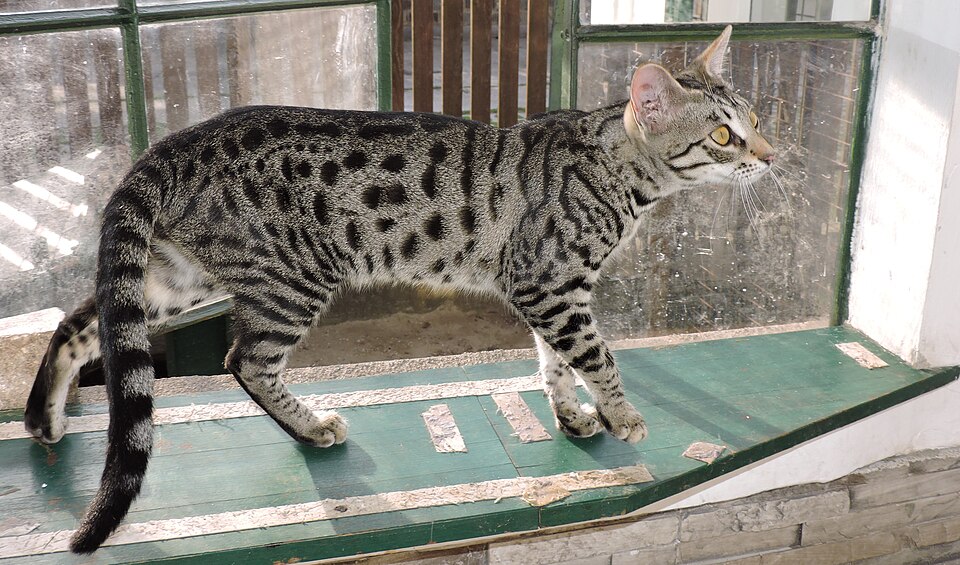
A long-legged, big-eared, spotted hybrid of the African serval and the domestic cat. It's very energetic with a strong prey drive. Early generations need a license or are banned in many countries, and animal welfare groups don't support breeding hybrids.

 Lifespan12–20 yearsrange from vet guides; no breed study
 Weight14–24 lb (6.3–11 kg)males; F1 largest, females a bit smaller
 Shoulder height13–18 in (32.5–45 cm)males; smaller in later generations
 OriginServal × domestic catrecognized by TICA in 2001
 CoatShort, spottedlow maintenance
 EnergyVery highF1 and F2 are the most active
 With other petsRiskystrong prey drive, territorial
 Legal statusMay be restrictedF1–F4 covered by CITES; varies by country
The Savannah is a hybrid of the domestic cat and the serval, a long-legged, big-eared wild cat from Africa. With its spotted coat, tall upright ears and long legs, it looks like a small wild cat. Its fans describe a dog-like, playful cat devoted to its people; animal welfare organizations stress that the needs that come with its wild genes are very hard to meet in a home. On this page we've laid out both sides, along with the legal issues anyone considering this breed should know, drawing on breed sources, animal welfare resources, official regulations and scientific studies.
- A hybrid breed: It comes from crossing domestic cats with the wild serval; how many generations a cat is removed from the serval (F1, F2, F5...) shapes its temperament, size and legal status.
- Very energetic: It jumps, climbs and explores; it can show a strong prey drive and territorial behavior.
- Legal status: The serval is listed by CITES, and early generations need a license or are banned in many countries. In Türkiye, check with the authorities before getting one.
- The welfare debate: International Cat Care does not support breeding hybrid cats; both the breeding process and life in a home raise serious welfare concerns.
- Health: PK deficiency, which causes anemia, has been reported; a DNA test exists.
What to know
 What is the Savannah like?
A Savannah's temperament depends heavily on its generation. According to vet-reviewed sources, an F1 has a serval as a parent and an F2 has one as a grandparent; with each generation, cats get both smaller and calmer. Fans describe well-socialized Savannahs as "dog-like" cats that follow their people from room to room, play fetch, go for walks on a harness and love playing with water. When it has something to say, it can say it loudly.
International Cat Care paints a more cautious picture: because they retain wild genes, Savannahs can have strong predatory instincts and can be territorial with people and other pets; they are highly active and exploratory and have behavioral needs that differ from those of domestic cats. According to an official statement from Austria, first-generation hybrids can have a pronounced wild character; hand-raised animals may seem tame but can be aggressive toward strangers, and problems often emerge only when the cat matures at 2 to 3 years old.
Every cat is an individual. Breed traits describe general tendencies; with the Savannah, generation, contact with people as a kitten and how it was raised also strongly shape its behavior.
 Who is it a good fit for?
The Savannah isn't an easy cat even for people with long cat experience who can set up tall climbing spaces and a secure catio and provide hours of play and enrichment every day. For early generations (F1 to F4), Austrian authorities state that appropriate care in a private home isn't feasible without extensive expertise and experience with wild animals.
| Situation | Good fit? |
|---|---|
| Apartment | Hard; needs a lot of vertical space and intense daily activity |
| Family with small kids | Early generations aren't suitable; PetMD advises at least F3 |
| Birds, rodents, small pets | Not suitable; very strong prey drive |
| Other cats and dogs | Possible if well socialized as a kitten, but territoriality may show |
| Long hours alone | Hard; may become destructive when bored |
| First-time cat owners | Not suitable |
Vet-reviewed sources recommend F3 or later generations for homes with children and for people who want an everyday companion cat; these generations tend to be smaller and calmer.
Where does it come from?
The Savannah's other ancestor, the serval, is a medium-sized, large-eared wild cat of Africa's open country. According to International Cat Care, Savannahs are produced by crossing domestic cats with captive-housed servals. The registry TICA recognized the breed in 2001; according to a 2024 UK study, the breed's arrival in Britain was around the same time.
Welfare problems in breeding
Animal welfare sources point to the breeding process itself. According to International Cat Care, female domestic cats are bred with much larger and stronger male servals and risk injury, and the male servals and early-generation hybrids live their entire lives in captivity. Because the two species have different pregnancy lengths, premature or difficult births and health problems in kittens can occur. Austrian authorities also list forced matings, difficult births, miscarriages, stillbirths and emergency cesarean sections, and consider breeding early generations to be animal cruelty.
Appearance and colors
The Savannah is slim, long-legged and noticeably larger than domestic cats, but its size varies a lot by generation. According to a 2019 study, F1 males can weigh about 18–24 lb (8–11 kg; exceptionally up to about 40 lb, 18 kg) and stand about 16–18 inches (40–45 cm) at the shoulder, while F4 or F5 males weigh about 14–18 lb (6.3–8.2 kg) and stand around 13–15 inches (32.5–38 cm). Females are slightly smaller. The same study notes that Savannahs can leap about 8 feet (2.5 m) high from a standing start.
- Ears: Very large for the head and upright, much like a serval's.
- Coat: Short, dense and spotted. According to PetMD, the main colors are black spotted tabby, silver spotted tabby, black and black smoke, with rarer colors also seen.
- Face: Dark lines running from the eyes to the nose and a prominent brow are typical.
Daily care
Grooming is easy: brushing the short coat once a week is enough, and it doesn't shed excessively. The real work is in environment and time.
- Vertical space: Sturdy, floor-to-ceiling cat trees, wall shelves and high resting spots are a must.
- Daily play and enrichment: Hunting games, fetch, food puzzles and reward-based training several times a day.
- Safe outdoor time: Vet-reviewed sources advise never letting a Savannah outside off-leash; an enclosed catio or harness walks are safe options. An escaped hybrid is a risk to wildlife: a study of Australia found that most of the country's land mammals could have been at risk of predation by Savannah cats.
- Home safety: It jumps and climbs superbly; fit sturdy window screens and put breakables away.
- Water: Many love playing with water; keep the ears dry after baths or swims.
For ideas, see our articles on playing with an indoor cat, cats and high places and a cat-safe garden.
 Diet and weight
According to vet-reviewed sources, a complete, balanced cat food suited to its age is enough for a Savannah too. They suggest splitting the daily food into two or more small meals and using food puzzles to satisfy its hunting instincts.
- Because size and weight vary so much by generation, always decide the daily amount with your vet based on your own cat's ideal weight.
- Don't switch to raw meat or special "wild cat" diets without talking to your vet.
- Count treats as part of the daily food.
 Health issues to know about
Some inherited problems have been reported in the Savannah. The information below is for awareness only; ask your vet about diagnosis and treatment.
Pyruvate kinase deficiency (PK deficiency)
A recessively inherited disease that makes red blood cells break down early and causes anemia. International Cat Care notes that it has been identified in this breed, and a 2012 study by Grahn and colleagues recommends testing Savannahs as well. In a 2022 study of more than 11,000 cats, the variant was found in 11 of the 78 Savannahs tested. Lethargy, pale gums, poor appetite and weight loss are the signs to watch for.
Progressive retinal atrophy (PRA)
Inherited eye diseases in which the retina degenerates, leading to blindness. In the same 2022 study, the late-onset rdAc-PRA variant was found in 10 of the 80 Savannahs tested, and the early-onset PRA-b variant first described in Bengals was found in 1. Both have DNA tests.
Heart disease (HCM)
Vet-reviewed sources note that HCM, the most common heart disease in cats, can also occur in Savannahs and can be detected early with a heart ultrasound (echocardiography).
Finding a vet
Before you bring one home, ask whether your local vet has experience with hybrid cats.
- Pale or yellowish gums, marked lethargy
- Bumping into things, trouble finding its way in the dark
- Fast or open-mouth breathing
- Sudden aggression or a marked change in behavior
How long does it live?
We couldn't find a large lifespan study for the Savannah, and the breed isn't included in the UK VetCompass lifespan studies. Vet-reviewed sources give a range of 12–20 years. That's a general estimate, not scientific data, so take it as such.
The most concrete ways to extend lifespan are the same for every cat: spaying or neutering, a healthy weight, a safe indoor life, a vet checkup at least once a year and dental care.
 Before you get one
- Consider adoption: A 2019 study notes that hybrid cats are often surrendered to wildlife shelters or released. If you want to give a Savannah a home, look at adoption listings first.
- Know the welfare debate: International Cat Care does not support breeding hybrid cats; producing early generations raises serious welfare problems for both female domestic cats and servals.
- Later generations only: If you buy, choose a later-generation cat (ideally F5 or beyond) with pedigree papers that prove it.
- CITES and other countries: The serval is listed in CITES Appendix II. US rules implementing CITES treat hybrids with a listed species in their last four generations as CITES specimens, so moving F1 to F4 Savannahs between countries may require CITES documents. Austria bans keeping Savannahs up to the fourth generation; in the UK, first-generation (F1) cats require a dangerous wild animal license; Australia has banned Savannah imports since 2008; and some US states ban these cats outright.
- In Türkiye: Importing and exporting CITES-listed species requires a CITES document, and for mammals this is handled by the Ministry of Agriculture and Forestry's General Directorate of Nature Conservation and National Parks (Doğa Koruma ve Milli Parklar Genel Müdürlüğü). Keeping wild animals without documents is also prohibited. We couldn't find a provision that clearly sets out how hybrids like the Savannah, especially early generations, are treated under these rules. Check with this directorate and its provincial office before getting one or bringing one from abroad.
- Registration: Rules vary by country; many places require or recommend microchipping. In Türkiye, owned cats must be microchipped and registered in the PETVET system. See our PETVET and microchip guide for details.
Frequently asked questions
Is a Savannah a wild cat or a domestic cat?
Somewhere in between. Later-generation Savannahs (F5 and beyond) are treated as domestic cats in many countries, while early generations are so close to the serval that some countries treat them like wild animals and require a license or permit.
What do F1, F2 and F5 mean?
They show how many generations a cat is removed from the serval. An F1 has a serval as a parent, an F2 as a grandparent. With each generation, cats get smaller, calmer and closer to a domestic cat.
What's the difference between a Savannah and a Bengal?
Both are wild cat hybrids, but the Bengal's ancestor is the Asian leopard cat, while the Savannah's is the African serval. The Savannah is larger, longer-legged and bigger-eared. See our Bengal page for details.
Can a Savannah live in an apartment?
Later generations can, with a lot of vertical space and intense daily activity, but International Cat Care stresses that meeting these cats' needs indoors is extremely difficult. Early generations aren't suited to apartment life.
Is it legal to keep a Savannah in Türkiye?
We couldn't find a clear rule on this. In Türkiye, keeping wild animals and trading CITES-listed species require official documents. If an early-generation cat is involved, or you plan to bring one from abroad, check with the General Directorate of Nature Conservation and National Parks.
Sources
- International Cat Care · Savannah
- Dickman et al. · Assessing risks to wildlife from free-roaming hybrid cats: the proposed introduction of pet Savannah cats to Australia as a case study, Animals (2019)
- Draper et al. · Private keeping of dangerous wild animals in Great Britain, Animals (2024)
- State of Lower Austria · Ban on keeping hybrid cats (Verbot der Haltung von Hybridkatzen)
- legislation.gov.uk · Dangerous Wild Animals Act 1976, Schedule (UK)
- US Code of Federal Regulations · 50 CFR 23.43, What are the requirements for a wildlife hybrid?
- Species+ (UNEP-WCMC / CITES) · Leptailurus serval, CITES listing
- Grahn et al. · Erythrocyte pyruvate kinase deficiency mutation identified in multiple breeds of domestic cats, BMC Veterinary Research (2012)
- Anderson et al. · Genetic epidemiology of blood type, disease and trait variants in over 11,000 domestic cats, PLOS Genetics (2022)
- PetMD (vet-reviewed) · Savannah cat breed
- Ministry of Agriculture and Forestry (Türkiye) · Regulation implementing CITES
- Ministry of Agriculture and Forestry (Türkiye) · Regulation on keeping, breeding and trading game and wild animals
By Tüylüm · Last checked: November 3, 2026. Compiled from the sources above and written in our own words. Spotted a mistake? Write to [email protected] and we'll fix it right away. Photo from Wikimedia Commons, used under the license shown below it.