 Tüylüm
Sun Conure
One of the showiest conures with its yellow-orange colors, but its scream is piercing and its lifespan can reach 30 years. Endangered in the wild (IUCN: Endangered), with trapping and trade a major threat. If you get one, buy from a documented, legal source and be ready for the noise.

 Lifespan≈ 25–30 yearsMerck up to 30, ADW 15–30
 Length≈ 12 in (30 cm)about 3.5–4.5 oz (100–130 g)
 OriginNorthern Brazil, Guyanasavannas around Roraima
 VoiceVery loudMerck: piercing screams
 Social lifeFlock birdpairs or groups of 3–15
 CageWide and longsafe flight every day
 DietPellets + veggiesfruit and flowers too
 LegalCITES App. IIask for papers and legal source
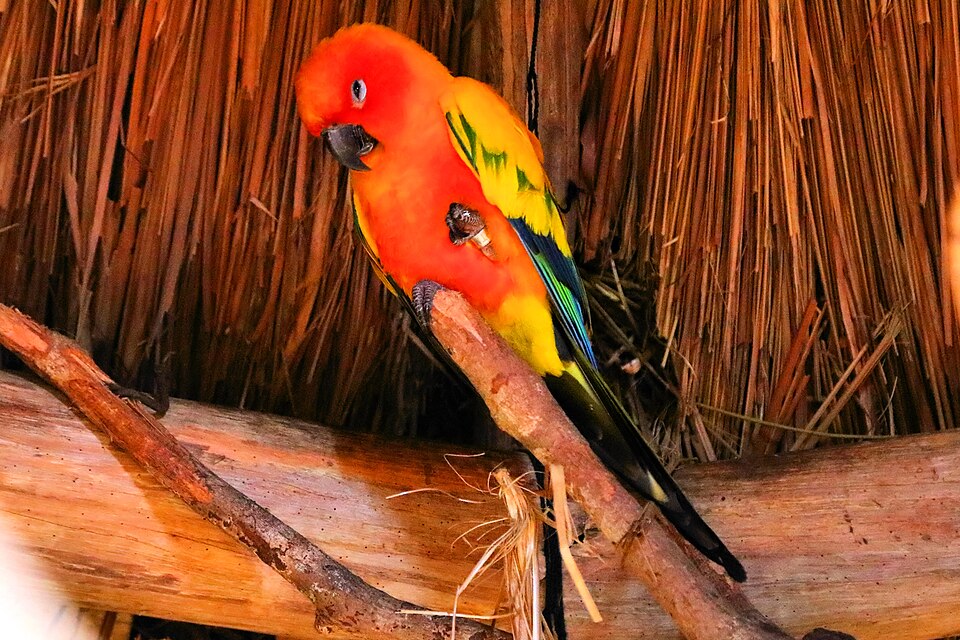
The sun conure, with its yellow, orange and green feathers, looks like a fruit basket and catches the eye at once. But behind that look are two realities: a very loud voice and a species under serious threat in the wild. On this page we cover both, based on veterinary and conservation sources.
- Lots of noise: Merck points to conures' piercing screams, a serious matter for apartments and shared walls.
- Lifespan: Merck says up to 30, the World Parrot Trust about 30 and Animal Diversity Web 15–30 years.
- Status in the wild: Endangered on the IUCN Red List; trapping is the main threat.
- Legal status: Recorded as CITES Appendix II; lists can change. When buying, ask for papers and legal origin.
- Talking: Merck says it is not known for talking.
- Social life: A flock bird; needs attention, play and flight every day.
What to know
 What is the Sun Conure like?
Animal Diversity Web describes the sun conure as highly social: in the wild it lives in pairs or groups of 3–15, and flocks of 20–30 form where food is plentiful. In flight it gives a loud, high-pitched "screek" repeated three to six times; while feeding it is usually quiet. Merck describes the conure group (Aratinga) as small-to-medium birds with piercing screams that are not known for talking.
The World Parrot Trust writes that the sun conure enjoys socializing and bathing. In a 2011 survey of avian veterinarians and parrot owners by Gaskins and Bergman, the most common behavior problems were aggression, screaming and feather picking; screaming is an especially important issue with conures.
The sun conure's scream is not a flaw; it is the species' natural way of communicating. For someone who cannot live with that sound, this bird is the wrong choice.
Who is it a good fit for?
The sun conure suits people who are ready for a lot of noise, can spend long stretches with their bird every day, can set aside a roomy living space and accept a 25–30 year commitment. RSPCA Australia reminds readers that birds can live 10 to 50 years, that noise levels vary greatly by species and that a bird vet can be hard to find.
| Situation | A good fit? |
|---|---|
| Apartment | Difficult; loud |
| Family with kids | Be careful; bites and screams can happen, so supervise |
| Home with a cat or dog | Be careful; never leave a bird alone with a cat or dog |
| Often away from home | Not suitable; screaming and feather picking risk rises |
| First-time bird owners | Usually not suitable; the noise and lifespan weigh heavily |
Where does it come from?
According to Animal Diversity Web it lives in the Roraima region of northern Brazil and neighboring Guyana, in open savannas, dry woodland and palm groves. The World Parrot Trust says the wild population is about 1,000–2,499 mature birds and falling, and that because of a very rapid decline over three generations the species was moved on the IUCN Red List from Least Concern to Endangered. Trapping is the main threat: large numbers of birds were exported from Guyana and trappers have now turned to Brazil, where the population has dropped 50–79% over three generations. Trapping pressure in Guyana is reportedly easing, with signs of recovery.
So buying this species, even from a legal, documented source, is a decision connected to the wild population. Do not buy a wild-caught bird.
Appearance and colors
Animal Diversity Web gives about 12 in (30 cm) and 3.5–4.3 oz (100–123 g), and the World Parrot Trust about 12 in (30 cm) and 4.2–4.5 oz (120–130 g). The head and body are yellow-orange and the wings green with blue tones. These showy colors make the species attractive, but looking good does not make it easy to keep. A bird with fluffed, dull or plucked feathers should be seen by a vet.
 Daily care
- Flight: Free flight in a safe, enclosed room every day; window, door, fan and heater precautions; toxic plants removed.
- Mental work: Merck lists lack of mental stimulation among the causes of feather picking; rotate toys and set up foraging games.
- Regular attention: Merck recommends consistent, regular interaction.
- Sleep: Merck values uninterrupted nights; RSPCA suggests a separate night cage instead of covering the cage.
- Bathing: The World Parrot Trust says it enjoys bathing; a mister or shallow dish.
Also see bonding with your bird and toys for birds.
 Cage and living space
RSPCA Australia's rule for a pair: the width at least three times the combined wingspan of the two birds, the height at least three times the head-to-tail length of the largest bird, and at least two wingbeats between perches. For a bird about 12 in (30 cm) long, that is a height of at least about 3 ft (90 cm). Birds fly horizontally; a long cage beats a tall one. RSPCA writes that birds confined to cages risk obesity, arthritis, boredom, feather picking, screaming and aggression; a flight aviary or regular safe flight is a must.
- Material: For aviary wire for birds of 80–200 g, RSPCA suggests about 1.2 mm wire. Poorly galvanized wire can poison with zinc; Merck prefers stainless steel.
- Perches: Natural, non-toxic branches; avoid metal pipe, cotton-rope and sandpaper-covered perches.
- Bowls: Stainless steel, glass or glazed ceramic.
- Floor: Newspaper or paper towel.
- Location: In a corner, away from traffic and constant noise. See the cage placement guide.
- Cleaning: At least weekly, ideally every 1–2 days.
Diet
Animal Diversity Web says the wild sun conure eats seeds, fruit, nuts, blossoms and buds, that a varied diet is advised at home and that seed alone can harm breeding. According to Merck Veterinary Manual, a diet built around seeds and nuts is fatty and lacks many vitamins and minerals. The recommended base is a complete formulated pellet plus a smaller amount of fresh vegetables and fruit; work out the proportions with a vet who sees birds. Switch gradually.
- Fresh water every day; do not mix powdered supplements into the water.
- Vitamin A deficiency is common and often missed in seed-fed birds.
- For harmful foods, see foods that are harmful to birds.
 Health issues to know about
Merck says birds hide illness. What follows is for information; for diagnosis and treatment, talk to a veterinarian who sees birds.
- Nutrition problems and obesity: Linked to seed-heavy diets.
- Feather picking: Merck says medical causes should be ruled out first, then psychological ones such as stress and boredom considered.
- Chlamydia (psittacosis): A disease that can spread through droppings, nasal discharge and feather dust and pass to people. Animal Diversity Web also says the capture trade has spread infectious diseases among birds. Merck lists testing new birds, isolating sick birds, gloves and hand washing.
- Fume and gas poisoning: Overheated nonstick coatings, aerosol sprays, room fresheners and burning plastic can kill birds quickly.
- Heavy metals: Galvanized wire, metal toys and old paint are risky.
- Open-mouth breathing, tail bobbing or wheezing
- Fluffed feathers and sitting low on the perch or the floor
- Loss of balance or weakness
- Marked change in appetite or droppings, vomiting
- Exposure to smoke, spray or nonstick pan fumes (move to fresh air first, then go to the vet at once)
How long does it live?
Merck says up to 30 years, the World Parrot Trust about 30 and Animal Diversity Web 15–30 in captivity; lifespan in the wild is unknown. Plan for decades. The expert panel in Chalmers and colleagues (2024) lists the lack of a life plan for birds (moves, illness, rehoming) among the priority welfare issues for pet parrots.
 Before you get one
- Legal status: The World Parrot Trust lists the species in CITES Appendix II, and the EU list also puts the Psittaciformes order generally under Appendix II ("II"). Lists can change, so verify the current status. When buying, ask for the exact species name and paperwork; confirm the details for Türkiye with the relevant official authorities. (Animal Diversity Web writes "no special status" for this species; that information is out of date.)
- No wild-caught birds: Trapping is the main factor reducing the wild population; buy only from a documented, known breeding source.
- Rescues and shelters: Look for organizations that rehome birds.
- Assess the seller: Pick one who knows the species, gives health and diet information, and offers returns or support; RSPCA warns against impulse buying.
- Vet: First find out whether a bird vet is available near you.
Frequently asked questions
Does a sun conure talk?
Merck says it is not known for talking. Some individuals may imitate words, but there is no guarantee.
Does it scream a lot?
Yes; Merck clearly notes the piercing screams. Think hard if you share a wall.
Can it live alone?
It is a social bird; RSPCA writes that birds are flock animals and that their companion is either another bird or you.
Why is it endangered in the wild?
The World Parrot Trust and Animal Diversity Web name trapping for the pet trade as the main cause.
Do I need a CITES permit?
The species is recorded under CITES Appendix II; ask for the paperwork when you buy and confirm the details with the relevant authorities.
Sources
- Merck Veterinary Manual · Choosing a Pet Bird
- Merck Veterinary Manual · Nutritional Disorders of Pet Birds
- Merck Veterinary Manual · Skin and Feather Disorders of Pet Birds
- Merck Veterinary Manual · Disorders Affecting Multiple Body Systems of Pet Birds
- Merck Veterinary Manual · Illness in Pet Birds
- Animal Diversity Web (University of Michigan) · Aratinga solstitialis
- World Parrot Trust · Sun Conure
- RSPCA Australia Knowledgebase · What kind of enclosure does my bird need?
- RSPCA Australia Knowledgebase · Are birds the right companion animals for me?
- Gaskins and Bergman (2011) · Surveys of avian practitioners and pet owners regarding common behavior problems in psittacine birds, J Avian Med Surg
- Chalmers et al. (2024) · What are the priority welfare issues facing parrots in captivity?, Animal Welfare
- EU Regulation (EU) 2017/160, Annex B (Psittaciformes spp. (II); legislation.gov.uk copy)
By Tüylüm · Last checked: November 10, 2026. Compiled from the sources above and written in our own words. Spotted a mistake? Write to [email protected] and we'll fix it right away. Photo from Wikimedia Commons, used under the license shown below it.