 Tüylüm
Toyger
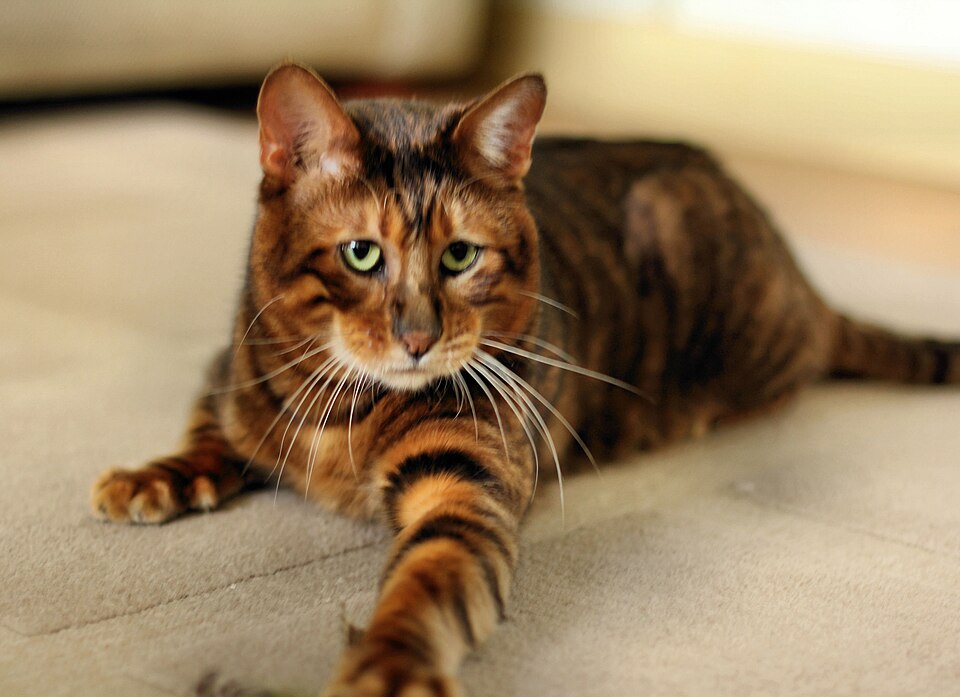
Known for its tiger-like stripes and glittering coat, but a fully domestic cat. It was developed from Bengals and striped house cats; it is not a wild-cat hybrid. Affectionate, playful and trainable; since it's a small breed, choosing the breeder matters.

 LifespanNo datawe found no breed-specific lifespan study
 Weight8–15 lb (3.6–6.8 kg)GCCF: female 8–12, male 10–15 lb
 OriginUSAdeveloped by Judy Sugden from the late 1980s
 CoatShort, plush, glitteredcomb once a week
 EnergyActivesmart, playful and trainable
 With kidsUsually goodif introduced young
 Other petsUsually finecat-friendly dogs too
 Alone timeHardseparation anxiety can develop (GCCF)
The Toyger is a house cat that resembles a tiny tiger: thick, swirling stripes on an orange ground, circular markings on the face and a rope-like tail. But it's a fully domestic cat, with Bengal in its ancestry and no direct crossing with a wild species. On this page we cover where the breed came from, its temperament and care, and what we do and don't know about its health.
- Temperament: Active, smart, playful and affectionate; according to the GCCF, separation anxiety can develop if it's left alone too much.
- Look: A short, plush, glittered coat; a "modified" mackerel tabby pattern with circular face markings.
- Not a wild cat: The line comes from the Bengal, but it rests on house-cat lines; even FIFe doesn't count it as a new breed based on a wild species.
- A small breed: Health information is limited; ask the breeder about the parents' health checks and the diversity of the pedigree.
- Registration: In Türkiye, microchipping and PETVET registration are mandatory for cats.
What to know
 What is the Toyger like?
According to the GCCF the Toyger is an active, intelligent, playful and affectionate cat. It generally gets along with other cats, cat-friendly dogs and children, especially when introduced young. It's easy to train; it can learn to fetch and get used to walking on a harness. It can develop separation anxiety if left alone for long periods.
The standard from the NSW Cat Fanciers Association describes the breed's purpose the same way: a dependable, quiet-tempered, laid-back, intelligent, easy-to-train-and-handle, athletic companion, designed with active cat ownership in a modern urban setting in mind.
Every cat is an individual. Breed traits describe general tendencies; the home it grows up in and its early contact with people shape its character at least as much as breed does. The Toyger standard describes a design goal; that doesn't mean every cat will have this temperament.
 Who is it a good fit for?
It suits families who are ready to play with their cat, train it and give it time, and who are home a lot or can keep it company.
| Situation | A good fit? |
|---|---|
| Apartment | Yes, but climbing spots and play are a must |
| Family with children | Usually (GCCF), especially if introduced young |
| Other cats and dogs | Usually fine; cat-friendly dogs too |
| Long hours alone | No; separation anxiety can develop |
| First-time cat owners | Possibly; take its energy and attention needs seriously |
Where does it come from?
According to the GCCF, the Toyger was developed in the USA by Judy Sugden, whose mother, Jean Mill, founded the Bengal breed. From the late 1980s Sugden worked to sharpen the markings of mackerel tabbies descended from Bengals and house cats; her goal was a tiger-like body, swirling stripes, circular facial markings and a calm house-cat temperament. The foundation cats included a striped domestic shorthair, a Bengal and a street cat from Kashmir named Jammu Blu, imported in 1993.
Recognition varies by organization:
- TICA: According to the GCCF the breed was accepted for registration in 1993, moved to new-breed exhibition classes in 2000 and gained full championship status in February 2007.
- GCCF: Recognized the breed in October 2015; it reached preliminary status in June 2016.
- FIFe: Keeps the Toyger on its list of non-recognized breeds (TGR non). FIFe states that the Toyger is an established breed based on the Bengal, not a new breed based on a wild species. Only Toygers with no other breed in their ancestry (the previous 4 generations) can be registered, and the only accepted variety is black (brown) mackerel tabby.
- NSW CFA (Australia): Publishes a detailed breed standard.
 Appearance and colors
The GCCF describes the Toyger as a medium-to-large, long, low-slung foreign-type cat with a muscular, athletic build. The tail is long, thick and rope-like; the head is long and broad; the ears are small and rounded. Females generally run 8 to 12 pounds (3.6 to 5.4 kg) and males 10 to 15 pounds (4.5 to 6.8 kg); the NSW CFA standard says females may be somewhat smaller and less muscular, and that well-muscled males may lack shoulder-to-neck definition.
- Coat: Short, thick, very soft, plush but resilient. The NSW CFA standard asks for "glitter": a shimmer on the hair tips that reflects the light.
- Pattern: A modified mackerel tabby: bold, braided vertical stripes on the body; circular markings on the face; dark backs of the ears with a light "thumbprint"; mascara- and lipstick-like dark markings; paw pads and tail tip black. The belly, inner legs and chest should be light.
- Colors: The GCCF recognizes three: brown (black) mackerel tabby, blue-eyed snow mackerel tabby and AOC-eyed snow mackerel tabby. FIFe accepts only black tabby.
- Eyes: Small to medium, round with gentle hooding; the color varies with coat color.
Daily care
Coat care is easy: according to the GCCF a light brushing and comb once a week removes loose hair and keeps the coat in good condition.
- Nails: A scratching post is a must; trim nails the way your vet shows you.
- Play and mind: An intelligent, athletic, trainable cat; give it toys, puzzle feeders, a climbing tree and daily hunting games. The GCCF says it can learn to fetch and to walk on a harness.
- Separation: Keep alone time short; consider a second cat or an enriched environment if needed.
More in our posts on play for indoor cats and why cats love high places.
 Diet and weight
We found no special diet recommendation for the Toyger. A balanced, complete cat food suited to its age and lifestyle is enough. Even though it's an active, muscular cat, measure the food, subtract treats from the daily amount, work out the daily amount with your vet and weigh your cat once a month.
 Health issues to know about
The information below is for general awareness; for diagnosis and treatment, talk to your veterinarian.
We found no source reporting a breed-specific disease in the Toyger; neither the GCCF's description nor the NSW CFA standard mentions health problems. The NSW CFA standard lists "excellent health and longevity" as part of the breed profile, but that is a goal, not a proven outcome. Keep in mind that the breed is small and may be under-researched. A 2025 review in the journal Animal Welfare points out that heavy inbreeding to establish breeds can lead to small gene pools and a greater tendency to disease. So ask the breeder:
- The health checks of the mother and father (including whether any heart screening was done).
- The diversity of the pedigree (is there close inbreeding?).
- Whether the kitten has had a vet check.
As with any cat, regular vet checkups for heart, kidney and dental health are a good start.
- Fast or open-mouth breathing
- Sudden weakness, limping or pain in the back legs
- Drinking or urinating a lot, loss of appetite or weight loss
- Hiding and reacting when touched (cats hide pain)
How long does it live?
We found no breed-specific lifespan study for the Toyger, so we're not giving a number. Ideal weight, regular vet checkups, neutering and a safe home affect lifespan the most. Having no number doesn't mean a cat will live a short or long life; there is simply no reliable figure for the breed. Asking about the parents' ages and health history when you get a kitten fills that gap to some degree. Regular checkups, vaccinations, parasite prevention, dental health and a calm, safe home are the foundation of care; ask your vet which checkups they recommend as your cat ages.
 Before you get one
- Consider a shelter too: Striped, short-coated house cats can turn up in shelters; they may not be as "tiger" as a Toyger, but lively, affectionate cats may be waiting there.
- If you buy from a breeder: Ask to see the parents; ask about health checks, the pedigree and vaccination records. Stay away from sellers who call any striped cat a "Toyger"; the Toyger standard asks for a detailed pattern and a glittering coat, so stripes alone aren't enough. Also avoid cats marketed as a "mini tiger" or a "wild-cat hybrid."
- Red flags: Sellers who won't show the mother, always have kittens, offer no paperwork or rush you to buy now.
- Legal registration: In Türkiye, microchipping and PETVET registration are mandatory for cats. Details in our PETVET registration and microchip post.
- First days: International Cat Care advises starting a new cat in a single room, leaving a hiding place it can retreat to and letting it come to you rather than forcing contact. Our first week with a new cat post walks you through it.
Frequently asked questions
Is the Toyger a wild cat or a hybrid?
No. The Toyger is a domestic cat. According to the GCCF it was developed from Bengal and striped house-cat lines; FIFe also sees it as an established breed based on the Bengal, not a new breed based on a wild species.
Are the Toyger and the Bengal the same?
No, they're relatives. The Toyger was developed by Judy Sugden, the daughter of Bengal founder Jean Mill; the Toyger has a "modified" mackerel tabby pattern of swirling vertical stripes, like a tiger.
What colors does it come in?
The GCCF recognizes three: brown (black) mackerel tabby, blue-eyed snow mackerel tabby and AOC-eyed snow mackerel tabby. FIFe accepts only black tabby.
Can it be left home alone?
The GCCF says separation anxiety can develop if it's left alone for long periods. Play, attention and an enriched environment are a must.
Does it get along with children and other pets?
According to the GCCF it generally does, especially if introduced young. Keep introductions supervised and slow.
How big does it get?
According to the GCCF females run 8 to 12 pounds (3.6 to 5.4 kg) and males 10 to 15 pounds (4.5 to 6.8 kg). Work out your own cat's ideal weight with your vet.
Sources
- GCCF (Governing Council of the Cat Fancy) · Toyger
- NSW Cat Fanciers Association · Toyger ırk standardı (Haziran 2024)
- FIFe (Fédération Internationale Féline) · Breeding and Registration Rules, 2026 baskısı (TGR non bölümü)
- Animal Welfare dergisi (2025) · A framework to refocus the conversation around the welfare of UK purebred cats
- International Cat Care · Helping your new cat or kitten settle in
- Resmî Gazete · Kedi, Köpek ve Gelinciklerin Kimliklendirilmesi ve Kayıt Altına Alınmasına Dair Yönetmelik (26 Şubat 2018)
By Tüylüm · Last checked: November 10, 2026. Compiled from the sources above and written in our own words. Spotted a mistake? Write to [email protected] and we'll fix it right away. Photo from Wikimedia Commons, used under the license shown below it.