 Tüylüm
Airedale Terrier
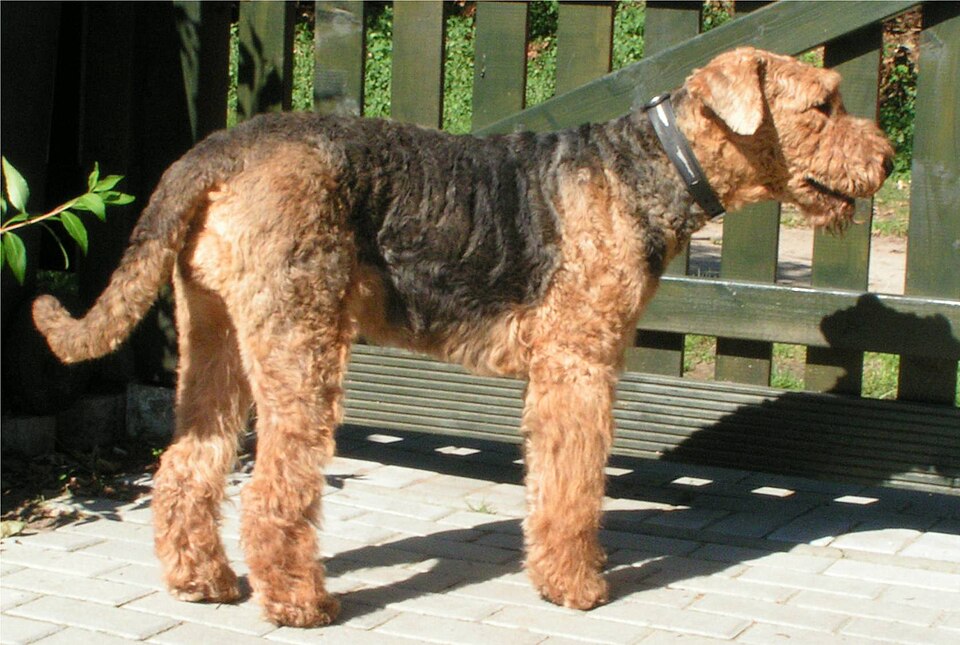
The largest of the terriers: a wire-coated, lively and intelligent dog bred for hunting along the riverbanks of Yorkshire. The FCI describes it as outgoing, confident, courageous and intelligent; breed-specific health data is limited, so hip and elbow screening and coat care stand out.

 Lifespan≈ 10+ yearsRKC: over 10 years; no breed-specific study found
 Height at shoulder22–24 in (56–61 cm)FCI: males 23–24, females 22–23 in
 OriginEnglandYorkshire, the Aire valley
 CoatWiryFCI: hard, dense, wiry; outer coat may be slightly waved
 SheddingLowRKC: listed as not shedding; daily grooming
 ExerciseModerateRKC: up to 1 hour a day
 IntelligenceHighFCI: intelligent, quick, alert
 Legal statusAllowednot on the banned list in circular 2021/48
The Airedale Terrier earns the nickname "King of Terriers" by being the largest of the terrier breeds. According to the FCI, the breed comes from Yorkshire; many "Waterside Terriers" from the valleys of the rivers Wharfe, Calder and Aire were exhibited at the Airedale Show, and the breed took its name from it. The FCI standard describes its character as lively, quick of movement and on the tiptoe of expectation: outgoing, confident, friendly, courageous and intelligent; alert at all times, not aggressive but fearless. We built this page from the FCI standard, the Royal Kennel Club and the AKC. An honest note: for the Airedale we found less breed-specific health research than for some other breeds, so the health section is general and short.
- Temperament: According to the FCI, lively, outgoing, confident, friendly, courageous and intelligent; not aggressive but fearless.
- Size: Males about 23–24 in (58–61 cm), females about 22–23 in (56–59 cm) (FCI). The standard gives no weight.
- Coat: Hard, dense and wiry; the Royal Kennel Club says it needs grooming every day and lists the breed as not shedding.
- Health: The Royal Kennel Club recommends hip and elbow screening for breeders; we found no other strong breed-specific data.
- Lifespan: The Royal Kennel Club says over 10 years; we couldn't find a solid breed-specific lifespan study.
What to know
 What is the Airedale Terrier like?
The FCI standard describes the Airedale's character as shown by the expression of the eyes and the carriage of the ears and erect tail: a keen, lively dog ready to move at any moment, outgoing, confident, friendly, courageous and intelligent; alert at all times, not aggressive but fearless. The AKC also calls the breed versatile, excelling as a hunter, an athlete and a companion, and says its size, strength and determined spirit earned it the nickname "King of Terriers."
With a terrier temperament, patient, consistent training is a must. It can be a dog that likes to make its own decisions and take off after something interesting; recall practice and a safe area matter. The Royal Kennel Club says the breed gets by on up to an hour of exercise a day but wants a large house and garden.
Every dog is an individual. Breed describes what a dog was bred for; it can't tell you how a particular dog will turn out. The parents' temperament, early experiences and training matter at least as much as breed.
 Who is it a good fit for?
The Airedale Terrier suits people who can give daily walks, play and mental work, make time for regular coat care and train consistently.
| Situation | Good fit? |
|---|---|
| Apartment | Hard; the Royal Kennel Club suggests a large house and garden |
| House with a yard | Good; a solid fence and daily exercise |
| Family with kids | The FCI says friendly; children and dogs should never be left unsupervised together |
| Home with other dogs or small pets | Careful introductions; it has a hunting background |
| First-time dog owners | Possible, but be ready for the training and coat care |
| People who are away for long hours | Hard; an intelligent, lively dog, and a bored one can develop behavior problems |
| Home with frequent guests | Can be a fit; friendly but alert |
Where does it come from?
According to the FCI, the Airedale Terrier is a native of Great Britain, from the county of Yorkshire. Many "Waterside Terriers" from the valleys of the rivers Wharfe, Calder and Aire were entered in the Airedale Show, and the breed took its name from the show. The FCI says it's the largest of all the terrier breeds, encompasses all the characteristics of the group and is also known as the "King of Terriers." The standard also describes the breed's remarkable scenting powers, its use for tracking in Africa, India and Canada, its aid to the Red Cross in times of war and its service with police and armed forces in both Britain and Russia.
The Royal Kennel Club also says the breed began with enthusiasts meeting to "show" their terriers at the Airedale Show in the area around Ilkley, that it was known as the Waterside Terrier because it worked the riverbanks to keep down vermin, and that it was used by the armed forces in the World Wars; its scenting powers led to its use as a tracking dog, a messenger dog in the trenches and a pack dog with the Red Cross.
Appearance and colors
According to the FCI, it's the largest of the terriers: a muscular, active, fairly cobby dog, with neither long legs nor an overlong body. The head is well balanced, the skull long and flat, the stop hardly visible and the nose black. In stance, the tail is set high and carried gaily.
- Height: Males about 23–24 in (58–61 cm), females about 22–23 in (56–59 cm) (FCI). The standard gives no weight.
- Coat: Hard, dense and wiry; the outer coat is hard, wiry and stiff, and the undercoat shorter and softer. The hardest coats are crinkling or just slightly waved; a curly or soft coat is highly undesirable.
- Color: The saddle on the body and top of the neck are black or grizzle (grey-brown mix), as is the top surface of the tail; all other parts are tan. The ears are often a darker tan, and a few white hairs between the forelegs are acceptable.
- Tail: Previously customarily docked. Docked or undocked, it's set on high and carried gaily; the FCI standard describes both.
In Türkiye, article 8 of Animal Protection Law no. 5199 bans cutting a pet's tail or ears to change its appearance or for any other non-therapeutic reason; where a veterinarian has a medical reason, that's treated separately. Rules vary by country.
Daily care
The Royal Kennel Club says the breed needs grooming every day and doesn't shed. A hard, wiry coat needs regular brushing and combing, and regular shaping. Talk with a groomer about the right method for the coat type (hand stripping or clipping) and how often. A beard holds food and water; wiping the face after meals is good for hygiene. See our dog grooming guide for general methods.
- Nails: Trim them regularly.
- Ears: Check the hair in and around the ears; look for dirt and redness.
- Teeth: Brush often with a toothpaste made for dogs.
- Hot weather: Shade, plenty of water and exercise during cool hours in summer. Our article on dogs in hot weather covers the warning signs.
Training and exercise
The Royal Kennel Club says up to an hour of exercise a day; given its terrier makeup, let that include sniffing and mental work as much as running and play. The FCI says it's intelligent and quick; in other words it learns, but finds its own fun when bored. Work with rewards and short, upbeat sessions.
- Early socialization: As a puppy, give it short, positive meetings with different people, children, sounds, vehicles and calm dogs, and keep this up through the first year.
- Recall: With a hunting terrier's drive it may chase when off leash; in a safe area, practice coming when called with rewards, often. Our guide to recall training explains it step by step.
- Leash manners: Walking without pulling matters. See our guide to loose-leash walking.
- Mind and play: Sniffing games, reward-based trick training and agility are good outlets.
- Vet prep: Use rewards early on to get it comfortable with being handled and having its mouth, ears and paws checked.
 Diet and weight
We have no source saying the Airedale Terrier needs a special food; a balanced dog food suited to its age is the basis. Talk with your vet about the type of food and the amount.
- Watch the weight: If you can feel the ribs under a thin layer of fat and see a waist from above, the weight is about right.
- Treats: In reward-based training, count treats as part of the daily meals.
Also check our list of foods that are dangerous for dogs.
 Health issues to know about
The Royal Kennel Club says no breed-specific points of concern have been identified for the Airedale under Breed Watch (Category 1), and recommends elbow and hip dysplasia screening for breeders. We couldn't find a solid breed-specific disease study, so we're not writing anything we can't back up. The information below is for awareness only; ask your vet about diagnosis and treatment.
Hips and elbows
Hip and elbow dysplasia mean the joints don't fit together properly and cause problems over time. That's why the Royal Kennel Club's screening (the BVA/RKC hip and elbow schemes) matters. Limping, trouble getting up and avoiding stairs can be signs. When choosing a puppy, ask for the parents' hip and elbow results.
Skin, ears and coat
In wire-coated breeds, skin and ear problems are closely tied to coat care. If you notice itching, redness, constant ear scratching or a bad smell, show your vet.
General checkups
As dogs age, signs such as lumps, weight loss or changes in appetite or drinking can appear; a vet checkup at least once a year as it gets older is a good habit for any breed.
- Sudden limping or an obvious change in gait
- A rapidly growing lump
- Severe itching, redness, skin sores or a bad smell from the ears
- Redness, squinting or cloudiness in the eye
- Repeated vomiting, diarrhea or loss of appetite
- Fast, labored breathing or stumbling in the heat
How long does it live?
The Royal Kennel Club says "over 10 years" for the Airedale Terrier. That's a broad range, and we couldn't find a solid breed-specific lifespan study, so we're not giving a single number.
The honest summary: a puppy from screened parents, a healthy weight and regular vet checkups are the most concrete steps.
 Before you get one
- Consider a shelter: Purebred and terrier-type dogs end up in shelters too. Seeing an adult's temperament up front is an advantage. Our guide to adopting a dog from a shelter walks you through it.
- If you buy from a breeder: Meet the parents in person and make sure they're calm and steady. Ask for hip and elbow screening results. Ask for the inbreeding coefficient too.
- Red flags: Sellers who show no health records or test results; promises of a "rare color"; sellers who won't show you the mother.
- Time and budget: Coat care (a groomer), training, food and vet costs are a commitment of years.
- Registration: Rules vary by country. In Türkiye, owned dogs must be microchipped and registered; for puppies, a declaration is made within three months of birth. Details are in our article on PETVET registration and microchips.
Frequently asked questions
Is the Airedale Terrier banned in Türkiye?
No. Law no. 5199 bans breeding and owning animals the Ministry has designated as "posing a danger" (article 14/l), and the Airedale Terrier isn't among the six breeds named in the Ministry's 2021 circular. Rules can change, so check the current situation with your provincial or district agriculture directorate. Rules vary by country.
Why is it called the "King of Terriers"?
The FCI and the Royal Kennel Club say it's the largest of the terrier breeds and carries all the characteristics of the group; the AKC says its size, strength and determined spirit earned the nickname.
Does it shed?
The Royal Kennel Club lists the breed as not shedding; a wiry coat sheds little but needs regular grooming and shaping. No dog is completely "hypoallergenic."
Is it good in a home with children?
The FCI says friendly; but it's a lively, strong dog, and children and dogs should never be left unsupervised together.
Can it live in an apartment?
The Royal Kennel Club suggests a large house and garden; life in an apartment is hard and depends on regular, long outdoor exercise.
Sources
- FCI · Airedale Terrier breed standard (No. 7)
- The Royal Kennel Club · Airedale Terrier breed page (history, care, health screening)
- AKC (American Kennel Club) · Airedale Terrier breed profile
- Türkiye legislation database · Animal Protection Law no. 5199, current text (article 8, in Turkish)
- Türkiye Ministry of Agriculture and Forestry · Circular on animals posing a danger (2021/48, in Turkish)
- Resmî Gazete (Türkiye) · Regulation on the identification and registration of cats, dogs and ferrets (February 26, 2018)
By Tüylüm · Last checked: November 10, 2026. Compiled from the sources above and written in our own words. Spotted a mistake? Write to [email protected] and we'll fix it right away. Photo from Wikimedia Commons, used under the license shown below it.