 Tüylüm
Standard Schnauzer
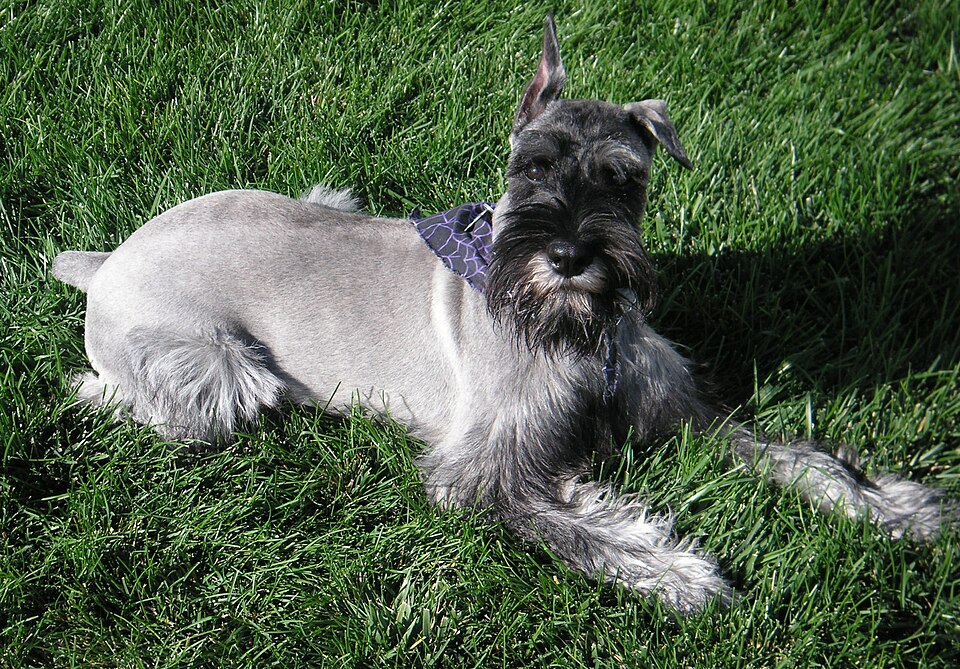
The middle and original size of the three schnauzers: a medium-sized, wire-coated, cheerful and loyal family dog descended from a German stable ratter. The FCI says it loves children and is alert without being noisy; it needs daily exercise, regular coat care and early socialization.

 Lifespan≈ 10+ yearsRKC: over 10 years; no breed-specific study found
 Weight31–44 lb (14–20 kg)FCI standard
 Height at shoulder18–20 in (45–50 cm)FCI: same range for males and females
 OriginGermanya stable and ratting dog
 CoatWiryFCI: wiry, harsh, dense; distinct beard and brows
 ExerciseModerateRKC: up to 1 hour a day
 With childrenLoves themFCI: loves children, playful
 TrainingEasyFCI: intelligent and trainable
The Standard Schnauzer is the middle size and the original of the schnauzer family: neither miniature nor giant. The Royal Kennel Club describes it as the original variety of the breed; the name means "whiskered snout" in German and points to the harsh coat and bristly beard. According to the FCI, it was once a stable dog living among horses, and it got the nickname "Rattler" (ratter) for killing rodents in a flash. The standard describes its temperament as lively with placid composure, good-natured, playful and proverbially devoted to its master; it loves children and is alert but not noisy. We built this page from the FCI standard, the Royal Kennel Club and two published genetic studies of the breed. One thing to say up front: we found less health data on the Standard Schnauzer than on the Miniature or Giant, so the health section is short.
- Temperament: According to the FCI, lively with placid composure, good-natured, playful and devoted to its master; loves children, alert but not noisy.
- Size: 18–20 in (45–50 cm) and 31–44 lb (14–20 kg) (FCI); the same range for males and females.
- Coat: Wiry, harsh and dense; black or pepper-and-salt. The Royal Kennel Club says it needs grooming more than once a week.
- Health: Little breed-specific health research; a gene test relates to a hereditary brain disease in puppies (leukodystrophy), and the Royal Kennel Club also lists heart muscle disease (DCM) and hip screening.
- Lifespan: The Royal Kennel Club says over 10 years; we couldn't find a solid breed-specific lifespan study.
What to know
 What is the Standard Schnauzer like?
The FCI standard names the Standard Schnauzer's typical characteristics as a lively temperament coupled with placid composure, good nature and playfulness, and proverbial devotion to its master. It loves children, it's incorruptible, and alert yet not noisy. Highly developed senses, intelligence, trainability, fearlessness, endurance and resistance to weather and disease give it the makings of an outstanding family, guard and companion dog, also endowed with the qualities of a working dog.
The Royal Kennel Club says up to an hour of exercise a day and grooming more than once a week, and lists it as a dog that can live in a small house. With its ratting and farm background it enjoys play and sniffing jobs; if bored, behaviors like digging and barking can appear. Our article on why dogs bark explains the causes.
Every dog is an individual. Breed describes what a dog was bred for; it can't tell you how a particular dog will turn out. The parents' temperament, early experiences and training matter at least as much as breed.
 Who is it a good fit for?
The Standard Schnauzer suits people who can give daily walks and play, make time for regular coat care and spend lots of time with their dog. The Royal Kennel Club lists it as a dog that can live in a small house with a small or medium garden.
| Situation | Good fit? |
|---|---|
| Apartment | Possible; regular daily walks and play are a must |
| House with a yard | Good |
| Family with kids | The FCI says it loves children; children and dogs should still never be left unsupervised together |
| Home with other dogs | Careful introductions and early socialization are needed |
| First-time dog owners | Possible; be ready for the grooming and training |
| People who are away for long hours | Hard; a people-bonded, alert dog |
| Home with frequent guests | Possible; alert but not noisy (FCI) |
Where does it come from?
According to the FCI, the Standard Schnauzer comes from Germany and was originally used in the south of the country as a stable dog; it felt particularly at home in the company of horses and eagerly watched for rodents to kill in a flash. That earned it the nickname "Rattler" (ratter) very early. When the Pinscher-Schnauzer Club was founded in 1895, it was entered as the "rough haired Pinscher." The Royal Kennel Club says the breed has been known in Germany since at least the 14th century, that the word "schnauzer" means "whiskered snout" and describes the harsh coat, bristly whiskers and beard, and that the name came from the dog that won the first class for wirehaired pinschers in 1879; developed as a vermin killer, the breed also proved itself in herding livestock and pulling small carts.
According to the Royal Kennel Club, this is the original variety of the breed. The other two members of the family are the Miniature Schnauzer and the Giant Schnauzer; the three are treated as separate breeds, and the differences are mainly size.
Appearance and colors
According to the FCI, it's a medium-sized, strong, stocky rather than slim, rough-haired dog. The build is square, with height at the withers nearly equal to body length. The ears are drop ears set high, V-shaped, with inner edges lying close to the cheeks; the tail is natural, with a sabre or sickle carriage sought after.
- Height and weight: 18–20 in (45–50 cm) and 31–44 lb (14–20 kg) (FCI).
- Coat: Wiry, harsh and dense: a dense undercoat and a not-too-short topcoat. Short on the forehead and ears; a not-too-soft beard on the muzzle and bushy eyebrows that shade the eyes are typical. The hair on the limbs is less harsh.
- Color: Pure black with black undercoat, or pepper and salt (dark iron grey to silver grey); both need a dark mask, and distinct light markings on the head, chest and limbs are undesirable.
- Ears and tail: The FCI standard describes drop ears and a natural tail.
In Türkiye, article 8 of Animal Protection Law no. 5199 bans cutting a pet's tail or ears to change its appearance or for any other non-therapeutic reason; where a veterinarian has a medical reason, that's treated separately. In some countries you may see Schnauzers with cropped ears; in Türkiye and in the FCI standard, natural ears and tail are the norm. Rules vary by country.
Daily care
The Royal Kennel Club says the breed needs grooming more than once a week and sheds. A wiry coat is managed with brushing and combing; the beard and leg hair can mat. Talk with a groomer about shortening or shaping the coat: they can tell you the right method for the coat type (hand stripping or clipping). A beard holds food and water; wiping the face after meals is good for hygiene. See our dog grooming guide for general methods.
- Nails: Trim them regularly.
- Ears: Drop ears can trap dirt and moisture; check them.
- Teeth: Brush often with a toothpaste made for dogs.
- Hot weather: Shade, plenty of water and exercise during cool hours in summer. Our article on dogs in hot weather covers the warning signs.
Training and exercise
The Royal Kennel Club says up to an hour of exercise a day. The FCI lists intelligence and trainability among the breed's core traits; work with rewards and short, upbeat sessions. With its ratter background it may chase small animals; leash and recall practice matter in open areas.
- Early socialization: As a puppy, give it short, positive meetings with different people, children, sounds, vehicles and calm dogs, and keep this up through the first year.
- Basic cues: Come, wait, drop it and walking without pulling.
- Barking: It's an alert breed; the FCI wants it not to be noisy. If barking increases, find the cause: why dogs bark.
- Mind and play: Sniffing games, reward-based trick training and agility are good outlets.
- Vet prep: Use rewards early on to get it comfortable with being handled and having its mouth, ears and paws checked.
 Diet and weight
We have no source saying the Standard Schnauzer needs a special food; a balanced dog food suited to its age is the basis. Talk with your vet about the type of food and the amount.
- Watch the weight: If you can feel the ribs under a thin layer of fat and see a waist from above, the weight is about right.
- Treats: In reward-based training, count treats as part of the daily meals.
Also check our list of foods that are dangerous for dogs.
 Health issues to know about
Health in the Standard Schnauzer has been studied less than in the Miniature or Giant Schnauzer. The information below is for awareness only; ask your vet about diagnosis and treatment.
A hereditary brain disease in puppies (leukodystrophy)
A 2019 study (Stork et al.) reported a hereditary brain disease in Standard Schnauzer puppies that starts shortly after birth or before four weeks of age, with signs such as apathy, unsteady gait, tremor, head tilt, circling and seizures. The disease, in which the white matter of the brain makes markedly less myelin (the nerve sheath), was linked to a change in the TSEN54 gene; all 12 affected Standard Schnauzers studied carried the change in both copies. Since the gene change is known, breeders can in principle identify carriers; when choosing a puppy, ask the breeder whether any affected puppies have appeared in the pedigree and whether testing has been done.
Heart muscle disease (DCM) and hips
The Royal Kennel Club lists a DNA test for dilated cardiomyopathy (DCM, a weakening and enlargement of the heart muscle) and hip dysplasia screening for the breed. If you notice tiring easily, coughing, fast breathing or fainting, show your vet.
Pancreas and digestion
The study by Furrow and colleagues reported that a particular variant in the SPINK1 gene is very common in both Miniature and Standard Schnauzers (allele frequency 0.55 in Standards, 0.77 in Miniatures), and that among Miniature Schnauzers there was no difference between those with and without pancreatitis, so the variant didn't raise the risk. In other words, this gene change is common in the breed but isn't a risk marker on its own. Still, show your vet digestive signs such as vomiting, loss of appetite or belly pain.
- In a puppy, seizures, tremor, unsteady gait or head tilt shortly after birth
- Tiring easily, coughing, labored breathing or fainting
- Repeated vomiting, belly pain or loss of appetite
- Sudden limping or an obvious change in gait
- Cloudiness, redness or squinting in the eye
- Fast, labored breathing or stumbling in the heat
How long does it live?
The Royal Kennel Club says "over 10 years" for the Schnauzer (Standard). That's a broad range, and we couldn't find a solid breed-specific lifespan study, so we're not giving a single number.
The honest summary: a puppy from screened parents, a healthy weight and regular vet checkups are the most concrete steps.
 Before you get one
- Consider a shelter: Purebred and schnauzer-type dogs end up in shelters too. Our guide to adopting a dog from a shelter walks you through it.
- If you buy from a breeder: Meet the parents in person and make sure they're calm and steady. Ask about leukodystrophy (TSEN54) and DCM testing and hip screening. Ask for the inbreeding coefficient too.
- Three separate breeds: Don't mix up the Standard Schnauzer with the Miniature and Giant; size and needs differ.
- Red flags: Sellers who show no health records or test results; promises of a "rare color"; sellers who won't show you the mother.
- Registration: Rules vary by country. In Türkiye, owned dogs must be microchipped and registered; for puppies, a declaration is made within three months of birth. Details are in our article on PETVET registration and microchips.
Frequently asked questions
Is the Standard Schnauzer banned in Türkiye?
No. Law no. 5199 bans breeding and owning animals the Ministry has designated as "posing a danger" (article 14/l), and the Schnauzer isn't among the six breeds named in the Ministry's 2021 circular. Rules can change, so check the current situation with your provincial or district agriculture directorate. Rules vary by country.
What's the difference between the Standard and Miniature Schnauzer?
According to the FCI, the Standard Schnauzer stands 18–20 in (45–50 cm) and weighs 31–44 lb (14–20 kg) and is its own breed. The Royal Kennel Club describes the Standard as the original variety of the breed. For the smaller one, see our Miniature Schnauzer page.
Is it good in a home with children?
The FCI says it loves children; but children and dogs should never be left unsupervised together. Our article on kids and dogs at home covers the ground rules.
Does it shed a lot?
The Royal Kennel Club says it sheds and needs grooming more than once a week.
Does it bark a lot?
The FCI wants it alert but not noisy. Every dog is different, though; see our article on why dogs bark to understand the cause.
Sources
- FCI · Schnauzer (Standard Schnauzer) breed standard (No. 182)
- The Royal Kennel Club · Schnauzer (Standard) breed page (history, care, health screening)
- Stork et al. · TSEN54 missense variant in Standard Schnauzers with leukodystrophy, PLoS Genetics (2019)
- Furrow, Armstrong, Patterson · High prevalence of the c.74A>C SPINK1 variant in miniature and standard Schnauzers, Journal of Veterinary Internal Medicine (2012)
- Türkiye legislation database · Animal Protection Law no. 5199, current text (article 8, in Turkish)
- Türkiye Ministry of Agriculture and Forestry · Circular on animals posing a danger (2021/48, in Turkish)
- Resmî Gazete (Türkiye) · Regulation on the identification and registration of cats, dogs and ferrets (February 26, 2018)
By Tüylüm · Last checked: November 10, 2026. Compiled from the sources above and written in our own words. Spotted a mistake? Write to [email protected] and we'll fix it right away. Photo from Wikimedia Commons, used under the license shown below it.