 Tüylüm
Catalburun (Turkish Pointer)
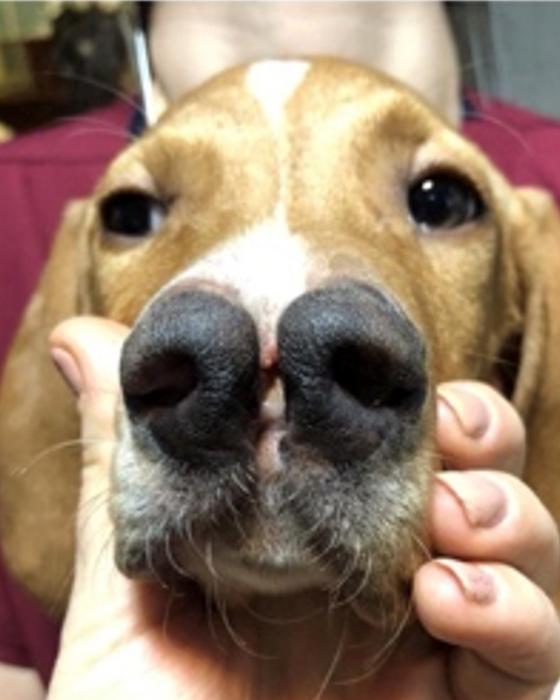
A medium-sized hunting dog from the Tarsus area of Mersin whose nose tip looks split down the middle. It's known for its scenting ability and for pointing game, and it's reported to be calm and gentle with people. It's a rare native breed under protection in Türkiye.

 Lifespan≈ 10–13 yearsfigure from a Turkish review; no large data
 Weight≈ 44–52 lb (20–24 kg)average of 100 dogs: 44.5 lb (20.2 kg)
 Height at shoulder≈ 18.5–20 in (47–51 cm)males slightly larger
 OriginTarsus (Mersin)known locally since the 1930s
 CoatShort, smoothmost often brown and white
 EnergyActivebred to track and point game
 With kidsReported to do wellstill always supervise
 TrainingTrainablehas also been trained to detect narcotics
The Catalburun is a medium-sized, short-coated hunting dog bred in and around Tarsus, a district of Mersin in southern Türkiye. Its name means "fork nose": the tip of the nose looks as if it's split down the middle. Hunters also call it the "Turkish Pointer," because it finds game and freezes to point it out. It's rare and is one of the native breeds Türkiye's Ministry of Agriculture protects. On this page we've brought together research from Turkish veterinary schools and a 2025 international study on the genetics of its split nose.
- Temperament: According to studies, usually calm, quiet and gentle with people and children; not much of a watchdog.
- Talent: Excellent at tracking scent and at finding and flushing game; it has also been trained as a narcotics detection dog.
- Activity: A hunting dog that needs long daily walks, sniffing games and runs in a safe area.
- Split nose: A 2025 study linked the split to a change in the PDGFRA gene, which also plays a role in palate closure; watch for nursing problems in puppies.
- Legal: In Türkiye, microchipping and PETVET registration are mandatory, and taking a Catalburun out of the country requires prior approval from the Ministry.
What to know
 What is the Catalburun (Turkish Pointer) like?
According to a 2014 study by Ograk and colleagues at Cumhuriyet University, hunters favor the Catalburun for its intelligence, its ability to stay quiet for long periods and its success at tracking. The same study reports that when kept as a pet it is calm and barks very little, and that it isn't known to bite or injure children.
A 2012 review by Petek and Dincel of Uludag University paints a similar picture: the Catalburun is a social dog that easily gets along with people outside the household, especially children. It isn't much of a watchdog, though: in one study cited in the review, 38% of males and 36% of females did a good job guarding the house, and the dogs were more alert and likely to bark at strangers at night. In another study cited in the review, 94% of the dogs showed no aggression; the authors stress that aggression depends on how a dog is raised as well as on heredity.
As a hunting dog, the Catalburun lives in a world of scents; keeping it on leash in areas that aren't secure is the safest choice.
Every dog is an individual. Breed traits describe general tendencies; how a puppy is raised, how well it gets to know people and its health shape its temperament at least as much as its breed.
 Who is it a good fit for?
The Catalburun suits owners who enjoy spending time outdoors and can offer their dog long walks and plenty of sniffing every day. Its medium size and calm manner at home make it a good match for houses with yards and active families.
| Situation | Good fit? |
|---|---|
| House with a yard | Yes; the fence must be secure |
| Apartment | Possible, with long daily walks and sniffing games |
| Family with kids | Reported to do well; still always supervise |
| Looking for a watchdog | No; its guarding ability is weak |
| Cats and backyard poultry | Be careful; it's a hunting dog |
| First-time dog owners | Possible, for someone who can meet its daily need for activity |
A hunting dog left alone all day without exercise can get bored. If you work long hours, consider finding someone to walk the dog during the day.
Where does it come from?
The Catalburun is a hunting dog native to Tarsus and the surrounding area in Mersin Province. According to Ograk and colleagues, it has been bred in Tarsus since the 1930s, and its numbers were thought to be around 200. The 2012 review by Yilmaz and Ertugrul also notes that its numbers are shrinking.
There are different views on the breed's origins. According to the review by Petek and Dincel, local folklore holds that Kitmir, the dog in the story of the Seven Sleepers, was a Catalburun, and a 17th-century oil painting in the Louvre is said to show a fork-nosed hunting dog. The review also notes that the Catalburun looks very much like the Pachón Navarro, a split-nosed hunting dog from Spain.
A 2025 international genetic study published in Genome Research (Buckley et al.) found that in the Catalburun, the stretch of DNA linked to the split nose is very similar to that of spaniels and setters, which have Spanish origins. The researchers think the trait may have arisen in Western Europe or on the Iberian Peninsula, and note that Türkiye and Spain were both under Umayyad rule in the 8th century, a possible route for cultural exchange. A split-nosed hunting dog also appears in a 1623 painting by Rubens and Brueghel, so this unusual nose has caught artists' eyes for at least 400 years.
Where things stand today
According to the 2012 review by Petek and Dincel, the breed isn't listed by international kennel clubs, and uncontrolled breeding has caused many dogs to lose their breed traits. A breeding colony of dogs closest to the original type was set up through the work of Istanbul University's veterinary school and the Tarsus municipality. The authors of a 2021 genetic study of 100 dogs (Ozarslan et al.) found that the dogs come from two closely related lines and that some measures of genetic diversity are low, and they stress that the breed needs protection as soon as possible. The Ministry's 2022 instructions list the "fork-nosed hunting dog" among breeds whose genetic resources are protected.
Appearance and colors
The Catalburun is a medium-sized, muscular, short-coated hunting dog. Its most distinctive feature is the moist tip of its nose, which looks as if it's split into two parts.
- Height and weight: In the 2021 study of 100 dogs, the average weight was 44.5 lb (20.2 kg) and the average height at the shoulder 19 in (48.2 cm). According to the review by Yilmaz and Ertugrul, males average 52 lb (23.6 kg) and 19.8 in (50.3 cm), and females 45 lb (20.3 kg) and 18.5 in (46.9 cm). In a 2014 study of 22 dogs in Tarsus and Adana, the average height at the shoulder was 20 in (50.8 cm).
- Coat: Short, smooth and normal in texture.
- Color: According to Ograk and colleagues, it can come in various colors, but it's usually yellowish brown to black markings on a white base. According to the review by Petek and Dincel, brown and white is the most common color in males, while brown and white and solid brown are most common in females.
- Eyes and nose: According to the review, the eyes are mostly honey-colored and the nose brown; black-coated dogs have black noses and eyes.
- Skin: The skin looks loose on the body but is very elastic when you hold it; the review describes this as a breed trait.
How it works in the field
According to studies cited by Petek and Dincel, once a Catalburun finds game, it stops and shows the hunter where it is without flushing it (pointing). Ninety percent of males point by freezing and 86% by lifting a front paw, and every dog shows at least one of the two. Most dogs can follow scent both on the ground and in the air. According to the review, Catalburuns have also been trained as narcotics detection dogs through a program run by Türkiye's General Directorate of Security and the Tarsus municipality.
Daily care
Thanks to its short, smooth coat, the Catalburun is easy to groom; brushing once a week with a rubber brush is usually enough. What needs the most attention, in a dog that runs in the field, are its ears, paws and skin.
- Ears: Check the drop ears once a week, and show your vet any odor, redness or scratching.
- Paws and skin: After walks in the countryside, check the paws, legs and skin for thorns, cuts and ticks.
- Nose: We didn't find any information suggesting the split nose needs special care. Show your vet any sore, scab, bleeding or constant discharge on the nose.
- Nails: In dogs that don't walk much on hard ground, nails can overgrow; check them once a month.
Training and exercise
The Catalburun was bred to search for and find game, and it needs long daily walks, chances to sniff and mental work. These needs don't go away just because it isn't used for hunting. Sniffing games suit this breed very well: finding hidden treats, following a trail and hide-the-toy.
The fact that it can be trained as a narcotics detection dog shows it's open to learning with the right methods. Short, consistent, reward-based sessions work best.
- Recall: The most important cue for a hunting dog that gets absorbed in scents. Practice first indoors, then in a fenced area on a long training line. Our article on teaching a dog to come when called walks you through it.
- Leash walking: Walking a dog that pulls toward every scent can be tiring. Loose-leash walking makes walks easier.
- Scent work: Set up small search games at home and in the yard; they satisfy its hunting instinct safely.
- Socialization: As a puppy, give it positive experiences with different people, children, sounds and calm dogs.
 Diet and weight
The Catalburun doesn't need a special food; a complete, balanced dog food suited to its age and activity level is enough. A dog that runs a lot during hunting season and one that spends most of its time at home have different needs; set the daily amount with your vet based on how active the dog is.
- Count treats as part of the daily food; use some of its kibble as rewards in sniffing games.
- If you can feel the ribs under a thin layer of fat, its weight is good.
- Bring water on walks and hunts.
Be careful with table scraps and bones; take a look at our list of foods that are dangerous for dogs.
 Health issues to know about
We couldn't find a comprehensive health study specific to the Catalburun. The information below is for awareness only; ask your vet about diagnosis and treatment.
The split nose and the palate
In a 2025 study in Genome Research (Buckley et al.), the Catalburun's split nose was linked to a change in a gene called PDGFRA. All three Catalburuns whose genomes were sequenced carried one copy of this change, and 13 of 14 additional dogs tested were also single-copy carriers. The researchers think the gene plays a role in closing the midline of the face and the palate, and that changes like this can be tolerated when only one copy is present. The study also notes that the Pachón Navarro, another split-nosed breed from Spain, is prone to cleft palate.
We couldn't find a study showing how often cleft palate occurs in the Catalburun. According to the University of Illinois College of Veterinary Medicine, puppies with a cleft palate may be thinner or smaller than their littermates, may cough while trying to nurse, and may have milk around their nostrils after nursing. Milk getting into the lungs can cause a life-threatening pneumonia. If you see these signs in a newborn puppy, get to a vet without delay.
Everyday risks for hunting dogs
A hunting dog running in the field is more exposed to thorns, cuts, paw injuries, ticks and other external parasites. Set up a parasite prevention plan with your vet, and check the dog after every walk.
- In a puppy: coughing while nursing, milk coming from the nose, failure to gain weight
- Fast or labored breathing, coughing and weakness
- Sudden limping or a deep cut on a paw
- Bleeding from the nose that won't stop, or a sore that's growing fast
How long does it live?
We couldn't find a large study of the Catalburun's lifespan. The 2012 review by Petek and Dincel gives an average of 10–13 years for the breed, but doesn't say what data it's based on, so it's best treated as a rough range rather than a firm figure.
The most practical tools you have for a longer life: regular vet checkups, a healthy weight, staying on top of vaccines and parasite prevention, and keeping preventable risks such as escapes, traffic and injuries during walks or hunts to a minimum.
 Before you get one
- Consider adoption: Hunting dogs and their mixes also turn up in adoption listings. Our guide to adopting a shelter dog explains the process.
- If you buy from a breeder: Because the breed is rare, it's very important to meet both parents and confirm that they show the breed's traits and are healthy. Ask whether the puppies nursed without problems.
- Relatedness: In a breed with few dogs, the risk of inbreeding goes up; ask the breeder whether the parents are related.
- Preparation: A secure fence, a sturdy collar and leash, an ID tag and some scent toys.
- Registration: Rules vary by country. In Türkiye, owned cats and dogs must be microchipped and registered in the PETVET system; see our article on PETVET registration and microchips.
The Ministry's 2022 instructions list the fork-nosed hunting dog among the breeds whose genetic resources are protected and whose departure from Türkiye requires prior approval. Under a 2012 regulation, applications go to the provincial directorate, and a commission assesses the dog's breed. Rules can change, so check with the provincial or district directorate of agriculture well before you travel.
Frequently asked questions
Why does the Catalburun's nose look split?
A 2025 genetic study linked this trait to a change in a gene called PDGFRA, which plays a role in the development of the midline of the face and the palate. The split nose is the breed's best-known feature.
Does the split nose affect the dog's health?
We didn't find a study reporting a health problem with the nose itself. But because the related gene also plays a role in closing the palate, and a similar split-nosed Spanish breed is known to be prone to cleft palate, it's worth watching newborn puppies for nursing problems.
Is the Catalburun a good family dog?
According to studies, it's usually calm, quiet and able to get along well with children. But it's a hunting dog and needs long daily walks and sniffing games.
Is the Catalburun a good watchdog?
Not really. According to a study cited in one review, only about a third of the dogs did a good job guarding the house.
Is the Catalburun the same breed as the Pointer?
No. Hunters call it the "Turkish Pointer" because of how it points out game, but the Catalburun is a separate native breed from Tarsus and, according to a 2012 review, isn't listed by international kennel clubs.
Sources
- Yılmaz ve Ertuğrul · Türkiye yerli köpek ırk ve tipleri, Iğdır Üniversitesi Fen Bilimleri Enstitüsü Dergisi (2012)
- Oğrak ve ark. · Tarsus Çatalburun ırkı Türk av köpeklerinin bazı morfolojik özellikleri, Eurasian Journal of Veterinary Sciences (2014)
- Petek ve Dinçel · Çatalburun köpekleri ve ırk özellikleri, Uludağ Üniversitesi Veteriner Fakültesi Dergisi (2012)
- Özarslan ve ark. · Evaluation of some morphological and genetic characteristics of Çatalburun dog breed, Turkish Journal of Veterinary and Animal Sciences (2021)
- Buckley ve ark. · Analysis of canine gene constraint identifies new variants for orofacial clefts and stature, Genome Research (2025)
- University of Illinois College of Veterinary Medicine · Palatal defect afflicts pets too
- Tarım ve Orman Bakanlığı · Kedi ve köpeklerin yurt dışına yolcu beraberi ve ticari sevklerine ilişkin uygulama talimatı (2022)
- Mevzuat Bilgi Sistemi · Yerli Evcil Hayvan Genetik Kaynaklarının Kullanılması ve Yurt Dışına Çıkarılması Hakkında Yönetmelik (2012)
By Tüylüm · Last checked: November 3, 2026. Compiled from the sources above and written in our own words. Spotted a mistake? Write to [email protected] and we'll fix it right away. Photo from Wikimedia Commons, used under the license shown below it.