 Tüylüm
English Pointer
An athletic, elegant British gundog that ranges over open ground to find the scent of game and then freezes to point it out. It has a kind, even temperament but needs more than two hours of running and activity a day. In Türkiye it's one of the top choices of partridge and quail hunters.

 Lifespan12–15 yearsAKC range; no separate row in UK data
 Weight45–75 lb (20–34 kg)AKC: males 55–75, females 45–65 lb
 Height24–27 in (61–69 cm)males 25–27 in, females 24–26 in
 OriginGreat Britaina favorite gundog of the 1700s and 1800s
 CoatShort, fineweekly grooming is enough
 Exercise2+ hours a dayRoyal Kennel Club guidance
 With kidsKind-naturedvery active; supervise with little ones
 TrainingNeeds patiencecan range far, fast, in open country
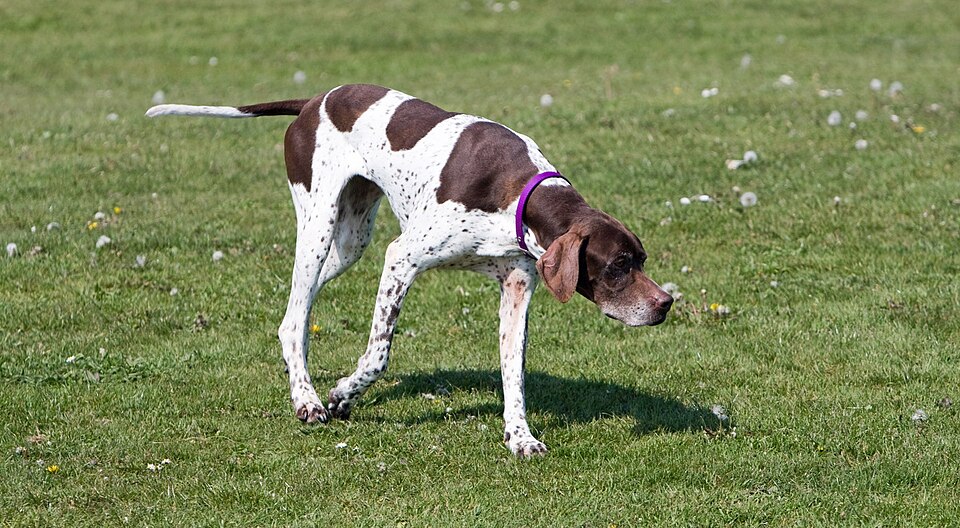
The English Pointer is a gundog known for its lean, long-legged frame, its raised nose and the way it freezes like a statue when it catches the scent of game. Its name describes its job: it shows where game is by turning its nose and body toward it and holding perfectly still. It's very common among hunters in Türkiye. It can also be a gentle family companion, but it needs to move like the athlete it is. On this page we've pulled together its temperament, care needs and health issues from breed registry standards and scientific studies.
- Temperament: Aristocratic, alert, kind and even-tempered, according to the FCI and Royal Kennel Club standards.
- Activity: The Royal Kennel Club recommends more than two hours of exercise a day; the AKC calls it an excellent companion for runners.
- Prey drive: It was bred to search wide open ground for game and can range far and fast once it catches a scent. Don't let it off leash in unsecured areas.
- Health: Generally considered sturdy; the Royal Kennel Club recommends hip screening. The gene change behind a rare inherited nerve disease is known.
- Türkiye: In a 2021 survey, it was the most preferred dog for partridge and quail hunting.
What to know
 What is the English Pointer like?
The FCI breed standard describes the English Pointer's bearing as "aristocratic": alert, with an appearance of strength, endurance and speed, and a kind, even disposition. The Royal Kennel Club standard likewise sums up its temperament as "kind, even disposition."
The Royal Kennel Club calls the breed "the supreme scenting machine" and a fine example of a breed fit for its original purpose. That purpose is to range across large expanses of land to find the scent of game, then turn toward it and freeze. That's why an English Pointer's world is made of open space, scents on the wind and running.
At home it's usually a gentle dog. But that calm usually shows only after it has had enough running outdoors. The AKC describes it as high-energy and an excellent companion for runners, which means that even as a family dog, it needs a life with long, fast exercise every day.
Every dog is an individual. Breed traits describe general tendencies; the temperament of the parents, how a puppy was socialized and the training it gets shape its personality as much as its breed.
 Who is it a good fit for?
The English Pointer suits people and families who love running and hiking and can spend hours outdoors every day. The Royal Kennel Club recommends a large home and a large yard.
| Situation | Good fit? |
|---|---|
| Apartment | Hard; it's a large, very active runner. More than two hours of activity every day is a must |
| Family with children | Kind-natured, but fast and energetic, so supervision is needed with young children |
| Other dogs | Usually fine; early socialization matters |
| Cats, birds and small pets | Be careful; it has a strong prey drive |
| Long hours alone | Struggles; it needs activity and attention |
| First-time owners | Only with a very active lifestyle and time for recall training |
The Royal Kennel Club's description of the gundog group says these breeds can make good family dogs thanks to their temperament. With an English Pointer, the condition is genuinely making room for its need to run.
Where does it come from?
According to the FCI, the English Pointer originates in Great Britain. The Royal Kennel Club notes that in the 18th and 19th centuries it was much in demand among the British gentry as the most stylish of gundogs. The AKC makes the same point: pointers have been pointing game birds for centuries.
As the club describes it, a pointer hunts with its head held high, lashing its thin, tapering tail from side to side. Its slightly concave muzzle is thought to help it lift its nose and catch scent.
The pointer in Türkiye
The English Pointer is common among hunters in Türkiye too. In a 2021 online survey of 1,325 hunters, 43.6% of respondents preferred the pointer for partridge, 40.4% for quail and 32.3% for turtle dove; it was the most chosen dog for all three. For woodcock it came second after the setter (26.7%). If you're thinking of hunting with a pointer in Türkiye, check the current hunting rules with the General Directorate of Nature Conservation and National Parks; rules vary by country.
Türkiye's native pointing dog, the Çatalburun, is also called the "Turkish pointer" by hunters; it's a separate breed with its own page: Çatalburun.
Appearance and colors
The English Pointer is symmetrical and well built, strong but supple-looking. The FCI standard describes its general outline as "a series of graceful curves." Its eyes are hazel or brown depending on coat color, and its thin ears lie close to the head.
- Height: Under the Royal Kennel Club standard, 25–27 in (63–69 cm) at the shoulder for males and 24–26 in (61–66 cm) for females.
- Weight: According to the AKC, 55–75 lb (25–34 kg) for males and 45–65 lb (20–29 kg) for females.
- Coat: Fine, short, hard, straight and with a distinct sheen.
- Color: Lemon and white, orange and white, liver and white, and black and white are the best-known colors; the standard also allows solid colors and tricolors.
Daily care
The English Pointer's short, fine coat is very easy to look after; the Royal Kennel Club suggests grooming once a week.
- Brushing: Once a week, remove loose hair with a rubber grooming glove or a soft brush.
- Ears: Look inside weekly; if you see redness, a smell or discharge, see your vet.
- Paws and skin: For a dog that runs through fields and brush, check the paws, between the toes and its thinly coated skin for burrs, seeds and small cuts after walks.
- Cold weather: Its coat is short and fine; don't leave it standing around for long in cold, wet weather. Our article on dogs in cold weather can help.
- Nails and teeth: Check the nails regularly, and get your puppy used to tooth brushing early.
Training and exercise
The Royal Kennel Club recommends more than two hours of exercise a day for the English Pointer. What this breed really needs is to run: the times it can run freely in a safe, wide, fenced area are the moments that make it happiest.
- Running partner: According to the AKC, it's an excellent companion for runners. You can run with an adult pointer; for puppies and young dogs, talk to your vet about how hard to go.
- Recall: The pointer was bred to range far and fast over open ground. When it catches the scent of a bird, it can be very far away within seconds. Practice recall at home first, then in a fenced area on a long training line; our article on dogs that won't come when called explains it step by step.
- Scent games: Its nose is very strong; treat hunts and search games tire out its brain. Our sniffing games article has ideas.
- Reward-based training: It's a gentle dog; short, patient, rewarding sessions work much better than harsh methods.
- Leash: It's a strong, fast dog; teach it to walk without pulling while it's young. Our loose-leash training article can help.
In summer, move long runs to cooler hours and carry water; our article on dogs in hot weather covers the signs of heatstroke.
 Diet
An English Pointer doesn't need special food; a complete and balanced dog food suited to its age and activity is enough. A dog that runs a lot needs more energy than a less active one; adjust the amount to how active your dog really is.
- Measure its food, and take treats out of the daily amount.
- You should be able to feel its ribs under a thin layer of fat; see your vet about any unexplained weight loss.
- Ask your vet for advice on not giving a big meal right before or right after a hard run.
- Don't feed from the table; check our list of foods that are harmful to dogs.
 Health issues to know about
The English Pointer is generally considered a sturdy breed. It sits in the lowest category of the Royal Kennel Club's Breed Watch list, meaning no breed-specific points of concern have been flagged for show judges, and the club holds it up as a good example of a breed fit for its original function. Still, there are issues worth knowing about. The information below is for awareness; for diagnosis and treatment, talk to your veterinarian.
Hip dysplasia
The Royal Kennel Club recommends that English Pointer breeders screen for hip dysplasia before breeding. Hip dysplasia means the hip joint didn't develop properly during growth, which can lead to painful arthritis over time. If you notice limping, trouble getting up or reluctance to run or jump, see your vet.
Insensitivity to pain and paw injuries (acral mutilation)
In this rare inherited nerve disease, puppies can't feel pain in their paws. According to a 2016 study, signs start at around 4 months of age: the puppy begins licking and biting its paws, and in severe cases injuries can go as far as lost claws, painless fractures and lost toes. The disease occurs in the English Pointer, German Shorthaired Pointer, English Springer Spaniel and French Spaniel, and in all of them it comes from the same recessive gene change (one that has to come from both parents). When getting a puppy, ask whether the disease has occurred in the family.
General
A dog that runs through fields and brush can pick up paw wounds, cuts and thorns; check it after every walk. For a large, athletic dog, regular vet checkups and a healthy weight are the most practical ways to protect its joints for the long run.
- A puppy licking or biting its paws until they bleed
- Sudden limping, or not putting weight on a leg at all
- A deep wound, bleeding or swelling on a paw
- Heavy panting, stumbling or confusion in the heat
How long does it live?
The AKC gives an expected lifespan of 12–15 years for the English Pointer, and the Royal Kennel Club lists the breed's lifespan as "over 12 years."
The large 2024 UK lifespan study, which used data on about 585,000 dogs, doesn't list the English Pointer as a separate row. According to the study's supplementary table, dogs registered as "Pointer" appear to have been grouped with the German Shorthaired Pointer, so we didn't use that figure for the English Pointer.
 Before you get one
- Consider a shelter: Gundogs end up in shelters and rescues too. Our article on adopting a dog from a shelter covers the first steps.
- If you buy from a breeder: Ask to meet the parents, ask for hip screening results and find out whether the nerve disease that causes paw injuries has occurred in the family.
- Time: Can you meet its need for more than two hours of activity every day? With this breed, that's the most important question.
- Safe space: Do you have a fenced yard or access to safe running areas? It's hard to meet a pointer's need to run with leash walks alone.
- Registration: In Türkiye, owned dogs must be microchipped and registered in the PETVET system. Details are in our article on PETVET registration and microchipping; rules vary by country.
- The first days: Our article a new puppy at home: the first week covers the first week step by step.
Frequently asked questions
Can a pointer be a family dog?
Yes. Its standards describe it as kind and even-tempered. But without more than two hours of running and activity a day, it gets bored and can become restless.
Can it be walked off leash?
Only in fenced, secure areas. It was bred to range far and fast over open ground; when it catches the scent of a bird, it may not hear you. Work on recall patiently with a long training line.
What's the difference between a pointer and a German Shorthaired Pointer?
The English Pointer is mainly a specialist at finding and pointing game; the German Shorthaired Pointer (Kurzhaar) is a versatile gundog that both points and retrieves, with English Pointer blood in its ancestry. See our German Shorthaired Pointer page for details.
Is the pointer the same breed as the Çatalburun?
No. The Çatalburun is a native pointing dog from the Tarsus area of Mersin; although hunters call it the "Turkish pointer," it's a separate breed. See our Çatalburun page for details.
Can it live in an apartment?
It's hard. The Royal Kennel Club recommends a large home and yard and more than two hours of exercise a day. If it lives in an apartment, long runs in safe areas every day are a must.
Sources
- The Royal Kennel Club · Pointer: breed profile and health screening
- The Royal Kennel Club · Pointer breed standard
- FCI · English Pointer breed standard (No. 1)
- AKC (American Kennel Club) · Pointer breed profile
- McMillan et al. · Longevity of companion dog breeds: those at risk from early death, Scientific Reports (2024)
- Plassais et al. · A point mutation in a lincRNA upstream of GDNF is associated to a canine insensitivity to pain, PLOS Genetics (2016)
- Özer · Hunting dog preferences of domestic hunters in Türkiye (in Turkish), Journal of Social and Humanities Sciences (2021)
- Official Gazette of Türkiye · Regulation on the identification and registration of cats, dogs and ferrets (February 26, 2018; in Turkish)
By Tüylüm · Last checked: November 3, 2026. Compiled from the sources above and written in our own words. Spotted a mistake? Write to [email protected] and we'll fix it right away. Photo from Wikimedia Commons, used under the license shown below it.