 Tüylüm
Turkish Greyhound (Tazı)
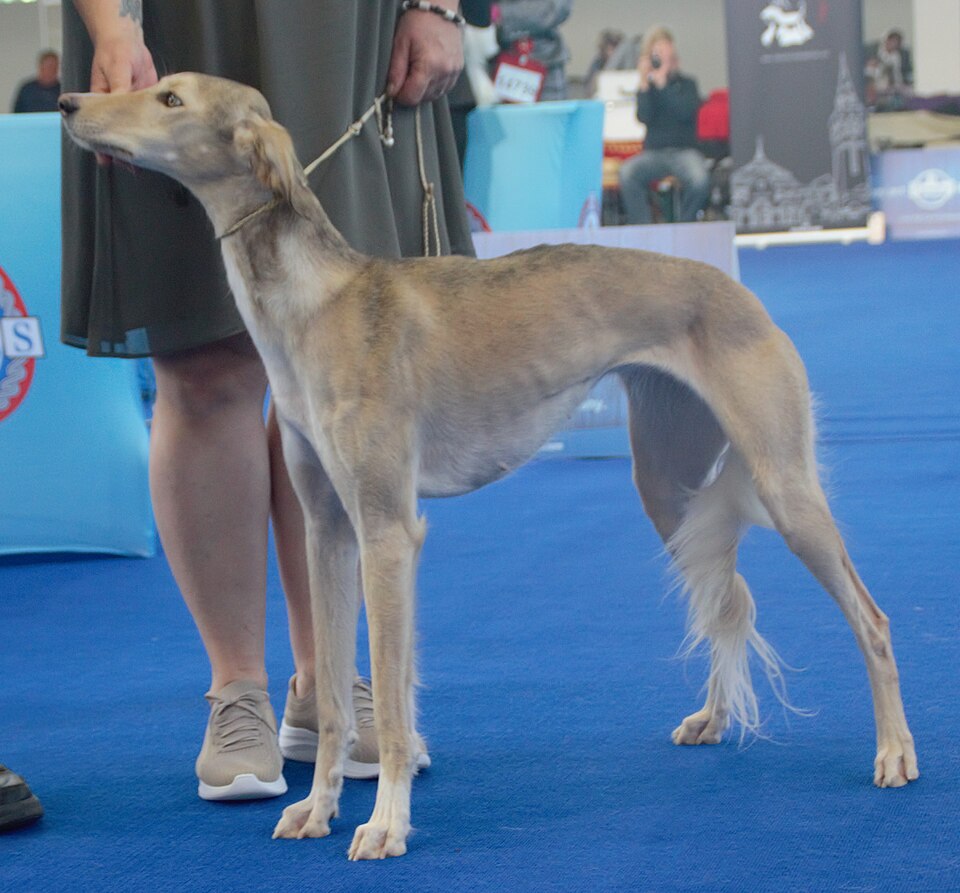
The lean, long-legged and very fast hunting dog of central and southern Anatolia, and the Turkish breed with the oldest historical records. Calm at home but with a strong chase instinct outdoors, it needs a safely fenced place to run, protection from the cold and a patient owner.

 LifespanNo datasimilar sighthounds in the UK: 11.5–13.3 years
 Weight≈ 39–42 lb (18–19 kg)adult averages measured in Türkiye
 Height at shoulder≈ 24–25 in (61–63 cm)females slightly smaller
 OriginCentral & southern Anatoliamost common around Konya and Sanliurfa
 CoatShorttwo types: feathered and smooth
 Exercise≈ 1 hour a dayRSPCA advice for sighthounds; safe sprints
 With kidsWith supervisionmay startle when asleep; needs its own spot
 TrainingStrong chase instinctvery hard to catch if it bolts
The Turkish Greyhound, or Tazi, is a lean, long-legged and very fast hunting dog that has been used for centuries to hunt hare, fox and birds in central and southern Anatolia. It belongs to the sighthounds, which hunt by sight, and resembles the Saluki, also known as the Persian greyhound. It is rare and little studied, but among Türkiye's dogs it has the oldest historical records. On this page we've brought together Turkish academic research and animal welfare resources on caring for sighthounds.
- Temperament: Usually calm and sensitive at home; outdoors, a strong chase instinct can kick in when something moves.
- Safety: Never let it off leash outside a securely fenced area; you can't outrun a sighthound that bolts.
- Climate: Sighthounds are affected by extreme cold and heat; in Anatolia, too, they're reported to be covered with a blanket in cold weather.
- Activity: About an hour of walking and play a day, plus short sprints in a safe area.
- Legal: In Türkiye, microchipping and PETVET registration are mandatory.
What to know
 What is the Turkish Greyhound (Tazı) like?
We couldn't find a study that systematically examines the Turkish Greyhound's temperament, so this section draws largely on animal welfare resources about sighthounds. According to RSPCA Australia's greyhound guide, although these dogs are known for their speed, they spend much of the day resting and are usually happy with a daily walk and some play.
The same source stresses that chasing behavior is influenced by genetics and that some greyhounds have a very strong instinct to chase. Some can live peacefully with cats and small dogs, while others can never be left alone with them. Because the Turkish Greyhound was bred as a hunting dog, this instinct deserves to be taken seriously.
RSPCA Australia notes that some greyhounds feel overwhelmed by all the changes when they arrive in a new home, while others settle in quickly. According to the same source, a sleeping greyhound can be startled if someone approaches, makes a noise or touches it, and may snap before it's fully awake, so if you need to wake it, call its name gently from a distance.
Every dog is an individual. Breed traits describe general tendencies; how a puppy is raised, how well it gets to know people and other animals, and its health shape its temperament at least as much as its breed.
 Who is it a good fit for?
The Turkish Greyhound suits owners in a calm home who can give their dog a daily walk and a safe place to run, and who are careful about leashes and fences. According to RSPCA Australia, greyhounds don't need a lot of space, but they do need a quiet spot of their own and a safe area to run.
| Situation | Good fit? |
|---|---|
| House with a yard | Yes; the fence must be tall and gap-free |
| Apartment | Possible, if there's a daily walk and a safe place to run |
| Family with kids | With supervision; it shouldn't be disturbed in its bed, and it needs a spot of its own |
| Cats and small animals | Be careful; the chase instinct can be strong |
| First-time dog owners | Possible, if leash and safety rules are followed strictly |
| Cold climates | Take care; it needs a coat and a warm bed in the cold |
If you have other pets, the safest approach is to find out before adopting whether the sighthound gets along with them, and to make the first introductions under control. RSPCA Australia also recommends getting expert help before introducing a greyhound to a cat.
Where does it come from?
According to a 2012 review by Yilmaz and Ertugrul, the Turkish Greyhound is not numerous, but it is the Turkish breed with the oldest historical records. Sighthounds appear in 16th-century Ottoman miniatures; one shows a son of Suleiman the Magnificent hunting with a tazi. It has been claimed that the Turkish Greyhound descends from the Kyrgyz sighthound and was brought to Anatolia during migrations from Central Asia, but this is presented as a claim.
According to a 2012 Selcuk University study, at an international shepherd dog symposium held in Konya in 1996, the Kangal, Akbash and Kars were counted as shepherd dogs and the Turkish Greyhound as a hunting dog. According to another 2012 study, tazis are bred mainly in Konya and Sanliurfa, and they're used to hunt quail, partridge, hare and fox in the wetter areas of central and southern Anatolia.
The Turkish Greyhound is not recognized by the FCI. A study published in 2020 examined the body proportions of tazis as groundwork for an official breed standard and identified three distinct types among 155 dogs based on body proportions. Selcuk University researchers also stress that more detailed studies are needed to define the breed's traits and genetic makeup. In a small 2005 genetic study (Altunok et al.), two of the sighthounds examined clustered in a separate group while one grouped with free-roaming dogs; in other words, the breed's genetic makeup isn't well understood yet.
Appearance and colors
According to Yilmaz and Ertugrul, the Turkish Greyhound has long legs, a slim body, a narrow, long head, a long neck, a deep chest and a tucked-up belly. It resembles the Saluki but is larger.
- Height and weight: In a 2011 study of 122 tazis, the average weight was 41 lb (18.4 kg) and the average height at the shoulder 24.4 in (62 cm). According to the review, males average 42 lb (19.0 kg) and 24.8 in (63.1 cm), and females 39 lb (17.8 kg) and 24.0 in (61.0 cm).
- Coat: A Selcuk University study of 30 tazis found two coat types: 73% were feathered (silky long hair on the ears, the underside of the tail, the legs and the back of the thighs) and 27% were smooth and short-coated. The review describes a short-coated type with a thin, hairless tail.
- Color: As reported by Selcuk University researchers, color isn't considered a defining trait of the breed. In the 2011 study, 35% of the dogs were black, 25% dun, 12% brown, 11% tan, 8% white and 8% pied. Two-colored and grizzled dogs were also common in the Selcuk University sample.
- Maturity: One study found that tazis reach adult weight and size at about two years of age; another put it at around one year.
Daily care
Thanks to its short or silky coat, the Turkish Greyhound is easy to groom; brushing once a week with a soft brush is usually enough. In feathered dogs, brush the ear and tail fringes separately so they don't tangle.
- Cold: RSPCA Australia notes that greyhounds don't cope well with very cold or very hot weather. Yilmaz and Ertugrul also write that in Anatolia, tazis are wrapped in a blanket in cold seasons to keep them warm. In winter it needs a coat, a thick, soft bed and a spot sheltered from the wind. Our article on dogs in cold weather covers the details.
- Heat: In summer, shade, water and walks during the cooler hours.
- Bed: RSPCA Australia recommends a comfortable bed in a quiet corner, away from doorways and busy passages. No one in the family should sit on that bed; it's the dog's safe place to retreat to.
- Nails and teeth: Trim the nails regularly, and plan dental care with your vet.
Training and exercise
According to RSPCA Australia, a daily walk and some play, about an hour of activity in total, is generally enough for greyhounds. The Turkish Greyhound was bred for speed, so being able to sprint flat out now and then in a safe, fenced area matters to it.
The most important rule: never let it off leash in an area that isn't secure. RSPCA Australia reminds owners that you won't be able to run fast enough to catch an escaped greyhound, and recommends a securely fenced yard that's free of obstacles. When it sees a moving animal, the chase instinct may keep it from hearing you call.
- Teach its name: Saying its name and immediately giving a small treat helps a sighthound respond to its name quickly; RSPCA Australia recommends this method.
- Recall: Practice first indoors, then in a fenced area on a long training line. Our article on teaching a dog to come when called walks you through it.
- Choosing a collar: RSPCA Australia advises asking your vet or the rehoming organization for advice on collars and leashes. Loose-leash walking makes walks easier.
- New surroundings: Introduce new things such as slippery floors, stairs and the vacuum cleaner slowly, with rewards.
RSPCA Australia stresses that greyhounds should never be punished, since punishment damages your relationship and increases the risk of behavior problems, including biting. Patient, reward-based training is best for these sensitive dogs.
 Diet and weight
The Turkish Greyhound doesn't need a special food; a complete, balanced dog food suited to its age and activity level is enough. Sighthounds are naturally lean, so it's possible both to overfeed a slim dog you think is too thin and to miss real weight loss. Work out your dog's ideal weight and daily food amount with your vet.
- Count treats as part of the daily food.
- Don't let it sprint right after eating.
- Weighing it once a month helps you spot weight loss early in such a lean dog.
- Fresh water should always be available.
Be careful with table scraps and bones; take a look at our list of foods that are dangerous for dogs.
 Health issues to know about
We couldn't find published health studies specific to the Turkish Greyhound. The points below are known concerns in sighthounds; ask your vet about diagnosis and treatment.
Cold and heat
RSPCA Australia notes that greyhounds don't cope well with very hot or very cold weather, and that those spending time outdoors need protection from sun, heat, cold and wind. Shivering in the cold or fast breathing in the heat are signs the dog needs protection.
Running injuries
A dog sprinting at full speed can hurt itself in an area with obstacles or rocks. RSPCA Australia recommends that a yard where greyhounds run be free of obstacles. If you notice limping, a cut on a paw or swelling after a run, show your vet.
Minor wounds
Scratches and scrapes are easy to spot on a short-coated dog; check the legs and paws after running and playing. See your vet for any deep or bleeding wound.
- Sudden, severe limping after a run, or not putting any weight on a leg
- A deep, bleeding or gaping wound
- Shivering that won't stop in the cold or weakness; fast, labored breathing or staggering in the heat
- Loss of appetite and rapid weight loss
How long does it live?
We couldn't find a study of the Turkish Greyhound's lifespan, so we're not giving a breed-specific number. For comparison: in a 2024 UK study using data on about 585,000 dogs (McMillan et al.), the median lifespan was 13.3 years for the Saluki and 11.5 years for the Greyhound. In the same study, mixed-breed dogs had a median lifespan of 12 years.
The most practical tools you have for a longer life: regular vet checkups, a healthy weight, staying on top of vaccines and parasite prevention, and a safe routine that keeps preventable risks such as escapes and traffic accidents to a minimum.
 Before you get one
- Consider adoption: Sighthound types and sighthound mixes also turn up in adoption listings. Knowing up front how an adult dog gets along with cats and small animals is a big advantage. Our guide to adopting a shelter dog explains the process.
- If you buy from a breeder: Meet the parents; look for calm temperaments and puppies that are being raised among people.
- Prepare your home: A gap-free fence, a self-closing yard gate, a collar it can't slip, an ID tag, a winter coat and a soft bed.
- For hunting: If you plan to use a tazi for hunting, check the current hunting rules with the authorities; in Türkiye that's the General Directorate of Nature Conservation and National Parks.
- Registration: Rules vary by country. In Türkiye, owned cats and dogs must be microchipped and registered in the PETVET system; for a dog that may bolt, a microchip and up-to-date registration matter even more. See our article on PETVET registration and microchips.
Frequently asked questions
Is the Turkish Greyhound the same as the Saluki?
No, but they're similar. According to Turkish reviews, the Turkish Greyhound resembles the Saluki, also known as the Persian greyhound, but is larger. The Turkish Greyhound is not a breed recognized by the FCI.
Can a Turkish Greyhound be walked off leash?
Only in a securely fenced area. Its chase instinct can be strong, and you can't outrun a sighthound that bolts.
Can it live with a cat?
Some sighthounds live with cats without problems, while others can never be left alone with them. Before adopting, find out the dog's history with cats, and make the first introduction under control with expert help.
Do sighthounds feel the cold?
Yes. RSPCA Australia notes that greyhounds don't cope well with very cold or very hot weather, and in Anatolia, too, tazis are reported to be covered with a blanket in the cold. In winter it needs a coat and a warm bed.
Is the Turkish Greyhound very energetic, and does it need a lot of exercise?
It's a fast dog, but it spends much of the day resting. About an hour of walking and play a day is generally enough for sighthounds; add short sprints in a safe area.
Sources
- Yılmaz ve Ertuğrul · Türkiye yerli köpek ırk ve tipleri, Iğdır Üniversitesi Fen Bilimleri Enstitüsü Dergisi (2012)
- Yılmaz ve Ertuğrul · Some morphological characteristics of Turkish Tazi (sight hound), Journal of Animal and Plant Sciences (2011)
- Erdoğan ve ark. · Comparison of some morphological characteristics of native Turkish dog breeds, Eurasian Journal of Veterinary Sciences (2012)
- Pakistan Journal of Zoology · Use of morphometric variables for differentiating breed variations in Turkish Tazi (sighthound) population (2020)
- Yılmaz ve Ertuğrul · Determination of Akbash Shepherd Dog raised in Turkey (Türk ırkları tablosu), Bitlis Eren University Journal of Science and Technology (2012)
- Altunok ve ark. · Genetic evidence for the distinctness of Kangal dogs, Bulletin of the Veterinary Institute in Pulawy (2005)
- RSPCA Australia Knowledgebase · What should I know about owning a greyhound?
- McMillan ve ark. · Longevity of companion dog breeds: those at risk from early death, Scientific Reports (2024)
By Tüylüm · Last checked: November 3, 2026. Compiled from the sources above and written in our own words. Spotted a mistake? Write to [email protected] and we'll fix it right away. Photo from Wikimedia Commons, used under the license shown below it.