 Tüylüm
German Shorthaired Pointer
An energetic, affectionate and eager-to-learn breed developed in Germany as a versatile gundog that both points and retrieves game. It needs more than two hours of activity and mental work a day. Its large, deep-chested build means watching for bloat (GDV); hip, elbow and eye screening are recommended.

 Lifespan≈ 13.4 yearsmedian, 2024 UK study
 Weight45–70 lb (20–32 kg)AKC: males 55–70, females 45–60 lb
 Height21–25 in (53–64 cm)males 23–25 in, females 21–23 in
 OriginGermanyfrom the Spanish Pointer and German bird dogs
 CoatShort, coarseweekly grooming is enough
 Exercise2+ hours a dayRoyal Kennel Club guidance
 With kidsAffectionatebig and active; supervise with little ones
 TrainingEager to learnbiddable and loyal per the standard
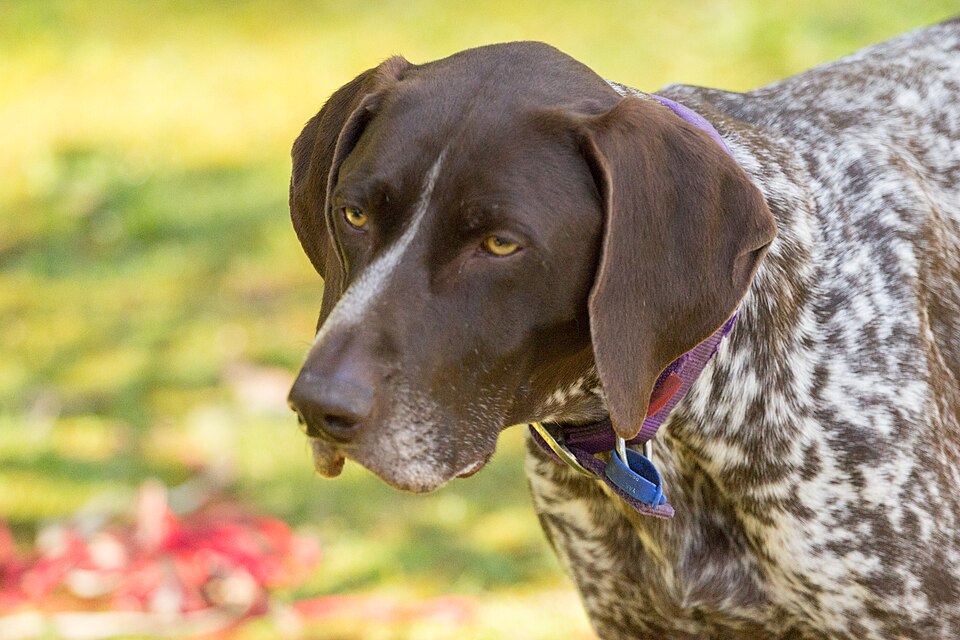
The German Shorthaired Pointer, known among hunters in Türkiye mostly as the "Kurzhaar," is a versatile gundog recognized by its liver or liver-and-white ticked coat. It searches for game, freezes to point it out once found, and retrieves shot game from land and water. That versatility has made it one of the best-loved hunting dogs in the world, but the same energy means a big daily exercise need when it lives as a family dog. On this page we've pulled together its temperament, care needs and health issues from breed registry standards and scientific studies.
- Temperament: Gentle, affectionate, even-tempered, alert, biddable and very loyal, according to the Royal Kennel Club standard.
- Activity: The Royal Kennel Club recommends more than two hours of exercise a day and a large yard; country living suits this breed better.
- Prey drive: It was bred to search, point and retrieve; solid recall is a must before letting it off leash in unsecured areas.
- Health: Its large, deep-chested build carries a risk of bloat; hip, elbow and eye screening are recommended.
- Lifespan: A large UK study found a median lifespan of 13.4 years.
What to know
 What is the German Shorthaired Pointer like?
The Royal Kennel Club's breed standard describes this dog as a natural gundog that both points and retrieves, with a very keen nose, perseverance in searching and initiative in finding game, equally good on land and in water. For temperament, the standard's words are gentle, affectionate and even-tempered; alert, biddable and very loyal.
The AKC describes it as an enthusiastic "gundog of all trades" that thrives on vigorous exercise, positive (reward-based) training and lots of love. According to the AKC, fans of the breed call it the "perfect pointer."
Because it was bred to search and run all day, it gets bored without enough to do. It's no surprise when a bored young GSP turns its energy on household items, digs up the yard or constantly demands attention. With the right amount of exercise and activity, though, it can be a calm companion at home that stays close to its family.
Every dog is an individual. Breed traits describe general tendencies; the temperament of the parents, how a puppy was socialized and the training it gets shape its personality as much as its breed.
 Who is it a good fit for?
The GSP suits active people and families who can spend hours outdoors every day and enjoy running, hiking or dog sports. The Royal Kennel Club recommends a large home, a large yard and the country rather than the city for this breed.
| Situation | Good fit? |
|---|---|
| Apartment | Hard; it's a large, very energetic dog. More than two hours of activity every day is a must |
| Family with children | Affectionate, but big and bouncy, so supervision is needed with young children |
| Other dogs | Usually fine with early socialization |
| Cats, birds and small pets | Be careful; it has a strong prey drive |
| Long hours alone | Struggles; it needs activity and attention |
| First-time owners | Only with a very active lifestyle and time to devote to training |
The Royal Kennel Club's description of the gundog group says these breeds can make good family dogs thanks to their temperament. With a GSP, the condition is truly meeting its need for exercise.
Where does it come from?
According to the Royal Kennel Club, the GSP is perhaps the most popular breed in the versatile "hunt, point, retrieve" (HPR) group of gundogs. Its ancestors include the Spanish Pointer and German bird dogs, with an infusion of English Pointer blood for speed. The club stresses that its unexaggerated build and coat equip it superbly for hunting.
The Kurzhaar is common among hunters in Türkiye too. In a 2021 online survey of 1,325 hunters, it was the most preferred dog for duck hunting (27.2%). For partridge, 15.9% of respondents chose the Kurzhaar, and for hare, 16.3%. If you're thinking of hunting with one in Türkiye, check the current hunting rules with the General Directorate of Nature Conservation and National Parks; rules vary by country.
Appearance and colors
The GSP is a balanced, muscular, unexaggerated and athletic dog. Under the Royal Kennel Club standard, its eyes are shades of brown that tone with the coat, and its ears are broad, set high and hang close to the head.
- Height: Under the Royal Kennel Club standard, 23–25 in (58–64 cm) at the shoulder for males and 21–23 in (53–59 cm) for females.
- Weight: According to the AKC, 55–70 lb (25–32 kg) for males and 45–60 lb (20–27 kg) for females.
- Coat: Short, flat and coarse to the touch; slightly longer under the tail.
- Color: Solid liver; liver and white in spotted, spotted and ticked, and ticked patterns; the same patterns in black and white; and solid black. The standard does not accept tricolor.
Color tells you nothing about health or temperament; when choosing a puppy, look at the parents' health screening and temperament, not the color.
Daily care
Its short, coarse coat is easy to look after; the Royal Kennel Club suggests grooming once a week. But it does shed.
- Brushing: Once a week, remove loose hair with a rubber grooming glove or a stiff-bristled brush.
- Ears: Look inside weekly and dry them, especially after swimming. If you see redness, a smell or discharge, see your vet.
- Paws and skin: For a dog that runs through fields and brush, check the paws, between the toes and the skin for burrs, seeds and small cuts after walks.
- Nails and teeth: Check the nails regularly, and get your puppy used to tooth brushing early.
See our dog grooming guide for more.
Training and exercise
The Royal Kennel Club recommends more than two hours of exercise a day for the GSP. A good day for this breed works its body, its nose and its mind.
- Running and searching: Off-leash running in safe, fenced areas, searching for hidden toys, fetch and swimming suit this breed well.
- Scent games: Its nose is very keen; treat hunts and trailing tire out its brain. Our sniffing games article has ideas.
- Recall: Once it catches the scent of a bird or a hare, it can range far and fast across open ground. Before letting it off leash, make recall reliable using a long training line; our article on dogs that won't come when called explains it step by step.
- Reward-based training: As the AKC stresses, it thrives on positive training; short, varied, rewarding sessions work best.
- Leash: It's a strong, fast dog; teach it to walk without pulling while it's young. Our loose-leash training article can help.
- Rest around meals: Because of the bloat risk, ask your vet for advice on avoiding hard exercise right before and after meals.
Move summer runs to cooler hours and carry water. Our article on dogs in hot weather covers the signs of heatstroke.
 Diet
A GSP doesn't need special food; a complete and balanced dog food suited to its age and activity is enough. A hard-working hunting dog's energy needs differ from those of a family dog living at home; adjust the amount to how active your dog really is.
- The Merck Veterinary Manual lists once-daily feeding and eating very quickly among the factors associated with bloat; talk to your vet about splitting the daily food into two or more meals.
- Measure its food, and take treats out of the daily amount.
- You should be able to feel its ribs under a thin layer of fat and see a waist when you look down from above.
- Don't feed from the table; check our list of foods that are harmful to dogs.
 Health issues to know about
The GSP is generally considered a sturdy dog, and it sits in the lowest category of the Royal Kennel Club's Breed Watch list, meaning no breed-specific points of concern have been flagged for show judges. Still, there are issues worth knowing about. The information below is for awareness; for diagnosis and treatment, talk to your veterinarian.
Bloat (GDV)
Gastric dilatation-volvulus is when the stomach fills with gas and twists on itself; it's a life-threatening emergency. Drawing on earlier research, a 2020 genetic study lists the GSP among the breeds at higher risk of GDV than mixed breeds, and GSPs were among the dogs with GDV examined in that study. According to the Merck Veterinary Manual, a deep, narrow chest and having a first-degree relative with GDV are among the risk factors.
Signs include trying to vomit without bringing anything up, drooling, restlessness and a quickly swelling belly; later, weakness, pale gums and trouble breathing. According to Merck, waiting more than 6 hours after signs start before seeing a vet raises the short-term risk of death; waiting is the biggest danger. Merck also describes a preventive surgery for at-risk breeds that tacks the stomach to the body wall (gastropexy); talk with your vet about whether it's right for your dog.
Hips, elbows and eyes
The Royal Kennel Club recommends that breeders X-ray for hip and elbow dysplasia and have an eye exam before breeding. Dysplasia means the joint didn't develop properly during growth, which can lead to painful arthritis over time. If you notice limping, trouble getting up or avoiding movement, see your vet.
An inherited skin disease of the GSP (ECLE)
Exfoliative cutaneous lupus erythematosus (ECLE) is an immune disease that has run in families of this breed for decades. According to a 2011 study, signs usually start at 16–40 weeks of age: severe skin inflammation with widespread scaling, lameness in some dogs and, in advanced cases, kidney disease. It's a severe disease; according to the same study, most affected dogs are euthanized before reaching 4 years of age. It's thought to be inherited recessively (it has to come from both parents), and the gene change involved has been identified. When getting a puppy, ask whether the disease has occurred in the family and whether the parents have been tested for it.
Insensitivity to pain and paw injuries (acral mutilation)
In this rare inherited nerve disease, puppies can't feel pain in their paws; at around 4 months of age they start licking and biting their feet, and in severe cases serious wounds develop. A 2016 study showed that this disease, first reported in GSPs in 1964, also occurs in English Pointers, English Springer Spaniels and French Spaniels and comes from the same recessive gene change. If your puppy keeps licking or biting its paws, see your vet.
- Trying to vomit without bringing anything up, a quickly swelling belly, restlessness
- Weakness, pale gums, fast or labored breathing
- A puppy licking or biting its paws until they bleed
- Sudden limping or obvious trouble walking
How long does it live?
A 2024 UK study using data on about 585,000 dogs from 18 different sources found a median lifespan of 13.4 years for the GSP; the median for mixed-breed dogs was 12.0 years. According to the study's supplementary table, dogs registered as "Pointer" may also have been counted in this group. The AKC gives an expected lifespan of 10–12 years, and the Royal Kennel Club says "over 10 years."
Enough exercise every day, a healthy weight and acting without delay at the first signs of bloat are the most practical ways to help a GSP live a long, healthy life.
 Before you get one
- Consider a shelter: Purebred gundogs end up in shelters and rescues too. Our article on adopting a dog from a shelter covers the first steps.
- If you buy from a breeder: Ask to meet the parents and ask for their hip and elbow X-ray results and eye exams. Also ask whether GDV, skin lupus or paw injuries have occurred in the family.
- Time: Can you meet its need for more than two hours of activity every day? With this breed, that's the most important question.
- Registration: In Türkiye, owned dogs must be microchipped and registered in the PETVET system. Details are in our article on PETVET registration and microchipping; rules vary by country.
- The first days: Our article a new puppy at home: the first week covers the first week step by step.
Frequently asked questions
Can a GSP be a family dog?
Yes. The Royal Kennel Club standard describes it as gentle, affectionate and very loyal. But without more than two hours of activity and mental work a day, it gets bored; that need doesn't change for a family dog.
Can someone who doesn't hunt keep a GSP?
Yes, but its hunting drive needs other outlets: scent and search games, fetch, long runs, dog sports. Without that work, it may channel its energy into unwanted behavior.
What's the difference between a GSP and an English Pointer?
The GSP is a versatile gundog that both points and retrieves; according to the Royal Kennel Club, English Pointer blood is part of its ancestry. The English Pointer is mainly a specialist at finding and pointing game across wide open ground. See our English Pointer page for details.
Can it live in an apartment?
It's hard. The Royal Kennel Club recommends a large home, a large yard and country living. If it lives in an apartment, long, tiring outdoor activity every day is a must.
Does it like water?
The Royal Kennel Club standard describes it as equally good on land and in water. Swimming can be good exercise for this breed; choose a safe spot with no current and dry its ears afterward.
Sources
- The Royal Kennel Club · German Shorthaired Pointer: breed profile and health screening
- The Royal Kennel Club · German Shorthaired Pointer breed standard
- AKC (American Kennel Club) · German Shorthaired Pointer breed profile
- McMillan et al. · Longevity of companion dog breeds: those at risk from early death, Scientific Reports (2024)
- Piras et al. · Identification of genetic susceptibility factors associated with canine gastric dilatation-volvulus, Genes (2020)
- Merck Veterinary Manual · Gastric dilation and volvulus in small animals
- Wang et al. · Familial cutaneous lupus erythematosus (CLE) in the German shorthaired pointer maps to CFA18, Immunogenetics (2011)
- Amerman et al. · German Shorthaired Pointer dogs with exfoliative cutaneous lupus erythematosus develop immune-complex membranous glomerulonephropathy, Veterinary Pathology (2023)
- Plassais et al. · A point mutation in a lincRNA upstream of GDNF is associated to a canine insensitivity to pain, PLOS Genetics (2016)
- Özer · Hunting dog preferences of domestic hunters in Türkiye (in Turkish), Journal of Social and Humanities Sciences (2021)
- Official Gazette of Türkiye · Regulation on the identification and registration of cats, dogs and ferrets (February 26, 2018; in Turkish)
By Tüylüm · Last checked: November 3, 2026. Compiled from the sources above and written in our own words. Spotted a mistake? Write to [email protected] and we'll fix it right away. Photo from Wikimedia Commons, used under the license shown below it.