 Tüylüm
English Bulldog
A calm, affectionate, family-devoted dog seen as a symbol of Britain. Its very flat face and folded skin make it highly prone to breathing problems, heatstroke, skin and eye disease, and most litters are born by C-section. A puppy from screened, more moderate parents is essential.

 Lifespan≈ 9.8 yearsmedian, 2024 UK study; mixed breeds 12.0
 Weight50–55 lb (23–25 kg)RKC standard: females 23, males 25 kg
 Height14–15 in (36–38 cm)AKC
 OriginEnglandfrom bull-baiting dogs to family pet
 SheddingYesshort coat; brush once a week
 ExerciseTwo short walksa day; RKC: gentle pace, never in heat
 Heat toleranceVery lowamong the breeds at highest heatstroke risk
 With kidsAffectionateRKC: bonds with family; supervise
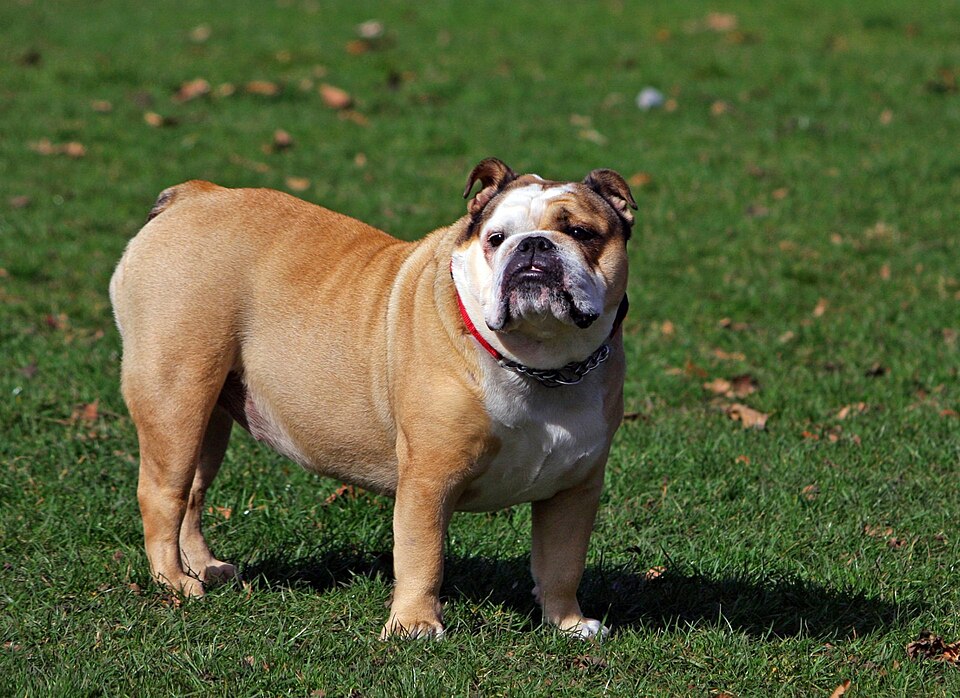
With its broad chest, short legs and wrinkled face, the English Bulldog is a calm, affectionate dog that has become a symbol of Britain. According to the Royal Kennel Club, despite its imposing look it is gentle and deeply attached to its family. But that familiar look comes with a serious health burden: breathing problems, heatstroke, skin-fold infections, eye disease and difficult births. On this page we've pulled together its temperament, care needs and health issues from breed registry standards, animal welfare resources and scientific studies, honestly and without blame.
- Temperament: Calm, affectionate and loyal; can be stubborn, so training takes patience.
- Breathing and heat: Its very flat face makes it highly prone to BOAS and heatstroke; in summer it's one of the most at-risk breeds.
- Skin and eyes: Skin-fold infections, "cherry eye" and dry eye are very common in this breed.
- Birth: The great majority of litters are born by cesarean section.
- Choosing a pup: Ask for both parents' breathing grades (RFGS) and eye exams; parents with a more moderate build and open nostrils are the better choice.
- Lifespan: A large 2024 UK study found a median lifespan of 9.8 years.
What to know
 What is the English Bulldog like?
According to the Royal Kennel Club, the Bulldog is a calm, affectionate breed that thrives on human company. Despite its imposing appearance, it's usually gentle and good-natured and forms close bonds with its family, children included. The breed standard describes it as alert, bold, loyal, dependable and courageous, "fierce in appearance, but possessed of affectionate nature." Many keep a watchful, protective instinct toward home and family, but according to the Royal Kennel Club this rarely turns into aggression; well-socialized Bulldogs generally get along with people and other pets.
It has a stubborn streak and isn't among the quickest breeds to train; short, positive sessions and patience work best. It shouldn't be left alone for long periods. In a 2020 UK study, 93% of Bulldog, French Bulldog and Pug owners said they'd want the same breed again; those who wouldn't recommend it mostly pointed to health problems and cost.
Every dog is an individual. Breed traits describe general tendencies; the parents' temperament, how a puppy was socialized and its health shape its personality as much as its breed.
 Who is it a good fit for?
The English Bulldog suits households that want a calm home life, won't leave the dog alone for long and are prepared for high vet bills.
| Situation | Good fit? |
|---|---|
| Apartment | Good; the Royal Kennel Club says it adapts to smaller homes, as long as the home stays cool |
| Family with kids | Good; bonds with the family, but supervise young children |
| Other pets | Usually gets along if socialized early |
| Long hours alone | Not recommended |
| Hot climate, home that can't be cooled | Not suitable; very high risk of heatstroke |
| Running, long hikes | Not suitable; two short, gentle walks a day are enough |
Where does it come from?
According to the Royal Kennel Club, bull baiting was brought to Britain by the Normans in the 12th century and by the 1500s had become a spectacle for all classes. Over time, the leggier mastiff types used for it were replaced by smaller, thick-set dogs with strong heads and jaws: the ancestors of today's Bulldog. Bull baiting was outlawed in 1835, and the breed, now without a job, faced extinction. Dogs kept as companions became the core of its revival once dog shows grew fashionable, and The Kennel Club recognized the breed in 1873.
A 2022 VetCompass paper describes the original Bulldog as a far more muscular, athletic dog that, under the breed standard written in the 1890s and show-ring fashion, was quickly transformed into a dog with a shorter face, a protruding lower jaw, a heavier build and bowed front legs. According to the Royal Kennel Club, dedicated breeders have worked since the start of the 21st century to reduce these exaggerations, and the breed standard has been changed in that direction.
Appearance and colors
The Royal Kennel Club standard describes a smooth-coated, thick-set, low, broad, powerful and compact dog. The face is relatively short and the muzzle broad and slightly upturned, but the standard says this should not be excessive.
- Weight: The Royal Kennel Club standard gives 55 lb (25 kg) for males and 50 lb (23 kg) for females. The AKC gives 50 lb (about 23 kg) for males and 40 lb (about 18 kg) for females. In the 2022 VetCompass study, UK Bulldogs averaged 25.55 kg (about 56 lb).
- Height: According to the AKC, 14–15 inches (36–38 cm) at the shoulder.
- Eyes: According to the standard, neither sunken nor prominent, and free from obvious eye problems.
- Colors: Brindle, fawn, red, white and their combinations with white. The Royal Kennel Club won't register merle Bulldogs because of the health risks.
The standard clearly states that dogs showing breathing distress or making excessive breathing noise are unacceptable, and asks for a hard-muscled body with no tendency toward obesity. The Royal Kennel Club's Breed Watch list for show judges highlights breathing distress, eyelids turned in or out, a heavy wrinkle over the nose, skin-fold irritation, a missing or screw tail, pinched nostrils and excess weight as points needing special attention.
 Daily care
According to the Royal Kennel Club, the short coat needs a weekly brush, but the folds need attention every day.
- Folds: A veterinary article published by the Royal Kennel Club recommends cleaning the folds on the face, around the tail and, in females, around the vulva every day, and keeping them dry after bathing and drinking. Show your vet any bad smell, redness or discharge.
- Paws: In the 2022 study, interdigital cysts (between the toes) were about 13 times more common in Bulldogs than in other dogs; check between the toes regularly.
- Eyes: Check daily for redness, discharge, dryness or a red swelling in the corner of the eye.
- Teeth: The lower jaw may jut forward; have the teeth checked regularly.
- Home: A cool room, shade and fresh water at all times are a must in summer.
Our dog grooming guide covers brushing and nail care.
 Training and exercise
The Royal Kennel Club says two short, gentle walks a day are generally enough for a Bulldog and that exercise should be avoided in hot weather because the breed overheats easily. In training, short, positive, reward-based sessions work best; it can lose interest quickly, so skip long repetitions. Early socialization matters.
- Harness: A veterinary article published by the Royal Kennel Club recommends a harness instead of a collar for dogs with BOAS, to avoid pressure on the airway.
- Brain games: Hidden treats and sniffing games keep it busy without straining its breathing.
- Alone time: The Royal Kennel Club advises against leaving it alone for long periods.
A UK study of 2016 data found that Bulldogs had about 14 times the odds of heatstroke compared with Labradors, one of the highest risks among the breeds studied. In summer, move walks to early morning and late evening, don't go out in the midday heat and never leave your dog in a car. According to the Royal Kennel Club's article, very heavy panting, glazed eyes, vomiting, excessive drooling, a dark red tongue and staggering are signs of overheating; if you see them, move your dog into the shade right away, soak it with water, offer small sips of water and call your vet at the same time. See our article on dogs in hot weather for details.
 Diet and weight
Bulldogs don't need a special food; a complete, balanced dog food that suits their age is enough. According to the veterinary article published by the Royal Kennel Club, RVC research identifies obesity as the top health concern for Bulldogs and Pugs; extra weight makes BOAS signs worse and can aggravate other problems too.
- Measure food; decide the daily amount with your vet based on your dog's ideal weight.
- Count treats as part of the daily food, and don't feed from the table.
- Being able to feel the ribs under a thin layer of fat and seeing a waist from above are good signs.
- Weigh your dog once a month.
Some human foods are toxic to dogs; see our list of foods dogs should never eat.
 Health issues to know about
A 2022 VetCompass study of UK veterinary records found that Bulldogs had about twice the odds of being diagnosed with at least one disorder compared with other dogs, and that most of these problems stem from the breed's extreme body shape; the authors strongly urge an immediate redefinition of the breed toward a more moderate shape. The information below is for awareness only; ask your vet about diagnosis and treatment.
Airway obstruction (BOAS)
In a short face, the nostrils are narrow and the soft palate long and thick; according to the Royal Kennel Club, in the Bulldog in particular this can be accompanied by a narrowed windpipe. In the 2022 study, BOAS was diagnosed about 19 times more often than in other dogs. In work by the Cambridge group, only about 11% of Bulldogs showed no signs of BOAS at all. Snoring and snorting at rest, labored breathing, stopping on walks, brief pauses in breathing during sleep and foamy saliva are among the signs. Snoring while awake isn't normal. UFAW also notes that dogs with BOAS face a higher risk under anesthesia.
Skin and paws
In the 2022 study, skin-fold dermatitis was about 38 times more common in Bulldogs than in other dogs, the highest risk found in the study. Interdigital cysts were also markedly more common.
Eye problems
Prolapse of the third-eyelid gland ("cherry eye") was about 27 times more common in the 2022 study. In a separate 2021 VetCompass study, the risk of dry eye (reduced tear production) was about 38 times higher in Bulldogs than in mixed-breed dogs. UFAW notes that the nose fold and inward-turning eyelids can constantly irritate the eye.
Hips, elbows and heart
The Royal Kennel Club lists joint problems such as hip and elbow dysplasia among the breed's common issues and recommends hip and elbow screening. According to UFAW, the Bulldog is the breed in which pulmonic stenosis (a narrowing where blood leaves the heart for the lungs) occurs most often; it's more common in males and can be picked up early when a vet listens to a puppy's heart. The Royal Kennel Club also recommends a DNA test for hyperuricosuria (HUU), an inherited condition that raises uric acid in the urine.
Giving birth
In a 2010 UK survey, more than 80% of Bulldog litters were born by cesarean section; UFAW cites a figure of 86%. Because the puppies have large heads and the mother's pelvis is narrow, a natural birth often isn't possible.
- Struggling to breathe, bluish or gray tongue and gums, collapse
- Signs of overheating: very heavy panting, staggering, vomiting
- Sudden cloudiness, squinting or redness in an eye, or a red swelling in its corner
- Tiring quickly on walks along with fainting or a swollen belly
How long does it live?
A 2024 study using data on about 585,000 dogs from 18 UK sources found a median lifespan of 9.8 years for Bulldogs; for mixed-breed dogs it was 12.0 years. The study lists the Bulldog among the breeds most at risk of early death.
Life tables built from VetCompass data in 2022 gave a life expectancy at birth of 7.39 years, and among the 18 breeds studied, the Bulldog was the earliest (at 9–10 years) to see its remaining life expectancy fall below a year and a half. The Royal Kennel Club gives the breed's lifespan as "under 10 years," and the AKC as 8–10 years. Weight control, a cool lifestyle and catching skin, eye and breathing problems early are the most practical ways to extend a Bulldog's life.
 Before you get one
- Consider a shelter: Bulldogs end up in shelters and rescues too. Our article on adopting a dog from a shelter covers the first steps.
- Breathing grade: The Royal Kennel Club treats RFGS breathing grading and an eye exam as the minimum tests breeders should do. A trained vet listens to the dog's breathing before and after a brisk walk and gives a grade from 0 to 3; grade 3 dogs shouldn't be bred from.
- Other screening: Also ask about the HUU DNA test and hip and elbow screening.
- Look for yourself: The parents' nostrils should be open; avoid parents that snore or wheeze while awake or have had breathing surgery. Check the folds for redness and the eyes for discharge.
- A moderate build: Choose parents with longer muzzles, fewer wrinkles and no excess weight; UFAW notes that breeding only from dogs that were themselves born naturally could solve the birthing problem over time.
- Budget: Be ready for high vet costs related to skin, eyes, breathing and birth.
- Registration: Rules vary by country. In Türkiye, owned dogs must be microchipped and registered in the PETVET system.
The 2022 VetCompass paper reported that a court ruling in Norway had banned Bulldog breeding that year. According to ScienceNorway, however, Norway's Supreme Court ruled in 2023 that Bulldog breeding is allowed as long as breeders follow a specific breeding program (in the same ruling, breeding Cavalier King Charles Spaniels was banned). Rules vary from country to country.
Frequently asked questions
Is it normal for English Bulldogs to snore?
Not necessarily. Snoring and snorting can be a sign of a narrowed airway. Talk to your vet if you hear the noise while your dog is awake, if it tires quickly on walks or if its breathing pauses during sleep.
Why are Bulldogs born by C-section?
The puppies have large heads and the mother's pelvis is narrow, so a natural birth often isn't possible. In a UK survey, more than 80% of litters were born by cesarean section. That's why it's so important to ask about the parents' health before getting a puppy.
Can a Bulldog live in an apartment?
Yes. According to the Royal Kennel Club, its exercise needs are low and it adapts to smaller homes, as long as it isn't left alone for long and the home can be kept cool in summer.
How long do Bulldogs live?
The 2024 UK study found a median lifespan of 9.8 years, and the Royal Kennel Club says "under 10 years." With good care and weight control, some Bulldogs live longer.
Are English Bulldogs and French Bulldogs the same breed?
No. Although the French Bulldog's roots go back to small English "toy bulldogs," it's a separate breed today: smaller, with bat ears and a partly different set of health problems. See our French Bulldog page for details.
Sources
- The Royal Kennel Club (UK) · Bulldog: breed profile and health screening
- The Royal Kennel Club · Bulldog breed standard
- The Royal Kennel Club · Breed Watch: Bulldog (category 3)
- The Royal Kennel Club and University of Cambridge · Respiratory Function Grading Scheme (RFGS)
- The Royal Kennel Club (author: Dr. Rowena Packer, RVC) · Brachycephalic obstructive airway syndrome (BOAS)
- The Royal Kennel Club (author: Dr. Rowena Packer, RVC) · Skin problems in brachycephalic dogs
- AKC (American Kennel Club) · Bulldog breed profile
- FCI · Bulldog (149) breed nomenclature
- Science for Animal Welfare (UFAW) · English Bulldog: Brachycephalic airway obstruction syndrome
- Science for Animal Welfare (UFAW) · English Bulldog: Brachycephalic ocular syndrome
- Science for Animal Welfare (UFAW) · English Bulldog: Dystocia due to foetal-pelvic disproportion
- Science for Animal Welfare (UFAW) · English Bulldog: Pulmonic stenosis
- O'Neill et al. · English Bulldogs in the UK: a VetCompass study of their disorder predispositions and protections, Canine Medicine and Genetics (2022)
- O'Neill et al. · Keratoconjunctivitis sicca in dogs under primary veterinary care in the UK: an epidemiological study, Journal of Small Animal Practice (2021)
- Hall et al. · Incidence and risk factors for heat-related illness (heatstroke) in UK dogs under primary veterinary care in 2016, Scientific Reports (2020)
- Evans and Adams · Proportion of litters of purebred dogs born by caesarean section, Journal of Small Animal Practice (2010)
- Tomlinson et al. · A cross-sectional study into the prevalence and conformational risk factors of BOAS across fourteen brachycephalic dog breeds, PLOS One (2026)
- Packer et al. · Come for the looks, stay for the personality? Reacquisition and owner recommendation of Bulldogs, French Bulldogs and Pugs, PLOS One (2020)
- McMillan et al. · Longevity of companion dog breeds: those at risk from early death, Scientific Reports (2024)
- Teng et al. · Life tables of annual life expectancy and mortality for companion dogs in the United Kingdom, Scientific Reports (2022)
- ScienceNorway · Why Norway has banned the breeding of Cavalier King Charles Spaniels (Norwegian Supreme Court ruling, 2023)
- Resmî Gazete (Türkiye) · Regulation on the identification and registration of cats, dogs and ferrets (February 26, 2018)
By Tüylüm · Last checked: November 3, 2026. Compiled from the sources above and written in our own words. Spotted a mistake? Write to [email protected] and we'll fix it right away. Photo from Wikimedia Commons, used under the license shown below it.